Sportflight Aviation Talon

Magnum

The LSA Talons are strut-braced three-axis aircraft with conventional gear and a pusher prop configuration, based on an ultralight style of construction.

Sport Flight Aviation uses CAD/CAM technology to refine and verify its designs while also improving manufacturing processes. CNC machining of Talon components is done in-house, producing Talon aircraft kits.

With the powder-coat option, the only painting required on the Talon is the nose cone. The Talon has only a few welded components, such as the elevator interlink, torque tube, and fuel tank. All welding is done at the factory.
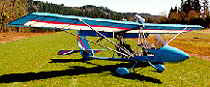
XP

The range of the Talon varies depending on the model, engine used, loading, and fuel capacity. The TalonXP equipped with the standard 11.75 gallon welded aluminum fuel tank and Rotax 582 C drive, with 70 inch 3-blade prop can fly for at least 2.5 hours at 68mph. A TalonXP equipped the same, but with the HKS 700E 60hp four-stroke engine, can stay aloft for over three hours with a reasonable reserve. The single seat Magnum and Typhoon can accept an optional 22 gallon welded aluminum fuel tank.

The two-seat TalonXP has an empty weight of 479lbs and a gross weight of 950lbs. With the NorthSlope package installed, the useful payload can be increased to 570lbs. The TalonXP with a Rotax 582 engine can fly at 90mph in level flight. The Talon cruises between 62 and 85mph, depending on the model and engine installation. A typical TalonXP equipped with a Rotax 582 engine cruises at about 70mph. The single seat Magnum and Typhoon comparably equipped will cruise at 76-80mph.

All Talons are equipped with 3-position flaps; 10, 22, and 35 degree positions. Set in the 35 degree position, The TalonXP can comfortably fly at 40-43mph at low power settings. The stall takes place at 33-38mph.

The main boom is 5in. OD x .065in. wall 6061-T6 seamless drawn aluminum tubing. This tube is sleeved at hard points, such as the landing gear carry-through, for added durability. The skins are .050 6061-T6 mated together with stainless steel rivets, creating a light, strong, box-type structure. The Talon’s gear legs are nickel plated 4130 steel alloy tubing with .120in. wall, heat-treated in a special salt bath for strength and integrity.

All Talons come standard with an Aviation Products 5in. break-away full swivel steerable tail wheel.

All Talon models include a built-in curved instrument panel, 3-point shoulder harness, 8-inch spun aluminum welded wheels, streamlined aluminum struts, padded configurable seats, 3-axis control, AN aircraft hardware throughout (included with kit), welded aluminum fuel tank with 11.75 US gallon capacity, tinted polycarbonate windshield, differential ailerons, stainless steel control and structural cables, Mil-spec control pulleys, engine mount with 6 rubber isolators, and preformed wing ribs (XP and Super Magnum: 40 total, Magnum: 36 total)

Talon Magnum
Engine: HKS 700E, 61 hp
HP range: 40-70
Length: 21.6 ft
Wing span: 26 ft 3 in
Wing area: 138 sq.ft
Cruise: 80 mph
Stall: 38 mph
Range: 230 sm
Rate of climb: 1000 fpm
Takeoff dist: 175 ft
Empty weight: 437 lb
Gross weight: 735 lb
Fuel capacity: 11.75 USG
Landing dist: 225 ft
Seats: 1
Cockpit width: 24 in
Landing gear: tailwheel
LSA: yes

Talon XP
Engine: HKS 700E, 61 hp
HP range: 40-80
Length: 21.6 ft
Wing span: 28.5 ft
Wing area: 148 sq.ft
Empty weight: 535 lb
Gross weight: 1050 lb
Fuel capacity: 11.75 USG
Cruise: 72 mph
Stall: 41 mph
Range: 230 sm
Rate of climb: 900 fpm
Takeoff dist: 250 ft
Landing dist: 250 ft
Seats: 2 tandem
Cockpit width: 24 in
Landing gear: tailwheel
LSA: yes
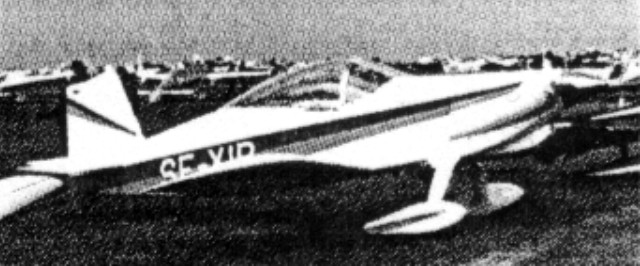
Sport Aircraft S-18

Modelled after the Thorp T-18 and incorporating folding wings.

Engine: Lycoming, 150 hp
HP range: 150-180
Speed max: 183 mph
Cruise: 165 mph
Range: 530 sm
Stall: 63 mph
ROC: 1200 fpm
Take-off dist: 900 ft
Landing dist: 1200 ft
Service ceiling: 18,000 ft
Fuel cap: 29 USG
Weight empty: 923 lbs
Gross: 1600 lbs
Height: 5.1 ft
Length: 19.33 ft
Wing span: 20.8 ft
Wing area: 86 sq.ft
Seats: 2
Landing gear: tail wheel

Spitfire Taurus

Earlier, in August 1978, P.Z.L. Swidnik concluded an agreement with the Spitfire Helicopter Company of Media, Pennsylvania, US allowing them to market a modified version of the Kania (itself an Mil Mi-2 verion) in Western countries under the name Spitfire Taurus. This differed primarily from the standard Polish version by introducing uprated Allison 250-C28 turboshaft engines, each with a take-off rating of 373kW fed by a large common intake; revised nose contours and sporting a ventral fin. However, the company has since gone out of business, and it is not known if any conversions were completed.

Taurus
Engine: 2 x Isotov 350P, 400 shp
TBO: 3500 hr
Main rotor: 48.3 ft
Seats: 9
Length: 39.2 ft
Height: 12.3 ft
Max ramp weight: 7400 lb
Max takeoff weight: 7400 lb
Standard empty weight: 5166 lb
Max useful load: 2234 lb
Max landing weight: 7400 lb
Max sling load: 1763 lb
Disc loading: 4 lbs/sq.ft
Power loading: 9.3 lbs/hp
Max usable fuel: 1472 lb
Max rate of climb: 900 fpm
Service ceiling: 13,300 ft
Hover in ground effect: 6,900 ft
Hover out of ground effect: 7900 ft
Max speed: 147 kt
Normal cruise @ 3000 ft: 128 kt
Fuel flow @ normal cruise: 435 pph
Endurance @ normal cruise: 2.8 hr

Spitfire Mark 1 / II / IV

Spitfire Mk.II

The Spitfire Mark I was a utility helicopter built in the United States in the late 1970s and intended for series production. In essence, the Mark I was an Enstrom F-28 that was modified to use an Allison 250 turboshaft engine and geared transmission in place of the original piston engine and system of vee belts. The resulting powerplant installation was lighter and more compact, which allowed for additional cargo or fuel.

Spitfire Helicopters’ parent company, Fetsko Aviation Sales and Transportation began work on the prototype in January 1976, and on a number of pre-production aircraft in February 1977. Fetsko displayed a mockup of the concept at the National Maintenance and Operations Meeting at Reading, Pennsylvania in June 1976.

The prototype (registered N4890) first flew in December 1978. By May 1979, Spitfire had supplemental approval for the turbine conversion and by July, the company reported that it had sold 42 examples of the Mark I and Mark II and expected to build 60 aircraft during 1980. The engine installation on production models was to be slightly further forward than on the prototype.

The Spitfire II derivative of the Enstrom uses a new four seat front fuselage and the Allison engine with Enstrom rotor and rear fuselage.

Other projects included Spitfire Mark IV with auxiliary propulsion engines at tips of stub wings.

However, Spitfire remained dependent on Enstrom to supply airframes for remanufacture, and Enstrom distanced itself from the project somewhat. Competing plans by Enstrom and Spitfire to market Polish-built Mil Mi-2 helicopters in the United States might have contributed to the friction. In Spitfire’s version of the deal, Polish manufacturer PZL-Świdnik would also contribute to the Spitfire manufacturing efforts. By November 1979, Enstrom refused to supply airframes to Spitfire.

The situation improved somewhat in the 1980s, and Spitfire president Jack Fetsko reported in May 1983 that relations with Enstrom had improved to the point where the two companies could “talk programs”. By that time, costs had increased from $US 165,000 expected in 1979 to $US 285,000 but Spitfire had taken deposits for 50 Mark Is, and had a firm sale for the first production aircraft. Together with companies Sodian and Soprea, Spitfire formed a new venture, Spitfire Helicopters International, to manufacture the Mark I and Mark II in Málaga, Spain.

Nothing came of the joint venture, and Spitfire’s attempts to market F-28 derivatives came to an end. In the 1990s, Enstrom marketed its own turbine-powered version of the F-28 as the Enstrom 480.

Mark 1
Engine: Allison 250-C20B, 420 shp
TBO: 3500 hr
Main rotor: 32 ft
Seats: 3
Length: 29.4 ft
Height: 9.2 ft
Max ramp weight: 2350 lb
Max takeoff weight: 2350 lb
Standard empty weight: 1292 lb
Max useful load: 1058 lb
Max landing weight: 2350 lb
Disc loading: 2.9 lbs/sq.ft
Power loading: 5.6 lbs/hp
Max usable fuel: 469 lb
Max rate of climb: 1550 fpm
Service ceiling: 15,000 ft
Hover in ground effect: 13,400 ft
Hover out of ground effect: 8000 ft
Max speed: 112 kt
Normal cruise @ 3000 ft: 96 kt
Fuel flow @ normal cruise: 180 pph
Endurance @ normal cruise: 2.4 hr
Range: 308 mi

Mark II Tigershark
Engine: 420hp Allison 250-C20B
Rotor: 31’11”
Useful load: 1175 lb
Max speed: 135 mph
Cruise: 120 mph
Seats: 4

Mark IV
Engine: 420hp Allison 250-C20B
Rotor dia: 33’4″
Length: 30’0″
Useful load: 2100 lb
Max speed: 215 mph
Cruise: 201 mph
Range: 482 mi
Seats: 4-5

Spitfire Helicopter Co

USA
Based at Media, Pennsylvania. In January 1975 began design of Spitfire Mark I light helicopter, developed from Enstrom F-28A but with turbine powerplant. Other projects included Spitfire Mark II helicopter with additional cabin space and more engine power, and Spitfire Mark IV with auxiliary propulsion engines at tips of stub wings.

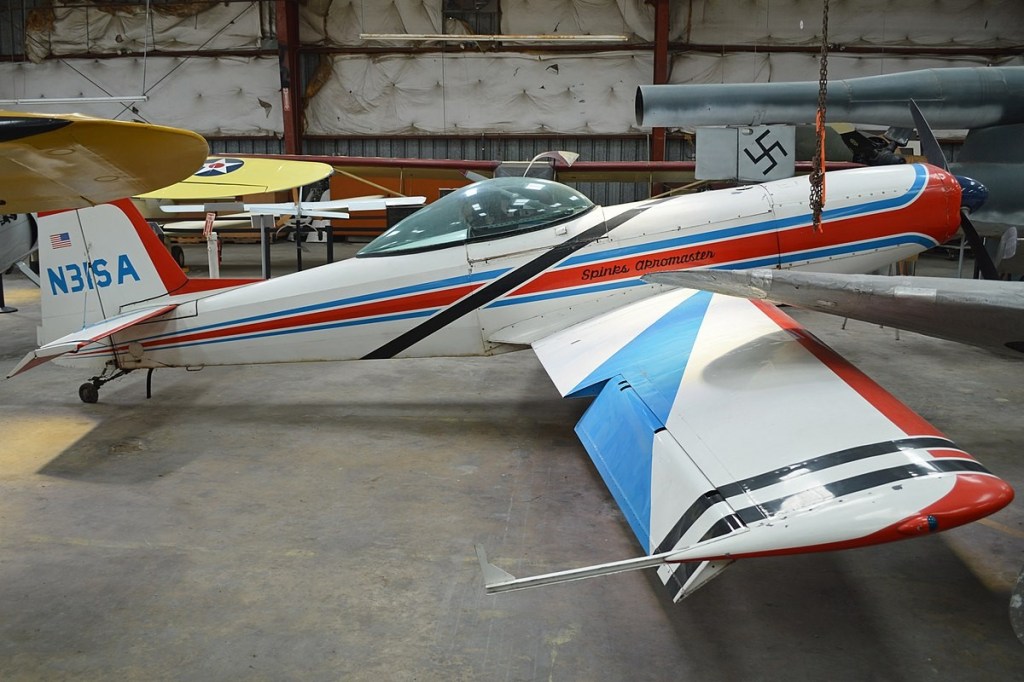
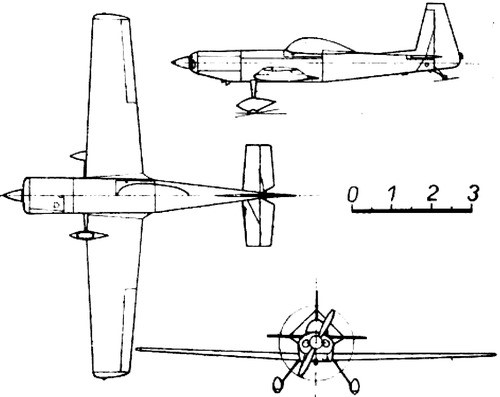
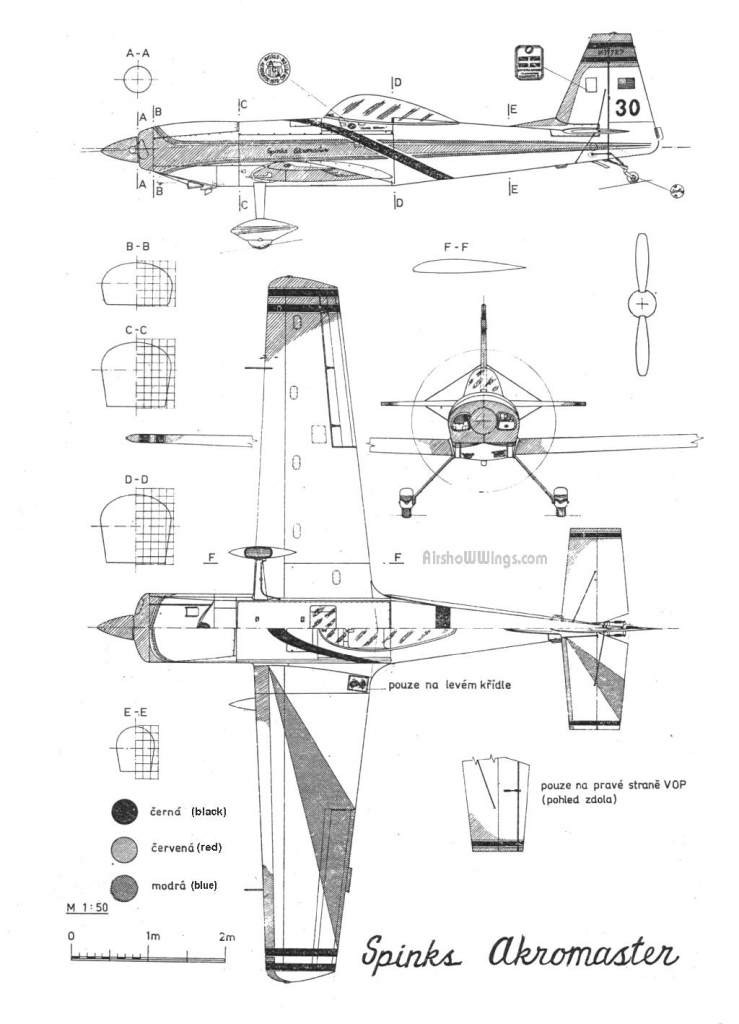
Spinks Akromaster

M H Spinks Sr designed and built the Spinks Akromaster, N7727, first flying on 28 August 1968.

A single-place cabin, low wing monoplane, it was marketed as a home-built for aerobatics.

Engine: 200hp Lycoming IO-360
Wingspan: 30’0″
Length: 24’0″
Useful load: 475 lb
Max speed: 280 mph
Cruise: 170 mph
Stall: 55 mph
Range: 1100 mi
Seats: 1