Sport Flight International LLC is a small company dedicated to producing trikes available in America.
Era
Sport Flight Sky Pup
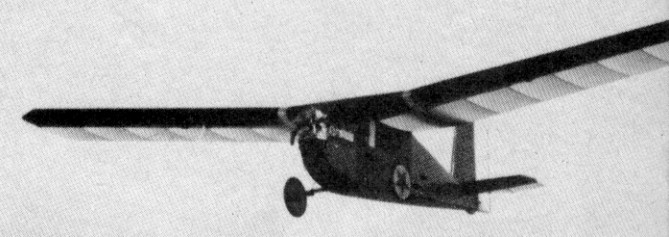
Single seat single engine high wing monoplane with two axis control. Conventional tail. Pitch control by elevator on tail; yaw control by fin mounted rudder; no separate roll control; control inputs through stick for pitch and pedals for yaw. Cantilever wing; wing profile; double surface. Undercarriage has two wheels with tailskid. Wood/foam fuselage, partially enclosed. Engine mounted at wing height driving tractor propeller.
Announced in 1983, the Sky Pup is a development of Steven Wood’s one off ultralight called the Blue Light Special. With the Sky Pup, the accent is on simplicity and low build cost; the aircraft is only sold in the form of plans, the company reckoning that the machine can be built for less than $1000 excluding power pack.
The design principle is to use foam to carry shear loads and wood to carry bending loads. Ribs and fuselage panels are cut from foam and then bonded to wood capstrips and gussets, with plywood covering for the leading edge and dope and fabric covering for the rest of the flying surfaces.
Engine is a Cuyuna 215RR coupled to the company’s own propeller via a reduction drive. Unlike most two axis aircraft, the Sky Pup is not purely stick controlled. The centre-mounted stick moves fore and aft only, to control pitch, while pedals are used for rudder control. The plans cost $50 in the US, $52 in Canada, $56 elsewhere.
Engine: Rotax 277
Empty wt.: 205 lbs
Max wt.: 400 lbs
Height 5’2”
Width 74”
Length 15’11”
Wing span: 31 ft
Wing area: 130 sq.ft.
Wing loading: 3.1 lbs/sq.ft
Power loading: 14.3 lbs/hp
Max speed: 61 mph
Cruise: 57 mph
Stall: 26 mph
Vne: 69 mph
Seats: 1
Vne 69 mph
L/D 12:1
Minimum sink rate 260 fpm
Takeoff roll 200’
Climb rate 450 fpm
Load factors +6, -3 G’s
Engine: Cuyuna 215RR, 20 hp at 5500 rpm
Propeller diameter and pitch 58 x 24 inch, 1.47 x 0.61 m
Reduction 2.3/1
Power per unit area 0.15 hp/sq.ft, 1.7hp/sq.m
Length overall 15.9 ft, 4.85 m
Height overall 4.3ft, 1.32m
Wing span 31.0ft, 9.45m
Mean chord 4.2ft, 1.28m
Dihedral 6.5 deg
Total wing area 130 sq.ft, 12.1 sq.m
Wing aspect ratio 7.4/1
Empty weight 195 lb, 88kg
Max take off weight 400 lb, 181kg
Payload 205 lb, 93kg
Max wing loading 3.08 lb/sq.ft, 15.0kg/sq.m
Max power loading 20.0 lb/hp, 9.1kg/hp
Load factors design; +6.0
Never exceed speed 69mph, 111 kph
Cruising speed 55mph, 88kph
Stalling speed 26mph, 42kph
Max climb rate at sea level 450 ft/min, 2.3 m/s
Best glide ratio with power off 12/1
Sport Flight Engineering
1983: P.O. Box 2164, Grand Junction, CO 81502, USA.
UL builder
Sport Copter Vortex

A single-seat partially enclosed autogyro, Sport Copter’s composite seats conform to the pilot’s shape, including the head, provide comfort as well as crucial support. Independent toe-operated hydraulic disc brakes are standard on all models. Its unique nose-wheel suspension operates independently from the rudder to make for smooth takeoffs and landings in crosswinds. Vortex reaches 100 mph with a 67-hp engine and has seating for one with a useful load of 460 pounds. Kits for the Vortex in 2001: US$20,400
Standard: semi-enclosure, folding rotor mast, pre-rotator, independent hydraulic disc brakes, new rotor head and roto-control Cyber Seat, nosewheel and main gear suspension.
Engine: Rotax 582, 67 hp
Rotor Blades: 25′ Sport Rotors
Height: 8.3 ft
Length: 12 ft
Disk span: 25 ft
Disk area: 490.8 sq.ft
Width: 7’4″
Empty wt: 350 lbs
Gross wt: 760 lbs
Fuel cap: 10 USG
Max speed: 100 mph
Cruise speed: 80 mph
Range: 170 sm
ROC: 1200 fpm
Take-off dist: 50 ft
Landing dist: 0-10 ft
Service ceiling: 13,000 ft
Seats: 1
Sport Copter II
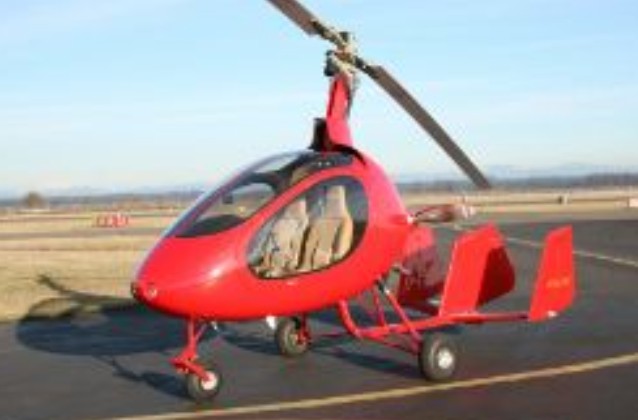
Full Body Enclosure including Fire Wall w/ two removable doors, Heavy Duty Engine Mounts, Mechanical Prerotator System, 8.5” X 31’ Sport Rotors Rotor System w/ Adjustable Pitch , Rotor Brake, Independent Hydraulic Disc Brakes, toe actuated, Roto-Control System, Cyber Seats w/ Adjustable Seat Backs and Adjustable Lumbar.
Heavy Duty Suspension, rate sensing shocks w/ springs (11” of travel!), Nosewheel, full castering with suspension (offering self alignment), Spun Aluminum Wheels, strong lightweight wheels, Customized 27 Gal. Aluminum Fuel Cell, Landing Lights (2), Cockpit Interior Lighting.
The “Quick Build “, High Performance Kit: offers a pre-fabricated, one piece cabin, so that no gluing is required to assemble the Kit. The cost is $59,995.00 in 2009 (less engine and prop package).
Engine: Lycoming IO-360
Propeller: Sport Copter Controllable pitch, three-blade
Rotors: 8.5″ x 31′
Fuel Capacity: 27 gal
Min Speed: 10-20 mph
Cruise: 100 mph
Top Speed: 120 mph
Empty Weight: 1000 lbs
Useful Load: 650 lbs
Gross Weight: 1650 lbs
Cabin Width 49″
Aircraft Width: 81″
Height: 10′
Length: 15.5′
Seats: 2
Engine: Subaru, 160 hp
Max speed: 130 mph
Cruise speed: 100 mph
Range: 310 sm
ROC: 1200 fpm
Take-off dist: 50 ft
Landing dist: 0-10 ft
Fuel cap: 25 USG
Empty wt: 650 lb
Gross wt: 1300 lb
Height: 9.75 ft
Length: 17 ft
Disk span: 30 ft
Disk area: 706.7 sq.ft
Seats: 2
Sport Copter Lightning / Vancraft Lightning
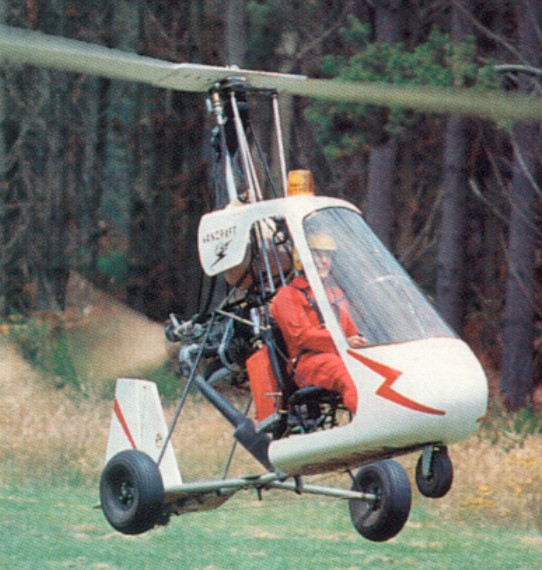
Originally marketed as the Vanvraft Lightning, the Lightning comes with most of the Vortex components. The all triangulated airframe is built of large-diameter aluminum tubing, with a truly remarkable suspension system and the finest control system in the industry (Roto-Control) We have designed a new composite seat to ensure unparalleled pilot comfort and crashworthiness. Up-grading to a partial enclosure is easy. The new shock mounted rotorhead and independent toe-operated hydraulic disc brakes are standard.
A step-by-step video is included with the assembly manual. The instructions and components are so complete it requires only 40 – 60 hours to bolt together using basic hand tools. The Lightning uses a Rotax 503 with oil injection, and a 2.58-to-1 reduction gear box delivering 52 horsepower.
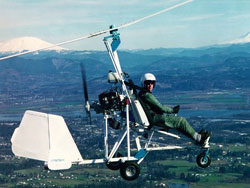
A unique feature on both the Vortex and Lightning is float capability The Lightning must be equipped as an experimental model with a 67-hp engine for this feature, but it typically operates as an ultralight with a 50-hp Rotax 503. Top speed is 63 mph with the ultralight or 80 mph with the experimental. Conforming composite seats, nosewheel suspension and independent disc brakes also come on the Lightning. Kits for the Lightning in 2001: $15,300
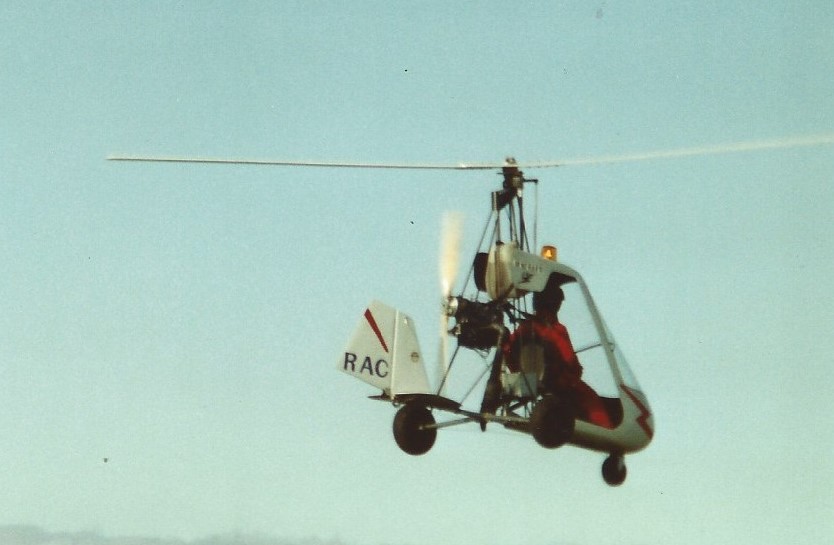
Engine: 50 hp Rotax 503 or 76 hp Rotax 582. Prop: 60” x 32” GSC wood fixed pitch or Warp Drive 64” ground adjustable. Rotor blades: 23-25’ x 7” Sport Rotors or 23-25’ x 8” Sky Wheels.
Standard: brakes suspension, new-design rotor head, Cyber Seat, independent nose wheel suspension and main gear suspension. Can be operated as ultralight or experimental. Options: prerotator, semi-enclosure, floats, instrumentation, folding mast. Info package $12, video $13, both $25. Kit: $15,300 in 2009.
Engine: Rotax 503, 46 hp
Rotor Blades: 23′ Sport Rotors
Disk span: 23 ft
Disk area: 415.4 sq.ft
Vne: 80 mph
Max speed: 63 mph
Cruise speed: 55 mph
Range: 90 sm
ROC: 1000 fpm
Sustained Climb: 500 fpm
Fuel cap: 5 USG
Empty wt: 252 lbs
Gross wt: 600 lb
Height: 8 ft
Length: 11 ft
Width: 6 ft 1.75 in
Seats: 1
Sport Copter Inc
Offers single-seat kit-built ultralight Lightning and kit-built Vortex autogyros, plus two-seat Sport Copter II autogyro.
1996-7: 34012 N. Honeyman Rd, Scappoose, OR 97056, USA.
2009: Sport Copter, Inc, 34012 Skyway Dr, Scappoose, OR 97056, USA.
Sportavia SFS 31 Milan / Scheibe SFS 31 Milan
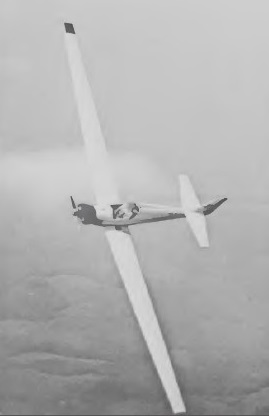
Designed by Rene Fournier and Egon Scheibe, Sportavia built the SFS 31 Milan, a single seat development of the Fournier RF4D with a sailplane wing of the Scheibe SF-27M motorglider and a feathering prop. The Milan’s designation is formed by adding together the manufacturers’ initial letters and the numbers in the designations of these two aircraft.
Like all of Rene Fournier’s designs, it had a big bubble canopy. It has spoilers for approach control and outrigger wheels and a steerable tailwheel to aid in taxiing. The cantilever wings are low-set instead of in the shoulder position of the SF-27M and Zugvogel V, with 4° dihedral from the roots, and are wooden structures with a pine box spar and plywood ribs covered with birch plywood and fabric; Schempp-Hirth glassfibre/metal air brakes are fitted in the upper surfaces. The SF-27M’s wings were made stronger than those of the unpowered SF-27 Zugvogel V, and it is powered by a 26hp Hirth Solo vertically-opposed four-cylinder engine. The Milan’s powerplant is a 39hp Rectimo (converted Volkswagen) 4 AR 1200 ‘flat four’ engine in a conventional tractor installation, driving a Hoffman two-blade fixed-pitch or fully-feathering wooden propeller, of 4ft 4in of 4ft 5.5in diameter respectively. The single fuel tank in the fuselage has a capacity of 7.7 Imp gallons. The landing gear is similar to the RF4D’s, but with spring-assisted retraction of the main wheel.
The Milan prototype, D-KORO, made its first flight on 31 August 1969. The SFS 31 was produced jointly by Sportavia and Scheibe.
Milan SFS-31
Engine: 29kW / 39 bhp Rectimo 4AR 1200
Wing span: 15 m / 49 ft 2.5 in
Wing area: 12 sq.m / 129 sq.ft
Aspect ratio: 18.6
Airfoil: Wortmann
Length: 19 ft 10.25 in
Height: 5 ft 1.75 in
Empty Weight: 310 kg / 682 lb
Payload: 130 kg / 286 lb
Gross Weight: 440 kg / 968 lb
Wing Load: 36.67 kg/sq.m / 7.5 lb/sq.ft
Max cruising speed: 112 mph at sea level
L/DMax: 29 95 kph / 51 kt / 59 mph
MinSink: 0.82 m/s / 2.7 fps / 1.60
Take-off run: 690ft
Range with max fuel: 415 miles
Structure: wood
Seats: 1
No. Built: 24
Sportavia RS-180 Sportsman
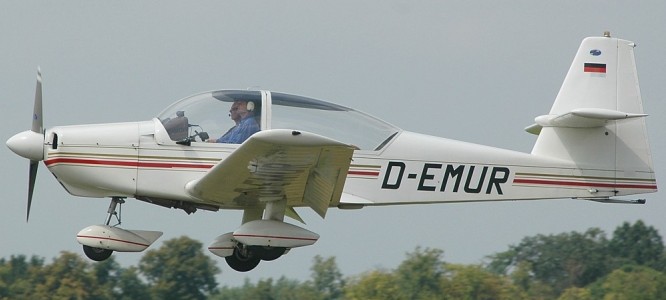
A four-seat lightplane
Sportavia / Sportavia-Putzer GmbH
Alfons Pützer and Comte Antoine d’Assche, director of the French company Alpavia SA, formed a new company in 1966, Sportavia-Pützer, to produce the Fournier series of light aircraft.
Formed to take over from Alpavia SA manufacture of Avion-Planeur series designed by Rene Fournier, by spring 1969 had delivered 150 RF4D single-seaters. Two-seat RF5 flew 1968, followed by RF6 and RS180 Sportsman four-seat lightplane.
Sportavia Pützer went bankrupt in 1977 not long after the first prototype RF-9 had made its maiden flight.
Became entirely owned by Rhein-Flugzeugbau GmbH 1977 and lost name 1981.

