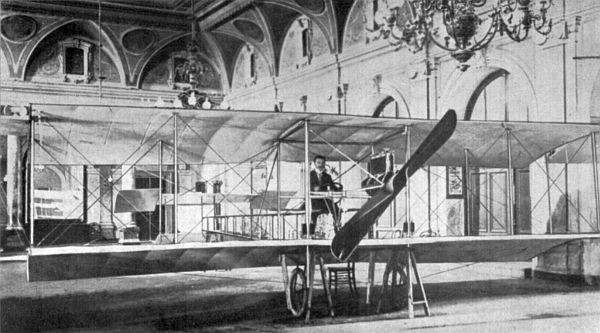
The first design of brothers Franz and Josef Spiller in Graz, Austria. It was exhibited in Graz in June 1910 before tests on the Graz flying field Thalerhof. The engine was a 50 hp Austro-Daimler automobile motor similar with that which Etrich also had no joy in Spring 1910 (before Ferdinand Porsche designed an aero engine of it). The Spillers later that year changed to a Puch aero engine, also built in Graz. Details of their achievements are almost undocumented, but they were experimenting at Thalerhof at least until 1912, with more or less success.
1956: W K Foss, Schenectady NY, and Spibec Corp, Philadelphia PA.
Spibec’s original intent was to experiment with fiberglass in lightplane construction, but poor sales of a fiberglass model introduced by Taylorcraft compelled the company to cancel its plans.
1958: Acquired rights for Luscombe Gullwing.
Spibec’s goal was to incorporate as Colt Aviation & Engr Corp.
1964: Sold rights to Swallow Aircraft Corp, Covina CA.
The Spezio DAL-1 Tuholer stems from a design by Tony Spezio in the late 1950s and is said to have been based loosely on the Howard Ike racer of the 1930s. As the Tuholer name implies, it is a two-seat, open cockpit, strut-braced, low-wing taildragger. The original was built using parts collected from various surplus and wrecked sources, and with no hangar space the wings were designed to fold. The first flight of the type occurred on 2 May 1961.
Spezio Tuholer N9110R
Marketed plans for home-builders. Mechanix Illustrated Golden Hammer Award c.1961 for design.
N140P First plans built DAL-1, builder Ken Patsch, August 1987
The fuselage and tail structure are welded steel tubing. Its large center section, supporting the folding wing mechanism is fashioned from a trio of one-inch .049 tubing with end plates, fittings and large bolts that allow the wings to fold for storage. The wings are wood with fabric cover.
The 1919 Sperry Sportplane was a two-place, open cockpit biplane, powered by two 38hp air-cooled, 2-cycle, 4-cyl Sperry WBB engines. The aircraft was fitted with folding wings.
The 1922 Hi-Lift was an experiment by Sperry in modifying a Curtiss JN-4D into a monoplane with an internally-braced, one-piece high-wing with I-beam spars, to produce a craft capable of carrying five, when it was originally designed for two. Despite successful trials and demonstrations, nothing came of the idea.