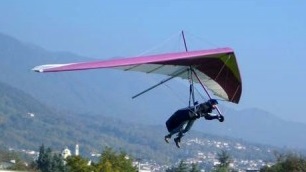
The Thalhofer GT Appeared in 1989.
Wing area: 15.8 m²
Wing span: 10.3 m
Aspect ratio: 6.71
Hang glider weight: 29 kg
Minimum speed: 25 km/h
Maximum speed: 80 km/h
Packed length: 6 m
Packed length short: 3.9 m
Nose angle: 124°
The Thalhofer GT Appeared in 1989.
Wing area: 15.8 m²
Wing span: 10.3 m
Aspect ratio: 6.71
Hang glider weight: 29 kg
Minimum speed: 25 km/h
Maximum speed: 80 km/h
Packed length: 6 m
Packed length short: 3.9 m
Nose angle: 124°
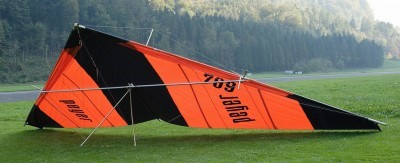
The Thalhofer Flamingo first appeared in 1976.
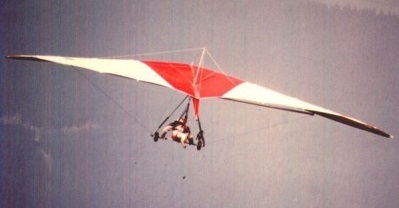
The Thalhofer Cloud first appeared in 1979, followed in the same year by the Cloud 2.
The Cloud 3 appeared in 1982.
The Cloud 4 appeared in 1984.
Cloud 2
Wing area: 16.9 m²
Aspect ratio: 6.08
Hang glider weight: 26 kg
Minimum pilot weight: 68 kg
Maximum pilot weight: 85 kg
Minimum speed: 25 km/h
Maximum speed: 72 km/h
Packed length: 3.8 m
Packed length short: 2.25 m
Nose angle: 125°
Single seat single engined high wing mono¬plane with conventional three axis control. Wing has unswept leading and trailing edges, and constant chord; conventional tail. Pitch control by elevator on tail; yaw control by fin mounted rudder; roll control by half span ailerons; control inputs through stick for pitch/roll and pedals for yaw. Wing braced from below by struts; wing profile Worth¬mann FX63 137; double surface. Undercar¬riage has three wheels in tricycle formation with additional tailskid; suspension on all wheels. Push right go right nose¬wheel steering connected to yaw control. No brakes. Aluminium tube framework, without pod. Engine mounted below wing driving pusher propeller.
An important manufactur¬er of hang gliders, producing around 300 of these aircraft per year, Thalhofer produced its first microlight in 1976. Two prototypes of the Bronco were built and flew for the first time at the end of March 1983. Production got under way in 1983, after the certification of the model.
Length overall 18.7ft, 5.70m
Wing span 28.5 ft, 8.70 m
Constant chord 3.9 ft, 1.20 m
Sweepback 0 deg
Tailplane span 5.2ft, 1.60 m
Total wing area 114 sq.ft, 10.6 sq.m
Total aileron area 6.9 sq.ft, 0. 64 sq.m
Total fin and rudder area 16.4 sq.ft, 1.52 sq.m
Total tailplane and elevator area 17.2 sq.ft, 1.60 sq.m
Wing aspect ratio 7.1/1
Wheel track 5.9 ft, 1.80 m
Engine: Konig SC430, 25hp at 4200rpm
Propeller diameter 55 inch, 1.40 m
Belt reduction, ratio 1.8/1
Max static thrust 132 lb, 60 kg
Power per unit area 0.22 hp/sq.ft, 2.4 hp/sq.m
Fuel capacity 5.3 US gal, 4.4 Imp gal, 20.0 litre
Empty weight 221 lb, 100 kg
Max take off weight 486 lb, 220 kg
Payload 265 lb, 120 kg
Max wing loading 4.24 lb/sq.ft, 20.7 kg/sq.m
Max power loading 19.4 lb/hp, 8.8 kg/hp
Load factors; +6.0, 3.0 ultimate
Max cruising speed 59 mph, 95 kph
Economic cruising speed 40mph, 65kph
Stalling speed 24mph, 40 kph
Max climb rate at sea level 400 ft/min, 2.0 m/s
Take off distance 165 ft, 50 m
Land¬ing distance 100 ft, 30 m
LS-ac / HG-hg
1983: Thalhofer, Steinengrabenstrasse 12, D 7440 Nfirtingen, West Germsny.
By 1998 UP Delta had bought out aircraft manufacturer Thalhofer.
In 1998 UP Europe was manufacturing the wings for the rigid wing Pegasus of Jurgen Lutz, having bought out aircraft manufacturer Thalhofer.
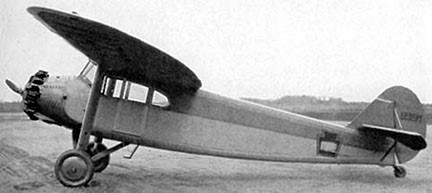
A four-seat all-metal monoplane, powered by a Wright Whirlwind engine. Built in 1930 (ATC 2-247), two were built; N898M c/n 3, and NC502V c/n 4.
Engine: Wright J-6, 300hp
Wingspan: 45’0″
Length: 32’10”
Useful load: 1435 lb
Max speed: 135 mph
Cruise speed: 110 mph
Stall: 59 mph
Seats: 4
The single Thaden T-2 built was similar the Argonaut, but with a full-cantilever wing and flaps. Built in 1928, the T-2 was registered N7074 c/n 2.
Engine: Comet, 150hp
Wingspan: 39’0″
Length: 25’1″
Useful load: 1180 lb
Max speed: 121 mph
Cruise: 90 mph
Stall: 46 mph
Seats: 4
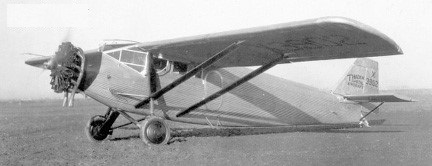
The 1928 Thaden T-1, or Argonaut, (ATC 2-29) was designed by Herbert von Thaden, registered NX3902, and first flew on 15 January 1928, piloted by George R Pond. The only one built crash-landed on 30 March 1933 in Chitkina AK., was recovered in 1988 and restored by an EAA group.
Engine: P&W Wasp A, 400-420hp
Wingspan: 53’0″
Length: 35’3″
Useful load: 2200 lb
Max speed: 135 mph
Cruise speed: 105 mph
Stall: 52 mph
Seats: 6-8
1928: (Herbert von) Thaden Metal Aircraft Co,
Oakland Airport
USA
and
San Francisco CA
USA
1928:
1625 Island Ave,
Pittsburgh PA.
USA
Pittsburgh Metal Airplane Co Formed in 1929 to take over the San Francisco-based Thaden Metal Aircraft Company, which had built the Thaden T-4 four-seat all-metal monoplane, powered by a Wright Whirlwind engine.
Textron Inc reached a deal to buy Beechcraft Corp. for $1.4 billion in December 2013. The Providence, Rhode Island-based company will purchase all outstanding equity interests in Beech Holdings LLC, the parent of Beechcraft, it said in a statement yesterday. The deal, which includes the repayment of Beechcraft’s working capital debt, will be financed by a combination of available cash and as much as $1.1 billion in new debt.
Adding Beechcraft models such as the twin-engine King Air will complement a Cessna lineup that ranges from two-seaters to the Caravan turboprop. That market segment is less competitive than private jets, where Cessna has struggled because it doesn’t build the large, long-range planes now favored by corporate buyers.
Textron will take over service for Hawker jets and hopes to convert those owners to Cessna jets, Donnelly said. The company is expecting low revenue from the T-6 military training plane as the U.S. military winds down it purchases and foreign sales of the plane would be a plus, he said.
Of the aircraft in service, 6,400 are King Airs and 2,250 are Hawker jets. The Beechcraft business was in good shape even with the bankruptcy and Textron wasn’t expected to invest extra to fix it.

