2009
David Thatcher
1020 E. Jordan St., Unit A
Pensacola, FL 32503
Built the CX4 LSA
2009
David Thatcher
1020 E. Jordan St., Unit A
Pensacola, FL 32503
Built the CX4 LSA
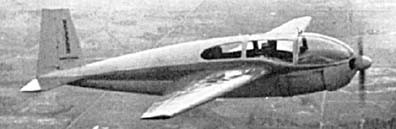
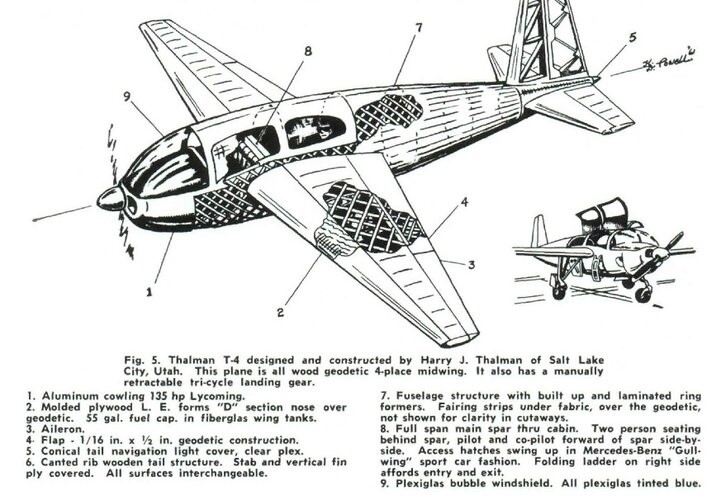
In 1949, Harry formed Thalman Aircraft Inc. at Salt Lake City. In the same year, he designed the Talman T-4 which, flew in 1951. The 1953 Thalman T-4 was a four-pace mid-wing cabin monoplane of all-wood geodetic construction. The T-4 followed the same wooden geodetic construction employed by Harry J. Thalman and William Earl Player when they helped form Plxweve Aircraft. (Construction techniques followed those of Thalman’s Oregonian mentor, George Yates – bending strips of cedar around heated former moulds.) In general construction technique, the T-3 and T-4 were similar – the T-3 being fabric-covered, the T-4 having a fibreglass covering.
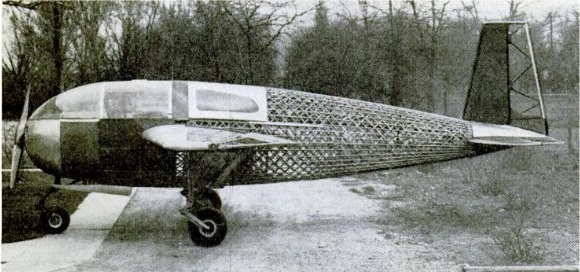
Designed by Harry J. Thalman, the one built, N53389, had manually retracting undercarriage. Initially powered by a 135hp Lycoming O-290, it was later converted to T-tail with a 170hp O-340.
Convinced that serial wooden geodetic construction would be less expensive than by-then conventional metal construction, Thalman spent the next decade trying to get the T-4 into production. At one point, Thalman approached the Cache Chamber of Commerce in Utah for start-up funds of $50,000 (and a suitable workspace) to launch T-4 production – presumably near Logan, UT. The Chamber passed.
By 1960, Thalman Aircraft Corp. was doing business as Thalman Industries (sometimes given as Thalman Aircraft Industries). However, the firm was now planning to relocate to Roseburg, OR – 900 miles to the west. Roseburg businessman Lynn Andreas had become president and it was Andreas who was announcing the construction of a new factory on 5 acres of leased land at the Roseburg municipal airport. Early reports said that site ground preparation work had begun and that a “plywood plane” would be built. Harry Thalman is quoted, saying that his aircraft will sell for less than $14,000.
By 1963, Harry Thalman was working as a mechanic for Kelsey-Ellis Air Service at Salt Lake City Airport. The T-4 was in storage (and possibly disassembled by then) but Harry was still flying the T-3B. On 15 March 1963, Harry was doing flying cross-country when he flew into a blinding snowstorm. Harry Thalman died instantly when he crashed his T-3B monoplane in a gully outside of Grantsville, UT.
Engine: 135hp Lycoming O-290, later 170 hp Lycoming O-340
Wingspan: 40 ft 2.5 in
Length: 21 ft 6 in
Height: 6 ft 0 in
Empty weight: 1050 lb
MTOW: 2000 lb
Useful load: 1050 lb
Max speed: 175 mph
Cruise: 155 mph
Stall: 45 mph
Range: 700 mi
Seats: 4
Undercarriage: manual retractable
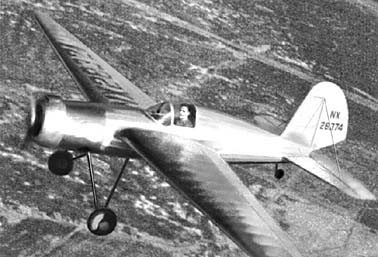
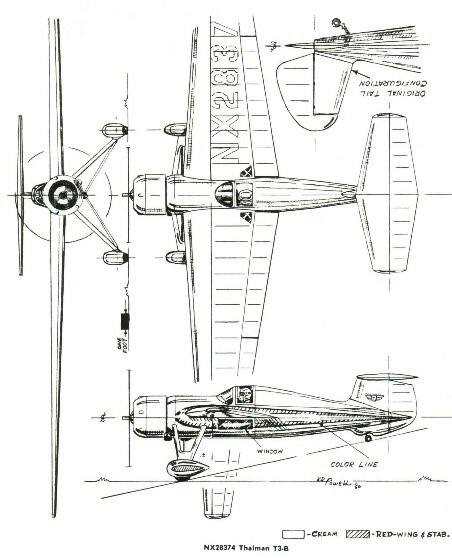
The 1941 T-3B was a single-place cabin monoplane of fabric-covered wood geodetic construction by Harry J. Thalman. One was built, registered NX28374.
The T-3B was a revised airframe with a T-tail and spats fitted to main wheels.
Engine: Velie M-5, 55hp
Wingspan: 41’0″
Max speed: 130 mph
Cruise: 120 mph
Stall: 38 mph
Seats: 1
A 1935 two place, open cockpit monoplane, powered by a 60hp Thalman engine and registered N12793 c/n 1.
Harry J. Thalman: born 25 March 1911 at Challis, Idaho, USA.
George Yates of Beaverton, Oregon had been the mentor of Harry J. Thalman’s designs, Yates had been wooden geodetic construction pioneer, Thalman made several trips from Salt Lake City to Beaverton to learn about geodetic construction techniques from from Yates.
Thalman and Player were joined by a third geodetic aircraft builder – John Greenleaf of Portland, OR, to form the Plxweve Aircraft Company in 1940. Greenleaf then arranged financing through Ralph Hemphill of Los Angeles. As a result, the Plxweve Aircraft Co. became a division of another Hemphill-controlled firm – Aero Industries Technical Institute, Incorporated (Aero ITI). Ralph Hemphill became President of the Plexweve division but refused further investment. The money was run through quickly and much legal wrangling ensued.
The T-3 had first flown in 1941
At some point, the partners went their separate ways. In 1949, Harry formed Thalman Aircraft Inc. at Salt Lake City. In the same year, he designed the Talman T-4 which, flew in 1951.
By 1957 Thalman Aircraft Corp. had relocated to Mount Pleasant, UT, with plans to establish T-4 production there. In a letter to Flying Magazine (March 1957, pages 6 & 8), Mount Pleasant resident Rex C. Staker writes that the production T-4 was to be offered with 150-, 170-, or 180 hp engines. According to Aerofiles, Thalman Aircraft also took over a concept from Van Nuys-based ATS (Aircraft Technical Services Inc., Floyd E. Snow) in 1959. That ATS design was described as a 4-place mid-winged cabin monoplane (“reportedly 50 percent complete”).Thalman Aircraft then began reworking this laminar-flow winged design as a “twin-engine development”.
By 1960, Thalman Aircraft Corp. was doing business as Thalman Industries (sometimes given as Thalman Aircraft Industries). However, the firm was now planning to relocate to Roseburg, OR – 900 miles to the west. Roseburg businessman Lynn Andreas had become president and it was Andreas who was announcing the construction of a new factory on 5 acres of leased land at the Roseburg municipal airport. Early reports said that site ground preparation work had begun and that a “plywood plane” would be built. Harry Thalman is quoted, saying that his aircraft will sell for less than $14,000.
According to local media reports, the production type’s structure – under its fiberglass shell – would be an aluminum honeycomb. That jives with an article in Sport Aviation August 1961 – Geodetic Aircraft Structure by Keith D. Powell, EAA. On page 22, Powell writes that Thalman was “now working on another midwing featuring a plastic bonded honeycomb sandwich airframe.” Reportedly, circa 1958, Harry began losing interest in geodetic structures. Lynn Andreas was also president of the Oregon Red Cedar Co.
Contemporary reports say that Thalman was “working on a fifth model which will include a number of modifications, such as a more powerful motor, sweptback tail assembly, and electrically-operated landing gear and flaps.” These all sound like sensible updated for a production variant. But the The News-Review report says that an “all-hydraulic retractable landing gear” was to equip the production type. Needless to say, that Roseburg factory never materialized. In the early ’60s, some airport was holding the parked Thalman T-4 until storage fees in the order of $800 were paid.
By 1963, Harry Thalman was working as a mechanic for Kelsey-Ellis Air Service at Salt Lake City Airport. The T-4 was in storage (and possibly disassembled by then) but Harry was still flying the T-3B. On 15 March 1963, Harry was doing flying cross-country when he flew into a blinding snowstorm. Harry Thalman died instantly when he crashed his T-3B monoplane in a gully outside of Grantsville, UT.
Harry J. Thalman: died 15 March 1963.
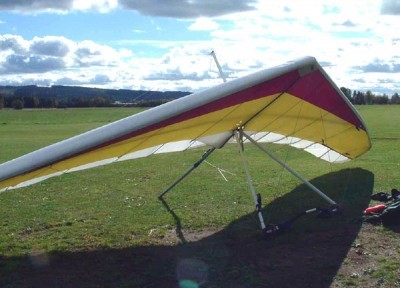
The Thalhofer Vector hang glider appeared in 1993.
Wing area: 14.6 m²
Wing span: 10.3 m
Aspect ratio: 7.3
Hang glider weight: 28 kg
Minimum pilot weight: 65 kg
Maximum pilot weight: 100 kg
Minimum speed: 25 km/h
Maximum speed: 80 km/h
Packed length: 5.1 m
Packed length short: 3.9 m
Number of battens: 25
Nose angle: 127°
The Thalhofer Topswing hang glider appeared in 1987.
The Thalhofer Swing hang glider appeared in 1987.
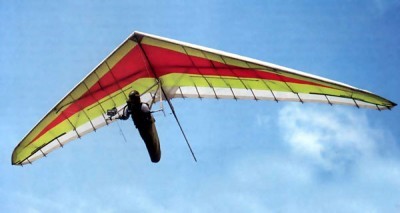
The Thalhofer Reflex appeared in 1991.
CS
Wing area: 12.7 m²
Wing span: 10.3 m
Aspect ratio: 8.4
Hang glider weight: 29 kg
Minimum pilot weight: 55 kg
Maximum pilot weight: 80 kg
Packed length: 5.4 m
Packed length short: 3.8 m
Number of battens: 31
Nose angle: 127°
C1
Wing area: 14 m²
Wing span: 10.65 m
Aspect ratio: 8
Hang glider weight: 31 kg
Minimum pilot weight: 60 kg
Maximum pilot weight: 100 kg
Packed length: 5.2 m
Packed length short: 3.9 m
Number of battens: 31
Nose angle: 127°
C
Wing area: 14.2 m²
Wing span: 10.65 m
Aspect ratio: 8
Hang glider weight: 31 kg
Minimum pilot weight: 60 kg
Maximum pilot weight: 100 kg
Packed length: 5.6 m
Packed length short: 4 m
Number of battens: 33
Nose angle: 127°
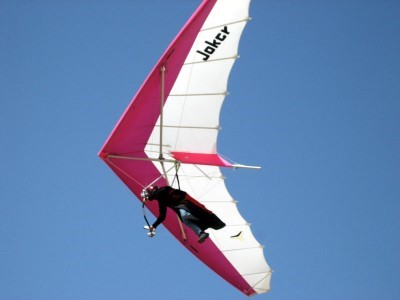
The 1989 intermediate Thalhofer Joker is described as a very stable and easy glider which is good for beginner pilots. Easy to fly and land, it stays up in 12 knots on low coastal dunes (20-30ft) and makes top landing zone feel like a runway.
The Joker can aerotow.
Joker
Wing area: 16.5 m²
Wing span: 9.65 m
Aspect ratio: 5.6
Hang glider weight: 24 kg
Minimum pilot weight: 65 kg
Maximum pilot weight: 95 kg
Minimum speed: 25 km/h
Maximum speed: 80 km/h
Packed length: 5.5 m
Packed length short: 3.8 m
Number of battens: 14
Nose angle: 122°

