An unidentified type was built c/n A-1 registration NC6525, which had the same registration as a Curtiss JN-4C.
One on-line copy of the FAA register contains a suggestion that this may have been a Curtiss rebuilt by the Corporation. No proof is given. It could be the Commercial Wing with the Curtiss OXX engine.
A 1929 Trimotor designed by Carroll was noted as being test flown by Williams on 5 October 1929. It was to be powered by three 60 hp Velie and used as a photographic survey plane.
On 6 October 1929 the plane was flown to San Antonio for use by West Texas oilman Joe Palmer of the Texas Pacific Coal and Oil Company of Fort Worth.
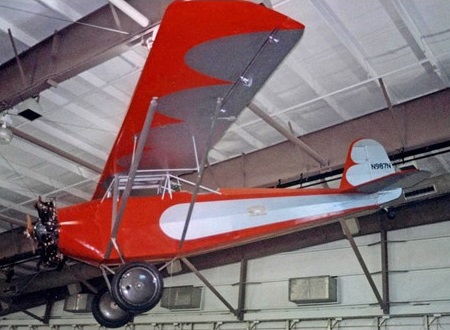
Temple Sportsman N987N on display at the Frontiers of Flight Museum at Dallas, Texas
Designed by George W Williams and George Carroll, the Sportsman was a parasol winged monoplane, equipped with two seats arranged in tandem. The cockpit had an open layout. A fixed tail-wheel undercarriage was fitted. The tailplane was set low on the fin. A 100 h.p. Cirrus III was initially fitted.
Three examples of the Sportsman were completed: NC480 manufacturers number 1; NC852H and N987N manufacturers number 107. There was no N987N registered in FAA records at the time, so it is likely to be from a later registration. There was an NC987H, but that was the registration for a different make of aircraft, a Smith S-1 with a Velie engine. The Sportsman was suitable for operation by individual sporting pilots. Williams was killed during 1930 in the crash while flying with a trainee pilot. The company folded after the accident.
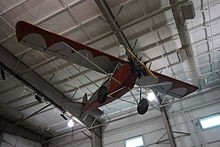
One Texas-Temple Sportsman still exists. It had been found in bits by an airplane restorer, Jerry D Ferrell, who reconstructed it. The plane undertook its airworthiness test on July 26, 1990. Ferrel donated the plane for display at the Frontiers of Flight Museum, Love Field, Dallas, Texas. The plane is fitted with a Clyde Cessna modified engine, the Anzani.
The Texas-Temple Sportsman on display at the Frontiers of Flight Museum
The 1928 Aero C-4 was designed to carry 4 passengers in an enclosed cabin with the pilot in an open cockpit behind the wing. Possibly powered by a Wright J-5B engine. Only one was built, c/n X-101, registration NC-7458.
The 1979 M79S Wasp II was a two place Ag modification of the Bell 47G. First flown on 6 January 1979.
First flown in 1979 with a piston engine, the M79T Jet Wasp II was a two-seat turboshaft powered modification of the Bell TH-13T helicopter. One was built (N1001X) in 1982.
M79S Wasp II Engine: TVO-435, 270hp Rotor: 37’1″ Length: 36’0″ Useful load: 1480 lb Max speed: 106 mph Cruise: 80 mph Range: 300 mi Seats: 2
M79T Jet Wasp II Engine: Soloy-Allison 250 Seats: 2
Developed M74 Wasp (certification 1976) and M79T Jet Wasp II (first flown 1979 with piston engine) as single-seat piston-engined agricultural/utility and two-seat turboshaft- powered modifications of Bell 47G/ TH-13T helicopters respectively. Assets bought by Aerodyne in 1985.
USA Dallas-based company which in mid-1970s acquired assets of Carstedt Inc and is continuing marketing of latter’s Jetliner 600 lengthened-fuselage turboprop conversion of de Havilland Dove as the CJ600.