The O-155 engine built by Victor J Caron in 1941 was a 75hp 153.9ci horizontally opposed four-cylinder air-cooled aero engine.
Era
Caron, Victor J
Haverhill MA.
USA
Built an O-155 aero engine in 1941.
Carma VT-1 Weejet / Dale Air-Engineering WEEJET 800
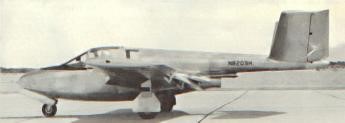
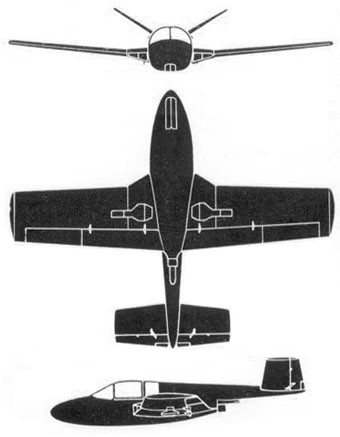
In the early fifties Harold Dale played with the idea to design the ideal jet trainer: seating trainee and instructor side-by-side in front of the wing for clear visibility all around. It should have a slow landing speed and a comfortable cruising speed of 350 mph. The plane Harold had in mind was a mid-wing cantilever monoplane of aluminium alloy structure, with slotted flaps, leading edge intake ducts, semi-monocoque fuselage, upwards opening doors, butterfly tail unit and retractable tricycle landing gear.
Harold Dale was a project engineer with North American working on the F-100, so his ideal plane had to be designed in the spare time. He had assistance from his wife Eleanor who also had an engineering degree, handling much of the mathematics, administration, etc.
The name chosen was the WEEJET 800 (WE=Harold and Eleanor), the 800 meaning the power class of the licence built Turboméca Marboré II engine of 880 lb thrust.
In February 1952 Dale Air-Engineering (Torrance, California) and the WEEJET 800 were official registered and the first material was submitted to the CAA West Region Administration. It was the first jet aircraft in the small plane field submitted to the CAA, who followed every phase of the two and a half years of design and evaluated all data during development.
In 1954 a local aircraft parts manufacturer (Carma Manufacturing Co) heard of the design and got involved in the project in two ways: he supplied the hydraulic shock absorber struts and offered to built the aircraft in his plant in Tucson, Arizona. Now it became feasible to produce and market the aircraft. Construction started at Tucson in the second half of 1954 and five people worked one and a half years on it.
The prototype (N8209H) conducted its 20 minutes first flight on Good Friday March 30, 1956, with Harold Dale at the controls. During the following weeks further test flights were made by another pilot, except for the spin tests, these were performed by USAF-pilot Doneby; the aircraft handled and performed well.
During 1956 the US Navy had become interested in jet trainers and the WEEJET was to be in their evaluation. Therefore all data had to be available before the end of the month and the aircraft was to be flown to Patuxtent, Maryland on April 29. On April 28 1956 disaster struck: during the final spin test the pilot inadvertently activated the trim tab into full nose-down position. The pilot lost control while trying to recover and had to bail out, the aircraft crashed and burned. Later data was found thrown clear of the wreckage, showing the spin tests were a complete success.
All following data was issued on April 25, 1956 in a proposal to the US Navy for the production version. The designation was Carma WEEJET TRAINER.
Carma VT-1 WEEJET
Type: Two side by side seat primary jet trainer
Engine: Continental J69-T-9 (Marbore II), 920 lb (417 kg) s.t.
Wingspan: 28 ft 0 in (8.53 m)
Length: 24 ft 6 in (7.47 m)
Height: 6 ft 8 in (2.03 m)
Wing area: 150 sq.ft (13.94 sq.m)
Empty Wt: 2,481 lb (1,125 kg)
Max T/O Wt: 4,541 lb (2,060 kg)
Max speed: 334 mph (537 km/h) at 15,000 ft (4,570 m)
Cruise speed: 208 mph at 25,000 ft
Max climb: 2,200 ft (670 m)/min
Service ceiling: 35,000 ft (10,670 m)
Endurance: 1.72 hr at sea level
Carma Manufacturing Co
USA
Established 1948 to manufacture electrical, mechanical, and aircraft control equipment. Aircraft manufacturing division formed in 1954 at Tucson, Arizona, to build a turbojet- powered two-seat trainer, the Carma VT-1 Weejet. Prototype first flew March 30,1956.
CARMAM M-200 Foehn / CVT M200
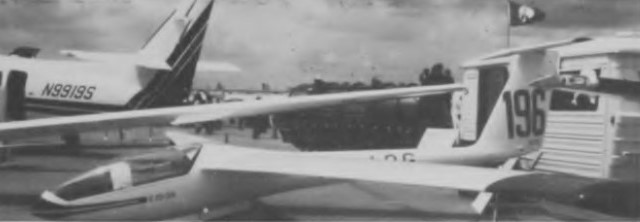
Designed by Alberto and Piero Morelli, the M-200 is a two-seater high performance version of their Standard Class M-100S which was built under licence both in Italy and by CARMAM at Moulins-Avernes as the M-100S Mesange (Tomtit). The prototype M-200 was built under contract for the Aero Club of Italy by the CVT (Centra di Volo a Vela del Politecnico di Torino) at Turin, and made its first flight in May 1964.
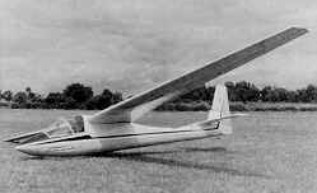
Production was undertaken under an exclusive licence by CARMAM, who built it as the M-200 Foehn, completing one more prototype and five pre-production aircraft before starting the definitive production batch. Main difference between the M-200 and the M-100S is the former’s widened fuselage to accommodate two staggered side-by-side seats, the one-piece canopy opening sideways to port; this seating arrangement obviates the need for ballast when the aircraft is flown solo, and gives good visibility to both pilots. The M-200 is designed to be easy to fly for first solos and, like the M-100S, is fully aerobatic; it is also suitable for flying in cloud. Wing span of the M-200 has been increased from the 15m of the M-100S to 18.15m (59ft 6.5 in) and it is slightly longer; the wing structure is very similar to that of the M-100S, with a leading edge torsion box and air brakes consisting of four instead of three pairs of light alloy rotating plates above and below each wing. The fuselage is of plywood construction with frames and stringers and the landing gear consists of a non-retractable monowheel with a drum brake and a rubber-sprung nose-skid; there is also a tailskid.
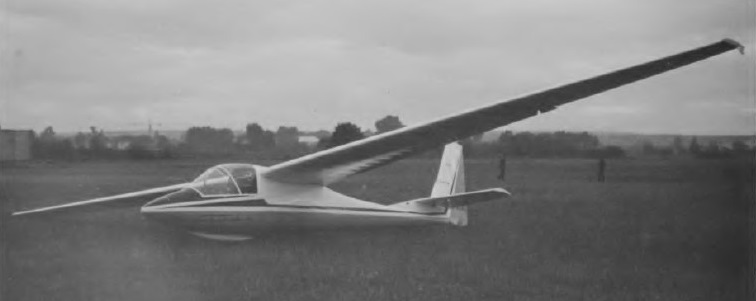
M-200
Span: 18.14m / 59 ft 6.5 in
Length: 7.6 m / 24 ft 1.25 in
Height: 6 ft 5 in
Wing area: 17.46 sq.m / 188.4 sqft
Aspect ratio: 19.0
Empty Weight: 345kg / 760lb
Gross Weight: 570kg / 1255lb
Payload: 225kg / 495lb
Water ballast: None
Wing Load: 32.65kg/sq.m / 6.7lb/sq.ft
Max speed: 121 kt / 225 km/h / 140 mph (in smooth air)
Max rough air speed: 81 kt / 150 km/h
Stalling speed: 38 kt / 70 km/h
MinSink: 0.64 m/s / 2.1 fps / 1.24 kt
Best glide ratio / L/DMax: 32:1 at 98 kph/ 54 kt/ 61 mph
No. of Seats: 2
Airfoil: NACA 63-619/15
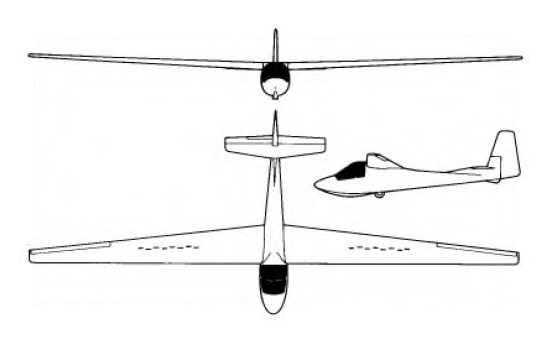
CARMAM JP-15 / Pettier PA 15-34 Kit-Club
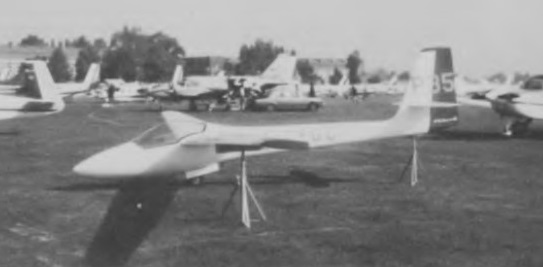
The Aiglon (Eaglet) was a private venture design by CARMAM’s technical directors Robert Jacquet and Jean Pettier, and is a restricted Standard Class sailplane; design work began in September 1971, and the prototype made its first flight on 14 June 1974.
Series production began in 1976, the first production JP15-36A making its first flight on 16 October that year; a version with a retractable monowheel and provision for up to 121 lb of water ballast is designated JP 15-36AR.
The single-seater Aiglon is intended for intensive club use and so special attention has been paid to good flying qualities and safe landing characteristics for not-so-experienced pilots. Construction is of glassfibre, the cantilever mid wing having a single glassfibre spar and a glassfibre/Rohacell/epoxy sandwich skin and steel-tipped wing tip ‘salmon’ fairings. The ailerons are of plastic and can be operated either differentially or in unison, and there are Schempp-Hirth airbrakes on the upper and lower surfaces; for ease of wing rigging the aileron and air brake controls are designed to connect automatically. The semimonocoque glassfibre fuselage is moulded in two halves and joined at the centreline, a single bulkhead forming the cockpit backrest and a shock-absorbing structure for the monowheel. A large one-piece canopy gives excellent visibility, while both seat and rudder pedals are adjustable in flight: on the JP 15-36A the monowheel s fixed and has a cable brake, and there is also a tail bumper. The swept back fin is integral with the fuselage, and the wooden rudder is fabric-covered, the all-moving tailplane is of plastics construction.
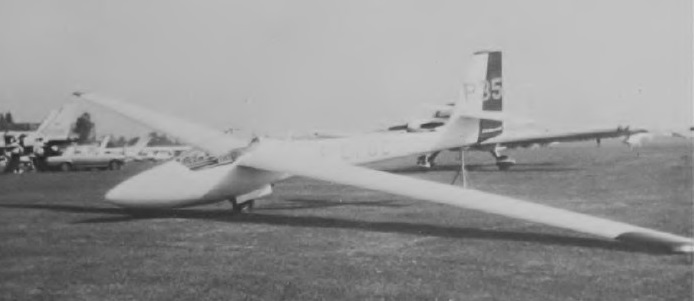
The Pettier PA 15-34 Kit-Club homebuilt version is essentially the same as the JP 15-36A but with some structural simplification and redesign to make it more suitable for amateur builders; the glassfibre wings are factory-made. Plywood-covered spruce construction of the fuselage and tail unit replaces the Aiglon’s more sophisticated glassfibre structure, although the Kit-Club’s nose-cone is of glassfibre. The tail boom, rudder and rear part of the tailplane are fabric-covered, and there is a fixed unsprung monowheel, with a cable-operated drum brake on production aircraft. The change to wood construction results in only a slight weight penalty, the maximum weight going up to 926lb, and performance is very similar to the JP15-36A’s. The prototype Kit-Club made its first flight on 6 November 1976, and 12 had been built by December 1979. The Kit-Club is also available in factory-built form from CARMAM.
By January 1980 a total of 39 JP 15-36Aand JP 15-36AR Aiglons had been sold
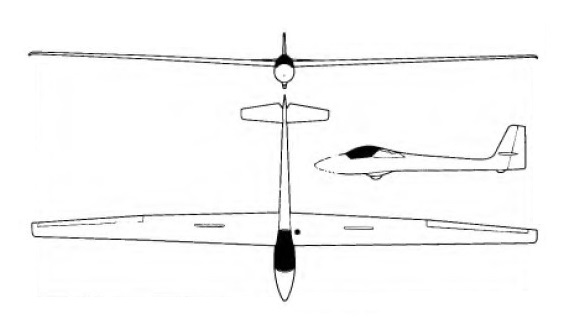
The CARMAN JP 15-38 Standard Class single seater utilises the same wings as the JP 15-36A Aiglon with provision for 220lb of water ballast; these are married to a new fuselage of similar construction to the JP 15-36A, which has a mechanically retractable unsprung monowheel. Instead of the Aiglon’s low-set tailplane the 15-38 has a T-tail, with elevator and spring trim.
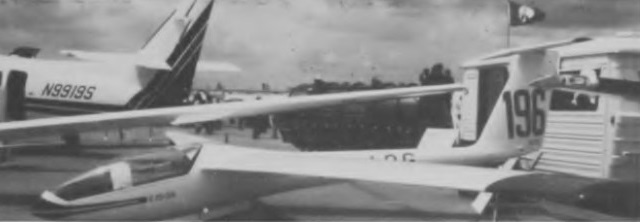
Construction of the 15-38 began in February 1977 and the prototype made its first flight on 17 June 1979.
JP. 15-36 Aiglon
Wing span: 15.0 m / 49 ft 2.5 in
Length: 6.4 m / 21 ft 0 in
Height: 1.4 m / 4 ft 7 in
Wing area: 11.0 sq.m / 118.4 sq.ft
Wing section: Wortmann FX-67-K-170/67-126
Aspect ratio: 20.4
Empty weight: 200 kg / 441 lb
Max weight: 390 kg / 860 lb
Water ballast: None
Max wing loading: 35.5 kg/sq.m / 7.27 lb/sq ft
Max speed: 130 kt / 240 km/h
Stalling speed: 33.5 kt / 62 km/h
Min sink: 0.6 m/sec / 2 ft/sec at 40.5 kt / 75 km/h
Max rough air speed: 108 kt / 200 km/h
Best glide ratio: 36 at 49.5 kt / 92 km/h
CARMAM JP15-36A
Span: 49ft 2.5 in
Length: 20ft 3 in
Height: 4ft 7 in
Wing area: 114.7 sqft
Aspect ratio: 20.4
Empty weight: 505 lb
Max weight: 860 lb
Max speed: 136mph (in smooth air)
Max aero-tow speed: 103 mph
Min sinking speed: 2.03ft/sec at 45 mph
Best glide ratio: 36.9:1 at 50 mph
CARMAM 15-38
Span: 49ft 2.5 in
Length: 21 ft 11.75 in
Height: 4ft 8 in
Wing area: 118.4 sqft
Aspect ratio: 20.6
Empty weight: 507 1b
Max weight: 970 lb
Max speed: 136 mph (in smooth air)
Max area-tow speed: 136 mph
Min sinking speed: 1.97ft/sec at 46.5 mph
Best glide ratio: 38:1 at 62 mph
Carlson Sparrow
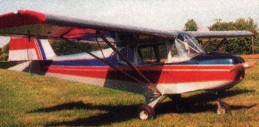
The Carlson Aircraft Sparrow Ultralight is a three axis aircraft conforming to FAA 103 regulations.
The Sparrow II is a two seat version of the Sparrow ultralight with optional folding wings.
Sparrow II
Engine: Rotax 582, 66 hp.
Speed max: 130 mph.
Cruise: 110 mph.
Range: 300 sm.
Stall: 36 mph.
ROC: 1750 fpm.
Take-off dist: 75 ft.
Landing dist: 150 ft.
Fuel cap: 10 USG.
Weight empty: 510 lbs.
Gross: 1050 lbs.
Height: 7.75 ft.
Length: 18 ft.
Wing span: 31.5 ft.
Wing area: 140 sq.ft.
Seats: 2.
Landing gear: nose wheel.
Sparrow II XTC
Engine: Subaru, 82 hp.
HP range: 66-85.
Speed max: 130 mph.
Cruise: 110 mph.
Range: 400 sm.
ROC: 1100 fpm.
Take-off dist: 150 ft.
Landing dist: 250 ft.
Service ceiling: 13,000 ft.
Fuel cap: 22 USG.
Weight empty: 600 lbs.
Gross: 1250 lbs.
Height: 7.75 ft.
Length: 18 ft.
Wing span: 31.17 ft.
Wing area: 140 sq.ft.
Seats: 2.
Landing gear: nose wheel.
Optional Continental C-85 or Rotax 912 engine.
Sparrow Sport Special
Engine: Rotax 503, 52 hp.
Speed max: 120 mph.
Cruise: 85 mph.
Range: 300 sm.
Stall: 31 mph.
ROC: 1750 fpm.
Take-off dist: 85 ft.
Landing dist: 175 ft.
Service ceiling: 12,000 ft.
Fuel cap: 10 USG.
Weight empty: 360 lbs.
Gross: 710 lbs.
Height: 5.3 ft.
Length: 16.8 ft.
Wing span: 26.8 ft.
Wing area: 117 sq.ft.
Seats: 1.
Landing gear: tail wheel.
Sparrow Ultralight
Engine: Rotax 277, 28 hp.
Wing span: 30.2 ft.
Wing area: 120 sq.ft.
Length: 16.75 ft.
Height: 6.75 ft.
Weight empty: 115 kg / 254 lbs.
MTOW Weight: 229 kg / 504 lbs
Fuel cap: 5 USG.
Cruise: 50 kt / 58 mph / 93 kmh.
Range: 200 sm.
Stall: 26 mph / 23 kt / 42 kmh
VNE: 55 kt / 63 mph / 101 kmh
ROC: 750 fpm.
Take-off dist: 140 ft.
Landing dist: 195 ft.
Service ceiling: 10,000 ft.
Seats: 1.
Landing gear: nose wheel.
Carlson Aircraft Inc
Manufactures kits to construct the Sparrow series of micro-light/homebuilt high-wing monoplanes in several single- and two-seat versions, plus the single-seat low-wing Sky-cycle (developed from an original 1945 design).
1995-7: PO Box 88, East Palestine, OH 44413-0088, USA.
Carlier 1911 biplane
In 1911 Rene Carlier designed and built a biplane in France with a 26’3″ wingspan and 23′ in length.
Carlingford Aërial Chariot / Aerhedon
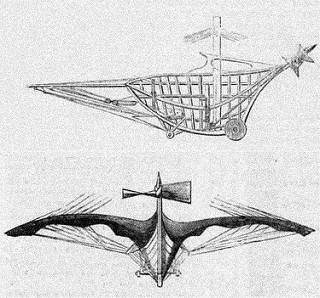
In 1856 Godwin Swift of Kilkenny, Ireland, aka Viscount Carlingford patented an aeroplane both in England and France, resembling in outline a falcon gliding downward with partially closed wings, described by the inventor as follows: “The aerial chariot in form is something in the shape of a boat, extremely light, with one wheel in front and two behind, having two wings, slightly concave, fixed to its sides”. “A tail can be raised and lowered at pleasure by means of a cord. The chariot is drawn forward by an ‘aerial screw’ in front thereof, which screws into the air at an elevation of 45°, turned by means of a winch acting on three multiplying wheels.” The machine was built and tested by swinging it from a rope. The propeller and a wheel are preserved at the Rothe House Museum of Kilkenny.

