Construcciones Aeronauticas SA formed 3 March 1923, with a factory at Getafe, to produce all-metal aircraft for the Spanish Air Force. Began by license-building Breguet XIX reconnaissance-bomber biplanes, followed by other aircraft of foreign design including Dornier Wai flying-boats (at Cadiz), Vickers Vildebeest torpedo-bombers, Gotha Go 145C biplane trainers, Junkers Ju 52/3m transports, Bucker Bu 131, and 133 aerobatic trainers and Heinkel He 111 medium bombers. Opened a design department after the Second World War; first series product was Dornier Do 27 general-purpose lightplane, followed by CASA-201 Alcotan, CASA-202 Halcon and CASA-207 Alcotan twin-engined transports of own design. Completed 70 Northrop F-5 fighters under license for Spanish Air Force. In 1972 took over Hispano Aviacion, followed by the ENMASA aero- engine concern in June 1973. Currently has three divisions, namely Aircraft, Maintenance, and Space: Aircraft division activities include design of aircraft and integrated structures; share in international Airbus, Eurofighter, and FLA programs; manufacture of structural parts and components for Boeing, Eurocopter, Northrop Grumman, and Saab aircraft; continuing development and production of C-101 Aviojet advanced and lead-in jet trainer/light attack aircraft (first flown June 1977), C-212 Aviocar (first flown March, and currently offered in Series 400 form as first flown April 1997) in transport and maritime versions, and development of the new ATX family of advanced trainers and light combat aircraft; and production of CN 235 via international Airtech company.
Era
Cartercopters CarterCopter

Carter designed, built, and flown several prototype aircraft to develop and demonstrate their slowed rotor technology. The original CarterCopter Technology Demonstrator flew between 1998 and 2005
In 2001 the CarterCopters Rotor Wing existed only as a prototype.

Cartercopters
2001: CarterCopters L.L.C., 5720 Seymour Hwy., Witchita Falls, TX 76310, USA.
Gyrocopter builder
Carter 1911 biplane
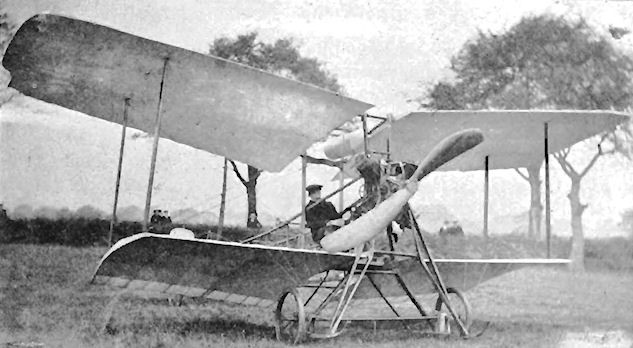
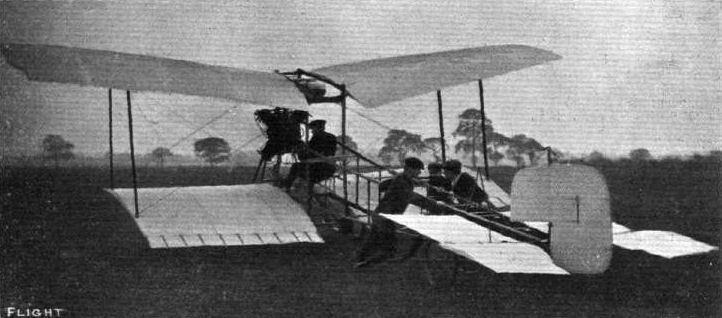
In the UK in 1911 Mr. Carter was out on the new machine and with the engine running fairly well, the machine made a few hops. The machine is of the biplane type of very short span, with the upper planes of slightly greater span than the lower ones. There is no elevator in front, but that position is occupied by the engine and propeller. The engine is an 8-cyl. made by the Nonpareil Motor Fitting Co. at Birmingham. At present it gives about 60-hp, but when properly tuned up it is expected to reach about 80-hp Mr.Carter succeeded in getting the biplane off the ground for short distances.
Mr. Carter was also out with his biplane after having made a few alterations to the tail. The machine rises very rapidly, in one case getting off the ground in 15 ft. but no extended flights were made owing to the fact that the engine was not running up to form.
Carson Helicopters Inc
USA
Formed in 1963 at Perkasie, Pennsylvania, to develop conversion schemes to improve payload and performance of standard U.S. light helicopters, i.e., Bell 47 and Hiller UH-12. A four-seat conversion of three-seat Bell 47G called the Carson Super C-4 was also produced. Company later became a helicopter overhaul organization and charter operator.
Carroll and Stupar 1918 biplane
In the latter part of 1918 Carroll and Stupar built a biplane powered with a 15 hp Excelsior motorcycle engine. The span was 26 ft and it weighed 225 lb.
Carmichael Home Grown I
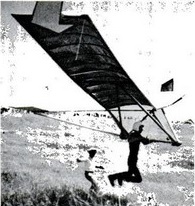
Doug Carmichael’s 1974 Home Grown I was designed and built as a student project at Cal State Poly, San Luis Obispo. The airframe is aluminium tubing, control surfaces are wood framed, and covering is aluminized Mylar. The tip-rudders are controlled by a drum on the right-hand hang tube.
Carpenterie M 81 Butterfly
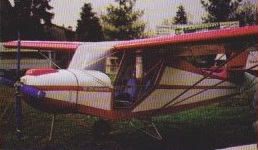
The M 81 uses mixed wood and steel construction, all covered in heat-shrunk Dacron.
Engine: Rotax 912, 80 hp
Wing span: 9.6 m
Wing area: 15.5 sq.m
MAUW: 450 kg
Empty weight: 255 kg
Fuel capacity: 40 lt
Fuel consumption: 15 lt/hr
Max speed: 150 kph
Cruise speed: 120 kph
Minimum speed: 65 kph
Climb rate: 3 m/s
Seats: 2
Price (1998): 30,000 DM
Kit price (1998): 20,000 DM
Carpenterie Air-Brako

The Air-Brako has an option a four cylinder inline Skoda engine.
Empty weight: 80 kg
Wing span: 10 m
Wing area: 10 sq.m
Fuel capacity: 60 lt
Engine: Rotax 503, 40 hp
MAUW: 450 kg
Seats: 2
Max speed: 160 kph
Cruise speed: 120 kph
Minimum speed: 45 kph
Climb rate: 7 m/s
Fuel consumption: 13 lt/hr
Price (1998): 14 000 000 L
Carpenterie
1998:
Via Vittorio Veneto 9
I-31010 Pianzano (VT)
Italy
Trike and LSA builder

