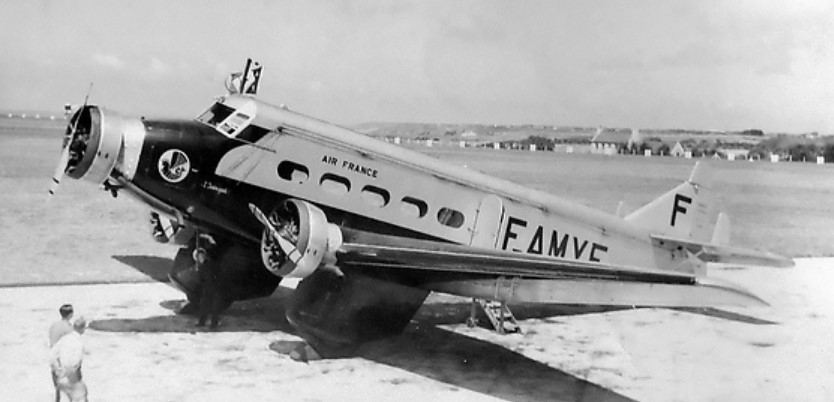
Wibault 280 T / 281 T / 282 T / 283 T

283 T.12

The Wibault 280-T was a French 12-passenger civil airliner produced by Wibault backed by money from the Penhoët shipyards and also known as ‘Penhoët Wibault’.
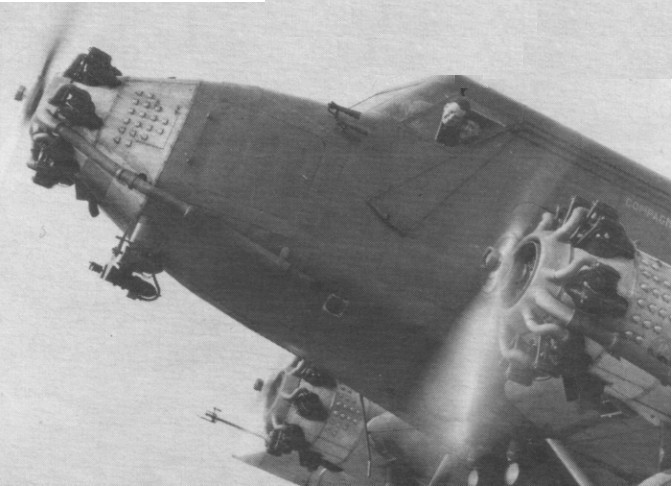
280 T

The prototype Penhoët Wibault 280-T first flew at Villacoublay in November 1930 with the development backed by funds from the Penhoët shipyards of St Nazaire. It was an all-metal low-wing cantilever monoplane powered by three 300 hp (224 kW) Hispano-Wright 9Qa radial engines although these were soon replaced by three Gnome-Rhône 7Kb and the aircraft was redesignated the Wibault 281-T.

A second aircraft was built to the 281 standard but then it was converted to a Wibault 282-T with three 350 hp (261 kW) Gnome-Rhône 7Kd engines and room for 12 passengers, seven further aircraft were built as 282s. Some of the 282s were operated by Air Union on the Paris-London Voile d’Or (“Golden Clipper”) service in 1933.
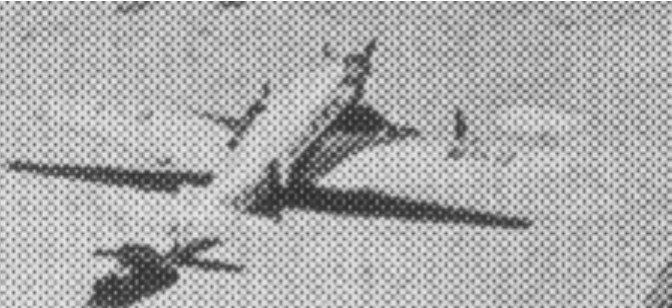
282.T12

Air France replaced its LeO 21 biplanes with a fleet of Wibault 282s, which in turn gave way to Bloch 220s.

In 1934 Air France took delivery of the first of ten Wibault 283-Ts which had an increased fuel capacity and modified tail. Some of the 282s were converted to 283 standard. Some of the commercial aircraft were later taken over as military transports.

Wilbault 283 T Article

Accidents and incidents

On 9 May 1934, Wibault 282-T F-AMHP of Air France crashed into the English Channel off Dungeness, Kent, United Kingdom, killing all six people on board.

On 19 May 1934, a Golden Clipper of Air France crash-landed on a cricket pitch adjacent to Croydon Airport, Surrey, United Kingdom, due to fuel exhaustion. Only one of the ten people on board was injured.

On 24 December 1937, Wibault-Penhoët 283.T12 (c/n 11) F-AMYD of Air France crashed near Zhůří (currently part of Rejštejn), Czechoslovakia, due to a navigational error. The aircraft was supposed to land at Prague, but was directed by controllers to fly south and crashed in foggy, snowy and dark conditions after 120 km (75 mi). Two pilots and a single passenger were killed.

Gallery

Variants

Penhoët Wibault 280-T
Prototype
one built converted to a 281 and then to a 282.
Engines: three 300 hp (220 kW) Hispano-Wright 9Qa

Wibault 281-T
Prototype
One built as such and one converted from 280-T.
Both converted to 282-Ts.
Engines: three 350 hp (260 kW) Gnome-Rhône 7Kd

Wibault 282-T
10-passenger production variant
cowlings around the wing-mounted engines
Six built from new plus two converted prototypes.
Engines: 3 x Gnome-Rhône 7Kd

Wibault 283-T
Production variant for Air France
NACA cowlings, increased fuel capacity, higher weights and a modified tail
ten built.
Engines: three Gnome-Rhône 7Kd

283-T-12
Powerplant: 3 × Gnome-Rhône Titan Major 7Kd, 260 kW (350 hp) each
Wingspan: 22.61 m (74 ft 2 in)
Wing area: 64.4 m2 (693 sq ft)
Length: 17.0 m (55 ft 9 in)
Height: 5.75 m (18 ft 10 in)
Empty weight: 4,266 kg (9,405 lb)
Gross weight: 6,350 kg (13,999 lb)
Maximum speed: 251 km/h (156 mph, 136 kn)
Cruise speed: 230 km/h (140 mph, 120 kn)
Range: 1,000 km (620 mi, 540 nmi)
Service ceiling: 5,200 m (17,100 ft)
Crew: 2
Capacity: 10 passengers

Wibault 282 T12

Wibault, Michel

Established in Paris. Wibauit’s first aircraft, a single-seat fighter, appeared too late to see service in First World War. Subsequently designed night bombers and fighters for the Armee de I’Air, as well as civil aircraft. Produced an allmetal aircraft in 1921 and changed from biplane to monoplane configuration 1923. In 1924 flew the prototype of a monoplane fighter, the Wibault 7, produced from 1925 and built under license by PZL and Vickers.

Wicko / Wickner Aircraft

Wickner Aircraft of Australia, formed by Geoffrey Wickner in 1929 to build the high-wing Wizard monoplane and light single-seat Lion monoplane. Rebuilt several Avro Avians before helping to form Foster Wickner.
Cheap and efficient aircraft were the hallmark of Geoffrey N. Wikner, who achieved a measure of success in his own country with his Wicko and Wicko Lion sports monoplanes, before setting up in Britain.

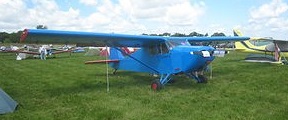
Wickham Model E Sunbird II

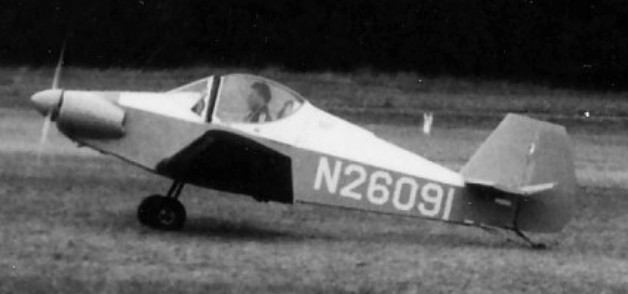
The Wickham Model E Sunbird II is a single seat homebuilt aircraft designed by engineer James M. Wickham.

The Sunbird II is a single place low wing aircraft made primarily of wood. It differs from the Model C by employing tricycle landing gear, a larger wing, and power from a larger 1835cc VW engine.

The Wickham E was the fifth of six designs by Wickham, which first flew on August 8, 1979 at Arlington, WA. The aircraft was lost following a spin test where the aircraft did not recover on July 20, 1980.

Only the one was ever built.

Engine: VW, 1835cc
Propeller: 2-bladed 54/40
Wingspan: 26 ft 8 in / 8.13 m
Wing area: 82 sq ft / 7.6 m2
Aspect ratio: 8.7
Length: 18 ft / 5.5 m
Height: 7 ft / 2.1 m
Maximum speed: 104 kn / 193 km/h / 120 mph
Seats: 1

Wickham A Bluebird

The A Bluebird built in 1955 by Boeing engineer James Wickham, N4944V, was all-metal construction. A high-wing, cabin, monoplane, first flying with a 115hp Lycoming, it was later repowered with a 135hp Lycoming.

Engine: 115hp Lycoming
Wingspan: 33’0″
Length: 21’0″
Useful load: 750 lb
Max speed: 120 mph
Cruise speed: 100 mph
Stall: 45 mph
Range: 300 mi
Seats: 4

Wickham Model B

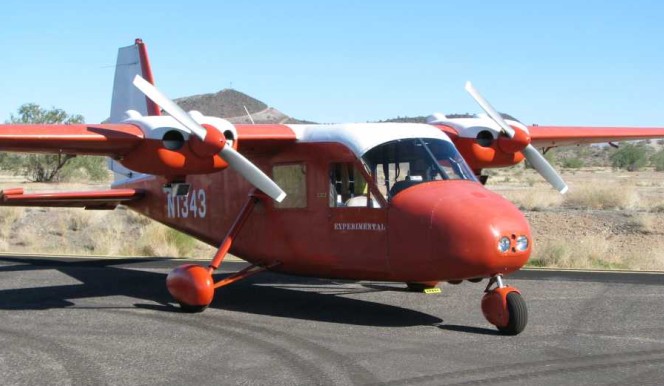
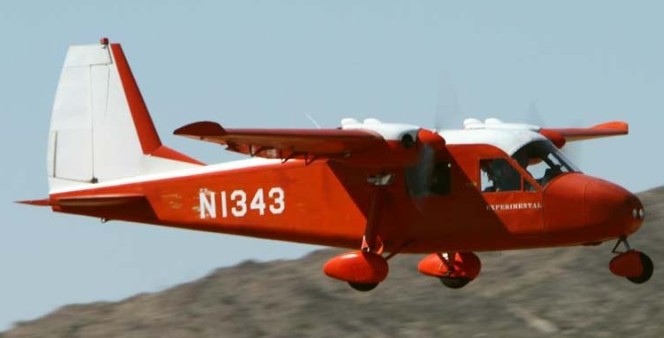
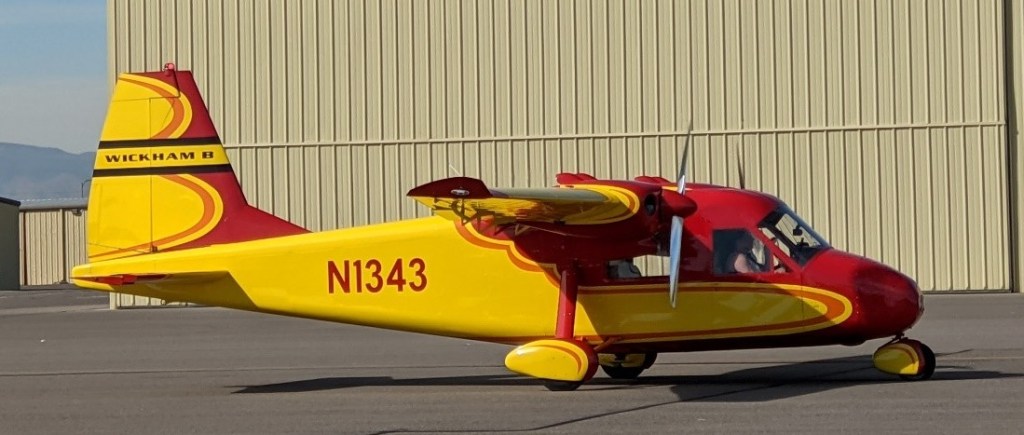
The Wickham B twin engine homebuilt aircraft was designed by Boeing engineer Jim Wickham in order to fly safely on one engine over the Seattle area, and completed in 1968.

The model B is a high-wing, fixed tricycle landing gear, all metal, twin engine aircraft. The aircraft uses all aluminum construction with fiberglass cowlings, nose cone and wheel pants. The wings are configured with Fowler flaps. The two 25 U.S. gallons (95 L; 21 imp gal) fuel tanks are independent of each other. There is no cross-feed. The aircraft uses a throw-over yoke control, similar to a Beechcraft Bonanza.

The aircraft cost US$7,000 in 1968. Help by Wickham able to purchase scrap aluminium from a Boeing surplus store at 10c in the dollar.

Jim Wickham put more than 600 hours on his craft and the Wickham B was donated to the Seattle Museum of Flight to avoid any product liability issues. The craft was later traded to the South Seattle Community College for an F-4 Phantom.

Eventually Boeing Field hanger area was to be remodeled and the Wickham B had to go. The aircraft was sold to Austin Ballard, dismantles, and moved to Everett, Washington.

In 2002, the aircraft was sold and restored to flying condition. Many parts had been missing but were recovered. The restoration and flight was completed in 2005.

By 2012 it was owned by Curtis Clark of Scottsdale AZ.

Performing a test run-up at its home airport (KDVT) on February 23, 2021. (courtesy Rom Solene)

Gallery

Engines: 2 × Lycoming O-320, 160hp
Prop: McCauley
Wingspan: 39′ 0″
Empty weight: 1,950 lb (885 kg)
Gross weight: 3,200 lb (1,451 kg)
Fuel capacity: 50 U.S. gallons (190 L; 42 imp gal)
Max speed: 150 mph
Cruise speed: 104 kn / 193 km/h / 120 mph
Stall: 60 mph
Singe engine cruise: 80 mph
Seats: 5
Registration: N1343