WNF Wn 16 / Meindl-van Nes A.XV / Meindl M.15

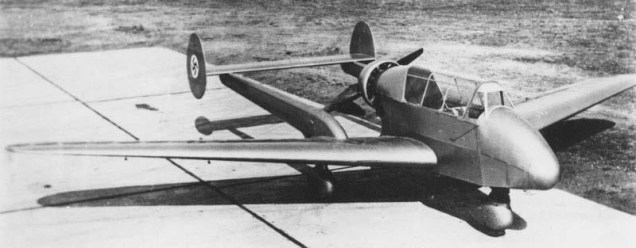
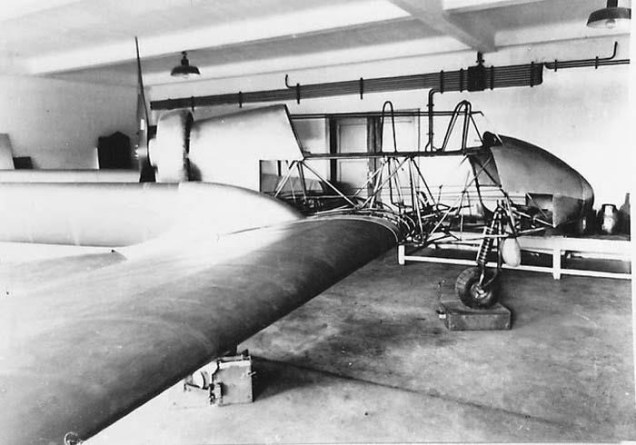
The WNF Wn 16, designed by Erich Meindl in 1937-1938, originally built as the Meindl-van Nes A.XV (aka Meindl M.15), was an Austrian experimental aircraft built in the late 1930s for tricycle undercarriage research. It was a swept wing tandem two-seater, with a pusher configuration engine and twin-boom fuselage. Its cantilever low wing had straight edges and 18.33° of sweep at quarter chord. The wing was in three parts, with a twin spar, steel tube framed centre section welded to the central fuselage which supported the tailbooms on its upper surfaces at their outer ends. The ribs were also formed from steel tube. The forward part of the centre section was plywood covered, with fabric aft. The outer wing panels were ply covered, each with a single wooden single spar. There was a split flap over the whole centre section trailing edge and slotted ailerons which filled the trailing edges of the outer panels.
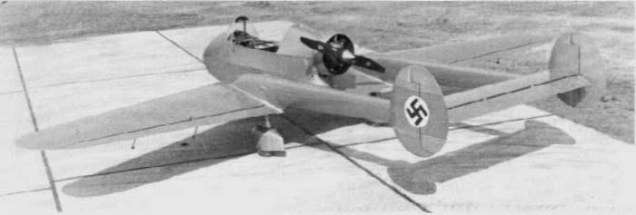
The short fuselage was also a welded steel tube structure, alloy skinned front and rear but with a fabric covered central section that contained the tandem seats under a continuous, multi-framed canopy which merged into the rear fuselage. The Wn 16’s pusher configuration, 37 kW (50 hp) Salmson 9Ad nine cylinder radial engine was installed within a Townend ring cowling at the rear of the fuselage beyond the wing, driving a two blade propeller. The Wn 16 was later re-engined with a 45 kW (60 hp) Walter Mikron.
The Wn 16’s tail-booms were wooden monocoques. The rectangular tail-plane and elevator was on top of them, with oval vertical tails acting as end-plates; the fins had ply covered wooden frames and the rudders had fabric covered steel frames.

Its tricycle gear was fixed, all units with bungee cord shock absorbers. Both legs and wheels were enclosed in streamlined fairings. The nosewheel was steerable via the rudder pedals.
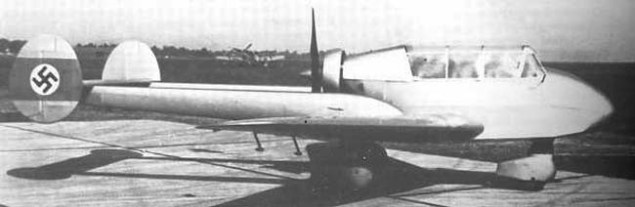
After the Anschluss of Austria, it was further developed by Wiener Neustadt Flugzeugwerke (WNF). The Wn 16 flew for the first time on 23 September 1939, carrying on board the German registration code D-ECAB. Development continued into World War II and the first flight with the Walter engine was on 7 August 1942.

The aircraft was tested in Germany, where it was later re-equipped with the Walter Micron engine (60 hp). The WN-16 successfully flew until the autumn of 1942, and then it was transferred to the Technical School in Stuttgart for further tests. There it remained until September 1944, until it was destroyed during an air-raid.

Engine: 1 × Salmson 9Ad, 37 kW (50 hp)
Propeller: 2-bladed
Length: 7.27 m (23 ft 10 in)
Wingspan: 9.84 m (32 ft 3 in)
Height: 1.80 m (5 ft 11 in)
Wing area: 13.50 m2 (145.3 sq ft)
Empty weight: 350 kg (772 lb)
Gross weight: 550 kg (1,213 lb)
Fuel capacity: 38 l (8.4 imp gal; 10 US gal)
Maximum speed: 160 km/h (99 mph; 86 kn) at sea level
Cruise speed: 145 km/h (90 mph; 78 kn)
Range: 400 km (249 mi; 216 nmi)
Service ceiling: 2,800 m (9,200 ft)
Rate of climb: 2.2 m/s (430 ft/min)
Landing speed: 65 km/h (40 mph)
Crew: Two
Wiener-Neustadter / WNF

Wiener-Neustadter Flughafen Betriebs GmbH
Wiener-Neustadter Flugzeugwerk GmbH

Germany
Originally Wiener-Neustadter Flughafen Betriebs GmbH, after the Anschluss of 1938 was amalgamated with Hirtenberg, whose manufacturing department it absorbed under the name Wiener-Neustadter Flugzeugwerk GmbH. Light two-seat biplane in production 1937, later undertook subcontracts on Bf 109. In 1943-1944 built the world’s first tip-jet helicopter, designed by team under Friedrich von Doblhoff. Four built and tested. Conventional piston-engine provided compressed air which, mixed with fuel, was fed to tip-mounted combustion chambers through rotor blades. System adopted by other designers.

Wiencziers Renneindecker

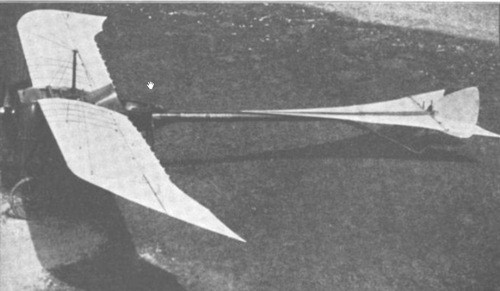
Built in Germany, the 1911 Eugen Wiencziers Renneindecker a very advanced monoplane with a very sleek fuselage which consisted of a metal tube only. The two wheel undercarriage could be folded back to the fuselage. The machine was intended as a two-seater, where the pilot sat enclosed and the passenger sat in a saddle just at his back on the steel fuselage, just like horse riding.

Widerues C.5 Polar / Honningstad Polar C5

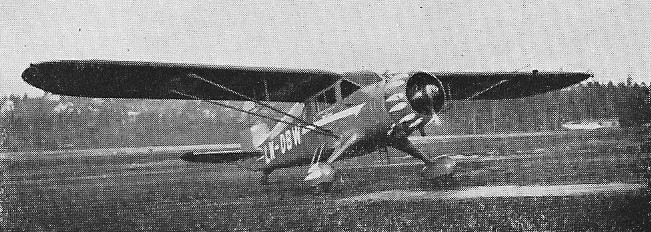
The Polar light utility monoplane built by Wideröe’s Flyveselskap og Polarfly A.S. in 1948, was designed by Birger Hönningstad to a specification prepared by the company. This called for an aircraft suitable for carrying a pilot and five passengers or cargo, capable of operating from wheels, floats or skis. Only one example of the Polar was built.

The Polar is of mixed construction, the plywood and fabric covered wing having two spruce spars and spruce ribs, and the fuselage has a welded steel-tube framework with a spruce and duralumin superstructure covered by light alloy panels forward and fabric aft.

Only one C.5 Polar was built, which was employed by the Wideröe company.

Engine: 1 x Wright R-769-E2, 350 hp
Span: 45 ft 0 in
Length: 29 ft 6 in
Height: 8 ft 4 in
Wing area: 269.09 sq.ft
Empty weight: 2550 lb
Loaded weight: 4130 lb
Max speed: 150 mph
Cruise speed: 130 mph
ROC: 800 fpm
Range: 625 miles

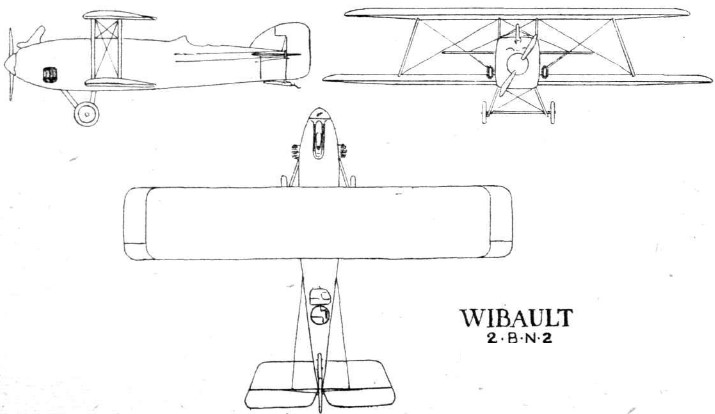
Wibault 2BN2

As the military description BN.2 indicates, the Wib 2 was designed as a two-seat night bomber, but the designer, Michel Wibault, had hopes of a passenger carrying derivative. As it was structurally an all-metal aircraft it had, by the standards of the times, a low structural weight and, as a consequence, a high useful load of 1,406 kg (3,100 lb) making the suggested capacity of thirteen passengers plausible. In addition to its metal construction, contemporaries noted other unusual design features, in particular the position of the wings well back along the fuselage, Flight speculated the idea being to distribute the passenger (or bomb) load symmetrically about the centre of pressure and over a greater longitudinal distance than usual, rather than along the span. The pilot sat quite close to the tail with the gunner (in the bomber version) in a separate, gun mounting equipped cockpit immediately behind him. Its span was large for a biplane with only a single set of struts and its upper wing had a shorter span than the lower.

The wings of the Wib 2 were rectangular in plan and mounted without stagger or dihedral. The single bays were defined by parallel pairs of inward leaning interplane struts, assisted by crossed flying and landing wires from the bases of the struts to the fuselage. Cabane struts supported the upper wing above the fuselage. The wings had thick, high lift coefficient sections, constructed around deep single spars built up from Duralumin sheet; the ribs were formed from cross-braced metal tubes. Ailerons were mounted only on the lower wing.

The fuselage was metal framed and fabric covered, with a straight edged, wire braced tailplane carrying divided elevators mounted on top. Its vertical tail was low and broad, with a curved leading edge; the rudder was deep and aerodynamically balanced. The Wib 2 was powered by a 600 hp (447 kW) water-cooled V-12 Renault 12 M engine completely enclosed within a smooth cowling and drove a two-blade propeller. Small radiators projected out on either side of the cowling. The undercarriage was of the fixed conventional type, with the mainwheels on a rigid axle supported by V-struts and assisted by a tailskid.

September 1922

Built by Lavasseur, the Wib 2 flew for the first time on 29 October 1921 but only one, in bomber configuration, was built.

Powerplant: 1 × Renault 12 Ma, 450 kW (600 hp)
Propeller: 2-bladed fixed pitch
Wingspan: 16.92 m (55 ft 6 in)
Wing area: 96.2 m2 (1,035 sq ft)
Length: 12.75 m (41 ft 10 in)
Height: 5.00 m (16 ft 5 in)
Empty weight: 2,096 kg (4,620 lb)
Gross weight: 4,286 kg (9,450 lb)
Maximum speed: 201 km/h (125 mph, 109 kn) at 1,980 m (6,500 ft)
Range: 600 km (370 mi, 320 nmi)
Endurance: 4 hr at full throttle
Service ceiling: 4,000 m (13,000 ft)
Wing loading: 44.6 kg/m2 (9.13 lb/sq ft)
Power/mass: 0.048 kW/m² (0.063 hp/lb)
Crew: Two