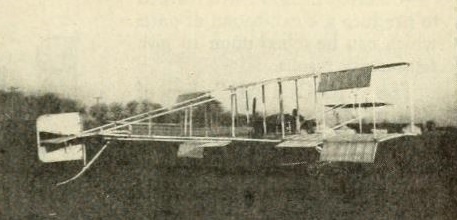
In 1910 Philip W. Wilcox built his first aeroplane as the required thesis in the Civil Engineering Department, in the University carpenter shop and christened it, “The Columbia.” At the end of the spring term, the machine was taken out to Garden City, L. 1., and assembled at the Triaca School of Aviation. This work required about a month for completion. After the aeroplane had been put together, an engine from the Eastern Cordage Cos., weighing 275 pounds and developing fifty horsepower, was installed. The engine was constructed of cast iron cylinders pressed in macadamite.
The finishing touches on the aeroplane were completed about the fifteenth of June and the machine was taken out for a trial. But the engine refused to work on account of water leaking into the cylinders. Two new cylinders were then obtained from the Eastern Cordage Cos., and preparations made for another trial. Louis Strang, the famous automobile driver, who has become an enthusiastic aviator, was engaged to make the flight. The performance, however, was a failure, due to lack of speed, caused by trouble with the radiator. In running around the field, one of the wheels ran into a stump and the aeroplane was damaged to the extent of $400, Strang escaped from injury, only by a miracle.
It required three or four weeks to make the necessary repairs and get the machine ready for another flight. The next attempt was made by C. K. Hamilton. Owing to a defect in the running gear the machine collapsed after running about 200 feet, causing another smash-up. Hamilton, however, escaped any serious injury. After this unsuccessful flight, the design of the running gear was changed from the Farman style to the Curtis type.
After making this change Wilcox decided to try out the machine himself. The aeroplane went up like a bird to a height of one hundred or more feet and flew about three-fourths of a mile, circled, returned to the field and made a beautiful landing near the starting point Wilcox was so overcome with this successful flight and excitement, that he had to be dragged from the machine by Captain Baldwin, Clifford B. Harmon, Mr, Fairchilds and a number of other noted aviators who had witnessed the flight.
On the morning of June 26, Wilcox made another flight, but after he had reached a height of fifty feet, the propeller was caught by a wire and broken. The machine descended without damage. The necessary repairs were made, and another attempt was made on the afternoon of the same day. Due to lack of experience in guiding the aeroplane, the machine was overturned by the wind, fell to the ground and was broken to splinters, Wilcox escaped injury only by some mysterious chance.

 All Aero