In order to test aerodynamics and the principles of the Hamilcar a half-scale test model was built.
The first flight was in 1941 at Snaith, Yorkshire.
Wingspan: 16.67 m / 55 ft 0 in
Length: 10.36 m 34 ft 0 in
In order to test aerodynamics and the principles of the Hamilcar a half-scale test model was built.
The first flight was in 1941 at Snaith, Yorkshire.
Wingspan: 16.67 m / 55 ft 0 in
Length: 10.36 m 34 ft 0 in
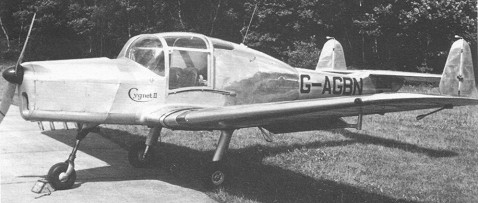
CW Aircraft was established in 1936 by C R. Chronander and J. I. Waddington to design and develop Cygnet two-seat all-metal cabin monoplane, which first flew in 1937. Rights in Cygnet acquired by General Aircraft Ltd. in 1938.
General Aircraft GAL-42 Cygnet Article
This 1936 side by side two seat training and club aircraft was an attempt at a more robust and easily made machine than those of longeron, plywood and fabric construction. It was the first British light aeroplane to have both metal skinned wings and fuselage. The first version had a single fin and rudder and a tailwheel landing gear. The later Cygnets had twin fins and a tricycle landing gear making it easier to fly.
There was also an experimental open-cockpit version, the Owlet.
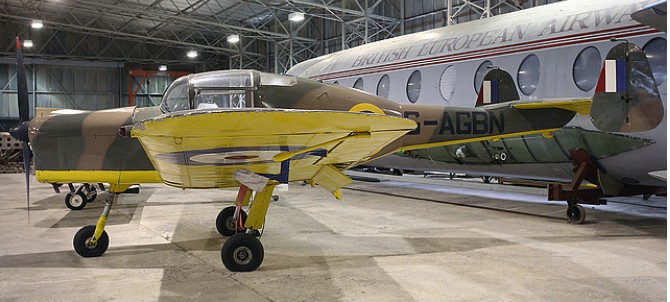
Cygnet
Engine: One 150 h.p. Blackburn Major II.
Length: 23.25 ft. (7.08 m.).
Wing span: 34.5 ft. (10.5 m).
Weight empty: 1,475 lb. (670 kg.).
Seats: 2.
Max cruise: 115 m.p.h. (185 km.p.h.).
Ceiling: 14,000 ft. (4,300 m.) fully loaded.
Range: 445 miles (720 km.).

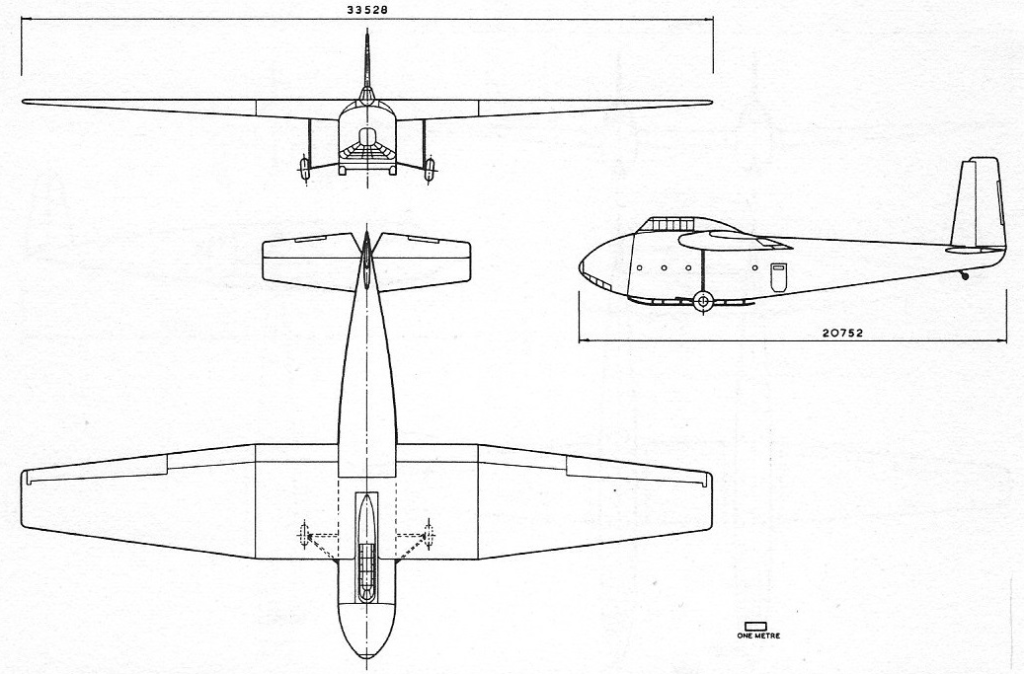
The General Aircraft GAL 49 Hamilcar 1 was a large transport glider of wooden construction, designed to A.M. Spec. X.27/40 to carry a crew of two and either 60 troops or a flight 7-ton tank.
A hinged nose section was fitted for loading. The undercarriage was jettisonable mainwheels and two steel sprung main skids. Trailing edge flaps were fitted.
They were built by General Aircraft Ltd and various sub-contractors. The first flight of the prototype was on 27 Mach 1942.
Variation
General Aircraft GAL.58 Hamilcar
Wing span: 110.007 ft / 33.53 m
Wing area: 1657.441 sq.ft / 153.980 sq.m
Length: 68.012 ft / 20.73 m
Height: 20.243 ft / 6.17 m
Max take off weight: 36005.4 lb / 16329.0 kg
Weight empty: 18402.9 lb / 8346.0 kg
Aspect ratio: 7.3
Wing section: RAF 34 modified
Max. speed: 130 kts / 241 kph
Max tow speed: 241 kph / 150 mph
Stall: 104 kph / 65 mph
Landing speed: 57 kts / 105 kph
Wing load: 21.73 lb/sq.ft / 106.0 kg/sq.m
Crew: 1
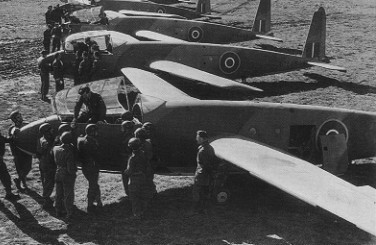
The General Aircraft GAL 48 Hotspur I was an eight-seat troop carrying glider of all wood construction designed to Air Ministry Specification X.10/40 and built by General Aircraft and Slingsby Sailplanes in 1941.
The prototype first flew in 1941.
The General Aircraft Hotspur 8 seat assault training glider was first intended to be released at 20,000ft for long gliding missions, but 16ft was lopped off the span and it was used for training as the Hotspur 2.
The GAL.48 Hotspur 2 were built by Harris Lebus and other sub-contractors, in 1941.
The GAL.48 Hotspur 3 were Hotspur 2 fitted with dual controls.
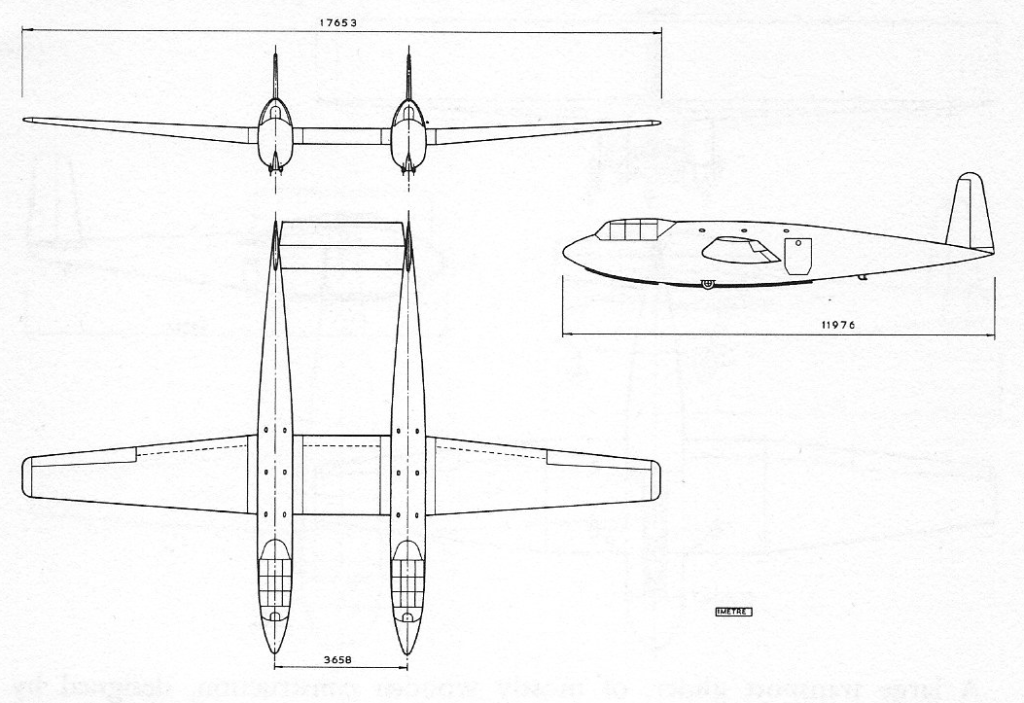
The GAL.48B Twin Hotspur was a sixteen-seat troop transport glider built by General Aircraft Ltd in 1942. It was two Hotspur 2 fuselages joined together with a short centre wing. The first flight of the prototype was in August 1942. It was flown from the port fuselage, there being no controls in the starboard cockpit.
General Aircraft GAL 48 Hotspur
Training glider, United Kingdom, 1940
Length: 39.304 ft / 11.98 m
Height: 10.827 ft / 3.3 m
Wing span: 61.909 ft / 18.87 m
Wing area: 272.006 sq.ft / 25.27 sq.m
Max take off weight: 3598.6 lb / 1632.0 kg
Weight empty: 1660.4 lb / 753.0 kg
Max. speed: 113 kts / 209 kph
Landing speed: 49 kts / 90 kph
Cruising speed: 78 kts / 145 kph
Cruising altitude: 20013 ft / 6100 m
Wing loading: 13.33 lb/sq.ft / 65.0 kg/sq.m
Range: 72 nm / 134 km
Crew: 8
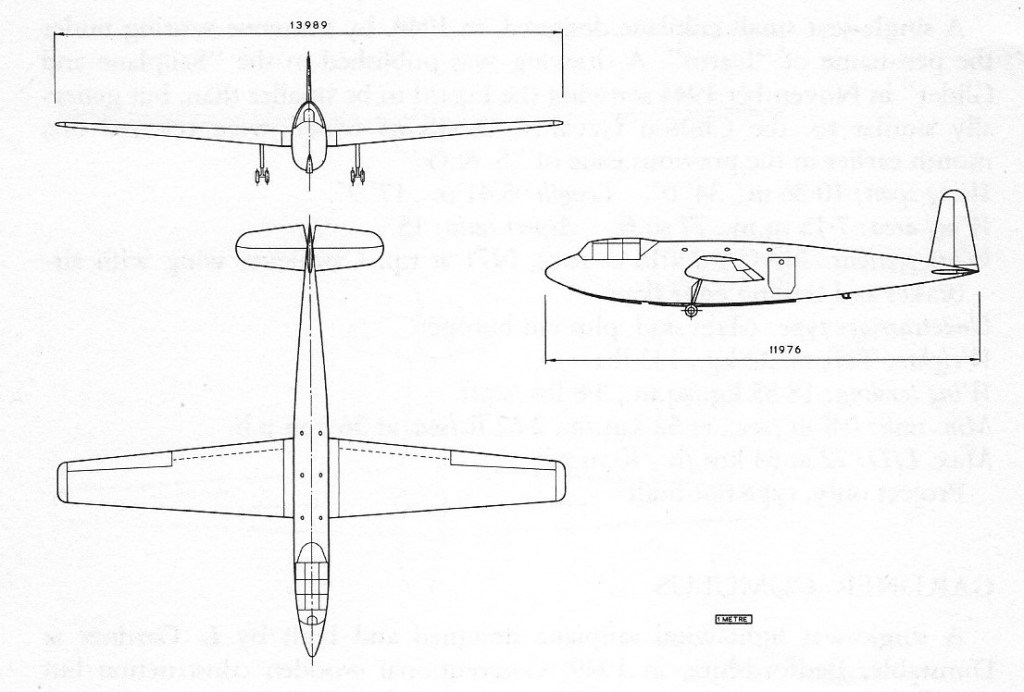
GAL 48 Hotspur 2
Wing span: 13.99 m / 45 ft 10.75 in
Length: 11.98 m / 39 ft 3.5 in
Wing area: 25.04 sq.m / 272 sq.ft
Aspect ratio: 7.7
Empty weight: 753.4 kg / 1661 lb
AUW: 1632 kg / 3598 lb
Wing loading: 71.77 kg/sq.m / 14.7 lb/sq.ft
Max speed: 273 kph / 170 mph
Normal glide: 129 kph / 80 mph
GAL.48B Twin Hotspur
Wingspan: 17.65 m / 57 ft 11 in
Length: 11.98 m / 39 ft 3.5 in
Wing area: 33.9 sq.m / 365 sq.ft
Aspect ratio: 9.25
Empty weight: 1456 kg / 3210 lb
AUW: 2925.7 kg / 6450 lb
Max speed: 249 kph / 155 mph
Stall: 105 kph / 65 mph
GAL 41 Monospar of 1939 was first British aircraft with pressurized cabin.
In 1937 the British Admiralty issued a requirement for a novel type of aircraft to shadow enemy fleets, especially by night. The Air Ministry issued Specification S.22/37 calling for an aircraft compatible with aircraft carriers which would provide comfortable accommodation for a pilot, observer and radio operator, outstanding all round view and the ability to cruise at 40 knots for 11 hours. Two prototypes were built, the Airspeed A.S.39 (serial N1323) and the General Aircraft G.A.L.38 (P1758). These flew after the out break of the Second World War. Both were high wing aircraft with extensive slats, flaps and drooping ailerons all in the slipstream of four 130 hp Pobjoy Niagara V radials driving fixed pitch propellers. The G.A. aircraft was all wood, but the Airspeed Fleet Shadower, had a metal fuselage; the former had a nose¬ wheel and tall single fin, while the Airspeed had a tail wheel and three small fins. Each seated the observer in a panoramic nose, the pilot high and behind and the radio operator further aft. Both aircraft met the requirement but the Admiralty changed their minds about the desirability of such an air¬ craft and scrapped this programme in 1940.
Span: 17.02m (55ft 10in)
Length: 11 m (36 ft 1 in)
Gross weight: 3897 kg (8590 lb)
Maximum speed: 185 km/h (115 mph).
General Aircraft Ltd, Feltharn, UK.
Established 1931 at Croydon Airport. Chief designer was Swiss H. J. Stieger. Acquired world rights from Monospar Company for its system of construction for aircraft up to 1,360kg laden weight. First type was ST-3 three-seat enclosed cabin monoplane with two 45 hp Salmson radial engines. Later built series of light twins; GAL 41 Monospar of 1939 was first British aircraft with pressurized cabin. Single-engined pre-Second World War Cygnet monoplane was first light all-metal stressed-skin civil aircraft in U.K.; also an experimental open-cockpit version, the Owlet. Took over premises of British Aircraft Manufacturing Company in 1938. Built Hotspur training gliders and later Hamilcar assault gliders during Second World War. Postwar work included conversion of Mosquitoes as target tugs and design of GAL- 60 Universal Freighter, built as the Beverley after General Aircraft merged with Blackburn in January 1949.
The Monospar company was established in 1926 and was later absorbed by the General Aircraft Company.
General Aircraft Ltd
During 1948, discussions between General Aircraft Ltd and the Humberside firm of Blackburns led to a merger of the two companies under the joint name of Blackburn & General Aircraft Ltd. The new company was formed on 1 January 1949 and it was proposed that all work in progress at the various factories be completed as originally planned.
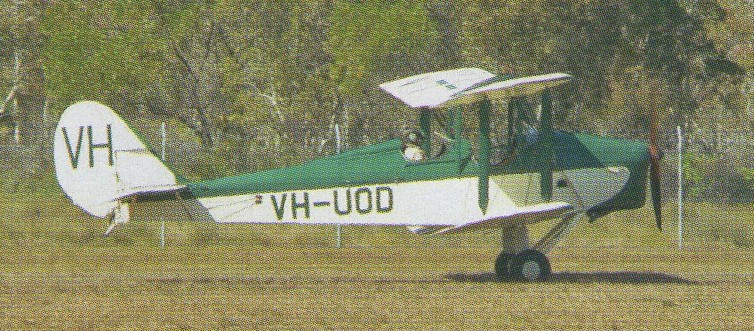
The first Genairco flew on December 20, 1929, and bore a marked similarity to the D.H.60, although it had a two-place front cockpit. The seventh and eighth aircraft produced were modified into cabin biplanes, resembling the D. H, 83 Fox Moth. The Depression and availability of D.H. types put General Aircraft out of business by early 1933.
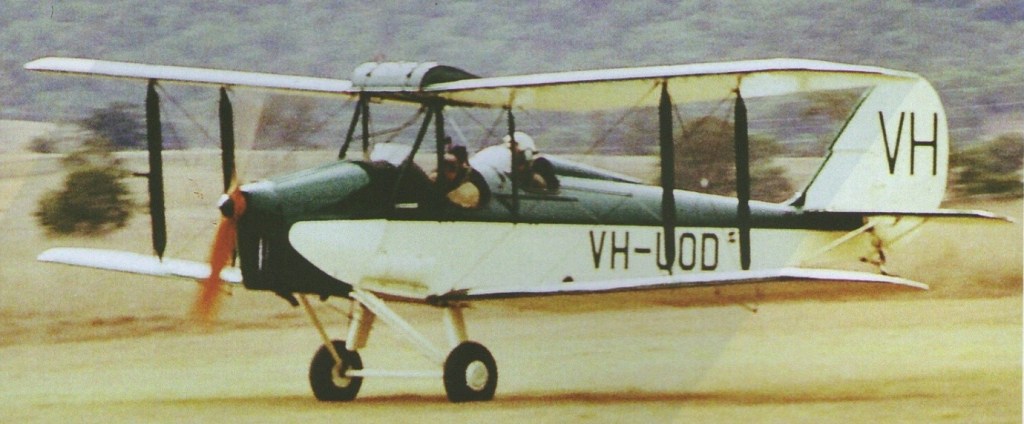
General Aircraft built about 12 Genaircos from late 1929 in ‘cabin’ and ‘open’ forms. A three-seater, two passengers are side-by-side in the front and pilot behind.
General Aircraft Company Ltd. formed in 1929 at Sydney/Mascot Aerodrome. Built large factory, initially carried out overhauls, but by 1930 had designed a three-seat biplane, the Genairco, powered by Cirrus Hermes engine. Subsequently produced a four-seat version. Company thought to be inactive by about 1934.
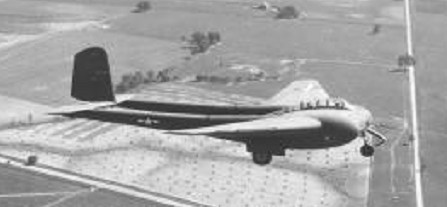
William Hawley Bowlus, a sailplane and glider manufacturer, designed a flying wing glider, the MC-1 in February 1942. Its design was a departure from single fuselage designs and incorporated a twin boom design. The MC-1 was an all-wood twin boom military transport glider of 91ft 10in span, featuring an aerofoil-sectioned lifting fuselage between the booms in which either cargo or troops could be carried in two 16ft x 7ft compartments. The load could be four tons of cargo or 48 armed troops. The front of the wing opened upwards and downwards like a pair of jaws, the bottom doors doubling as a loading ramp. A mock-up of the troop accommodation shows that the compartment tapered towards the trailing edge, allowing little headroom for those unfortunates at the back. The crew of two sat in tandem beneath a continuous canopy atop the centre section.
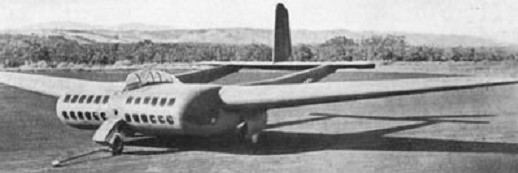
A single fin and rudder was mounted on the tailplane between the booms. The tricycle landing gear was retractable, and flaps were fitted to the outer wing panels and the fuselage centre section. The MC-1 was constructed mainly of plywood, although all flying surfaces and flaps were fabric-covered.
Early test flights of a full scale model proved disastrous when unsecured weighted bags shifted causing it to become unbalanced and killing the pilot and several passengers.
Hawley’s General Airbourne Transport Company received a contract in November 1943 to build the glider. The first glider was delivered six months late at three times the cost in the summer of 1943.
The MC-1 was test flown by the company and Richard duPont was the instigator of a demonstration for the military on September 11, 1943 from March Field.
The pilot of the glider was Col P. E. Gable, deputy director of the Army Air Corps assault glider program. The copilot was Howard Morrison, a long time associate of Bowlus and a test pilot.
Several VIPs set off on the flight. They included Richard Dupont, special assistant to Gen Arnold; Col Ernest Gabel, another glider specialist on the staff of the Chief of Staff of the Air Force, and C. C. Chandler, thrice soaring champion. In order to bring the glider up to more-or-less full load, bags of sand and lead shot were loaded aboard but apparently were in securely lashed some reports say they were not lashed to the glider at all. The glider was towed off from March Field by a Lockheed C-60. During turbulence the bags shifted aft and set up a porpoising moment. The tow release did not release at first pull but released on the third porpoise of the MC-1. It released from the glider. The glider entered a flat spin from which it failed to recover. Three managed to take to their parachutes but the other occupants, including Dupont, perished. Only one survived the jump.
One report says that Gable had less than 6 hours total time on gliders and allowed the XCG-16 to fly into the wake of the C-60, causing the glidcr to pitch violently and breaking the cable. The ballast shifted aft, and the glider entered the flat spin.
Despite this tragic occurrence the company persevered with a further XCG-16, albeit six months late and costing three times the estimate. It was tested at Clinton Army Air Field and at Orlando, Florida. This is probably the aircraft tested by GAT test pilot Paul E. Tuntland and Northrop test pilot J. Meyers together with army officers from the glider branch at Dayton Ohio. Total flying time for the tests was 34 hours, including 50 landings made under Service operating conditions.
Once the factory flight tests on the XCG-16 were completed, glider pilots at CCAAF flew the XCG-16 on over 70 flights in October of 1944 before the glider was rejected.
In his pilot’s test report summary, Tuntland had this to say about the handling of the XCG-16: “In my opinion the XCG-16 has excellent handling qualities. During the flight tests I had the impression of flying a large sail plane. It is laterally stable in that it has a tendency to over-bank in steep spirals. I always had good lateral control at the slower airspeeds and higher angles of attack. Longitudinal control was normal with high elevator forces noted at increased airspeeds. “Directional control was good throughout the normal speed range. There was sufficient vertical area in the tail group to maintain good directional control throughout the approach and landing roll, even in moderate crosswinds. There was no tendency to yaw before or during the landing roll except in a crosswind, where normal correction was satisfactory. The subject aircraft is very maneuverable, being capable of rolling from one vertical turn to another in a minimum of time. On one occasion I was able to soar the aircraft in moderate lift conditions. Stalling characteristics are excellent. The first stall warning is indicated about 15 m.p.h. above actual stalling speed. This aircraft made normal landings at between 40 and 75 m.p.h. with the average about 48 m.p.h. A minimum of longitudinal trimming control was necessary in a c.g. shift from 24 per cent MAC to 36 per cent MAC. Normal landings were made with the flaps retracted at approximately 70 m.p.h.
“The copilot’s lateral vision is rather poor from the rear cockpit. The pilot’s front cockpit vision is excellent forward, and good towards the sides.
“The ground cushioning effect is very noticeable and is a desirable feature of the type, assisting soft ground contact from a rough approach.
“Any glider of either tricycle or conventional landing gear that has sufficient vertical tail surfaces for directional stability will tend to turn into the wind during crosswind landings at high or low angles of attack. In this respect the XCG-16 glider has absolutely no objectionable qualities compared to any other aircraft with which I have had experience. The tendency to turn could be readily corrected by the action of the rudder and of the brakes at slow speeds.”
The report is dated October 31, 1944. Despite the favorable flying qualities of the XCG-16 there were a number of operational snags; rather too many, as it turned out. These included: inadequate protection in the event of a crash; insufficient exits for crew in the event of an emergency; unsatisfactory loading ramps; poor location of flight equipment, and critical lateral loading. After tests by the AAF Board at Clinton Army Air Field and at Orlando, the contract for the XCG-16 was cancelled on November 30, 1944.
Span: 91 ft 10 in.
Length: 48 ft 4 in
Height: 18 ft 4 in.
Aspect ratio:7.4:1
All up weight: 19,580 lb.
Empty weight: 9,500 lb
Cargo: 10,080 lb.
Max speed: 220 mph
Stall speed flaps down: 58 mph
Stall speed flaps up: 62 mph

