General Airmotors Moore Three Valve

The General Airmotors Moore Three Valve features a compression control mechanism for easy altitude adjustment. There are 3 valves per cylinder – 2 intake and 1 exhaust. A Poultice head is secured to the cylinder barrel by a patented conforming clamp. The Moore Three Valve has low head temperature maximum 350 degrees F, and oil temperature of 120 degrees F.

Valve rocker arm assembly is a unit of three parts and three sets of ball bearings. Valves seat in steel cylinders. The crankcase assembly is two major ohnalite castings. Here is a two piece crankshaft, counterbalanced, with a solid master rod. Full floating main bearings on crank pin. Cylinders are carbon steel cup shaped blanks, forged and bored.

Accessories available were Heywood starter, propeller hub, nose cowling and exhaust manifold.

Type: 5 cylinder fixed radial, air cooled
Commercial Rating: 150 hp at 1850 rpm
Displacement: 540 cu.in
Compression ratio: 5.4-1
Bore: 5 in
Stroke: 5 1/2 in
Length: 41 1/2 in
Diameter: 44 5/8 in
Weight: 365 lb
Fuel consumption: not more than .53 lb/hp/hr
Oil consumption: not more than .015 lb/hp/hr
Lubrication: Force feed
Ignition: 2 Scintilla Magnetos PN-5-D
Carburation: 1 Stromberg NA R 5A
Spark plugs: 2 per cylinder

General Aircraft Corp / GAC G1-80 Skyfarer

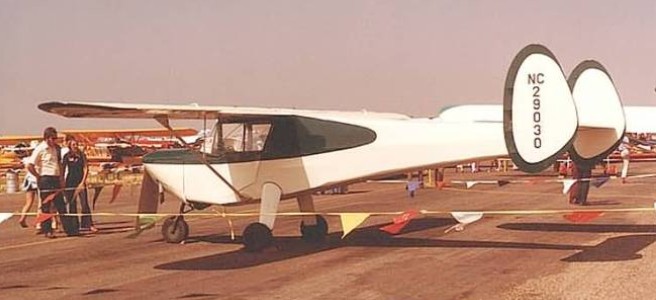
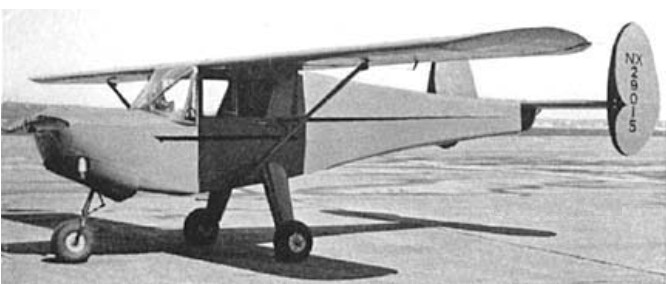
The General Aircraft Corporation was established to build an aircraft designed by Doctor Otto C. Koppen from the Massachusetts Institute of Technology. The aircraft was the G1-80 Skyfarer, a two-seat cabin high-wing braced monoplane with a light alloy basic structure and a mixed steel tube and fabric covering. It had an unusual tail unit, a cantilever tailplane with the elevator mounted on the upper surface of the tail with aluminum endplate fins and no movable rudders. It was powered by a 75 hp (56 kW) Avco Lycoming GO-145-C2 geared air-cooled four-cylinder engine.

The aircraft incorporated aerodynamic control principles covered by patents issued to Fred Weick, an early aeronautical engineer who went on to design and market the Ercoupe. Since it had no rudders (or rudder pedals), it was simpler to fly (it had a single control wheel, which controlled the ailerons and elevator), and was considered spin-proof. The aircraft was certified in 1941 with a placard that stated the aircraft was characteristically incapable of spinning. The company also made a comment to Popular Science in a September 1941 article, with first public photos that an “average” person could learn to fly the Skyfarer …in an hour or so…

It was anticipated that many aircraft would be ordered and built, but the United States became involved in the Second World War and the Skyfarer programme was abandoned after 17 examples had been built. The rights and tooling passed to Grand Rapids Industries in 1943, who built 2 aircraft before stopping production. The company became a manufacturer of the Waco CG-4A troop glider.

L.W. DuVon and Dr. David O. Kime of Western Union College convinced the type holder Grand Rapids Industries, to give the equipment, tools and one of the finished planes to the college in 1944. They then found local investors who formed Mars Corporation in 1945. The aircraft was later licenced as the Mars M1-80 Skycoupe with a 100 hp engine. One example was built and production plans were estimated to be as high as 75 planes in its first year. The glut of aircraft produced after the war left little market for the aircraft. The facility to manufacture the aircraft was sold by 1946.

The aircraft NC29030 resides in the Plymouth County, Iowa Historical Museum.

Gallery

G1-80 Skyfarer
Engine: 1 × Lycoming GO-145-C2, 75 hp (56 kW)
Wingspan: 31 ft 5 in (9.58 m)
Wing area: 121.3 sq.ft (11.27 sq.m)
Length: 22 ft 0 in (6.71 m)
Height: 8 ft 8 in (2.64 m)
Empty weight: 890 lb (404 kg)
Gross weight: 1350 lb (612 kg)
Maximum speed: 144 mph ( km/h)
Cruise speed: 100 mph (161 km/h)
Range: 350 miles (563 km)
Service ceiling: 10,000 ft (3050 m)
Seats: 1 pilot, 1 passenger, side-by-side

General Aircraft Corp / GAC

Long Island, New York, USA
The company was established at Lowell, Massachusetts to build an aircraft designed by Doctor Otto C. Koppen, a professor of aeronautics from the Massachusetts Institute of Technology. The aircraft was the G1-80 Skyfarer, a two-seat cabin high-wing braced monoplane.

Before the company could produce the aircraft in any numbers the Second World War intervened, and the Skyfarer programme was abandoned after 17 examples had been built. Situated on Long Island, New York, the company became a manufacturer of the Waco CG-4A troop glider and the interests in the Wayfarer were sold to Grand Rapids Industries in 1943.

In 1969, the company bought the Helio Aircraft Company which specialised in building STOL aircraft for use by government agencies in south east Asia. The company ceased to manufacture aircraft in October 1976 when it sold the production rights and assets of its Helio Aircraft division.

General Aircraft GAL.61

The fourth glider in the GAL.56 research series was built as the GAL.61. The GAL.61 placed the pilot in a blister on the pot side whilst the observer was in a prone position on the starboard side with a window in the wing leading edge.

The glider was of all wooden construction. No fins or rudders were fitted, directional control being by drag rudders in the wingtips. The wing was symmetrical with cusped trailing edge. Split trailing edge flaps of 20% chord were hydraulically operated.

The undercarriage was hydraulically operated retractable tricycle.

Wingspan: 15.84 m / 51 ft 11.5 in
Overall length: 7.53 m / 24 ft 8.3 in
Aspect ratio: 5.94
Wing area: 41.8 sq.m / 450 sq.ft
Empty weight: 1972 kg / 4348 lb
AUW: 2350 kg / 5174 lb
Mean sweepback: 35 degrees
Max speed: 322 kph / 200 mph
Towing speed: 242 kph / 150 mph

General Aircraft GAL.58 Hamilcar 10

The General Aircraft GAL.58 Hamilcar 10 was a powered version of the Hamilcar 1 to AM Spec X.4/44, for Far-Easton Sector operations. The glider was fitted with two Bristol Mercury engines of 965 hp each, to enable the glider to maintain level flight when lightly loaded.

Wing span: 110.007 ft / 33.53 m
Wing area: 1657.441 sq.ft / 153.980 sq.m
Length: 68.012 ft / 20.73 m
Height: 20.243 ft / 6.17 m
Max take off weight: 45,500 lb / 20,412 kg
Weight empty: 25,510 lb / 11,571 kg
Aspect ratio: 7.3
Wing section: RAF 34 modified
Max speed: 145 mph / 233 kg
Max speed: 112 mph at 32,500 lb
Cruise: 180 kph at 14,742 kg

General Aircraft GAL.56

A series of tailless research gliders built by General Aircraft Ltd, having differing plan forms with various degrees of sweepback. Designed from 1943 to 1947 three were built under the designation of G.A.L. 56 having a common fuselage nacelle built from steel tubing covered with wooden formers and plywood.

The wings were of wooden construction covered with sheets of low-grade wood interspread with processed paper. On flight trials the gliders were towed by a Spitfire Mk.9.

Flight tests commenced in mid-November 1944.

The GAL.56/02 Medium U was as the GAL.56/01 but with small parallel centre section.

The GAL.56/03 Maximum V was as the GAL.56/01 but with 36.40 degrees sweepback.

The fourth glider in the series was built as the GAL.61.

G.A.L. 56/01 Medium V
Wingspan: 13.92 m / 45 ft 4 in
Overall length: 5.69 m / 18 ft 8 in
Wing area: 32.51 sq.m / 350 sq.ft
Aspect ratio: 5.8
Wing section: RAF 34 modified
Sweepback: 28.4 deg at 25% chord
Pneumatically operated trailing edge flaps
Empty weight: 1472 kg / 3244 lb
AUW: 2000 kg / 4400 lb
Wing loading: 61.37 kg/sq.m / 12.57 lb/sq.ft
Max tow speed: 241 kph / 150 mph
Max dive speed: 322 kph / 200 mph
Stall: 93 kph / 58 mph

GAL.56/02 Medium U
Wingspan: 15.5 m / 51 ft 0 in
Length: 6.4 m / 21 ft 0 in
Wing area: 41.80 sq.m / 450 sq.ft
AUW: 2540 kg / 5600 lb

GAL.56/03 Maximum V
Wingspan: 13.82 m / 45 ft 4 in
Overall length: 7.16m / 23 ft 6 in
Sweepback: 36.40 degrees
AUW: 2268 kg / 5000 lb

General Aircraft General Aircraft GAL.55

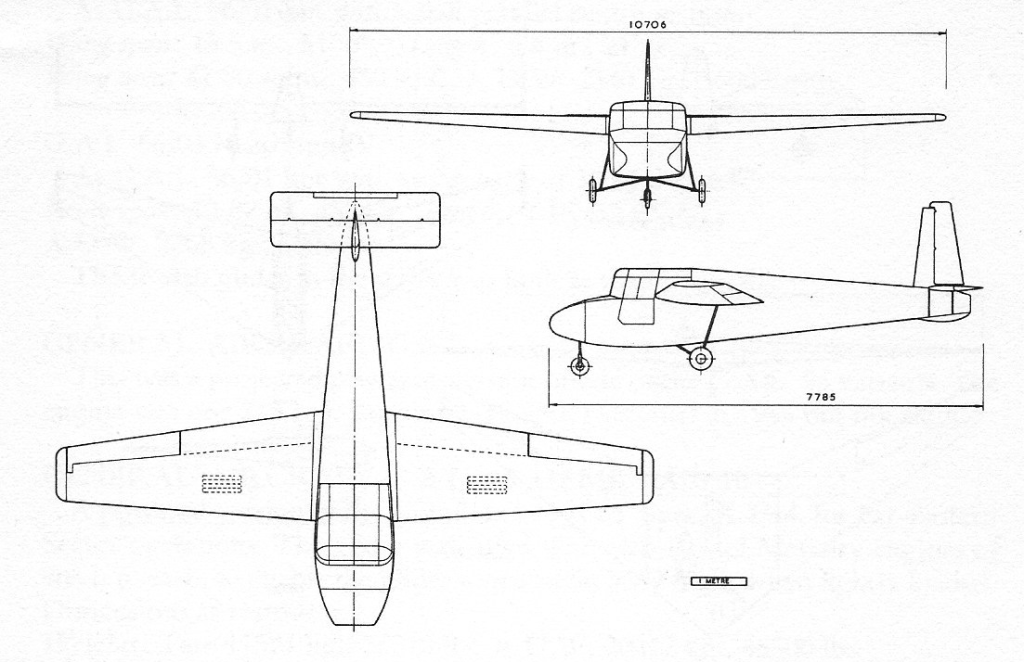
The General Aircraft GAL.55 was a two-seat training glider designed and built by General Aircraft Ltd to AM Spec TX.3/43 to train transport glider pilots.

Wings were built from spruce and plywood, the fuselage being made out of steel tubes faired with wooden formers and fabric covered.

Side-by-side seating with amber panels for daytime night flying.

The undercarriage was tricycle, of fixed centres, plus tail bumper. Dive brakes were fitted, plus bellows-operated split tailing edge flaps.

The first flights wee around the end of 1943, a Westland Lysander being used for towing.

Wingspan: 10.71 m / 35 ft 1.5 in
Length: 7.79 m / 25 ft 6.5 in
Wing area: 16.74 sq.m / 182 sq.ft
Aspect ratio: 6.8
Empty weight: 747.4 kg / 1650 lb
AUW: 1066 kg / 2350 lb
Max speed: 362 kph / 225 mph
Max tow speed: 282 kph / 175 mph
Stall: 100 kph / 62 mph flaps up / 87 kph / 54 mph flaps down