Around 1942 Bowlus began work on a twin boom flying-wing glider for military transport work. In order to test his design he began work on a half-scale proof-of-concept flying model, forming the Airborne Transport Company in Los Angeles, California for the purpose.
Construction of the test model was carried out in his tiny shop, a former dry cleaning shop where there was just sufficient room to build the two-seat open-cockpit prototype. On completion, the glider was flown at Muroc Dry Lake, now the sight of Edwards AFB. The glider flew well and Bowlus and partner Albert Criz set about designing, building and marketing the full-size glider, the XCG-16.
Era
General Airbourne Transport Co / Bowlus XCG-7 / XCG-8
Early in 1942 Bowlus was awarded a contract by the USAAF for two troop gliders – the eight-place XCG-7 and the 15-place XCG-8. The smaller glider was structurally unsound and failed official tests. The larger XCG-8 was really too large for Bowlus to handle and Douglas Aircraft came to the rescue. But this glider, too, failed to come up to scratch structurally; and both projects came to nothing.
General Aeronautique
France
Formed in February 1930 by a number of the most important French aircraft manufacturers, and one engine manufacturer, as a result of a concentration and rationalization of policy proposed by the French Air Minister. Companies were Lorraine-Hanriot, Chantiers Aero-Maritimes de la Seine, Nieuport-Delage, Societe Aerienne Bordelaise, Societe d’Emboutissage et de Constructions Aeronautiques, Latham, and Societe Lorraine.
General Aeronautic 1916 12-cyl
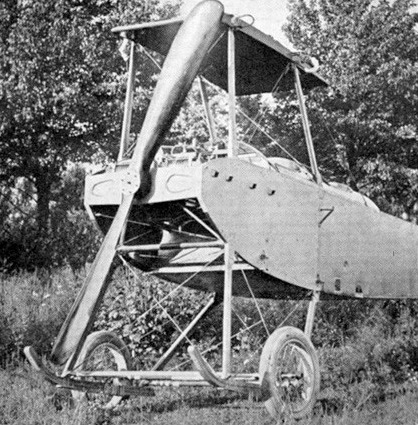
In 1916 General Aeronautic Co produced a 12-cyl “semi air-cooled” aero engine.
General Aeronautic Co
110-112 W 40 St
New York NY.
USA
Pioneer engine builder
Genair / General Aircraft Pty Ltd
South Africa
Durban-based (Genair / General Aircraft (Pty.) Ltd.) built the Piel Emeraude two-seat light aircraft under the name Aeriel Mk II. First prototype flown in October 1959, and first production aircraft in February 1960. Aeriel was subsequently built by Southern Aircraft Construction and Robertson Aircraft Sales, but in September 1962 Durban Aircraft Corporation was formed to continue its construction.
Gemini International Hummingbird
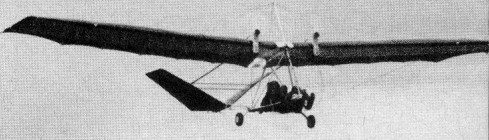
The Gemini Hummingbird 103 and Hummingbird Super 103 are single seat twin engined high wing mono¬plane with conventional three axis control. Wing has unswept leading edge, swept forward trailing edge and tapering chord; V tail. Pitch/yaw control by elevon; roll control by ailerons; control inputs through stick for pitch/roll and pedals for yaw. Wing braced from below by struts; wing profile; double surface. Undercarriage has three wheels in tricycle formation; no suspension on nosewheel and steel spring suspension on main wheels. Push right go right nosewheel steering connected to yaw control. Optional brake on nosewheel; optional brakes on main wheels. Aluminium tube framework, without pod (Hummingbird 103), totally enclosed (Hummingbird Super 103). Engines mounted at wing height driving tractor propellers. Two tractor Solo 210 engines, direct drive (two 20-hp Solos, 3:1 reduction unit, tuned exhaust optional). The Super 103 is the same basic configuration as the Standard 103 but POWERPLANT: Two Solo 210s, 3:1 reduction unit, tuned exhaust.
Gemini International Hummingbird Article
First year built: 1979. The 103 marks a change in marketing policy for the company, as it is the first kit built machine offered by the firm, taking two days to build. A wide range of options is available on the 103, including wheel spats and a fabric covering for the fuselage, with Lexan windows to make a fully enclosed cockpit. Thus modified, the aircraft is known as the Hummingbird Super 103 and costs $6185, as against $5495 for the Hummingbird 103, in 1982.
Other notable options are floats, amphibious floats into which the wheels retract, disc or drum brakes on the main wheels, a nosewheel brake, heavy duty 16 inch (41 cm) wheels and a ‘Super Wing’ high performance wing. Reduction drive is optional.
Units delivered by June 1981 48.
The Hummingbird Prospector had the wing braced from above by kingpost and cables, from below by cables. Aluminium tube framework, without pod (total enclosure optional). The Hummingbird Prospector was the flagship of the Gemini range in that it came complete and test flown from the factory, unlike the Hummingbird 103 and Hummingbird Super 103. It was an older design, easily distinguished from the 103s by its retention of kingpost and cable bracing. The Prospector was sold with two Solo 335 engines. However, there were plenty of Prospectors around with Limbach 275 cc engines. Latest power units for the Hummingbird Prospector were reduction drive Solos.
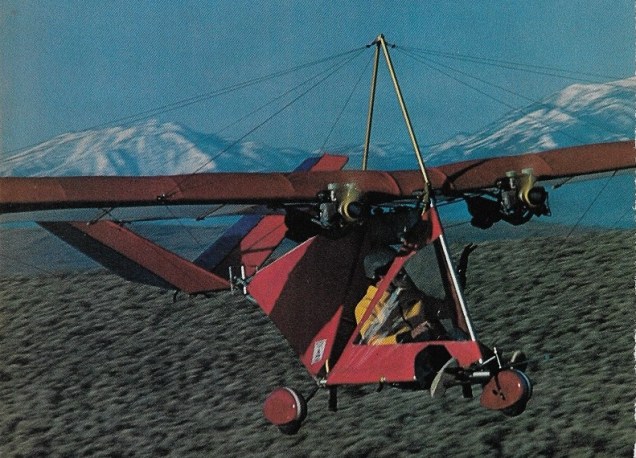
The Tractorplane is a utility ultralight version of Prospector. The Sport Hummingbird is a mono-wing with upright V-tail. Mixed three-axis controls make use of true ailerons for roll control and a separate elevator on the V-tail for pitch control. Construction is aluminum-tubing frame with the wings and tail surfaces covered with presewn 3.8-ounce Dacron. The engines are mounted in tractor position on the leading edge of each wing, and operated separately. Reduction drive turns each two-blade wooden Gemini propeller. Fuel tank is polypropylene. LANDING GEAR: Solid tricycle with steerable nosewheel. Wheels measure 16 inches.
Hummingbird
3-axis conventional (rudder, aileron, elevator).
Gross weight 415 lb.
Empty weight 163 lb (can be modified to 155).
Max pilot weight 230 lbs.
First year built 1979.
Hummingbird Standard 103
Engines: 2 x Solo 335, 20 hp at 7200 rpm.
Propeller diameter and pitch 52 x 27 inch, 1.32 x 0.69 m.
V belt reduction, ratio 3.0/1.
Max static thrust 340 lb, 154 kg.
Power per unit area 0.24 hp/sq.ft, 2.6 hp/sq.m.
Fuel capacity 4.4 US gal, 3.7 Imp gal, 16.6 litre.
Length overall 21.0 ft, 6.40 m.
Height overall 5.0ft, 1.52m.
Wing span 36.0ft, 10.97m.
Chord at root 5.0ft, 1.52m.
Chord at tip 3.9ft, 1.16m.
Dihedral 4 deg.
Sweepback 0 deg
Tailplane span 5.0ft, 1.52m.
Height of in¬clined fixed surface 5.0 ft, 1.52 m.
Total wing area 163 sq.ft, 15.1sq.m.
Total aileron area 18.0sq.ft, 1.67sq.m.
Inclined fixed area 18.0sq.ft, 1.67 sq.m.
Total elevon area 14.0 sq.ft, 1.30 sq.m.
Wing aspect ratio 7.9/1.
Wheel track 6.0ft, 1.82m.
Wheelbase 5.0ft, 1.52m.
Nosewheel diameter overall 6 inch, 15cm.
Main wheels diameter overall 6 inch, 15cm.
Optional floats: length 8.0ft, 2.43m.
Optional skis: length x width 6.0 ft x 3.5 inch, 1.82 x 0.08 m.
Empty weight 240 lb, 109 kg.
Max take off weight 560 lb, 254 kg.
Payload 320 lb, 145
Max wing loading 3.43 lb/sq.ft, 16.7 kg/sq.m.
Max power loading 14.0 lb/hp, 6.3kg/hp.
Load factors +4.5, 3.5 design; +5.0, 4.0 ulti¬mate.
Max level speed 62 mph, 100 kph.
Never exceed speed 70 mph, 113 kph.
Max cruising speed 57 mph, 92 kph.
Economic cruising speed 45 mph, 72 kph.
Stalling speed 22 mph, 35 kph.
Max climb rate at sea level 941 ft/min, 4.8 m/s.
Min sink rate 207 ft/min at 30 mph, 1.0 m/s at 48 kph.
Best glide ratio with power off 11/1 at 42mph, 67 kph.
Take off distance 100 ft, 30 m.
Land¬ing distance 120ft, 38m.
Service ceiling 27,000ft, 8235m.
Range at average cruising speed 100 mile, 160km.
Hummingbird Super 103
Engines: 2 x Solo 335, 20 hp at 7200 rpm.
Propeller diameter and pitch 52 x 27 inch, 1.32 x 0.69 m.
V belt reduction, ratio 3.0/1.
Max static thrust 340 lb, 154 kg.
Power per unit area 0.24 hp/sq.ft, 2.6 hp/sq.m.
Fuel capacity 4.4 US gal, 3.7 Imp gal, 16.6 litre.
Length overall 21.0 ft, 6.40 m.
Height overall 5.0ft, 1.52m.
Wing span 36.0ft, 10.97m.
Chord at root 5.0ft, 1.52m.
Chord at tip 3.9ft, 1.16m.
Dihedral 4 degs.
Sweepback 0 deg.
Tailplane span 5.0ft, 1.52m.
Height of in¬clined fixed surface 5.0 ft, 1.52 m.
Total wing area 163 sq.ft, 15.1sq.m.
Total aileron area 18.0sq.ft, 1.67sq.m.
Inclined fixed area 18.0sq.ft, 1.67 sq.m.
Total elevon area 14.0 sq.ft, 1.30 sq.m.
Wing aspect ratio 7.9/1.
Wheel track 6.0ft, 1.82m.
Wheelbase 5.0ft, 1.52m.
Nosewheel diameter overall 6 inch, 15cm.
Main wheels diameter overall 6 inch, 15cm.
Optional floats: length 8.0ft, 2.43m.
Optional skis: length x width 6.0 ft x 3.5 inch, 1.82 x 0.08 m.
Empty weight 240 lb, 109 kg.
Max take off weight 560 lb, 254 kg.
Payload 320 lb, 145
Max wing loading 3.43 lb/sq.ft, 16.7 kg/sq.m.
Max power loading 14.0 lb/hp, 6.3kg/hp.
Load factors +4.5, 3.5 design; +5.0, 4.0 ulti¬mate.
Max level speed 62 mph, 100 kph.
Never exceed speed 70 mph, 113 kph.
Max cruising speed 57 mph, 92 kph.
Economic cruising speed 45 mph, 72 kph.
Stalling speed 22 mph, 35 kph.
Max climb rate at sea level 941 ft/min, 4.8 m/s.
Min sink rate 207 ft/min at 30 mph, 1.0 m/s at 48 kph.
Best glide ratio with power off 11/1 at 42mph, 67 kph.
Take off distance 100 ft, 30 m.
Land¬ing distance 120ft, 38m.
Service ceiling 27,000ft, 8235m.
Range at average cruising speed 100 mile, 160km.
Hummingbird Prospector
Engines: Twin Solo 210 cc , 12.5 hp, 3:1 reduction unit, tuned exhaust.
Undercarriage: Standard tricycle, steerable nosewheel.
Wingspan 34 ft.
Wing area 153 sq.ft.
Aspect ratio 7.5:1.
Length 22 ft.
Empty weight: 240 lbs.
Payload 400 lbs.
Gross weight 640 lbs.
Wing loading 4.18 lbs/sq.ft.
L/D 10:1.
Cruise speed 33 mph.
Stall speed 21 mph.
Vmax 63 mph.
Takeoff/landing roll 75 ft.
Climb rate 600 fpm.
Fuel capacity 4.5 USG.
Engines: 2 x Yamaha KT1005, 30 hp, 3.0 reduction
Undercarriage: Tricycle 10-inch mains and steerable nosewheel.
Wingspan, 30 ft.
Wing area, 153 sq.ft.
Empty weight, 198 lbs.
Wing loading, 2.37 lbs/sq.ft.
Fuel capacity, 3.5 USG.
Hummingbird Tractorplane
Engines: Two Solo 210s, 3:1 reduction unit, tuned exhaust.
Undercarriage: Standard tricycle, steerable nose-wheel
Wingspan 34 ft.
Wing area 153 sq.ft.
Aspect ratio 7.5:1.
Length 22 ft.
Empty weight: 163 lbs. (can be modified to 155).
Max pilot wt: 230 lbs.
Payload 420 lbs.
Wing loading 4.18 lbs/sq.ft.
L/D 10:1.
Sport Hummingbird
Engine: Twin Gemini/Partner K-1200 100cc, 7 hp
Static thrust, 51 lbs each.
Wingspan, 34 ft.
Wing area: 186 sq.ft.
Aspect ratio, 7.5:1.
Empty weight, 138 lbs.
Usable payload (include fuel), 200 lbs.
Wing loading, 1.07 lbs/sq.ft.
L/D power-off glide ratio, 11:1.
Cruise speed (85% power), 30 mph.
Stall speed, 15 mph.
Approach speed, 25 mph.
Flair speed, 20 mph.
Liftoff speed, 17 mph.
Takeoff roll distance, 150 ft.
Rate of climb, 250 fpm.
Fuel capacity, 1.75 USG.
Range at cruise, 50 sm.
Gemini International Gemini
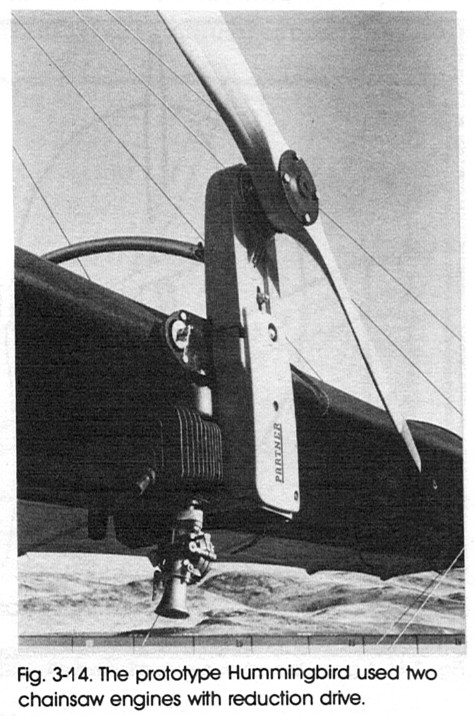
Ed Sweeney, president of Gemini International, was not only a longstanding friend of Klaus Hill but was also directly involved with him in the development of the Humbug and its evolution into the Hummingbird, which he continued to produce after the accidental death of Klaus. Earlier, Ed had been amongst the very first people to motorize hang gliders, using two cut down partner chain saw engines. This power pack was produced for two years, beginning in 1979, and more than 200 were sold under the name of Gemini.
Gemini International
1982: Gemini International Inc, 1080 Linda Way #21 Sparks, Nevada 89431, USA.
1983: 75 Bank St., Sparks, NV 89431, USA.
Ultralight / LSA builder
Gehrlein GP-1
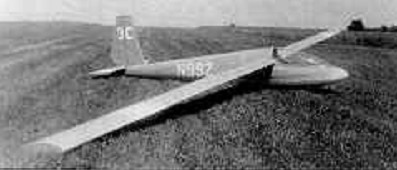
The GP-1, which first flew in 1968, was designed by Jay and Rod Gehrlein as a simple kit-built sailplane. The all metal ship features a constant-chord (76 cm/ 30 in) wing with scissors-type airbrakes.
Wing span: 15m / 49.2ft
Wing area: 11.5sq.m / 120sq.ft
Empty Weight: 208kg / 458lb
Payload: 92kg / 204lb
Gross Weight: 300kg / 662lb
Wing Load: 26.91kg/sq.m / 5.5lb/sq.ft
Aspect ratio: 20
L/DMax: 35 @ 97 kph / 52 kt / 60 mph
Airfoil: Wortmann FX-61-184
MinSink: 0.61 m/s / 2.0 fps / 1.18 kt
No. of Seats: 1
Structure: all metal
No. Built: 5

