ABC Robin

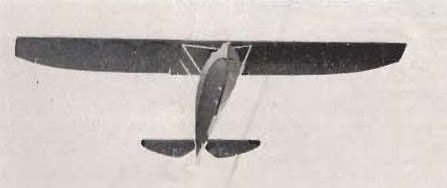
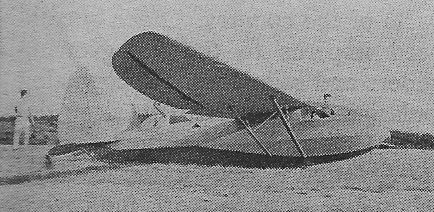
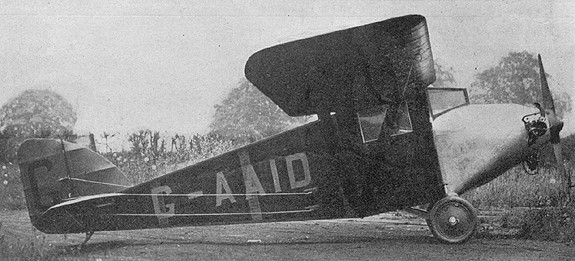
The ABC Robin was a British single-seat light aircraft designed by A. A. Fletcher in 1929. It was a high-wing, single-seat monoplane of conventional taildragger configuration. The cockpit was fully enclosed, the first lightplane to be so equipped in Britain. It was designed at the request of T.A.Dennis (Managing Director) specifically to use the firm’s 30–40 h.p. Scorpion engine.

Construction was primarily of wood with metal confined to fittings and a few highly stressed parts. The fuselage was constructed as a wooden box consisting of four spruce longerons with thin plywood covering with light internal bulkheads. The wood-framed wings, of RAF 34 section, were hinged at their inner rear corners to the top of the fuselage and supported by tubular struts in ‘Vee’ formation to the lower longerons of the fuselage. The tail was also wood-framed and both wings and tail were covered with doped fabric.

The Robin, registered G-AAID, was built by ABC Motors Limited at Walton-on-Thames in 1929. The first flight was at Brooklands in June, and it was displayed at the Olympia Aero Show in July. It was modified later in the year with the windscreen moved back to allow access to the fuel filler caps from the outside, and with an enlarged fin and rudder. The sole Robin built was scrapped at Brooklands in 1932.

Engine: 1 × ABC Scorpion II, 40 hp (30 kW)
Length: 17 ft 7 in (5.36 m)
Wingspan: 25 ft 4 in (7.72 m)
Wing area: 110 ft² (10.23 m²)
Height: 5 ft 9 in (1.73 m)
Empty weight: 415 lb (188 kg)
Loaded weight: 680 lb (308 kg)
Maximum speed: 105 mph (91 knots, 169 km/h)
Range: 340 mi (295 nm, 545 km)
Service ceiling: 17,000 ft (5,200 m)
Rate of climb: 750 ft/min (3.8 m/s)
Wing loading: 7 lb/ft² (34 kg/m²)
Power/mass: 0.058 hp/lb (100 W/kg)
Crew: one

ABC Scorpion

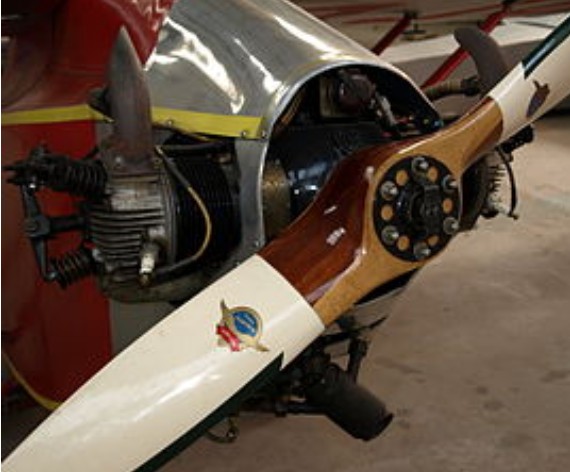
The ABC Scorpion is a 30 hp (22 kW) flat twin, two-cylinder aero engine designed by British engineer Granville Bradshaw for use in light aircraft. The engine was built by ABC Motors Limited and first ran in 1921.

Variants:

Scorpion I
1923, 30 hp (22 kW)

Scorpion II
1924, 34 hp (25 kW), increased bore and stroke.

Applications
ABC Robin
Boulton Paul Phoenix
BFW M.19
BFW M.23
Comper Swift
de Havilland Humming Bird
Farman Moustique
Hawker Cygnet
Heath Parasol
Hendy Hobo
Henderson-Glenny Gadfly
Kay Gyroplane
Luton Minor
Mignet HM.14 Pou-du-Ciel
Parmentier Wee Mite
SAI KZ I
Short Satellite
Snyder Buzzard
Wheeler Slymph
Westland Woodpigeon

Specifications:

Scorpion I
Type: 2 cylinder air cooled flat-twin
Bore: 3.6 in (87.5 mm)
Stroke: 3.7 in (91.5 mm)
Displacement: 73.32 cu in (1.1 L)
Dry weight: 90 lb (41 kg)
Valvetrain: Overhead valve, two valves per cylinder
Fuel system: Carburettor
Fuel type: 74 Octane petrol
Cooling system: Air
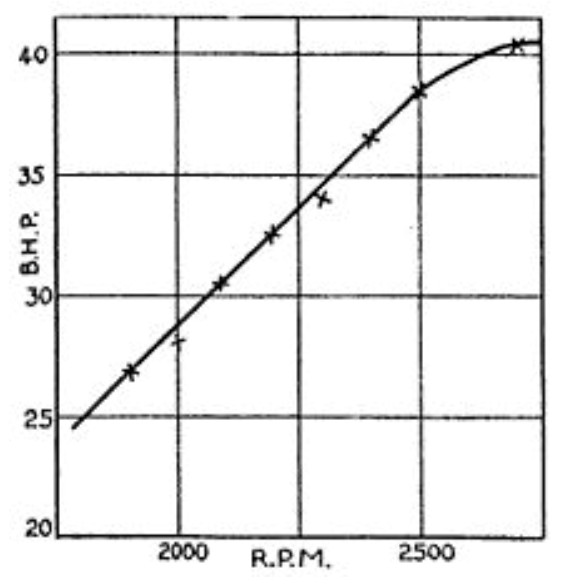
Power output: 30 hp (22 kW) at 2,750 rpm
Compression ratio: 4:1
Power-to-weight ratio: 0.33 hp/lb (0.53 kW/kg)

Abbott Farnham / Alert

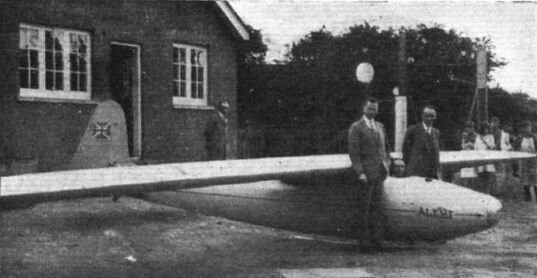
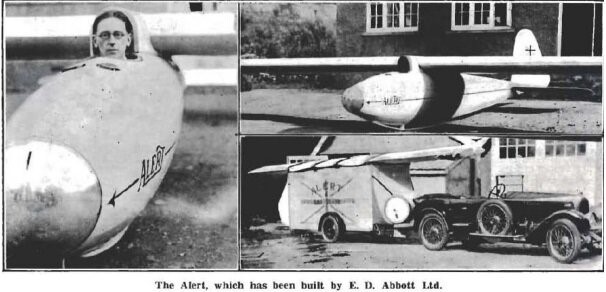
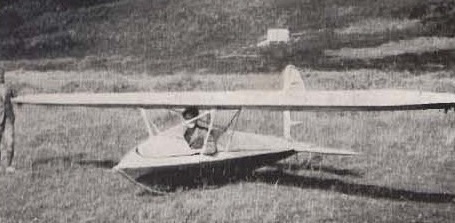
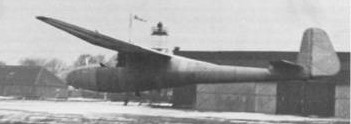
The Abbott Farnham sailplane or Alert (as it was marked on nose) was designed by T. C. Letcher and built in 1930 by E.D. Abbot company.

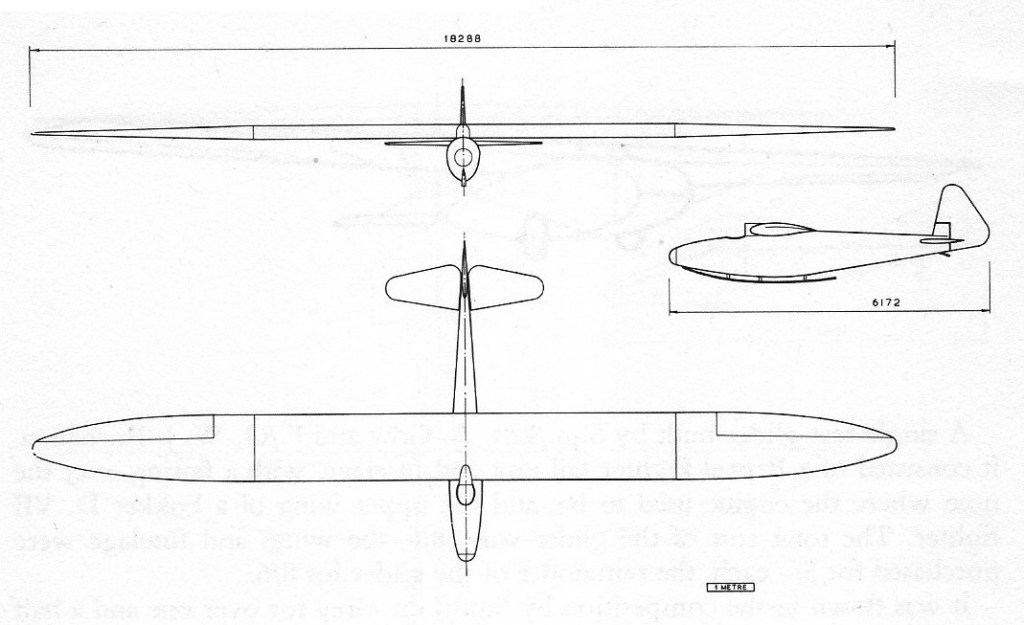
It features a three-piece cantilever wing with two spars. The undercarriage was a main skid plus tail skid. No airbrakes or flaps were fitted.

It was owned by L.H. Ellis and Russell Taylor.

The first flight was in August 1930 and it took part in the 1930 German National Competitions.

Only the one was built.

Wingspan: 18.29 m / 60 ft 0 in
Length: 6.17 m / 20 ft 3 in
Wing area: 20.81 s.m / 224 sq.ft
Aspect ratio: 16
Empty weight: 148.78 kg / 328 lb
Max L/D: 22

Abbott-Baynes Scud / Carden-Bayne Auxiliary

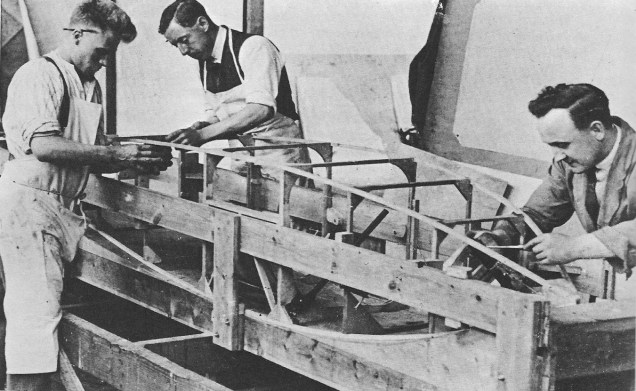
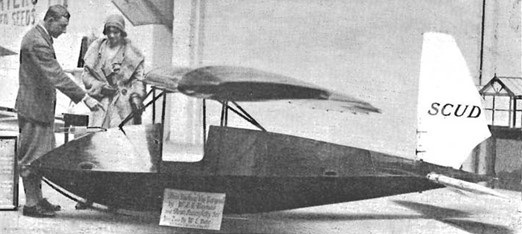
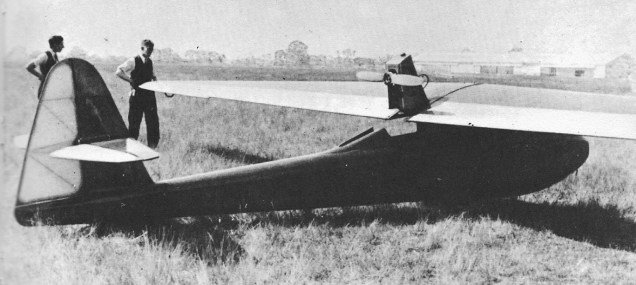
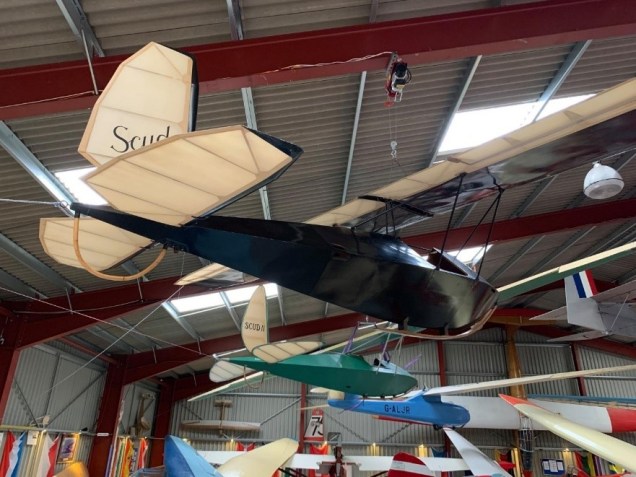
E.D.Abbott, Farnham, produced Mignet Fleas and Baynes Scud during 1935-36. Of conventional construction, the prototype was built by Brant Aircraft Ltd, Waddon Aircraft Factory, Croydon, Surrey. The prototype featured a wire trailing edges to the wings and empennage (fluted). The prototype first flew on 11 January 1931 at Totternhoe, Beds.

Production Scud I were built by Abbott-Baynes Sailplanes at Farnham, price in 1931 at £95 ex-works. No airbrakes or flaps were fitted. Undercarriage was a main skid only.

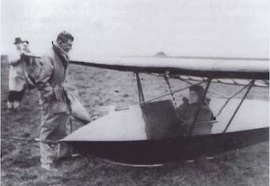
The Scud 2 designed by L.E. Baynes was a development of the Scud 1. The prototype first flew at Askam-in-Furness on 27 August 1932. With main skid undercarriage and a tail bumper, no airbrakes or flaps were fitted. They were priced at £150 ex-works in 1932.

In 1935, piloted by Mungo Buxton, a Sud 2 held the British height record of 8750 ft / 2666 m.

Scud 2 – L.E. Baynes with G. Mungo Buxton in cockpit before 29 September height record at Sutton Bank

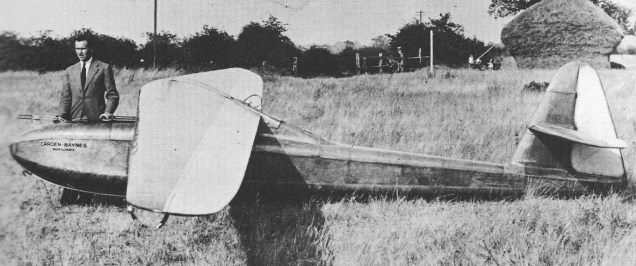
Baynes’ Scud 3 was designed specifically to include such a launching aid but was also capable of high-performance engineless flight. Without an engine it was known as the Abbott-Baynes Scud 3; with the engine, as the Carden-Baynes Auxiliary. Since the engine could be removed or retrofitted the nomenclature sometimes became confused. The Auxiliary is historically significant as the first sailplane with a retractable engine and propeller CG Grey, respected editor of The Aeroplane, wrote after the first flight of the Scud 3, piloted by Dr Dewsbery “Dewsbery now holds the certainly unique position of being the first aviator to retract his motor and airscrew while flying.”

The Scud 3 was an advanced sailplane in its time, all wood and with a long-span wing with heavy taper on the leading edge. The airfoil section was designed by Baynes and varied from the wing root outwards. At the centre it had a flat undersurface, making the wing thick and easy to strengthen as well as reducing wing root interference drag. Outwards, as thickness, chord and incidence reduced, the lower surface became increasingly concave, producing reflex camber. These features were intended to ensure that the stall started at the centre of the wing rather than at its tip. The ailerons were of the differential type. The wings were readily demountable for transport.

Carden-Bayne Auxiliary retracted

The fuselage was flat sided and plywood covered apart from near the nose; upper and lower surfaces were curved and again ply covered. The rounded nose was built up with a double layer of narrow spruce strips placed diagonally. The single cockpit was well ahead of the wings and their mounting pylon had a fairing which extended aft of the trailing edge and contained the engine. At the rear there was a tall fin with an unbalanced rudder. The tailplane was mounted about one third of the way up the fin, carrying split elevators; like the wings it could be removed for transport. The undercarriage was just a single wheel mounted partly inside the fuselage.

The unique feature of the Auxiliary was the powerplant and its mounting. Carden had selected a 250 cc single-cylinder, air-cooled two-stroke Villiers motorcycle engine. He encouraged Villiers to persuade this engine to run inverted, in order to put the propeller line to the top of the mounting and thus minimise air resistance. This proved satisfactory, and many hours of testing with the cowling in place and at full throttle showed there were no overheating problems. A small fuel tank was fixed above the crankcase, at the top of the engine. Carden also designed the engine mounting that enabled the engine and its propeller to be swung out of its housing and into action. The engine was hung to the top of the pylon bulkhead, just ahead of the trailing edge, on a diagonally cross-braced pair of tubes from the hinge to the crankcase and with V-tubes to the cylinder head.

In use the engine and propeller were vertical, the latter having a small diameter to clear the lips of the open top of the fuselage. The engine was held in position by a diagonal longitudinal member attached to a nut on a screw thread which could be rotated with a crank in the cockpit. As the lower end of this member moved forward, the engine rotated into the horizontal position, its fairing closing the fuselage opening. The propeller was indexed to stop in a vertical position and its lower tip moved forward on retraction into a slot in the bulkhead, whilst the other blade pressed on a lever that caused hinged fairing doors, previously held open with springs, to close over it. With the engine retracted, the rear of the pylon was as smoothly faired as on any conventional sailplane.

One other unusual and possibly unique feature of the Auxiliary was that it had a secondary throttle on the port wing tip, so that the pilot could easily taxi the aircraft whilst supporting the wing.

The Scud 3 first flew as an unpowered aircraft in May 1935, and took off under its own power on 8 August that year. It got airborne in 450 ft (140 m) climbing to 2,000 ft (610m) in 15 minutes before Dr Dewsbery retracted the engine and flew it as a sailplane. This first aircraft was still fitted with its engine in 1949, when it was registered as G-ALJR, but in 2010 was flying as an unpowered sailplane. Photographs from the 1930s and ’40s suggest that at some point the closing mechanism of the rear fairing was altered and a fixed slot provided for the propeller. A second Scud 3 was built in 1935 but not fitted with an engine until 1949, when a more powerful 350 cc Villiers was installed until late in 1951. It is on display at the Gliding Heritage Centre.

Scud I, II and III in a line

Gallery

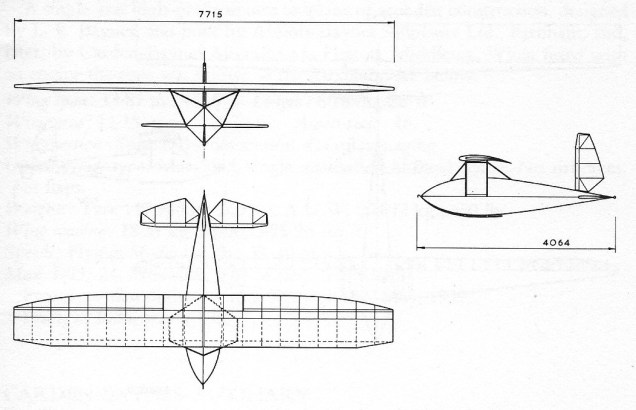
Scud I
Wingspan: 7.72 m / 5 ft 3.76 in
Length: 4.06 m / 13 ft 4 in
Wing area: 7.90 sq.m / 85 sq.ft
Aspect ratio: 7.5
Wing section: Gottingen 535 mod.
Empty weight: 46.72 kg / 103 lb
AUW: 114.76 kg / 253 lb
Wing loading: 14.54 kg/sq.m / 2.98 lb/sq/ft
Max L/D: 15
Min sink: 0.98 m/sec at 48-56 kph / 3.23 ft/sec at 30-35 mph

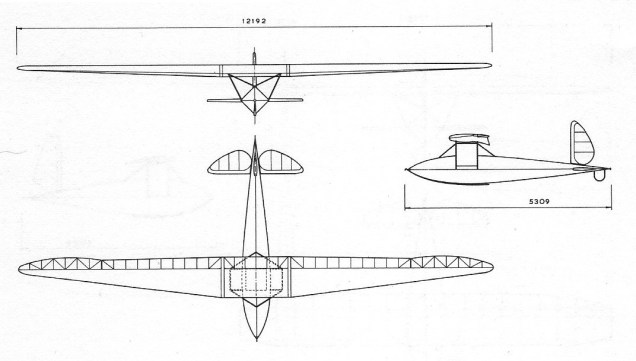
Scud 2
Wing span: 12.19 m / 40 ft 0 in
Wing area: 9.29 sq.m / 100 sq.ft
Aspect ratio: 18
Wing section: Gottingen 652
Length: 5.31 m / 17 ft 5 in
Empty weight: 68.04 kg / 150 lb
AUW: 145.15 kg / 320 lb
Wing loading: 15.63 kg/sq.m / 3.2 lb/sq.ft
Max L/D: 22
Min sink: 0.67 m/sec / 2.2 ft/sec

Scud 3
Wingspan: 45 ft 6 in (13.87 m)
Wing area: 120 sq ft (11 m2)
Aspect ratio: 16
Airfoil: Special Baynes section
Length: 22 ft 6 in (6.86 m)
Height: 4 ft 0 in (1.22 m)
Empty weight: 117.94 kg (260 lb)
Gross weight: 226.8 kg (500 lb)
Maximum speed: 40 mph (65 km/h, 35 kn)
Cruise speed: 35 mph (56 km/h, 30 kn)
Stall speed: 25 mph (40 km/h, 22 kn)
Maximum glide ratio: 1:22
Rate of sink: 132 ft/min (0.67 m/s)
Lift-to-drag: 24:1
Wing loading: 18.31 kg/m2 (3.75 lb/sqft)
Crew: 1

Scud 3
Wingspan: 48 ft 6 in
Length: 19 ft
Wing area: 175 sq.ft
Aspect ratio: 13.2
Empty weight: 300 lb
Gross weight: 470 b
Min sink: 2.8 ft/sec
Glide ratio: 18-1

Carden-Bayne Auxiliary
Powerplant: 1 × Villiers 250 cc, 9 hp (6.7 kW) at 3,500 rpm
Wingspan: 45 ft 6 in (13.87 m)
Wing area: 120 sq ft (11 m2)
Aspect ratio: 16
Airfoil: Special Baynes section
Length: 22 ft 6 in (6.86 m)
Height: 8 ft 2 in (2.49 m) with motor deployed, otherwise 4 ft 0 in (1.22 m)
Empty weight: 310 lb (141 kg)
Gross weight: 500 lb (227 kg)
Maximum speed: 40 mph (65 km/h, 35 kn)
Cruise speed: 35 mph (56 km/h, 30 kn)
Stall speed: 25 mph (40 km/h, 22 kn)
Endurance: powered, 30 min
Maximum glide ratio: 1:21
Lift-to-drag: 24:1
Wing loading: 4.2 lb/sq ft (20.5 kg/m2)
Crew: 1

Scud I
Scud 2

Abbott-Baynes Aircraft Ltd / Abbott, E.D.

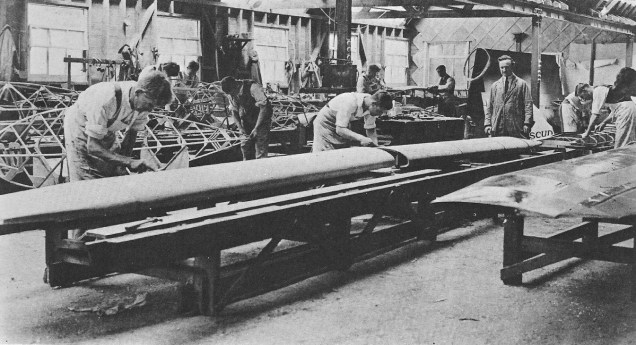
Coach building in the Wrecclesham village started before World War 1 at Warren’s works near the Cricketer’s Public House. In 1920 a company called Page and Hunt, run by Mr. Page who had been a painter at Warren’s, and financed by Mr. Hunt, who was in business in Castle Street, moved into larger premises by the railway bordering Weydon Lane. The firm specialised in custom built bodies which they fitted on Armstrong Siddeley and Daimler Chassis. The post war recession hit this firm badly and in 1928 they went into liquidation and Edward Dixon Abbott who had been the chief salesman for Page and Hunt, bought the business and changed its name to his own.


To keep the workforce busy during this difficult time he extended operations to work on commercial chassis and the refurbishing of older cars, including Rolls Royce. Under Abbott the company prospered and in the 30’s reverted again to building high quality coach-work on Rolls Royce, Daimler and Lagonda chassis specialising in convertibles.


During the early hours of 30th December 1935 a disastrous fire broke out in the saw mill and spread quickly to the body shop. About thirty new Frazer Nash, BMW and Talbot cars were destroyed. Temporary buildings were quickly erected while the factory was rebuilt. At this time there were about 110 employees on the payroll.

During the 30’s the firm branched out into the manufacture of light aircraft and gliders. This arose through the personal enthusiasm of Abbott who had been a World War 1 fighter pilot. Sir John Carden went into partnership with L. E. Baynes in 1930 to produce a one-off single-seat powered glider.

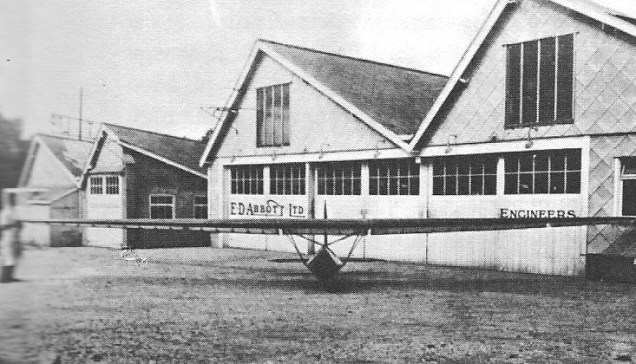
E.D.Abbot Ltd works in 1932

The Abbot-Barnes Sailplanes Ltd was established in 1931 when E.D. Abbot and L.E. Baynes entered into partnership to build Scud 1 and Scud 2 sailplanes of Mr Baynes design. The company was a subsidiary of A.E. Abbot Ltd of Farnham.

L.E. Baynes had originally started in the aircraft industry in 1916 with the Aircraft Manufacturing Co at Hendon, and later spent many years with Short Bros Lat at Rochester. In 1930 he designed the Scud 1 sailplane which was then built by Brant Aircraft Ltd (Baynes and Grant) at Croydon, Surrey. The Scud series was developed and extended by the Abbot-Baynes partnership and led to the Scud 3 / Auxiliary. This was designed to the requirements of Sir John Carden. He was a leading authority on tank design who had become interested in gliding but required a sailplane that could be put into the air without the help of others, so he suggested to Baynes the idea of a retractable engine. Carden also initiated the conversion of the Ford 10 car engine into a lightweight aero engine. Baynes installed one of these into a Flying Flea and several of these were built at the Abbot-Baynes factory incorporating many modifications by Baynes. Following several fatal accidents on the original type, a general ban was introduced and production of the Baynes version was discontinued.

During World War II the high grade skills of the work force were used to make aircraft components and by the late forties the firm was back into its original business with a series of high grade bodies on Rolls Royce, Bentley and Healey chassis.

By 1966 it was evident that Abbotts lacked the facilities to expand to cope with the increasing demand and Ford decided to take back the estate body production and to integrate it into their assembly lines at Dagenham.

Abbots had no other business to fall back upon so the firm went into liquidation.

Aachen FVA 13 Olympia-Jollie / Nord 2000

In the spring of 1938, the FVA was invited to participate in the development of a glider that should be flown by all participants at the Olympic Games 1940 in which the glider was initially provided as an Olympic discipline. Two test machines should provisionally be built, which had to be completed by January 1, 1939.

Because of the heavy time and performance pressure FVA decided just to build the FVA-13 VI in Aachen and in parallel, the V2 by FAG Darmstadt.

Herbert Kaulbach detailed in his thesis the general design and the construction of the hull.

The following extracts are taken from the thesis of Herbert Kaulbach, which he made with Prof. Wieselsberger and presented the original copy to the archive of the FVA.

“General Guidelines”
The task is: It is to design a glider that meets the guidelines for the Olympic unit glider. In following these guidelines will be briefly summarized as You Sans Vol Moteur 1938 were drawn up by the Commission. Following the decisions of the International Olympic Committee aerobatics competitions are not allowed in the Olympic Games. Taking into account the planned tender, which provides goal -haul flights from 70-100km, a glider is to be considered, which could be in terms of performance compared with the conventional glider pattern Rhön- buzzard. The Olympic unit Glider therefore needs to be a high-performance machine. Nevertheless, many gliders are present, corresponding to these Bedingzingen, it was decided by the Commission, according to very specific aspects of a new Olympic machine to create. All interested nations to construct an Olympic – glider to February 1939 prescribed conditions. These aircraft will be presented in flight in February 1939 in Rome. On this occasion, a commission of engineers and such pilots will select the best machine and determine the future Olympic machine.

The plans prepared by the CVSM guidelines that must be taken into account in the design of the aircraft, are as follows:

  • Span 15m
  • consistency of the material : steel, plywood and pine
  • The machine should be able to get yourself some time floating on the water.
  • dive brakes, limit the maximum speed in a dive to 200 km / h.
  • When setting up the driver’s seat, it must be of a size of the pilot of 1.80 m.
  • Hull with skid without chassis
  • Driver seat with back parachute
  • Äßre cab width 600 mm
  • Empty weight 160 kg maximum
  • 95 kg payload. If necessary, the load must be added to 95 kg through the attachment of weights. The secure attachment of Zuladungsgewichten is therefore berücksichligen at the design stage.

Justification of the draft
The above guidelines and the shortness of the resources available for development, design and construction of the aircraft time make it appear necessary to establish nothing fundamentally new, but to provide a reference to an existing pattern that has especially good flying characteristics. When comparing fly is ultimately be crucial if a machine is intended for Olympic machine unit, less on performance than the flying characteristics. It therefore seems pointless at design time to lose by hiring considerations, by any means, the choice of special profiles, or the like. Can achieve the best performance. Rather, I consider it one of the basic requirements, an existing pattern recognition as I said flying capacity to investigate even as all aspects out, ie firstly to provide a mathematically perfect base and secondly to identify the simplest and most expedient in terms of structure . Since the machine may need to be copied by all the participating nations, proper drawing pad with parts lists, numbering, subdivision into modules, etc. is essential. The price for each machine in series production is expected to amount to approximately 2,500 RM.

This price also requires an intent on extreme simplicity design. A wing monoplane design brings experience, a significant additional work as a result of the complicated fuselage wing transition, where this does not elaborate creations deal, especially since the use of light metal electron or duralumin, with its use could provide cheap these transitions with fitted manufacture else, due to the condition 2 is not allowed. The simplest type, in this case, the high-decker, as the neck can be trained so that the blade is tight everywhere.

As the glider FVA -9 has the aforementioned recognized good flight characteristics, the design of this pattern bezgl. Airfoils, wings outline and high position of the rudder leaning to one another. The new draft, however, in contrast to the pattern FVA-9, which is braced, a self-supporting surface before mounting. Since the machine is said to have particularly good maneuverability, was required in the benefit calculation, at least to reach the rotational speed of the FVA-9 and get hold as far as possible to that of the 10 – FVA . More details to follow in the design specifications.

The draft stipulates : an empty weight of 120 kg. This heavier than the pattern FVA-9 (95kg)is the counterbalance design and the stringent strength requirements that are set for the Olympic unit gliders from the Commission related. To keep the landing speed in normal limits , 45 km / h and the surface load less than 15 kg / m was maintained, and elected to G / F = 14.8 kg / m² . This results in an area of F = 14.5 m².

To get mathematically correct documentation, a model was made and measured in the wind tunnel of the Aerodynamic Institute of Aachen.

In order to do proper research regarding workshop excessive production, a dummy was built, which makes it possible to determine the cheapest Beplankungsart of the forward fuselage part practical and to make the installation of the driver’s seat as low as possible and continue to answer questions of the incorporation of control organs, etc. of material importance.

The outline of the wing to the pattern of the already executed FVA-9 adapt to a large extent. In the middle part of the wing outline is rectangular and decreases towards outward straight off. The depth of the fuselage is 1.22 m and remains in constant distance 2.75 m. From 2,75 m depth tapers to them at the end of the wing = 0.44 m. The taper ratio is therefore 0.363. This ratio has been reported in a paper by Koning and Boelen as the best. The wing tip is then completed by wingtip. “

In contrast to the FVA-9, at the design the FVA-13 leaned, for a cantilever surface mounting. For mounting reasons you chose them unbalanced, ie, the left wing was attached to the hull, but the right wing was attached to this projecting stub outside of the hull.

After the construction of the “Olympic dinghy” then weighed 156 kg, and the load was exactly 95 kg. The International Commisssion selected from the three received from Germany constructors, the “Olympic tit” by DFS, so the two FVA-13 VI and V2 were in the team possession. They were destroyed in the war as well as other machines.

Since the 1940 Olympics not held because of the outbreak of war, was also the “Olympia Meise” their original purpose no longer meet. However, it was present in large numbers at home and abroad and built after the war (in France under the name 2000.
Aachen FVA-12

Several reports and lectures on the history of the FVA has remained unclear which project FVA-12 was assigned.

The author of the memorial volume “60 years of FVA” could get only on the basis about it from extensive interviews with former members and from various information. It can be assumed with near certainty that the FVA-12 had been a design for a lightweight powered aircraft as part of a thesis. Bruno Sann and Felix Kracht still remember very well that the plan to build such a power plane in the 1937/38 period was discussed in the FVA, but soon fell into disuse because of the pressure of time for project FVA-13.

It was not possible to determine who was involved in the construction of the FVA-12, in any case it was never built.