The Polar Bear derivative of Model 75 was a special model produced for Uppercu’s hunting expedition to the Arctic Circle in spring 1923 with a glazed nose.
Inter-Wars
Aeromarine 75 / Navy Flying Cruiser
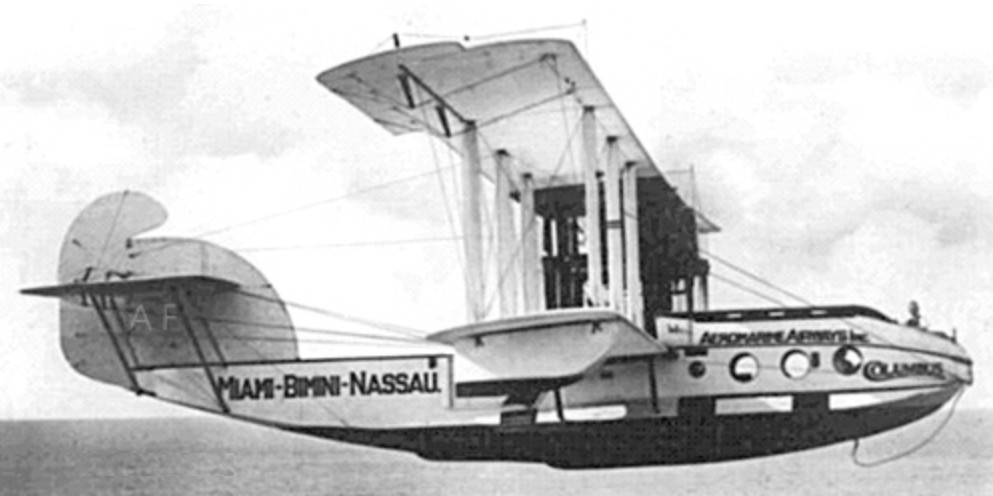
The Aeromarine 75s of 1920 were conversions of surplus USN Curtiss F-5Ls (actually ex-RAF Felixstowe F.5Ls). The conversion involved moving the two-place cockpit back to the trailing edge of the wings and installing passenger accommodations with side windows in the forward half of the hull.
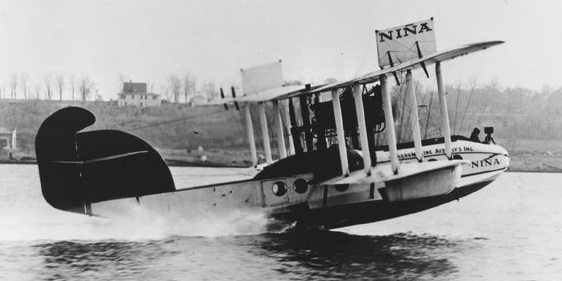
Completed in late 1920, the first two model 75s began operating in 1921 with Aeromarine’s subsidiary, Aeromarine East India Airways, where they commenced scheduled operations between New York City and Havana, Cuba, via Atlantic City, Beaufort, South Carolina, Miami, and Key West, carrying 12 passengers. The two-day air journey took only half the time required by train and boat. In 1922, as more model 75s came into service, the carrier opened a new route across Lake Erie between Detroit and Cleveland and extended southern services to include Nassau and Bimini islands.
In late 1923, after three year of regular flights, Aeromarine ceased operations due to financial difficulties.
Between 1920 and 1921 Aeromarine Plane and Motor Company modified for the needs for its subsidiary company Aeromarine Airways 8 F.5L coming from the surpluses of the US Navy. Arranged for the transport of 10 passengers, these sometimes baptized apparatuses Navy Cruiser they were used as of November 1920 between Key West, Florida, and Havana, Cuba. One of these seaplanes carried out as of the 1 {{er}} November 1920 the first international air postal connection on behalf of the US Post Office). Aeromarine Airways also exploited the seasonal connections Miami – Bimini – Nassau, New York City – Atlantic City, and the line Cleveland – Detroit starting from July 14th, 1922. These apparatuses were baptized Santa Maria / Wolverine, Pinta , Niña , Colombus , Balboa , Ponce of Leon , Buckeye and Mendoza. This last is famous to have flown over New York with 27 people on board in May 1922. The Polar Bear is a Aeromarine 75 especially arranged for a polar forwarding of hunting organized in spring 1923 by Inglis Moore Uppercu, sole distributer of the cars Cadillac with New York and managing director of Aeromarine.
Seven HS-2L were also converted.
Two F-5Ls (Aeromarine Model 75) with accommodation for 12 passengers used on Key West-Havana run until 1923, when air mail subsidies withdrawn.
Engines: 2 x Liberty 12A, 420 hp
Props: 2 blade wooden fixed pitch
Wing span – upper: 103 ft 9 in
Wing area: 1397 sq.ft
Length: 49 ft 4 in
Empty weight: 9000 lb est
Loaded weight: 13,600 lb
Max speed: 82 mph
Cruise: 75 mph
Ceiling: 5000 ft
Range: 830 mi
Passengers: 12-14 civil
Estimated 4-5 completed
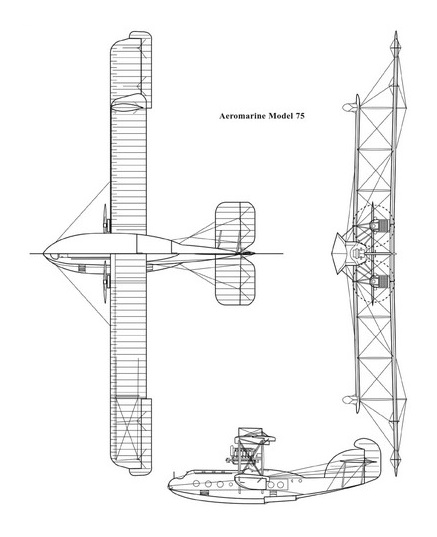
Aeromarine AKL-70 / 70 Trainer
The AKL-70 sold for US$3,550 in 1929, and US$2,500 in 1931.
From 1929, approximately 10 were built.
Engine: LeBlond 5E, 70hp
Wing span: 40 ft 2 in
Length: 23 ft 4 in
Payload: 565 lb
Max speed: 93 mph
Cruise speed: 80 mph
Stall speed: 38 mph
Range: 480 sm
Seats: 2
Aeromarine 60
The Limousine Flying Boat twin-engine biplane flying-boat was a five seat passenger aircraft of 1922/3.
Two designs; one unbuilt and one possibly built, but not flown. Found as the Model 60-U-8-D of 1922 and 60-S-2.
Engine: 2 x Hisso or Aeromarine U-8D, 180hp
Wing span: 55 ft 6 in-55 ft 9in
Length: 31 ft 9 in
Aeromarine 55
A 1922 version of the Aeromarine 52 with Aeromarine U-8D pusher engine. (also known as Model 55-L8)
A total of 4 or 5 of the 3 or 4 place 1919 Aeromarine 50 / 52 / 55 Limousine Flying Boat were built.
The models 50, 52, and 55 represented an ultimately unsuccessful attempt to offer civil versions utilising components of the Navy A40 trainer utilising the wings, tailplane, and general hull structure of the model 40F.
The model 50B of 1919, model 52 of 1921, and model 55 of 1922 all featured enclosed cockpits.
55-L8
Engine: Aeromarine U-8D
Aeromarine 52
A total of 4 or 5 of the 3 or 4 place 1919 Aeromarine 50 / 52 / 55 Limousine Flying Boat were built.
The models 50, 52, and 55 represented an ultimately unsuccessful attempt to offer civil versions utilising components of the Navy A40 trainer utilising the wings, tailplane, and general hull structure of the model 40F.
The model 50B of 1919, model 52 of 1921, and model 55 of 1922 all featured enclosed cockpits.
Aeromarine 52-U8D was a 1921, three seat version of the Aeromarine 50 with the Aeromarine U-8D engine.
Engine: Aeromarine U-8D
Wing span: 48 ft 6 in
Length: 28 ft 11 in
Seats: 3
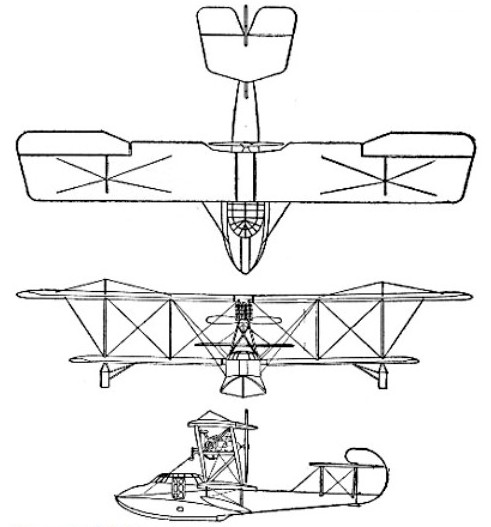
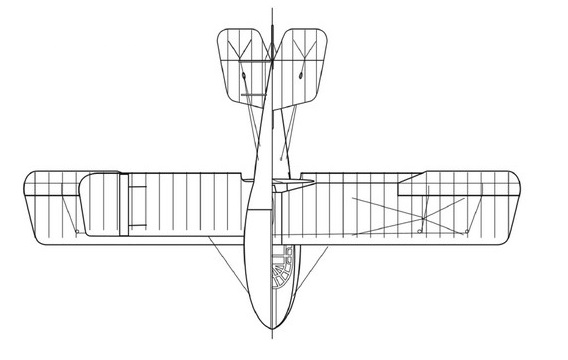
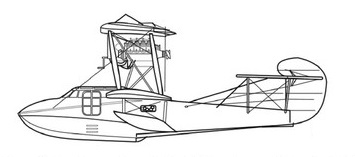
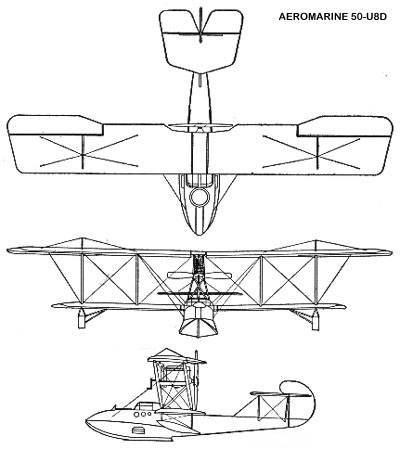
Aeromarine 50 / Limousine
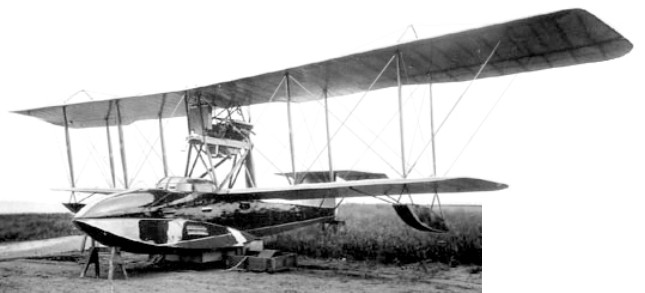
After the First World War, Aeromarine had completed over 300 aircraft. Production was centered around seaplanes for sport and commercial use. President Inglis M. Uppercu, marketed the seaplane based in its luxury interior.
The models 50, 52, and 55 represented an ultimately unsuccessful attempt to offer civil versions utilising components of the Navy A40 trainer utilising the wings, tailplane, and general hull structure of the model 40F.
The Aeromarine 50, also called the Limousine Flying Boat, was a luxury seaplane first flown in 1919 and introduced at the Chicago Air Show. The aircraft was a biplane seaplane with a two-pilot open cockpit and enclosed seating for three passengers. The 150hp Hispano Suiza engine was mounted in a pusher configuration.
The 50B of 1919 was a fully enclosed variant (also called Cabin Flying Boat) with 180hp Aeromarine U-8 (>B-8) pusher. An undocumented 50-B-2 Limousine Flying Boat version was also built.
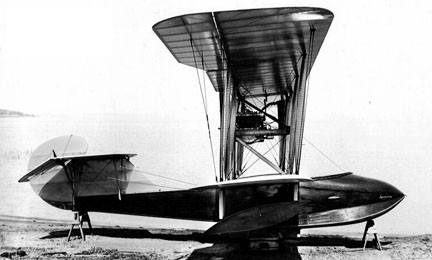
Other versions include 50-C, 50-L, and 50-S Limousine Flying Boat also known as Model 50-U8D; all-metal fuselage; 180hp U-8D or Hisso pusher. The model 50-S entered airline service with Aero Limited over the 100 mile route from New York to Atlantic City, New Jersey during 1919. Ostensibly as a passenger carrier, but more likely for the purpose of moving alcoholic beverages following the passage of the Prohibition Act earlier the same year. Those built included N2990 and N7691.
Aeromarine Airways also operated Model 50 flying boats on NYC-Atlantic City service.
A total of 4 or 5 of the 3 or 4 place 1919 Aeromarine 50 / 52 / 55 Limousine Flying Boat were built.
50 / Limousine Flying Boat
1919
Engine: Hisso A, 150hp
Seats: 3
Wing span: 48 ft 6 in
Length: 28 ft 11 in
50
1919
Engine: 1 × Aeromarine V-8 , 130 hp (97 kW)
Upper wingspan: 48 ft 6 in (14.78 m)
Lower wingspan: 37 ft 8 in (11.48 m)
Height: 12 ft 7 in (3.84 m)
Empty weight: 2,280 lb (1,034 kg)
Gross weight: 3,000 lb (1,361 kg)
Fuel capacity: 40 U.S. gallons (150 L; 33 imp gal)
Maximum speed: 65 kn; 121 km/h (75 mph)
Stall speed: 38 kn; 71 km/h (44 mph)
Endurance: 3.5 hr
Rate of climb: 220 ft/min (1.1 m/s)
Crew: 2
Passengers: 3
50-B
1919
Engine: Aeromarine U-8, 180hp
50 B-2
50-C
Engine: 150 hp (112 kW) Hispano Suiza
50-L
50-S / 50-U8D
1919
Engine: Hisso or Aeromarine U-8D, 180hp
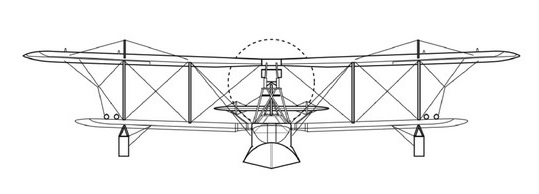
Aeromarine Plane & Motor Co Inc. / Aeromarine-Klemm Corp / Boland Aeroplane Co
The beginnings of the company dated to 1908, when Inglis M. Uppercu began to finance aeronautical experiments by a small firm at Keyport, New Jersey.
In 1914, Aeromarine Corp itself was founded at Keyport with Uppercu as president. Aeromarine built mostly military seaplanes and flying boats, the most significant of which were the models 39 and 40. The company broke new ground in aviation by offering some of the first regularly scheduled flights. Aviation promoter Harry Bruno worked with Aeromarine to commercialize the transportation potential of airflight.
1914: Renamed Aeromarine Plane & Motor Co (fdr: Inglis M Uppercu);
1917: Relocated to Keyport NJ.
1920: Aeromarine West Indies Airways Inc, Key West FL, established.
After the war, converted D.H.4s, built 25 Martin bombers (completed winter 1923/24) and undertook flying-boat conversions for civil use.
In 1923 built metal-hulled flying-boat and biplane mail-carrier.
1921: Became distributing agent for $4 million surplus USN aircraft and motors.
1924: Ended aircraft operations, and established Healey-Aeromarine Bus Co, Nutley NJ.
1928: Formed as a component of Aeromarine Plane & Motor Co Inc. to begin aircraft production as (Frank) Boland Aeroplane Co, Newark NJ; acquired manufacturing rights to Klemm L.25 and the name, Aeromarine-Klemm, came into use. The firm renamed itself Aeromarine-Klemm Corporation in 1929 and began producing mostly Klemm aircraft designs, until the Great Depression forced its closure in 1930.
1931: Receivership (assignor W L Dill), with employees reorganizing as Aeromarine Plane & Motor Co.
The firm also built aero engines.
1935: Assets sold to Burnelli Aircraft Corp.
1936: Engine rights sold to Lenape Aircraft & Motors Inc, Matawan NJ.
1937: Design briefly revived by Keane Aircraft Co, Keyport.
Aero Development Speer S-2-C
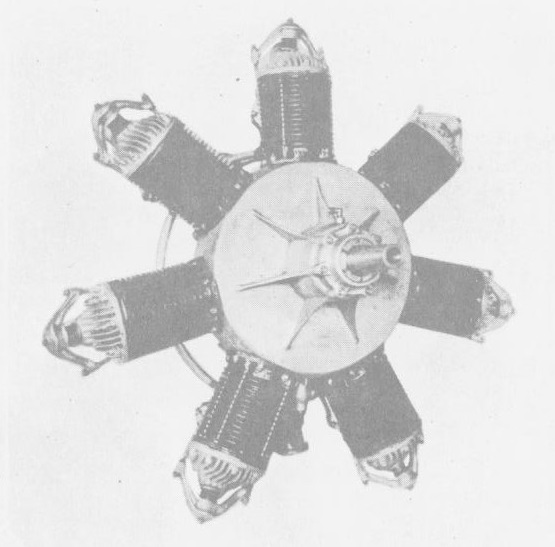
Produced in the 1920s, the Speer S-2-C features a solid master rod operating on roller bearings, and two piece crankshaft. The cast aluminium cylinder head are bolted to nickel iron brrel. The cylinder is of superposed or “F” head construction, the exhaust valve being in the head and the intake valve in the ell. The valves are operated by a special action that eliminates all parts outside the crankcase that require lubrication. The combustion chamber is of a type that provides high turbulence and resulting fuel economies.
All accessories are grouped at the rear of the engine for protection from the weather and to provide ease of maintenance.
Due to the fact that there are no babbit bearings, the need for high pressre lubrication has been eliminated, consequently only sufficient pressure is carried to serve as an indicationbthat oil is flowing.
Available at extra cost were Eclipse starter, Viking fuel pump, tools, and instruction book.
Type: 7 cyl air cooled radial
Power: 120 hp at 1800 rpm
Displacement: 491 cu.in
Compression: 5.2/1
Bore: 4 1/8 in
Stroke: 5 1/4 in
Length: 27 3/8 in
Diameter: 38 1/2 in
Weight: 330 lb
Fuel consumption: not more than .53 lb/hp/hr
Oil consumption: not more than .025 lb/hp/hr
Lubrication: Pressure and scavenging gear pumps
Ignition: Dual Scintilla MN-7D
Carburation: Stromberg NAS5B
Spark Plugs: 2 Champion/cylinder
Aero Development Co
Cedar Falls
Iowa
USA
Circa 1920s built aero engines

