United Kingdom
Developed aircraft between wars.
Inter-Wars
Aeroput MMS-3

Work on the design of aircraft Aeroput MMS-3 (Serbian Cyrillic: Аеропут ММС-3) was conducted in 1934, the sole designer was aeronautical engineer Milenko Mitrović – Spirta, whose initials are on the plane as the MMS label. The number on the label represents a 3-seater passenger plane. Mr Milenko Mitrović – Spirta was then technical director of Aeroput and suggested that the Board of Directors on the basis of his project, which was in March 1934 tested in the Eiffel wind tunnel in Paris, made for Aeroput in his workshop for repairing aircraft an airplane which would be used as aviotaxi, for whom he felt a great need. The constructor then tried several configurations, including inline and stellar engines, without guards and shields, placed at different distances from the gondola hull. Finally, selected system characterized by aerodynamic perfection of Class 12, in those years achieved only by a very good gliders.
The MMS-3 was a twin-engine high wing monoplane of wooden construction with the fuselage covered with plywood, and the wings with fabric, intended primarily for avio taxiing. It was powered by two 88 hp (66 kW; 90 PS) Pobjoy Niagara III the 7-cylinder piston radial engines. These engines were characterized by low fuel consumption and very quiet operation allowing greater passenger comfort. The aircraft flew with two bifurcated wooden propeller with fixed steps. The wooden wing consisted of a double box-shaped wing-spar with a leading edge covered with birch wood. Rest of the wing was covered with plywood covered with doped fabric. The fuselage section including the pilot /passenger cabin had a rounded well streamlined nose and ended at the rear with a small conical tail section. The fuselage had inside three seats placed on a row with two doors on each side that could be opened upwards. The elevator at the tail was fitted with small so-called ‘Flettner’-flaps. The single vertical tail was centrally placed on the horizontal tail section. For that time the plane had unusual concept, instead of conventional fuselage, in the extension of the engine carrier had two tail fins (bi-fuselage). Fuel tanks were located in the wing between the two engines with fuel capacity of 265 l (70 US gal). The cabins for pilots and passengers was one unit, which like gondola is located below the airplane wings. The cabin had a large window area that provided excellent visibility to the pilot and passengers. This made him an extraordinary airplane for panorama flights. It had a fixed landing gear of a conventional type, tail wheel was located at the rear of the gondola fuselage and the main gondola wheels were mounted on one side of the gondola fuselage and on the other side to engine mount. The main wheels have aerodynamic fairings. In 1940 the MMS-3 was used to test the tricycle undercarriage with the front wheel and served as a test basis for a hypothetical bomber version called NEMI, but the project never materialized.
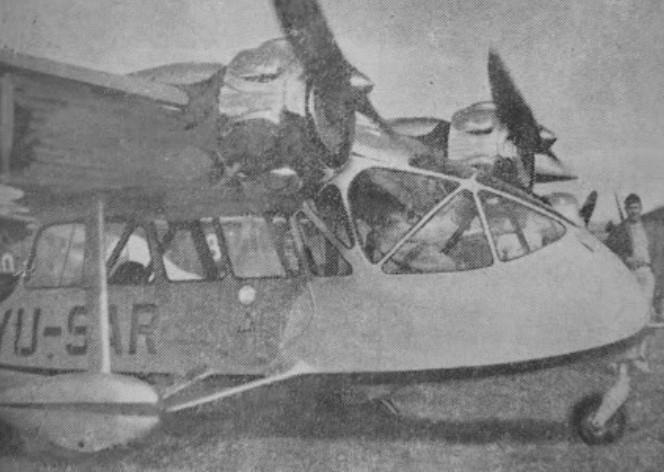
During 1935 the prototype was built, and flew the first time in January 1936. The first flight and test of aircraft conducted by pilot Vladimir Striževski – Striž head of Aeroput transport pilots. The plane showed good performance.
The appearance of the MMS-3, because of its outstanding aerodynamic characteristics, caused interest in France, United Kingdom, Germany and Czechoslovakia. Negotiations for the sale of the license were started, but were not concluded, and production did not take place.
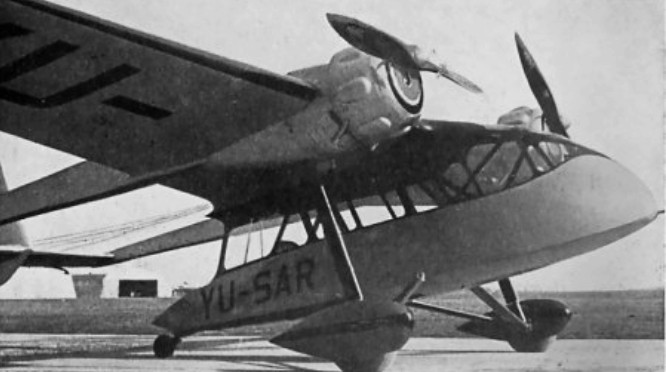
In the summer of 1936 the MMS-3 received a certificate and was registered as YU-SAR. It was used on passenger routes from Belgrade to Sarajevo, Podgorica and Skoplje, also carrying mail and newspapers. During the flight Belgrade – Podujevo – Skoplje on 15 September 1936 it made a forced landing due to an engine failure and was damaged slightly. The damage was quickly repaired so that by the end of 1937 the aircraft had 65 hours of flight time, 1938 – 79 hours, 1939– 102 hours. In addition, it was used for Aeroput’s pilots training. It was also used for publicity purposes, taking the visitors of aero-meetings at the minimum prices which contributed to the popularization of aviation and air transport in Yugoslavia. The passenger seats could be easily remove and the plane turned into the cargo airplane (the first Yugoslav cargo plane).
Just before the April War in 1941 the aircraft was used by the 603rd training squadron of the Royal Yugoslav Air Force (JKRV) which was located at Grab Airport near Trebinje and it was destroyed during withdrawal from the airport. According to other sources, in March 1941, ahead of the tense of international situation around Yugoslavia, the MMS-3 was taken over by the Royal Yugoslav Air Force (JKRV) and placed him in the 603rd Auxiliary Squadron, where it was to be used as a liaison aircraft, deployment and courier needs. According to eyewitness reports, after the German invasion of Yugoslavia in April 1941, the aircraft was destroyed by the crew at the airport near the village of Divci in Valjevo region so that it would not fall into enemy hands. The constructor Milenko Mitrović – Spirta (15 Febtuary 1905 Novi Sad, Serbia – 23 August 1986 Peterborough, NH, USA) in April 1941 photographed the plane before it was destroyed.

Engines: 2 × Pobjoy Niagara III, 88 hp (66 kW; 90 PS) each
Wingspan: 11.56 m (37 ft 11.1 in)
Length: 7.42 m (24 ft 4.1 in)
Wing area: 16 sq.m (172 sq.ft)
Height: 2.25 m (7 ft 4.6 in)
Empty weight: 630 kg (1,389 lb)
Loaded weight: 1,030 kg (2,271 lb)
Wing loading: 64.38 kg/sq.m (13.04 lb/sq.ft)
Power/mass: 128 W/kg (0.078 hp/lb)
Maximum speed: 235 km/h, 127 kn (146 mph)
Cruise speed: 215 km/h (134 mph)
Landing speed: 75 km/h
Range: 600 km (373 mi)
Endurance 3 pob: 3 hr
Endurance 2 pob: 5 hr
Service ceiling: 6,000 m (19,685 ft)
SE service ceiling: 1800 m
Rate of climb: 6.5 m/s (1,278 ft/min)
Climb to 5000 m: 22 min
Crew: 1
Capacity: 3 passengers


Aeroput
At the initiative of the Serbian Aero-Club on 6 February 1926 a conference was held at which embraced rules in the founding of the air traffic, and all participants have become founders. The rules are sent to the Ministry of Trade and Industry, which were approved on 13 March. After this, work centered on issuing shares. However, the registration of shares went below expectations and it was clear that further work was meaningless without a contract with the state to guarantee the Company. This agreement was signed on 25 January 1927, but subscription of shares was slow. The planned and required 24,000 shares (i.e. the then six million dinars required to purchase aircraft) by the end of March 1927, there were only about 10% subscribed and paid, which was in accordance with the applicable law of joint stock companies, but threatened Aeroput to be abolished.
The decision to accelerate the registration of shares found the aeronautical engineer Tadija Sondermajer, a member of the Company, a reserve captain and pilot of Salonika Front. He suggested that along with the pilot Leonid Bajdak, they perform a staged plane flight from Paris to Bombay, and thus prove the value and ability of Serbian pilots to make the local aviation and faster registration of shares. After a short preparation, Sondermajer and Bajdak flew from Paris on 20 April 1927. Finally, after covering 14,800 kilometers, 14 stages and 11 days of travel, on 2 May 1927 landed in Belgrade. The welcome was magnificent and more than 30,000 of Belgrade citizens hail to their heroes at the airport under Bežanijska Kosa. After this achievement of Sondermajer and Bajdak, subscription of “Aeroput” shares grew over all expectations. Aeroput was established with a capital of six million dinars, collected by 412 shareholders. Packets of shares was have: Vračarska Zadruga (Vračar Cooperative), Economic Bank, Postal Savings Bank, Gateret, Serbian bank of Zagreb, American-Serbian bank in Sarajevo, Teleoptik, Velauto, Ikarus from Novi Sad, Technical Society Voks and others. A total of 412 shareholders paid the 14,000 shares at 250 dinars, or 3.5 million dinars. Aeroput with that capital started to work and on that occasion they purchased four airplanes. For the three months were enrolled over 30,000 shares, which enabled the new company to overcome the crisis. Already on 17 June 1927 was performed a promotion of the Society in the Belgrade Commercial Court and from that day the Company for Air Traffic “Aeroput” is legal entity.
The first Aeroput aircraft arrived at Belgrade’s airport in early February 1928. Aeroput management bought four Potez 29/2 biplanes from the French company Potez. The choice of this type of aircraft management of Aeroput decided because the domestic factory Ikarus in Zemun produced planes under license from the same French company, the aircraft of type Potez 25, for Air Force Command and its air force units. Aeroput was important to in the immediate vicinity of airport is a factory that is capable of servicing their new aircraft. Biplane Potez 29/2 in that time had good characteristics for a passenger plane, the crew made up of two members, had five seats for passengers, range up to 500 kilometers, with a 450 hp engine, flying at a speed of 210 kilometers per hour, and the trunk is receiving load of 250 kilograms.
In the first three years, while in the fleet was the only Potez 29/2 biplanes, major aircraft maintenance for Aeroput is performed by aircraft factory Ikarus in Zemun, who have then the French licence for the Royal Yugoslav Air Force (JKRV) produced a similar plane Potez 25. Engine maintenance is performed at the factory Jasenica AD from Smederevska Palanka, which was produced under licence aircraft engines of the Lorraine brand. Early in 1931, the Aeroput buys a workshop for the repair of the aircraft from the French – Romanian company CIDNA, which was located at Zemun airport and assembly organized with the mechanics of Ikarus and the Air Force, and on that way organized its own technical aircraft maintenance service. Maintenance department was located in one of the large hangar at the civilian part of the airport, it was a modern and possessed a test stand for aero-engines. Since then, all the revisions, and airplane engines overhauling that had Aeroput was performed in they own technical service and the domestic design, the Aeroput MMS-3.
The bombing in 1941 was destroyed almost the entire property of the company. Aeroput submitted to the court for punitive damages on 31 October 1941. In 1942 year commissar administration banned Aeroput from work. German occupation authorities nationalized the property of the Aeroput in Knez Mihailova Street 32, where they moved their national airline D. H. N. – Deutsche Luft Hansa.
After the war the Aeroput renewed work on 2 July 1945, when the general meeting of shareholders elected the first post-war management of the company. Meeting was attended by delegates of the new government of Democratic Federative Yugoslavia (DFY), and with the participation of then the Head of State Ivan Ribar, who was a pre-war shareholder and board member. The work permit was a farce, since April 1947 JAT was created. Communist government adopted a decree prohibiting private joint-stock companies, pursuant solution, on 24 December 1948 the Aeroput was liquidated.
Aeronautical Products Corp Scorpion
A 100hp 336ci four cylinder, inline, air cooled engine.
Aeronautical Products Corp / Aero Products
Naugatuck CT.
USA
Engine builder circa 1928.
Aeronautical Products A-1

Two undergraduate engineers of the University of Michigan, Corwin Denny and Karl Schakel, with the Aeronautical Products Corporation of Detroit, Michigan, have designed and built a helicopter. Both of the designers left the corporation, but work progressed on the helicopter they initiated. First flown April 1944, during preparations for a trial flight, was damaged, and was rebuilt.
The Denny and Schakel helicopter is a single, main-rotor machine with an auxiliary tail rotor for torque correction. The main rotor is 9m in diameter and is powered by a ninety-horsepower engine. The gross weight is reported to be approximately 540kg. It has a fixed tricycle landing gear.
Built of welded-steel tubular construction, this helicopter is a single-seater with enclosed cabin. The pilot sits behind the engine, which is mounted in the nose. A long shaft extends under the pilot’s seat and is geared to the vertical shaft of the rotor.
It was not put into production.
Aeronautical Products Inc
Formed in Detroit, Michigan, in 1935 to manufacture aircraft engine parts, and in 1942 began development of a cheap helicopter, first flown April 1944. An improved type (A-3) was tested 1945. Both had nose-mounted engines.
In 1947 Aeronautical Products merged with the McQuay Company.
Aeronautical Corporation of Great Britain Ltd / Aeronco Light Aircraft Ltd
AAD Lang established the Lang Propeller Works at Weybridge, Surrey in 1913 and at its peak the company supplied wooden propellers to nearly every aeroplane company in Britain.
Light Aircraft Ltd of Hanworth, Middlesex, was registered on 26 August 1935 by Flt-Lt Bernard J.W. Brady and John Vivian Prestwich, son of JAP engine maker and founder, John Alfred Prestwich. Light Aircraft acquired the British Empire license to manufacture the American designed Aeronca C.3 from the Murray Aeronautical Corporation of Canada. Pending production of British model called the Aeronca 100, 16 American-built C-3 airframes were assembled at Hanworth, London.
In April 1936 the Aeronautical Corporation of Great Britain, Ltd. (Originally styled Aeronco) was incorporated, through a merger of Lang Propellers Ltd, Light Aircraft Ltd and Aircraft Accessories Ltd. Besides Brady and Prestwich, directors included H.V. Roe, who with his brother A.V. Roe had founded A.V. Roe & Co Ltd. in 1913. Lang did not continue with the new concern and joined the Board of Hordern-Richmond, another British company which was closely involved in the development and production of airscrews and propellers. Sales were to be dealt with through Aircraft Exchange and Mart, another of Brady’s companies. Aeronco also contracted J.A. Prestwich & Company, Ltd. (J.A.P.) in London to build a dual-ignition version of the Aeronca E-113C engine under license as the Aeronca-J.A.P. J-99. This engine was used extensively in British light aircraft.
Business was set up at the Aircraft Accessories factory (the Walton works) in Peterborough, which had originally been the site of Frederick Sage & Co. Ltd. A version of the Aeronca C-3, with fabric-covered ailerons instead of metal and British specification materials, designated the Aeronca 100 was produced, but the expected sales never materialized and only 24 were manufactured before production was halted. An improved version, the Aeronca 300 was in development when financial scandal saw the whole of the original board resign in April 1937, but on November 5th, 1937, the Aeronautical Corporation of Great Britain declared bankruptcy.
On 16 September 1938, Brady, along with John PA Fulton, another director from Aircraft Exchange and Mart, formed the Peterborough Aircraft Company Ltd to acquire what little remained of Aeronca, including the uncompleted Aeronca 300. A revised version of that was produced as the Peterborough Ely, but met with no success.
Aeronca E-113 / O-113 / JAP J-99
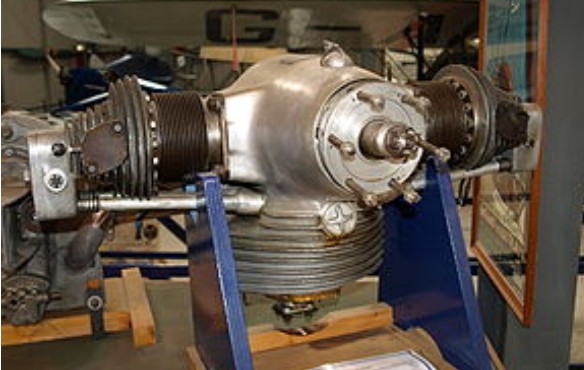
The E-113 was a small flat-twin, air cooled, piston engine developed by Aeronca for use in some of their light aircraft. First run in 1936, it was a development of the E-107.
Originally fitted with a single ignition system, this was uprated to dual ignition when changes in FAA regulations made this mandatory in 1939. By that time, however, both the engine and the aircraft that it powered were facing obsolescence. Altogether, some 1,800 examples were built by Aeronca and
JA Prestwich (under licence as the JAP J-99).
Variants
E-113A
Standard production model delivering 36-45 hp (26.85 – 33.56 kW)
ATC 71
E-113C
Uprated engine delivering 40-45 hp (29.83 – 33.56 kW)
ATC 189
Aeronca-JAP J-99
The E-113-C was license built in England as the Aeronca-JAP J-99 by J A Prestwich Limited (JAP) and powered several British aircraft types, differing from the E-113 by being fitted with dual ignition.
O-113
Engines fitted to impressed aircraft were given the designation O-113.
Applications
E-113:
Aeronca C-3
Aeronca K
Welch OW-6M
J-99:
Aeronca 100
Aeronca 300
Britten-Norman BN-1
Currie Wot
Dart Kitten
Hants & Sussex Herald
Heath Parasol
Hillson Praga
Luton Minor
Peterborough Ely
Slingsby Motor Tutor
Taylor J.T.1
Tipsy Junior
Specifications
E-113
Type: 2-cylinder air-cooled horizontally opposed aircraft piston engine
Bore: 4.25 in (107.95 mm)
Stroke: 4 in (101.6 mm)
Displacement: 113.49 in³ (1.86 L)
Dry weight: 118 lb (54 kg)
Power output: 36-40 hp (26.9-29.8 kW) at 2,400-2520 rpm
Compression ratio: 5.1:1
Aeronca E-107 / O-107

The Aeronca E-107 was one of the first low-cost reliable engines of the post-World War I era. A flat-twin aircraft engine designed by Ray Poole and Robert Galloway, the E-107 first ran in 1929.
The E-107A was a production engine designed to replace a Morehouse engine on the first prototype of the Aeronca C-2. The first five were produced without cooling fins on the crankcase. A Winfleld Model 5 carburetor was standard for the engine. The E-107 was replaced by the uprated E-113 engine based on the same design.
The major application for the E-107 was powering the Aeronca C-2.
Number built: 115
Variants
E-107
Standard production engine
E-107A
The E-107A was produced for Aeronca by the Govro-Nelson Company of Detroit, Michigan.
O-107
Designation given to engines fitted to impressed aircraft
Specifications
E-107
Type: 2-cyl. air-cooled horizontally opposed
Displacement: 107 cubic inches
Dry weight: 114 lb
Power output: 26hp

