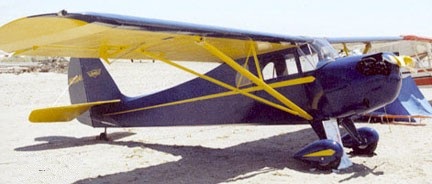
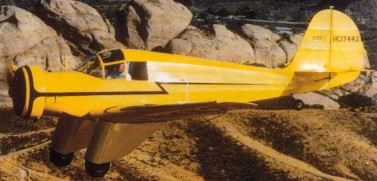
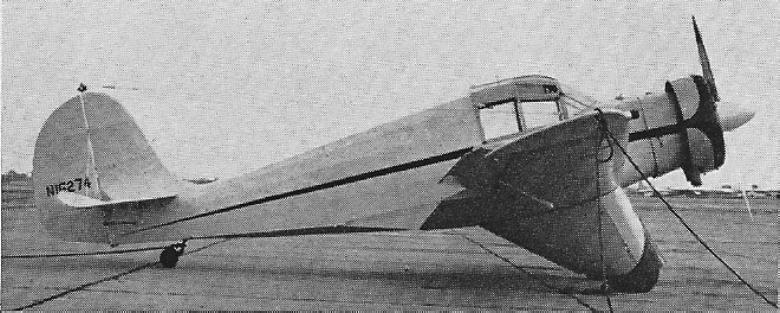
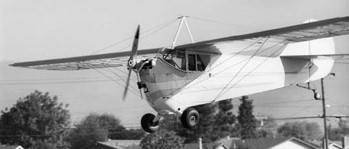
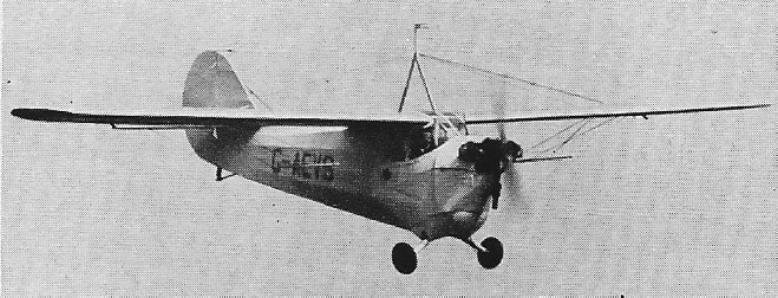
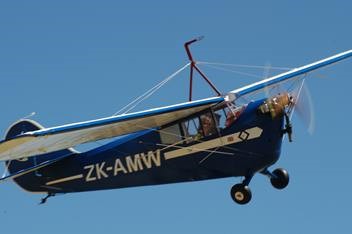
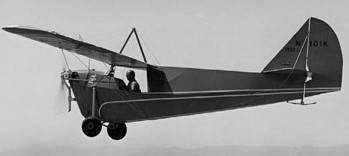
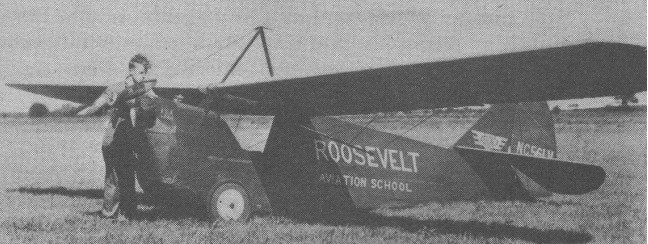
The 1942 model 6 was planned as a metal-framed replacement for the KCA Chief. Development cut off by the war and it was reportedly cut up for scrap. Only one was built (NX34484).
Engine: Continental C-75, 75hp Wing span: 35 ft 0 in Length: 22 ft 8 in
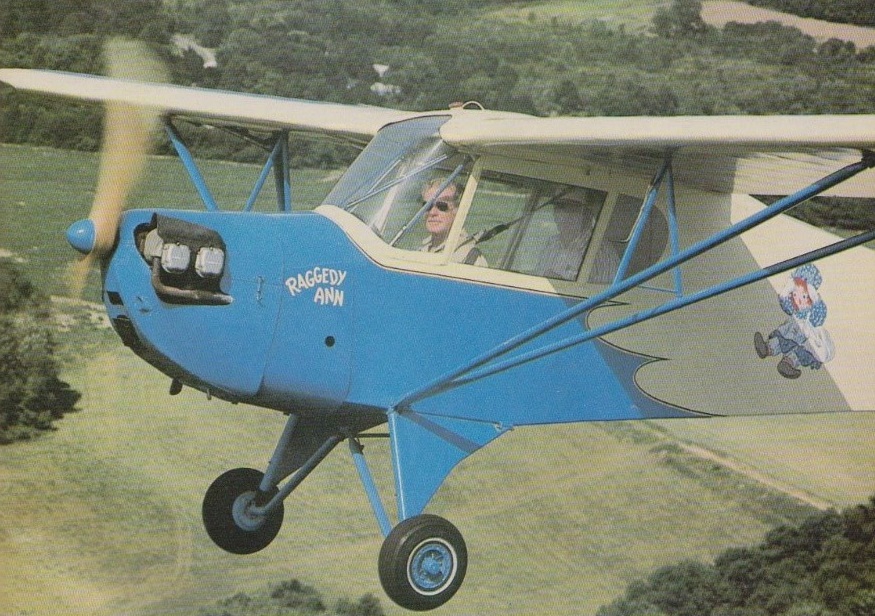
The Aeronca C-3 evolved into the Aeronca K Scout (ATC 634) in 1937, designed by Roger Schlemmer, the prototype being NX17440. A total of 344 were built, priced at $1,480, and $1,745 in 1938.
The 1937 KC Scout (ATC 655) sold for $1,590, and $1,295 in 1939. Thirty-four were built, and the float version was the two-door KC Sea Scout.
Aeronca KC
The 1938 KCA Chief (ATC 675) was priced at $1,695, and with65hp, $1,795. Sixty-two were built, the KCA evolving into the wide-cabin 50C Chief.
Aeronca KCA
The model 50C Chief was the first lightplane to fly non-stop from Los Angeles to New York City, on 19-39 November 1938, covering 2,785 miles in 30h 47m, avg: 90mph (registration NX21300 and piloted by Johnnie Jones).
The 1941 L-3 and O-58 Grasshopper was the military version of 65 with a greenhouse cabin and 65hp Continental YO/O-170-3. There were fifty-four; 42-456 to 42-459, and 43-2809 to 42-2858. These were followed by twenty L-3A (O-58A), 42-7793 to 42-7812, and 875 L-3B (O-58B), 42-14713 to 4214797, 42-36075 to 42-36324, 42-38458 to 42-38497, and 43-26754 to 43-27253.
The L-3C had no radio and weight reduction. 490 were built, three to the US Navy as XLNR-1; 36422 to 36424.
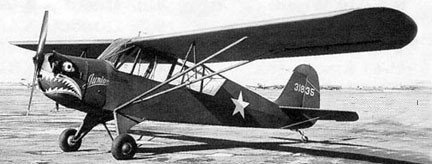
Aeronca L-3C 43-1835
Others were;
L-3D = Impressed 65TF with Franklin AC-167. POP: 11. L-3E = Impressed 65TC with Continental A-65-8. POP: 12. L-3F = Impressed Super Chief with A-65-8. POP: 19 including 42-78044 L-3G = Impressed Super Chief with Lycoming O-145-B1. POP: 4. L-3H = Impressed 65TL with O-145-B1. POP: 1. L-3J = Impressed 65TC with A-65-7. POP: 1.
The original model, the YO-58, was a conversion of the civil 65TAC Defender. Production models were the O-58, O-58A and O-59B, later designated L-3, L-3A and L-3B in 1942. L-3D to -3J were impressed by USAAF.
The O-58B differs primarily in having a more extensively glazed cabin.
Performance and specifications were similar to the civil models.
The difference between the 1938 L and LA Chief models (ATC 702) was that the 50L Lycoming O-145 had exposed cylinders, while the 50LA had a closed cowling. Priced at $1,695, there were 65 50L and 20 50LA models built, some for the USAAF as the L-3.
The 50C Chief of 1938 (ATC 675) was an improved KCA with a wider cabin. Priced at $1,795; $1,695 in 1939, 248 were sold. A 50C was the first lightplane to fly non-stop Los Angeles-New York City, on 29-30 November 1938, covered 2,785 miles in 30h:47m, avg: 90mph. NX21300 piloted by Johnnie Jones had a fuel cost-per-mile of about one cent was most impressive, even in 1938 dollars.
Forty of the 1938 50F Chief (ATC 688) were built, powered by a 50hp Franklin 4AC engine.
The 1938 KF Chief (ATC 688) was powered by a 50hp Franklin 4AC engine. Selling for $1,595, five were built, including; NC21067, NC21063, and NC21092. The KF Chief evolved into 50F Chief.
The 1938 KM Chief (ATC 676) was powered by a 50hp Menasco M-50 engine. Priced at $1,590, nine were built. The KM Chief evolved into the one 50M Chief built, NC21070.
The 1937 KS Sea Scout (ATC 634) was a floatplane version of the model K; thirteen were built.
The 50TC and 50TL Tandem (T-series) of 1939 were the first tandem Aeronca as competition for the Piper Cub. A total of 16 were built.
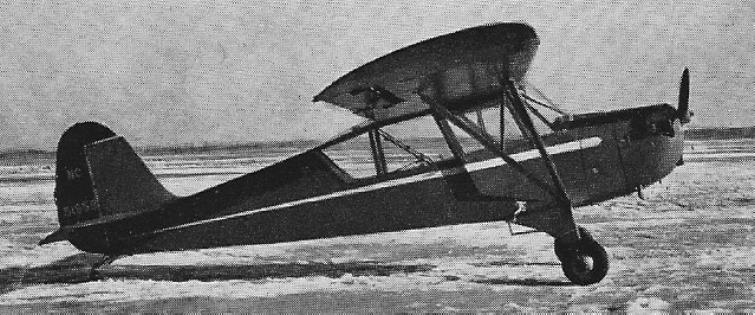
50C
In turn, the K evolved into the SOC Chief in 1938.
The 1940 60TF Tandem (ATC 728) was the same as 50TC, with 60hp Franklin and slightly increased performance. 60TL with 60hp Lycoming. Priced at $1,695, 118 were built, going to USAAF as O-58B with 65hp Continental A-65.
In 1939, the 65-series appeared and featured the 65 hp Continental option. The 65TC Defender (112 built), a tandem two-seat trainer, was widely used throughout the war, particularly in the Civilian Pilot Training Program. The CPTP and CAP versions were the 65TAC of which 154 were built. The Model L-3, the military version of the same airplane, featured a wider fuselage and larger window area to facilitate its role as an observation plane. Although provided with dual controls, the L-3 was designed to be flown from the front seat. The observer’s seat might face forward or aft. Many of the planes reached civilian hands after World War II.
The 1938 65C Chief and 65CA Super Chief (ATC 675) differed by the 65CA having an optional 8-USG auxiliary fuel tank and other deluxe appointments. The 65C price was US$1,795, and the 65CA US$1,895. Of the 279 model 65C built, many were impressed by USAAF as the O-58/L-3 in 1942. A total of 655 65CA models were built.
87 of the 1939 65LA Chief and 199 of the 65LB Super Chief (ATC 702) model were built. The 65LB with 65hp Lycoming O-145 in 1940.
One 50M Chief was built, 1938 (ATC 676), NC21070, priced at $1,695.
65TAF NC36817
65TAF (ATC 728) was CPTP and CAP versions of the 65TF with 59 of the 65TF built, and 115 of the 65TAF during 1940.
The 65TF Tandem and 65TAF Defender of 1940 were powered by 65hp Franklin 4AC engines. Fifty-nine 65TF were built and 115 of the 65TAF CPTP and CAP versions.
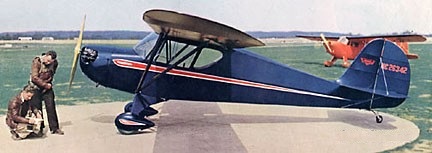
Aeronca 65TL NC24362
299 of the 1940 65TL Tandem and 65TAL Defender (ATC 728) were built plus military versions: 4 YO-58, 20 O-58, 701 L-3B, and 499 L-3C, plus 253 TG-5 gliders to AAF. The 65TAL was CPTP and CAP version with 100 built.
The 1939 models 50TC and 50TL Tandem (ATC 728) designed by James Weagle were the first tandem Aeronca, as competition for the Piper Cub. Sixteen 50TC (50hp Continental) were built, and 33 TL with the 50hp Lycoming engine.
L-3H Engine: Lycoming O-145-B1, 65hp One impressed 65TL
L-3C No radio, weight reduction. 490 built; additionally 253 built as TG-5 gliders
TG-5 / XLNR-1 65TL Tandem / 65TAL Defender Army Air Force glider version. Number built: 253 3 transferred to USN as XLNR-1 (36422/36424).
L-3 (O/YO-58) Engine: Continental O-170-3, 65 hp Length: 20.997 ft / 6.4 m Height: 7.677 ft / 2.34 m Wingspan: 35.07 ft / 10.67 m Wing area: 158.016 sq.ft / 14.680 sq.m MTOW: 1301.0 lb / 590.0 kg Weight empty: 835.7 lb / 379.0 kg Max speed: 76 kts / 140 km/h Cruising speed: 40 kts / 74 km/h Service ceiling: 10007 ft / 3050 m Wing load: 8.2 lb/sq.ft / 40.0 kg/sq.m Range: 174 nm / 322 km Number built: 54 (42-456/459, 43-2809/2858).
L-3A (O-58A) Number built: 20 (42-7793/7812)
L-3B (O-58B) Engine: Continental O-170-3, 65 hp Wing span: 35 ft Length: 21 ft 10 in Empty weight: 835 lb Loaded weight: 1260 lb Max speed: 87 mph Cruise: 79 mph Range: 218 mph Number built: 875 (42-14713/14797, -36075/36324, -38458/38497, 43-26754/27253 )
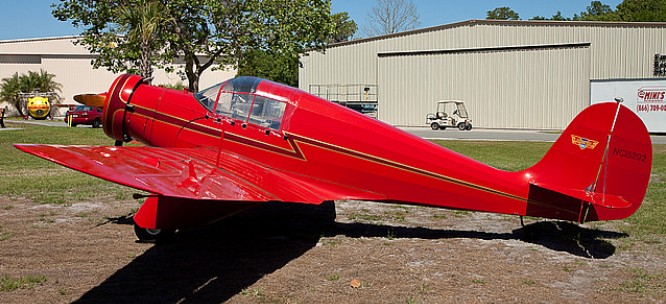
The 1935 Aeronca L cabin monoplane was the Aeronautical Corporation of America’s first attempt at constructing a low-wing side-by-side cabin airplane. It was produced in four versions: the LA with a 70-hp Le Blond, first flying in November 1935 and piloted by Fred Fluck, the LB (28 built ATC 596) of 1936 using an 85-hp LeBlond or 70hp Rearwin-LeBlond, the LC (25 built in 1937) using a 90-hp Warner Scarab Junior, and the LD powered by a 90-hp Lambert.
The 1936 LC (ATC 614) was the company’s first departure from its high-wings. The first was powered by a 50hp Warner engine, subsequent one had a 90hp Warner Jr, priced at $3,275. One was the float-equipped LCS NC16289.
The prototype LW (NX14558) with 42hp Aeronca L-113, was so underpowered it only made one short flight.
The airframe of the Model L is of conventional mixed construction. The wings were built around a structure of spruce spars and ribs. The fuselage was a framework of welded steel tubing. Both the fuselage and the wings were covered with fabric.
Thirteen of the 1935 LA and LW model (ATC 596) were built, selling for about US$2750 and the LB sold for US$3000. The LA, designed by Giles Barton and Roger Schlemmer (who did the L series), was first flown in November 1935, piloted by Fred Fluck. The prototype LW NX14558 was powered by a 42hp Aeronca L-113, which was so underpowered it only made one short flight.
About 25 of the 1936, $3,275 LC model were built, of which one was the float-equipped LCS (NC16289). The prototype LC was first equipped with a 50hp Warner engine.
The CF Scout of 1936 was the same as the KC Scout, but with a 40hp Franklin 4AC engine. Six were built; the prototype NX21355 c/n CF-1, NX22157, NC22196, NC22304, NC22391, and NC23528.
Engine: Franklin 4AC, 40hp Max speed: 90 mph Cruise speed: 85 mph Stall speed: 38 mph Range: 250 sm
First produced in 1938, a single-engine two-seat (tandem) high-wing monoplane with conventional tailwheel landing gear – soloed from rear seat – precursor to the 7 Champion.
Jean Roché experimented with a C-3, removing the main landing gear and substituting one wheel in the center of the fuselage. The wingtips had small tricycle wheels for launching and for the end of a landing roll. Quite a bit of weight was saved (about 40 pounds) and aerodynamic drag reduced. The C-3 was personally owned by Roché and shown in registers only as a racer. It was used in a race or two in 1933 wearing race number 17 (NR12407) then returned to conventional configuration. It came in third in a 115-c/i free-for-all.
The Aeronca C-3 (ATC 396) was an offshoot of the C-2 Deluxe. Introduced in 1934, it was similar to the C-2 in structure but was expanded to accommodate side-by-side seating for two, selling for $1,895. The C-3 was produced in two versions; the Master / Duplex of 1931 was the Deluxe Collegian with an enclosed cabin design and rounded spine, and the Collegian retained the open cockpit styling and is easily confused with its C-2 predecessor. By this time, the production of both the engine and airframe of the Aeronca took place in Britain.
The C-3 Collegian sold for US$1895 at the factory. Various improvements were incorporated in the C-3 design year by year, including detachable cabin enclosures, roomier cockpits, leather upholstery and cantilever single strut landing gear. The PC-3 being a pontoon equipped model.
The 36-hp E-113 engine underwent modification and by 1935, as the E-113C, powered the C-3 Master (ATC 2-375) with 40-hp, sell for US$1695 in 1931. Two were built as floatplanes (NC11277 and NC11416).
Other significant changes included a cabin heater and wheel brakes. The ‘razorback’ appearance changed when a non-structural wooden frame was formed around the triangular welded steel fuselage, earning the nickname ‘roundback’. Simultaneously, the C-3 Master acquired a rounded rudder.
Pending production of a British model called the Aeronca 100 (ATC 2-333), 16 American-built C-3 airframes were assembled at Hanworth, London by Aeronautical Corporation of Great Britain Ltd, powered by a 28hp Aeronca E-107A.
Aeronca 100
439 were built during six years of production including many conversions to C-3 Master; 14 PC-3 on floats, and 1 modified from C-1. Five appear in production records as C-3-SP “Special Purpose”.
The Aeronca C-3 evolved into the Aeronca K Scout in 1937.
Jean Roche, an Air Service engineer at Dayton, Ohio saw a need for an affordable and reliable light aircraft. In 1924, 1n conjunction with John Dohse and Harold Morehouse he designed a small, basic single-seat monoplane powered by a two-cylinder Wright-Morehouse engine. This aircraft failed to attract much interest due to the popularity of the Curtiss Jenny at the time. Following the departure of Dohse and Morehouse to pursue alternative ventures, in 1929, Roche sold his design to the Aeronautical Corporation of America. Further design work was done on the aircraft and in 1930 the Aeronca C-2 was produced. During the 1929 stock market crash the C-2 proved very popular due to its simplicity, low purchase price and low running costs. Aeronca produced this but quickly developed it into the two-seat 36-hp C-3 that remained in production into 1936.
Cincinnati’s Aeronautical Corp. of America debuted the Aeronca C-2 at the Los Angeles Air Races of 1929 and officially introduced it in 1930. The single place C-2 (first (X3774) flying on 24 October 1929 piloted by Fred Fluck) was similar to the 1925 “Roche-Dohse” fliver plane, the PC-2 being a pontoon equipped model. The first production aircraft (X626N c/n 2) was the beginning of the 22-year Aeronca line. Construction of the C-2 was conventional, utilizing a high-braced wing with two spruce spars and a welded steel-tube fuselage covered with fabric. Production totaled 167, including the C-2N Deluxe Scout version of 1931, which featured a 36-hp Aeronca powerplant. Two C-2N were built (NC13083 and NC13089) plus 1 converted from a C-1, and one from a C-2 (NC643W). The increased horsepower added about 20 mph to the C-2’s top speed and cruise speed but limited its range to 175 miles. Three were PC-2 on wooden floats. Several were built as two seat models. The C-2 sold for US$1545 and the PC-2 Scout for US$1245 in 1931. The C-2N sold for US$1695.