Designed by Gerald Vultee, the V-1 was an eight-seat commercial transport, low-wing monoplane. Powered by a 700 hp Wright Cyclone, it had a maximum speed of 225mph (362kmh).
Inter-Wars
Airplane Development Corp
Vultee entered aircraft manufacturing in mid-1930s, having formed in 1932 the Airplane Development Corporation, which two years later was acquired by the Aviation Manufacturing Corporation. A subsidiary of the Cord Corporation, its first product had the designation V-1 allocated by the designer, Gerald Vultee, who was for some years the chief engineer of the Lockheed Aircraft Company. The V-1 was a clean-looking eight-seat commercial transport of low-wing monoplane configuration. Powered by a 700 hp Wright Cyclone, it had a maximum speed of 225mph (362kmh). A subsidiary of the Cord Corporation founded in the early 1930s. Its first product had the designation V-1 allocated by the designer, Gerald Vultee, who was for some years the chief engineer of the Lockheed Aircraft Company. The V-1 was a clean-looking eight-seat commercial transport of low-wing monoplane configuration. Powered by a 700 hp Wright Cyclone, it had a maximum speed of 225mph (362kmh).
Airline Transportation Co Arrow / Rogers Aircraft Co Arrow
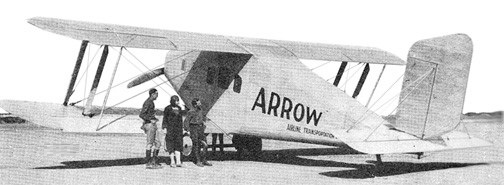
The Airline Arrow was a 1922 major modification of a Standard J-1 by (John W) Rogers Aircraft Co, Los Angeles, for this aspiring LA-Imperial Valley airline proved unsatisfactory. Seating 8 inside the cabin, it was the second commercial airliner design, after Lawson Air-Liner. It and the fledgling company flew into obscurity in the Depression Era.
Engine: possibly 300hp Hall-Scott
Cruise speed: 100 mph
Seats: 8
Airline Transportation Co
Airplane builder founded in 1921 by L E Hardy, in Los Angeles, California, USA.
Aircraft Investment Corp Ltd
UK
Formed 1929 to deal in or build lighter- or heavier-than-air craft. Technical advisor Sir Henry Segrave, pilot and sportsman. This group had interests also in Saunders-Roe Ltd. and Blackburn Consolidated Ltd. (founded 1929). Segrave designed twin-engined Segrave Meteor 1, built by Saunders-Roe, known also as Sara Segrave Meteor 1, and flown in King’s Cup Race 1930 by Major A. P. Holt. Segrave killed in Saro-built motorboat during speed record attempt in 1930, but development of Meteor 1 continued by Blackburn.
ADC Phi-Phi
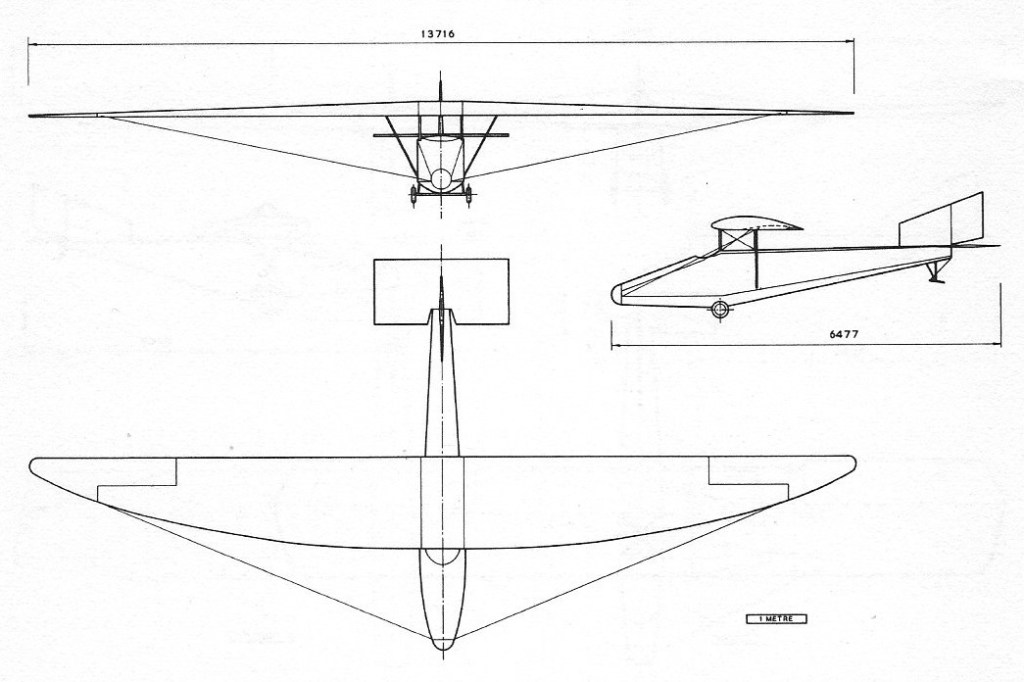
A single-seat glider built by the Aircraft Disposal Company Ltd. Of wooded construction, the parasol mounted wing used an Airdisco wing section. No brakes or flaps were fitted. Twin main wheels and a sprung and pivoted tailskid were fitted.
Only one was built, which crashed during competition. It was flown by Capt. R.H Stockton.
Wingspan: 13.72 m / 45 ft 0 in
Length: 6.48 m / 21 ft 3 in
Wing area: 13.94 sq.m / 150 sq.ft
Aspect ratio: 13.5
ADC Nimbus
The ADC Nimbus was a British liquid-cooled inline piston aero engine that first ran in 1926. The Nimbus was developed from the Siddeley Puma aero engine by Frank Halford of the Aircraft Disposal Company, the goal was to develop the Puma to produce its intended power output which Halford eventually achieved. The Nimbus was further developed into an air-cooled version known as the ADC Airsix which did not enter production and was not flown.
Applications:
Airco DH.9
de Havilland DH.37
de Havilland DH.50
Nimbus Martinsyde
Vickers Vendace
Components:
Valvetrain: 1 inlet and 2 exhaust valve per cylinder
Fuel system: Carburettor
Fuel type: 74 octane
Cooling system: Air-cooled
Reduction gear: Direct drive, right hand tractor
Nimbus
Type: Six-cylinder, inline, liquid-cooled, upright piston engine
Bore: 6.0 in (152 mm)
Stroke: 7.5 in (190 mm)
Displacement: 1,150.3 cu in (18.85 L)
Length: 70 in (1,778 mm)
Width: 17.5 in (444 mm)
Height: 44 in (1,118 mm)
Dry weight: 670 lb (304 kg)
Performance
Power output: 305 hp (227 kW) at 1,450 rpm (takeoff power)
Specific power: 0.26 hp/cu in (12 kW/L)
Compression ratio: 5.4:1
Power-to-weight ratio: 0.46 hp/lb (0.9 kW/kg)
ADC Cirrus / Cirrus Aero Cirrus / Cirrus-Hermes Cirrus Blackburn Cirrus

The 4-cylinder ADC Cirrus engines were originally built by ADC Aircraft until Cirrus Aero Engines Limited was formed in 1927. The company became Cirrus-Hermes in 1931 when it was bought by the Cirrus-Hermes Engineering Company and later became the Cirrus Engine Section of Blackburn & General Aircraft Limited in 1934, and operated as a separate division until production ended in the post-World War II era.
Cirrus’s first product was the 90 hp (67 kW) Cirrus I, which passed its 50 hour type rating in 1925. It was the first air-cooled inline engine, a design by Frank Halford that proved extremely popular for light aircraft. The basic layout (using one cylinder bank of an ADC Airdisco V-8 engine) was quickly copied by a number of other manufacturers. Later versions named the Cirrus II, and Cirrus III were produced each with slightly greater displacement, and power (Cirrus II – 85 hp, Cirrus III – 90 hp).

The next model line, Cirrus-Hermes I, II, and IV were produced ranging in power from 105 hp to 140 hp depending on type. The later Cirrus engines were designed to run inverted.
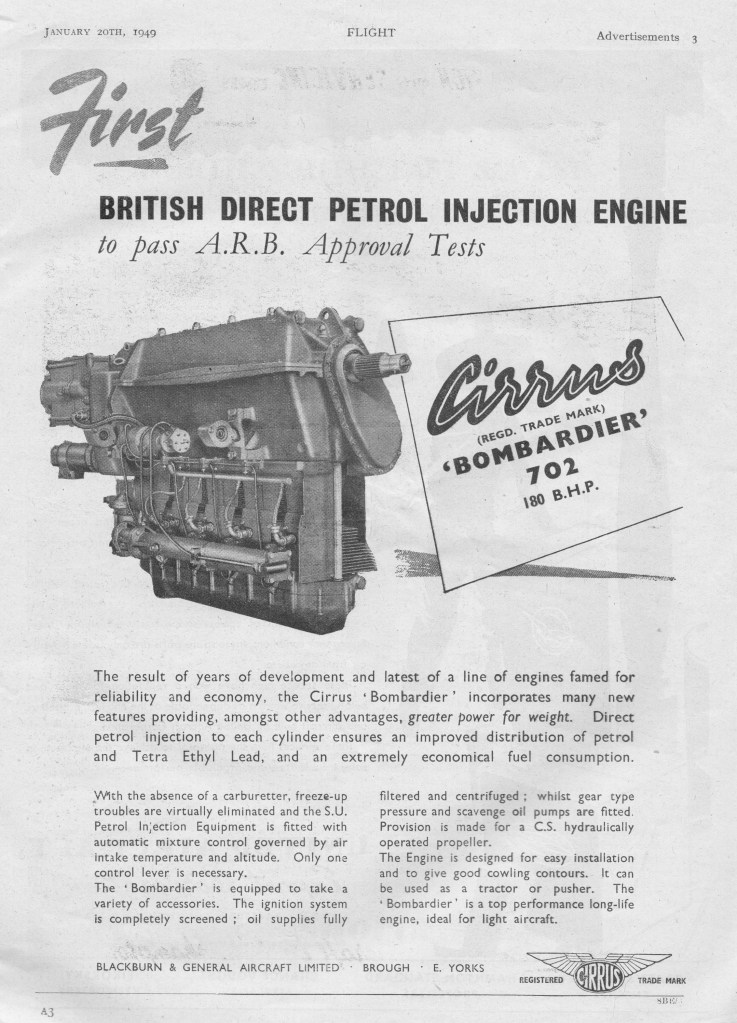
In 1949 Blackburn and General Aircraft Ltd extended the major inspection of the Cirrus Minor II from 300 hours to 400 hours.
Variants:
Cirrus I (1925)
Cirrus II (1926)
Cirrus III (1929)
Cirrus IIIA (1933)
Cirrus-Hermes I (1929)
Cirrus-Hermes II (1930)
Cirrus-Hermes IIB (inverted) (1931)
Cirrus-Hermes IV (1930)
Cirrus-Hermes IVA (1929) Inverted engine
Applications:
Cirrus I
Avro Avian
Avro Baby
de Havilland DH.60 Moth
Short Mussel
Westland Widgeon
Cirrus II
Avro Avian
de Havilland DH.60 Moth
de Havilland DH.71 Tiger Moth
Piaggio P.9
Short Mussel
Westland Widgeon
Bloudek XV Lojze
Cirrus III
Avro Avian
Blackburn Bluebird
Cierva C.17
de Havilland DH.60 Moth
de Havilland DH.71 Tiger Moth
Dudley Watt D.W.2
Klemm L.26
Klemm L.27
Short Mussel
Simmonds Spartan
Spartan Arrow
Westland Wessex
Westland Widgeon
Cirrus IIIA
Miles M.2 Hawk
Cirrus-Hermes I
Avro Avian
Blackburn Bluebird
de Havilland DH.60 Moth
Desoutter I
Hawker Tomtit
Hendy 302
Parnall Elf
Saro Cutty Sark
Simmonds Spartan
Southern Martlet
Westland Wessex
Westland Widgeon
Cirrus-Hermes II
Avro Avian
Blackburn Bluebird
Desoutter I
Spartan Arrow
Spartan Three-Seater
Westland Widgeon
Cirrus-Hermes IIB
Arrow Active
BFW M.23
Klemm L.27
Koolhoven F.K.44
Koolhoven F.K.45
Spartan Three-Seater
Cirrus-Hermes IV
Avro Cadet
Hendy 302
Miles M.2 Hawk
Percival Gull
Spartan Cruiser
Spartan Three-Seater
Cirrus-Hermes IVA
Avro Club Cadet
Blackburn B-2
Blackburn Segrave
Specifications:
Cirrus I
Type: Inline, air-cooled, upright 4-cylinder piston engine
Bore: 4.13 in (105 mm)
Stroke: 5.12 in (130 mm)
Displacement: 274.36 cu in (4.5 L)
Length: 45.8 in (116.3 cm)
Width: 18.26 in (46.4 cm)
Height: 34.3 in (87.1 cm)
Dry weight: lb ( kg)
Valvetrain: 1 inlet and 1 exhaust valve per cylinder
Fuel system: 1 Claudel carburettor
Fuel type: 70 octane
Cooling system: air
Power output: 60 hp ( kW)
Compression ratio: 4.7:1
ADC Airdisco
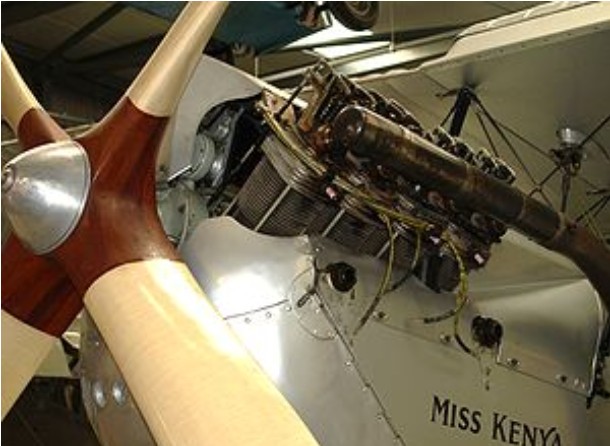
An air-cooled V-8 piston engine, the ‘Airdisco’ was developed from the French Renault 70 hp aero engine by Frank Halford of the Aircraft Disposal Company. First running in 1925, the main difference being the use of aluminium cylinder heads. Halford later used one bank of cylinders to create the Cirrus engine.
Components:
Valvetrain: 1 inlet and 1 exhaust valve per cylinder
Fuel system: Carburettor
Fuel type: 74 octane
Cooling system: Air-cooled
Reduction gear: 0.5:1, right hand tractor
Power output: 120 hp ( kW) at 1,800 rpm (takeoff power)
Compression ratio: 4.6:1
Applications:
Avro 548A
Cierva Parnall Gyroplane
de Havilland DH.51
Royal Aircraft Factory S.E.5A
Airdisco
Type: Inline air-cooled, upright, V-8 piston engine
Bore: 4.13 in (105 mm)
Stroke: 5.12 in (130 mm)
Displacement: 548.94 cu in (9 L)
Length: 46 in (1,168 mm)
Width: 21.3 in (541 mm)
Height: 31.1 in (790 mm)
ADC Nimbus Martynside
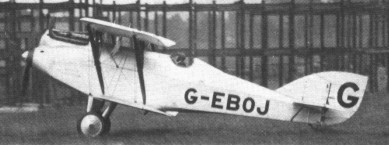
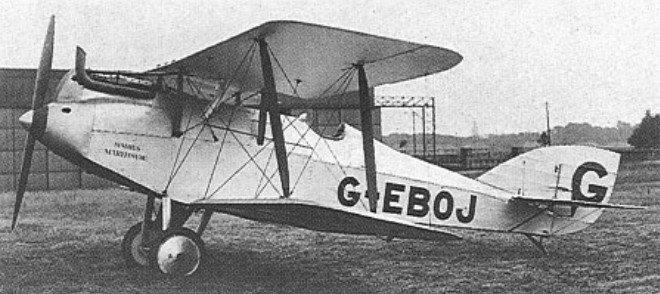
In 1926, John Kenworthy developed a single-seat fighter based on the F.4 Buzzard but utilising a 330 hp A.D.C. Nimbus six-in-line water-cooled engine. Referred to as the “Nimbus-Martinsyde”, with an essentially similar airframe to the Buzzard, it featured modified vertical tail surfaces with a horn-balanced rudder and revised aft upper fuselage decking. Its intended armament was two synchronised 0303-in (7,7-mm) Vickers machine guns, but these were never installed. Two prototypes were built and flown, both participating in the King’s Cup Air Race on 9-10 July 1926, and in 1927, the first prototype was modified with faired undercarriage legs and cylinder head fairings. No orders were placed for the Nimbus-powered aircraft and both prototypes were scrapped.
Engine; ADC Nimbus, 330hp
Span, 32 ft 9 in (9,98 m)
Length, 26 ft 10 in (8,18 m)
Height, 9 ft 6 in (2,89 m)
Wing area, 320 sq ft (29,73 sq.m)
Empty wt; 2014lbs, 914kg
Loaded wt; 2665lb, 1209kg
Max speed sea level, 150mph, 241 kph at sea level
Climb to; 10,000ft: 7min 30sec
Climb to 15,000ft: 14min
Climb to 20,000ft: 25min
Service ceiling; 23,500ft
Endurance: 2.5hrs

