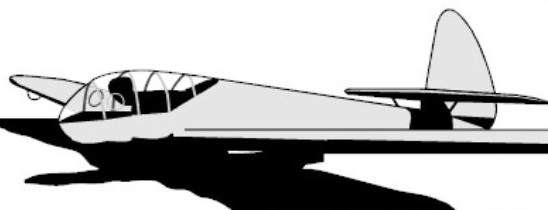
The FS-17 was designed and built from 1936. Only one example was built.
The FS-17 was designed and built from 1936. Only one example was built.
The Akaflieg München Mü11 Papagei is a primary glider that was designed and built at Akaflieg München in Germany in 1935.
The Mü11 Papagei, (Parrot), was a single-seat primary style training glider similar to the SG-38 but with a Mü Scheibe aerofoil section. Flight trials were carried out in 1935 but there is very little information available. Only one photograph and a contemporary model survive. The photograph shows the pilots seat surrounded by a plywood nacelle.
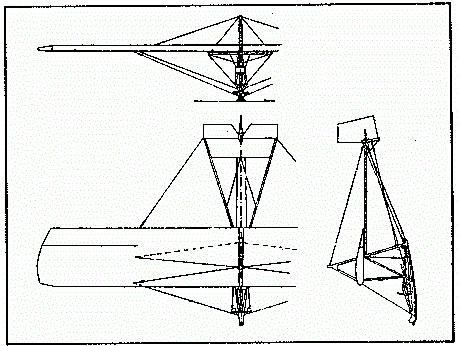
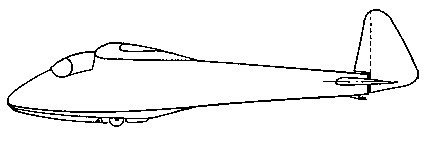
High Performance Glider, Germany, 1934
The Milan of 1934 was one of the first german, two-seater, high performance gliding airplanes. It had a steel tube frame and was developed by Egon Scheibe, who later became well known for glider design.
Length: 19.029 ft / 5.8 m
Wingspan: 58.399 ft / 17.8 m
Max take off weight: 407.9 lb / 185.0 kg
Max. speed: 65 kts / 120 km/h
Crew: 2
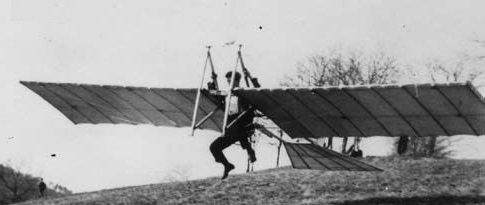
The Akaflieg Graz started early with their first model, the Mauwurf glider, in 1923.
The Akademische Fliegergruppe of Darmstadt Technical High School has been involved in designing, building and flying gliders since as far back as 1909, and among its more successful designs was the metal high-performance D-30 Cirrus, which had an unusual pod-and-boom type fuselage and a minimum sinking speed of only 1.6ft/sec, being among the most efficient of the prewar German designs.
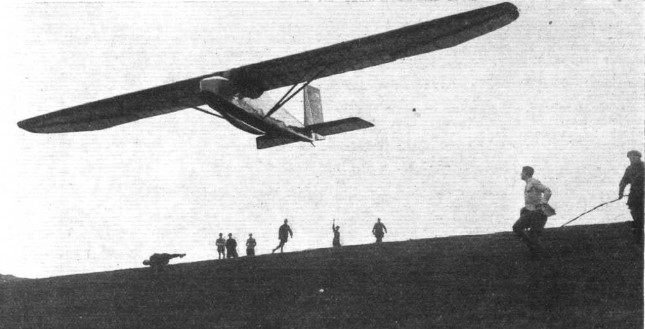
The Akademische Fliegergruppe of the Technical University of Darmstadt was first formed in 1921. It was, and is, a group of aeronautical students who design and construct aircraft as part of their studies and with the help and encouragement of their University. Designed by Fritz Hoppe, R. Kercher and E.Schatzki, the 1923 D-7 monoplane was their first two-seat design and one of the first of its kind, though the Fokker FG-2 two seat biplane glider flew the previous year; the D-7 was named after the wife of an Akaflieg Darmstadt student killed at the first Rhön (Wasserkuppe) glider meeting in 1920.
The Margarete was a wood framed aircraft with a high, braced, two spar wing with ply covering from the front spar to the leading edge and fabric covered aft. The wing had a thick and cambered profile inboard of the tips, which had a thinner and more symmetric profile. Initially the wing plan was rectangular, with triangular ailerons mounted on straight hinges which were attached to the front spar at the tips, reaching the trailing edge inboard. Later, the aileron area was reduced, partly by cropping them inboard and also by tapering their trailing edges and rounding their tips. Each wing was braced from the lower fuselage with an asymmetric, V-form, streamlined strut to the two spars at about one-third span.
The fuselage was plywood covered with a flat top, deep, slightly curved sides and a V-shaped bottom. The nose was blunt and the open, unscreened cockpit used for solo flying was well forward of the wing leading edge. The separate second cockpit was under the wing, close to the centre of gravity so that its occupation did not seriously affect the trim. The wing centre section was supported above this cockpit on an extension of the upper rear fuselage, which dropped away aft to become slender at the tail. There was a short undercarriage skid attached directly to the fuselage underside, aided by a small tailskid. A narrow, triangular, ply covered fin carried a fabric covered, trapezoidal rudder which extended to the bottom of the fuselage. The fabric covered tailplane was mounted on the top of the fuselage; in plan, tailplane and elevators were straight edged, only slightly tapered and with angled tips. A small elevator cut-out allowed rudder movement.
The D-7 Margarete first flew in 1923 and took part in both the 1923 and 1924 Rhön events, setting an unofficial record at the latter with a passenger-carrying flight of 21 minutes. It was later used for passenger flights, though not for basic training, until it was written off in 1927 when an aileron cable broke during landing.
Wingspan: 15.30 m (50 ft 2 in)
Wing area: 25 m2 (270 sq ft)
Aspect ratio: 9.36
Airfoil: Göttingen 533 at root, more symmetrical at tip
Length: 7.65 m (25 ft 1 in)
Empty weight: 180 kg (397 lb) structure
Gross weight: 320 kg (705 lb) in flight
Wing loading: 12.8 kg/m2 (2.6 lb/sq ft)
Crew: 1
The Akademische Fliegergruppe of Darmstadt Technical High School has been involved in designing, building and flying gliders since as far back as 1909, and among its more successful designs was the Edith of 1922.
Akaflieg Darmstadt
Akafliegheim Flughafen
38110 Braunschweig
Germany
Established in 1921 by students at the Technical High School, Darmstadt, for building and testing aircraft. Produced a number of sailplanes, and from 1924 a series of advanced light aircraft that held several class records. Work on powered aircraft ended 1939.
1939, single-seat performance glider, to meet the specifications of the Olympia tender (the competition to design a glider for the 1940 Olympic Games), cantilever shoulder-wing, dive air-brakes, all wood, constructed in 2 versions (version 2 = adjustable dihedral-angle)
1939, two-seater performance glider, planned, but not built

