For transatlantic attempt built (1919) a special P.2 Seabird biplane with 21 -hour endurance, powered by Napier Lion engine; a second example crashed attempting Australia flight.
Inter-Wars
Alliance Airplane Co P.1
biplane trainer
Alliance Airplane Co
Founded in London during the First World War by Lord Waring, and built large assemblies for Handley Page bombers. Shortly after the war amalgamated with the British Aerial Transport Co and British Nieuport & General Aircraft Co; also with other smaller companies including Ruffy, Arnell & Baumann Aviation Co. With last-named company the Alliance P.1 biplane trainer originated. For transatlantic attempt built (1919) a special P.2 Seabird biplane with 21 -hour endurance, powered by Napier Lion engine; a second example crashed attempting Australia flight
Allenbaugh Grey Ghost
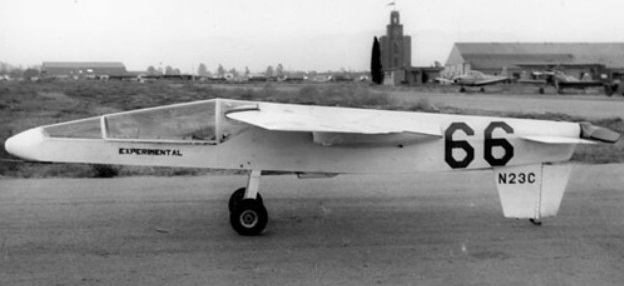
The Allenbaugh Grey Ghost Goodyear racer, No.66, registered N23C, was designed and built by Paul Schaupp for Ed Allenbaugh. A prone pilot required a fuselage of only 25 inch deep. The engine was behind the pilot.
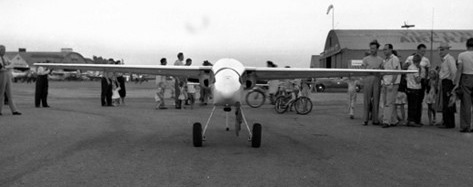
The pilot, Dwight Dempster, was killed on the first flight when the engine failed on take-off due to oil sump pump failure. The Prone pilot arrangement was outlawed by the P.R.P.A.
Engine: Continental C-85
Span: 18 ft
Length: 19 ft 6 in
Allen Aircraft Engine Corp O-675
The Allen Aircraft Engine Co. of Compton, a suburb of Los Angeles California, developed an eight-cylinder horizontally opposed aircraft engine during 1928–1929.
Little is known about this engine, other than that it was never given a Type Certificate and that it was not used on any known aircraft.
O-675
Type: 8-cylinder horizontally opposed
Bore: 4.75 in
Stroke: 4.75 in
Displacement: 673.4 ci
Dry weight: 575 lb
Cooling system: air-cooled
Ignition system: dual ignition
Power output: 200 hp@1800 rpm
Alfa Romeo D2
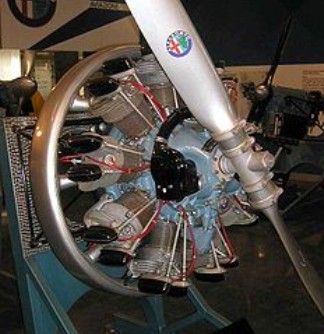
The Alfa Romeo D2 was a nine-cylinder radial engine for aircraft use produced in Italy. It was typically rated between 240-270 hp. The engine was designed by Vittorio Jano and produced 600 units between 1931-1934. This engine was also first purpose-built aircraft engine produced by Alfa Romeo, before it all Alfa engines used in airplanes were derived from engines used in cars. A supercharged derivative was produced as the D2 C.
Applications:
Breda Ba.25
Caproni Ca.101
General characteristics
Type: Nine-cylinder radial engine
Bore: 120 mm (4.724 in.)
Stroke: 135 mm (5.315 in.)
Displacement: 13.74 L (838.5 cuin)
Supercharger: 2.5:1
Power output: 270 hp
Compression ratio: 5:1
Alfa Romeo 135 Tornado / 136
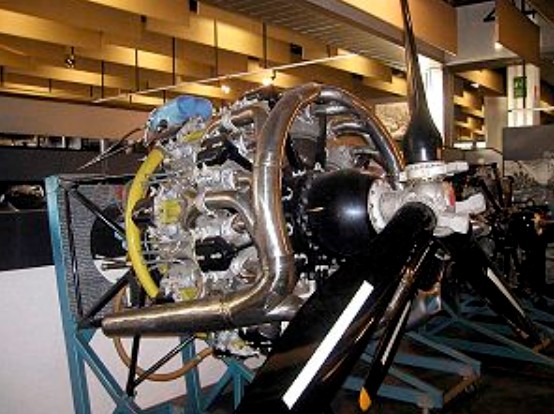
The Alfa Romeo 135 Tornado was an Italian 18-cylinder radial engine designed by Giustino Cattaneo in 1934-35. The engine consisted of two nine-cylinder radial banks, similar to the Alfa Romeo 126. Cattaneo left Alfa Romeo in 1936, leaving the development to eng. Bossi and his staff. At the time of its first running in 1938 and 1939 it was the most powerful radial engine in the world, generating just less than 1492 kW (2000 hp) on 100-octane fuel, but the normal was 87 (1,200-1,600 hp).Despite the obvious potential, this engine was affected by many reliability problems. Reliability was solved in 1939 but it suffered from overheating and vibrations, so seriously that it was rejected from service. By 1944 only an handful were made, and never fitted in a operational aircraft. Only around 150 units of this engine were manufactured.Variants: 135 R.C.32Power output: 1177 kW (1600 hp) at Take Off, 1030 kW (1400 CV) at 3200m Applications:Cant Z.1018 “Leone” Savoia-Marchetti SM.87 (four planes) Savoia-Marchetti SM.82 (central engine) Savoia-Marchetti SM.90 (one prototype) Cant Z 1014 (five prototypes)135 R.C.34Power output: 1194 kW (1600 hp)Applications: Focke-Wulf Fw 200 “Condor” (engines supllied for testing) 136 R.C.25Power output: 1765 kW (2400 hp) at 0m, 1360 kW (1850 CV) at 2500mApplications: CRDA CANT Z.1018 “Leone”136 R.C.65Power output:1618 kW (2200 hp) at Take Off, 1214 kW (1650 CV) at 6500mType: 18-cylinder radial engine
Alfa Romeo Jupiter / 125 / 126 / 128 / 129 / 131
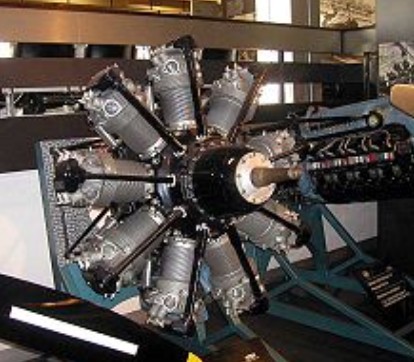
Alfa Romeo built/designed several aircraft engines based on Bristol Jupiter and Pegasus designs. These engines were named as 125, 126, 128, 129 and 131. The 126-RC34 was derived from Bristol Pegasus and 126-RC35 from Jupiter 9-cylinder radial design. All these engines were mainly fitted to Italian bombers in World War II. Between 1934 and 1944 Alfa Romeo built around 11,000 units.
Alfa Romeo Jupiter (Bristol)
Power output: 313 kW (420 hp)
Applications:
Caproni Ca.97
Alfa Romeo 125 RC.35
Power output: 485 kW (650 hp)
Applications:
Breda Ba.64
Savoia-Marchetti SM.79 “Sparviero”
Savoia-Marchetti SM.81 “Pipistrello”
Alfa Romeo 126 RC.34
Power output: 507-582 kW (680-780 hp)
Applications:
DAR-10A (prototype)
Savoia-Marchetti SM.73
Savoia-Marchetti SM.74
Savoia-Marchetti SM.79 “Sparviero”
Savoia-Marchetti SM.81 “Pipistrello”
Savoia-Marchetti SM.83
Caproni Bergamaschi AP.1
Cant Z.506B “Airone”
Junkers Ju 52
Alfa Romeo 126 RC.32
Power output: 1,006 kW (1,350 hp)
Applications:
Savoia-Marchetti SM.79-II “Sparviero”
Alfa Romeo 126 RC.10 (civilian RC.34)
Power output: 559-597 kW (750-800 hp)
Applications:
Cant.Z.506A
Macchi M.C.94
Macchi M.C.100[5]
Savoia-Marchetti SM.73
Alfa Romeo 128 RC.18
1939
Power output: 641-717 kW (860-962 hp)
Applications:
Fiat G.12
Savoia-Marchetti S.M.79B “Sparviero”
Savoia-Marchetti SM.82 “Canguru”
Savoia-Marchetti SM.95
Alfa Romeo 128 RC.21
Power output: 708 kW (950 hp)
Applications:
Savoia-Marchetti SM.75 “Marsupiale”
Savoia-Marchetti SM.82
Alfa Romeo 115
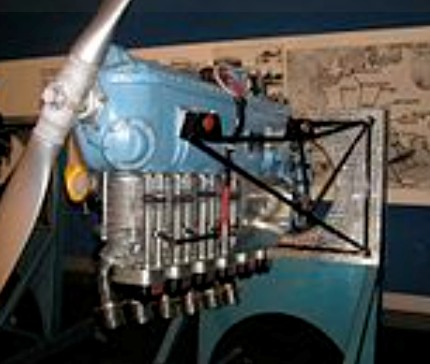
The Alfa Romeo 110 and 115 were Italian air-cooled inverted inline engines for aircraft use, mainly for training and light planes. The Alfa Romeo 115 was a six-cylinder engine produced between 1936 and 1956; some 1,600 units were built. It was based on the de Havilland Gipsy Six engine.
Alfa Romeo 115
Power output:89 kW (120 hp)
Applications:
Ambrosini SAI.2S (version 115-I)
Ambrosini SAI.3
Bestetti BN. 1 (one prototype)
Breda Ba.75 (prototypes)
Breda Ba.79S
CANT Z.1012 (or 110)
Caproni Ca.164
Caproni Ca.309 Ghibli (version 115-II)
Nardi FN.305
Nardi FN.315
Saiman 200
Alfa Romeo 115bis
Power output: 145 kW (195 hp)
Applications
Fiat G.46-1B
Fiat G.46-3B and G.46-4B
Alfa Romeo 115ter
Type: six-cylinder inverted air-cooled inline engine
Bore: 118 mm (4.65 in)
Stroke: 140 mm (5.52 in)
Displacement: 9.186 L (560.6 in3)
Length: 1,642 mm (64.7 in)
Width: 498 mm (19.6 in)
Height: 825 mm (32.5 in)
Dry weight: 233 kg (515 lb)
Valvetrain: Two valves per cylinder, sodium-cooled exhaust valves
Fuel system: Two downdraught carburettors
Fuel type: 100/130 grade
Oil system: Pressure type. One pressure and three scavenger pumps
Cooling system: Air-cooled
Power output: 168 kW (225 hp) (max power), 160 kW (215 hp) (normal)
Compression ratio: 6.5:1
Specific fuel consumption: 150 g/hp/hr (0.55 lb/hp/hr) (take-off)
Oil consumption: 2.5 kg/hr (5.5 lb/hr)
Power-to-weight ratio: 0.72 kW/kg (0.44 hp/lb)
Applications:
Ambrosini S.7
Fiat G.46-A, G.46-3A and G.46-4A
Alfaro 155hp
A 1938 engine designed by Heraclio Alfaro and built by the Indian Motorcycle Co (Hendee), Springfield MA. USA.
It was a 155hp 167ci 4-cyl barrel engine.

