Formed 1939 to take over Security Aircraft Corporation, including manufacturing rights for Security S1 -B two-seat tourer/trainer, a number of which were in production in the summer of 1939.
Inter-Wars
American Aeronautical Corp
Formed at Long Island, New York, October 1928 to build two types of Savoia-Marchetti flying-boat. These comprised S-55, as under Societa Idrovolanti Alta Italia, and S-56 three-seat biplane amphibian, the latter having an American Kinner engine. In 1931 the Dayton Airplane Engine Co acquired a controlling interest in the company.
American Eaglet
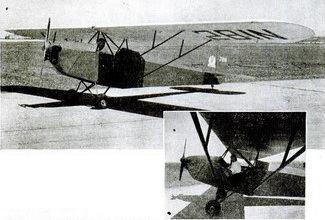
In 1930 American tested the American Eaglet at Kansas City. A home builders lightweight aircraft, it is a parasol type capable of carrying one person with a Cleone engine, or two with a Szekeley three cylinder 35 hp engine.
The conventional wings are built up in spruve and plywood. A feature of the fuselage is the way the lower longerons are brought together mid-way between the nose and tsil group as a single member. The fuselage is 23 inches wide and constructed of steel tubing as is the tail group.
Cables are used for control throughout. These run over pulleys and the aileron cables come down over two auxilliary pulleys at either side of the forward section of the cockpit. An aluminium seat is fitted with an instantaneous action safety belt.
The landing gear is a rigid inverted Vee type. It is equipped with 7×16 inch air wheels on four inch hubs. The landing gear is diagonally braced. A shoe tail skid is fitted, tied into the stern post and a rubber shock chord is used.
Wing tip ailerons are fitted. The horizontal stabiliser is ground adjustable and the fin is rigid. An unbalanced rudder is used.
Ordinary motor car gasoline and lubrication oil are mixed at 8:1 and carried in a single tank built into the cowling directly ahead of the pilot.
The gap where the wings are fasteed to the cabane section is covered with celluloid.
The Eaglet was sold for $995 with the Cleone engine and $1395 with the Szekeley in 1930.
Engine: Cleone
Wingspan: 34 ft 4 in
Length: 21 ft 6 in
Height: 78 in
Wing area: 164.4 sq. ft
Max weight: 580 lb
Engine weight: 46 lb
Prop weight: 4 lb
Battery weight: 15 lb
Fuel capacity: 36 lb
Speed: 60 mph
Landing speed: 15 mph
ROC: 350 fpm
Glide ratio: 12-1
TO MAUW: 13 sec
Fuel burn: less than 2 USG/hr
American Eagle
The Kinner powered American Eagle from the 1920s.
Ambrosini F.4 Rondone I / F.7 Rondone II
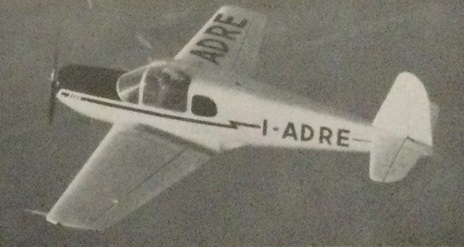
Designed by Stelio Frati, the Rondone was produced in two versions; the two-seat F.4 Rondone I and three-seat F.7 Rondone II (originally known as the Airone).
A batch of ten Rondone I two-seaters were built by S.A.I. Ambrosini, and additional aircraft were built by Legnami Pasotti & Co.
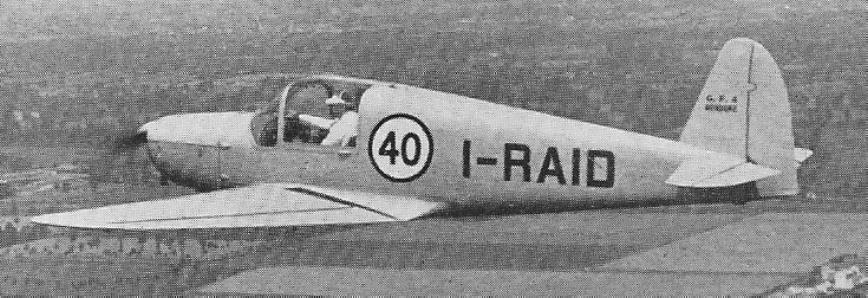
Both versions are generally similar externally.
The F 7 Rondone II with the 90 hp engine sold for 4.5 Mill.Lire.
Raab Flugzeugbau also acquired rights to license-produce the Ambrosini Rondone four-seat monoplane.
F.4 Rondone I
Engine: Walter Mikron II, 65 hp
Seats: 2
Empty weight: 749 lb
Loaded weight: 1212 lb
Max speed: 143 mph
Cruise: 124 mph
Range: 466 mi
Wingspan: 28 ft 2.25 in
Length: 20 ft 2 in
Wing area: 114.097 sq.ft
F.7 Rondone II
Engine: Continental C90, 90 hp
Seats: 3
Empty weight: 1124 lb
Loaded weight: 1742 lb
Max speed: 149 mph
Cruise: 130 mph
Range: 385 mi
Wingspan: 30 ft 6 in
Length: 22 ft 3.5 in
Wing area: 142.083 sq.ft
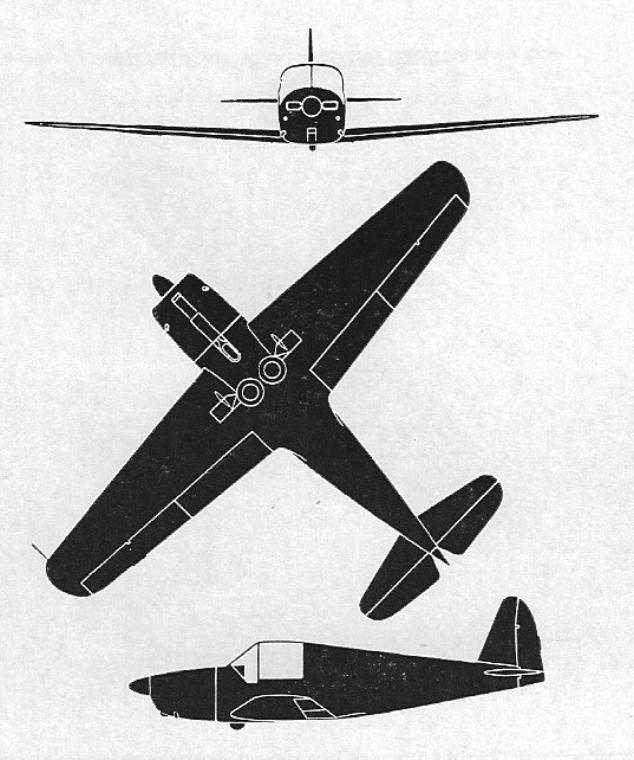
Ambrosini SS 4
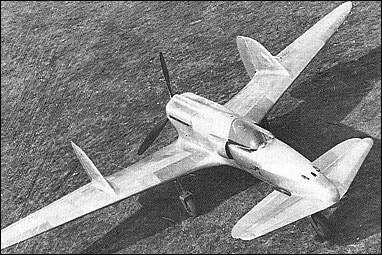
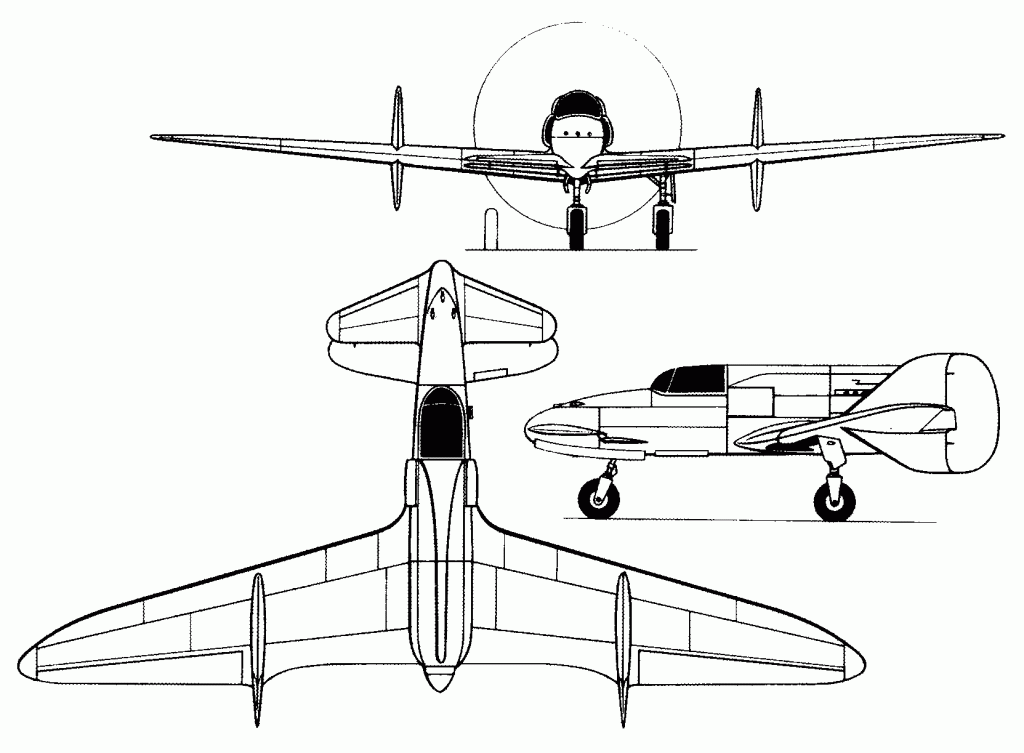
The single-seat S.S.4 monoplane fighter designed by Ing Sergio Stefanutti was tail-first configuration with a retractable nosewheel undercarriage. Built by the Societa Aeronautica Italiana Ing A Ambrosini it was of all-metal construction and powered by a 960hp liquid-cooled 12-cylinder Isotta-Fraschini Asso XI R.C.40 engine driving a three-bladed variable-pitch pusher propeller.
With a 960 hp Isotta Fraschini Asso XI 12 cylinder liquid-cooled engine, the S.S.4 was capable of a maximum speed of 540 kph (335 mph) at 5000 m (16,400 ft) and was to have been armed with two 20 mm and one 30 mm cannon.
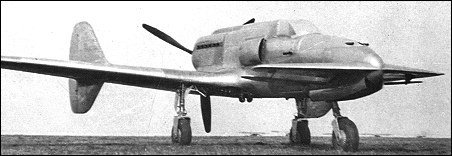
The sole prototype was first flown on 7 March 1939, but was destroyed during its second flight on the following day when the starboard aileron separated, the wing developed a high amplitude oscillation and the aircraft entered a dive and crashed at Guidonia.
Although. the Italian Air Ministry ordered another prototype, pres¬sure of other projects caused the fighter to be abandoned. No further development was undertaken.
Manufacturer’s estimates:
Engine: Isotta-Fraschini Asso XI R.C.40, 960hp
Take-off weight: 2446 kg / 5393 lb
Empty weight: 1800 kg / 3968 lb
Wingspan: 12.32 m / 40 ft 5 in
Length: 6.74 m / 22 ft 1 in
Height: 2.48 m / 8 ft 2 in
Wing area: 17.50 sq.m / 188.37 sq ft
Max. speed: 540 km/h / 336 mph
Ambrosini S.A.I.3
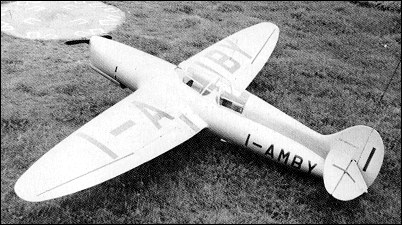
Designed as a two-seat light training and touring monoplane, the Ambrosini S.A.I.3 had long-span elliptical wings, a deep rear fuselage and a fixed tailwheel type landing gear. The chosen powerplant was either a 63kW Fiat A.50 radial or 97kW Alfa Romeo A.110 inverted inline piston engine, the latter enclosed within a close cowling. Small batches of the S.A.I.3 were built, some of them with an enclosed cabin in place of the more common tandem open cockpits. The more powerful Alfa Romeo-engined model had superior performance, despite a maximum take-off weight increase by 40kg to 830kg; maximum speed rose to 230km/h, service ceiling to 5200m and range to 680km.
S.A.I.3
Engine: 1 x Fiat A.50 piston engine, 63kW
Take-off weight: 790 kg / 1742 lb
Empty weight: 550 kg / 1213 lb
Wingspan: 10.45 m / 34 ft 3 in
Length: 7.05 m / 23 ft 2 in
Height: 2.8 m / 9 ft 2 in
Wing area: 14 sq.m / 150.69 sq ft
Max. speed: 200 km/h / 124 mph
Cruise speed: 170 km/h / 106 mph
Ceiling: 4000 m / 13100 ft
Range: 620 km / 385 miles
Ambrosini S.A.I. 2
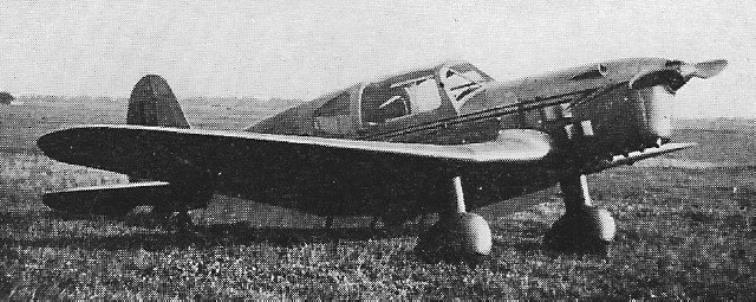
Ambrosini took over the Passignano factory of the Societa Aeronautica Italiana in 1934 and in 1935 produced the S.A.I. 2 five seat cabin monoplane for the Littorio Rally and Air Race,
The S.A.I. 2S four-seater cabin monoplane was developed from the S.A.I. 2, and the post-war Grifo and Girfalco were developed directly from this aircraft.
Engine: Alfa 115, 185 hp
Wingspan: 34 ft 11 in
Length: 25 ft 6 in
Height: 9 ft 2 in
Empty weight: 158 lb
Loaded weight: 3124 lb
Max speed: 161 mph
Cruise: 137 mph
Range: 702 mi
Ambrosini
After incorporation of Societa Aeronautica Italians with Ing A. Ambrosini & Cie, they specialised in fast tourers and sporting monoplanes, though SA11 was biplane. In the immediate pre-war years its Passignano plant was responsible for a successful series of light cabin monoplanes.
In 1939, the chief designer, Sergio Stefanutti, developed an unorthodox tail-first, single-seat fighter, the S.S.4.
The series of light monoplanes had culminated in the S.A.I.7, The series of light monoplanes had culminated in the S.A.I.7 which, of exceptionally clean design and powered by a 280-h.p. Hirsh H.M.508D air-cooled engine, gained the 100-km. closed circuit record for F.A.I. Category I aircraft with a speed of 244 m.p.h. in 1939. The S.A.I.7 possessed excellent flight characteristics. Stefanutti had designed the aircraft with the alternative role of fighter trainer in mind, and a fully militarized trainer prototype flew in 1941. The original prototype featured a long, faired windscreen which extended to the front of the engine cowling to reduce drag, but the military trainer had an orthodox cockpit canopy for the tandem-seated pupil and instructor, and the German Hirsh was replaced by a 280-h.p. Isotta-Fraschini Beta R.C.I0.
The S.A.I.7 trainer basic design were such that Stefanutti contemplated its adaptation as a lightweight interceptor fighter. The initial single-seat model, the S.A.I.I07, was built for research purposes.
The S.A.I.I07 was externally similar to the S.A.I.207, which was built to full fighter requirements and carried an armament of two 20-mm. cannon and two 12.7-mm. machine guns. In dives the S.A.I.207 fighter attained an indicated air speed of 466 m.p.h. at 10,000 ft. (representing a true air speed of 596 m.p.h., or Mach 0.86), and maximum level speed was 357 m.p.h., which was attained on the 750 h.p. provided by an Isotta-Fraschini Delta R.C.40 engine. 2,000 were ordered, though only 13 completed. The type being replaced by proposed production of the SAI 403, work on which finished at war’s end.
Encouraged by the performance of the S.A.I.207, Sergio Stefanutti developed the more ambitious S.A.I.403 Dardo, which featured increased wing area and redesigned tail surfaces. Carrying a similar armament to that of its predecessor, the Dardo was powered by a 750-h.p. Delta R.C.21/60 engine which provided a maximum speed of 403 m.p.h. Large-scale production of the Dardo was planned, but the armistice precluded further development.
Other wartime activities of the S.A.I.-Ambrosini concern were the construction of the AL-12P troop- and cargo-carrying glider designed by Aeronautica Lombarda S.A., and the development of the Ambrosini AR “flying bomb”. Conceived by General Ferdinando Raffaelli as an anti-shipping weapon, the flying bomb was powered by a 1,000-h.p. Fiat A.80 radial engine and was to have been flown off the ground by a pilot who would then bail out, the bomb being directed to its destination by remote radio-control. Flight tests began on 13th June 1943, and four further examples were built at the Venegono plant. Flight trials were successful and a speed of 225-230 m.p.h. was expected, but the bomb was too late to see operational service.
In 1948 the S1001 Grifo broke more records. The S 7 was delivered in small numbers and developed into the Super S 7 (1950s). The F 7 Rondone was 3/4-seat cabin tourer.
Alvis Leonides

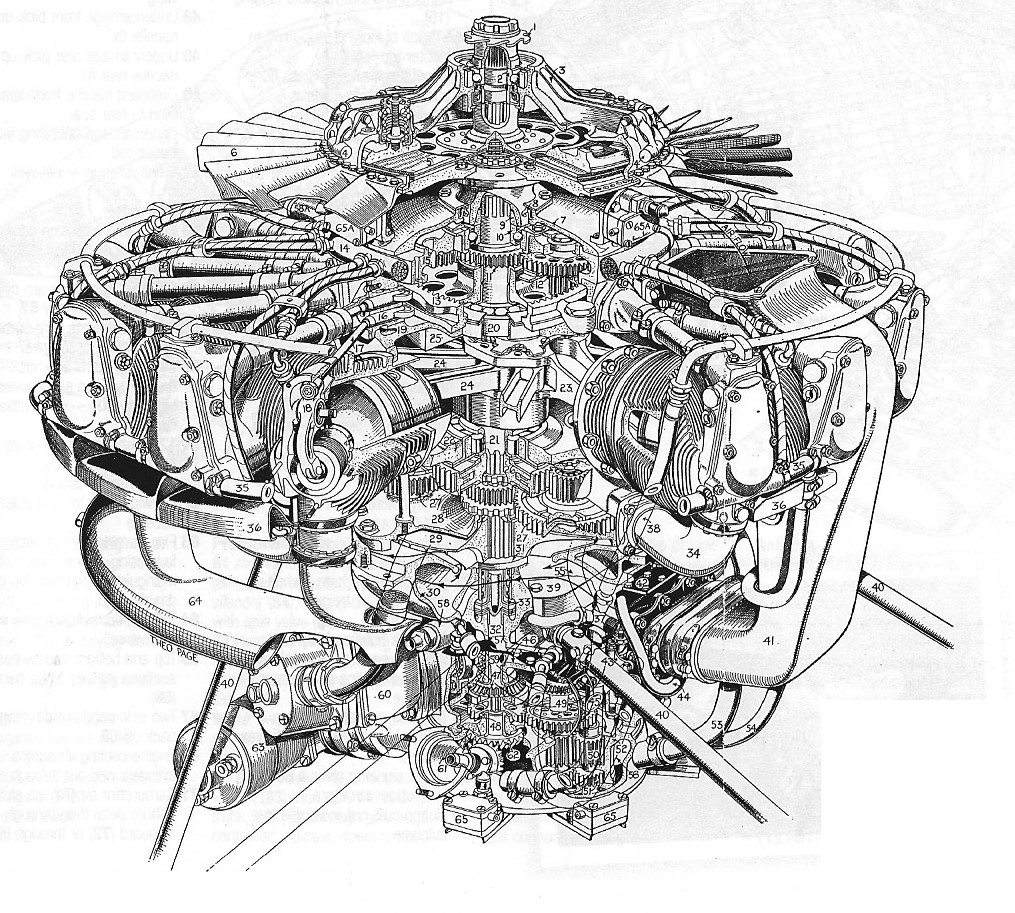
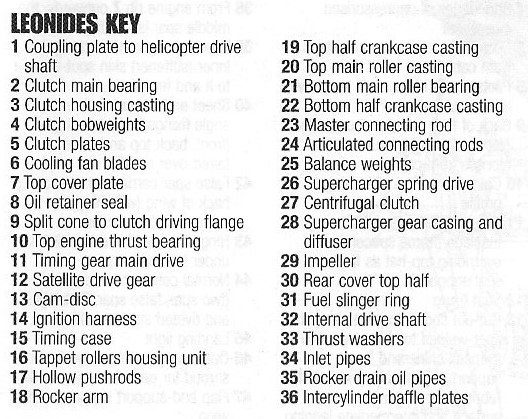
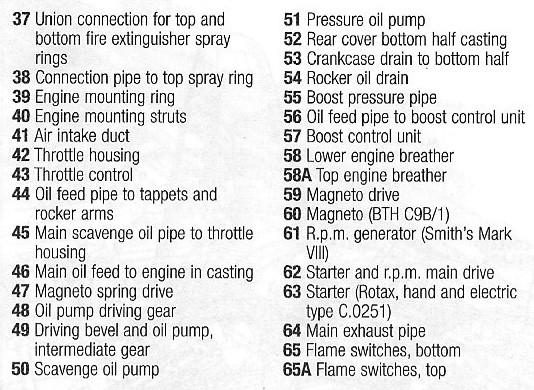
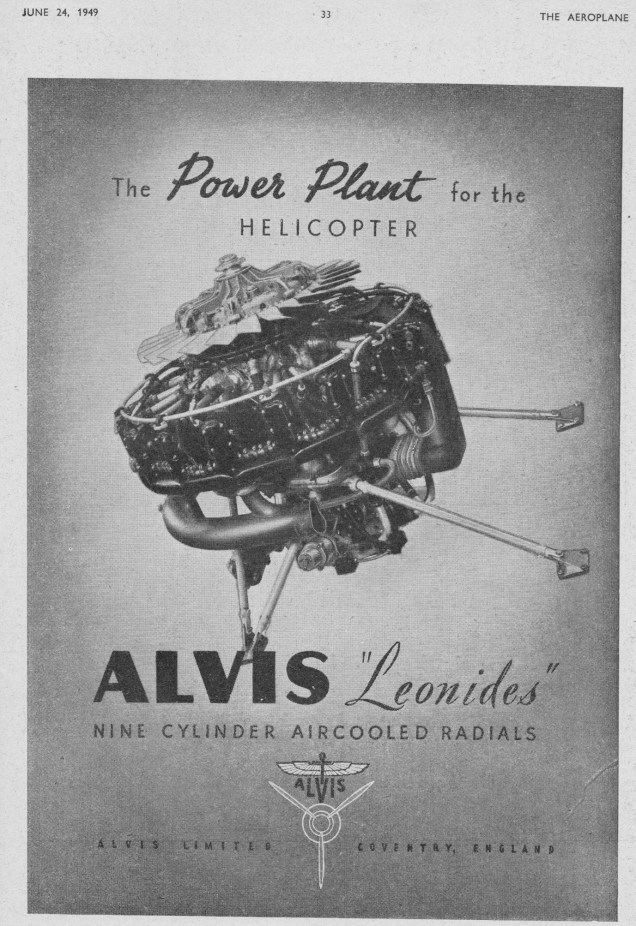
The Alvis Leonides was a British air-cooled nine-cylinder radial aero engines first developed by Alvis in 1936. Development of the nine-cylinder engine was led by Capt. George Thomas Smith-Clarke. The prototype engine, called 9ARS and which weighed 693 lb and developed 450 hp, was run in December 1936.
In 1938 Airspeed (1934) Ltd lent their test pilot, George Errington, and their much rebuilt Bristol Bulldog (K3183), to carry out test flights. Development was continued at a reduced pace during the Second World War and following testing in an Airspeed Oxford and an Airspeed Consul (VX587) Alvis was ready to market the engine in 1947 as the Series 500 (502, 503 and sub-types) for aeroplanes and Series 520 for helicopters. (Most helicopter engines were direct drive – no reduction gearbox – with a centrifugal clutch and fan cooling).
The first production use was the Percival Prince which flew in July 1948 and the Westland Sikorsky S-51 and Westland Dragonfly helicopters.
From 1959 the stroke was increased to 4.8 inch for the Series 530 (mainly the Mk. 531 for Twin Pioneers) rated at 640 hp. It was Britain’s last high-power production piston aero-engine when manufacture ceased in 1966.
Applications:
- Production –
Bristol Sycamore – 1x Mk. 173, 550 hp (410 kW)
Percival P.66 President/Prince – 2 x 503/7A, Mk 128 01/2, 540/560 hp (RAF: Pembroke, RN; Sea Prince)
Percival Provost – 1x 126, 550-hp (410 kW)
Scottish Aviation Pioneer – 1 x 503/7A, Mk 128 01/2, 540/560 hp
Scottish Aviation Twin PioneerCC1 – 2 x 514/8, 550 hp
Scottish Aviation Twin PioneerCC2 – 2 x 531/8,Mk138, 640 hp
Westland Dragonfly – 1x 521/1, 520shp (388 kW)
Westland Widgeon – 1x 521/1, 520shp (388 kW) - Conversions
Harker Leo-cat – 1x 560 hp (418 kW)
Server-Aero Leo-cat – 1x 560 hp (418 kW) - Prototypes
Agusta AZ8-L 4x 503/2
de Havilland Canada DHC-2 Beaver Mk.2 – 1x 502/4, 520 hp
Fairey Gyrodyne – one 525 hp to drive rotor and propeller
Fairey Jet Gyrodyne – one 525 hp to drive air compressor and propellers
Handley Page H.P.R.2 (WE505 only) – 1 x 502/4 550 hp
SR-N1 Hovercraft – the first hovercraft
Specifications
Type: 9-cylinder supercharged air-cooled radial piston engine.
Bore: 4.8 inch (122 mm)
Stroke: 4.41 inch (112 mm)
Displacement: 718.6 in3 (11.8 L)
Diameter: 41 inch (1.04 m)
Dry weight: 815 lb (370 kg)
Valvetrain: Two pushrod-actuated poppet valves per cylinder with sodium-cooled exhaust valve.
Supercharger: Single speed, single stage, boost pressure automatically linked to the throttle.
Fuel system: Hobson single-point fuel injection unit.
Fuel type: Petrol, 115 Octane
Oil system: Dry sump
Cooling system: Air-cooled.
Power output: 550 hp (410 kW)