The Amoit 122 was three-seat single-engined bomber, of which about 20 built by 1934. The type served with the French Air Force and in Brazil. Widely used by French Air Force in 1930s, but attained less than 320km/h.
Inter-Wars
Amiot 101
Of the late 1920s, the Amoit 101 was a monoplane fighter.
Amiot – S.E.C.M
Félix Amiot started his firm Amiot – S.E.C.M in 1916, building Bréguet and Morane-Saulnier machines under licence.
Avions Amiot products were known formerly by SECM prefix, latterly as SECM-Amiot or generally, Amiot, after founder Felix Amiot.
In 1929 Amoit amalgamated with Avions Latham.
The firm concentrated on large all-metal multi-engined aircraft, using light-metal stampings, though well before 1940 introduced stressed-skin construction. In the 1930s works at Colombes and Caudebec were reconditioning several types of metal aircraft for French Government. Changes in structural techniques were matched by aerodynamic advances; thus, the Amiot 143.
American Eagle-Lincoln Aircraft Corp Eagle-Lincoln A.P.
a three-seat cabin monoplane
American Eagle-Lincoln Aircraft Corp Eagle-Lincoln P.T.
A biplane trainer
American Eagle-Lincoln Aircraft Corp
Established May 1931 in merger between American Eagle Aircraft Corp and Lincoln Aircraft Co. In early 1930s built American Eaglet two-seat light parasol monoplane, which had particular success. Eagle-Lincoln P.T. biplane was a trainer and Eagle-Lincoln A.P. a three-seat cabin monoplane.
American Eagle Aircraft Corp
Established 1925 in Kansas City, with E. E. Porterfield as president.
1925: American Eagle Aircraft Co, 52 St and Prospect Ave, Kansas City MO (fdr: Edward E Porterfield Jr);
1925: 22 St and Harrison Ave
In 1926 built three-seat civil biplane with Curtiss OX-5 engine. Specially noted for American Eaglet light parasol monoplane, first two-seat light airplane to be granted Approval Type Certificate by US Department of Commerce. Several hundred Eaglets built before company suspended operations in 1930 Depression.
1928: American Eagle Aircraft Corp, with refinancing by A A Durant & Co (NYC), Fairfax Airport, Kansas City KS.
1929: Merged with Wallace Aircraft Co.
1930: Merged with Lincoln Aircraft as (Victor H) Roos Lincoln Aircraft Co, Lincoln NE.
1931: Acquired by Porterfield Aircraft Corp.
1931: Bought production rights to Wallace Touroplane.
1942: Company sold to Columbia Aircraft Corp; Porterfield to Ft Smith AR to manufacture gliders until retirement
c.1945. Company sold to Northwestern Aeronautical Corp, St Paul MN (neither Columbia nor Northwestern produced any Porterfield aircraft).
American Eagle Aircraft Corp Hudson-Hawk
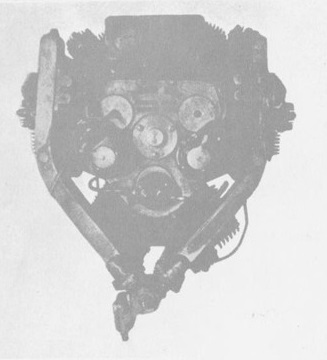
All moving parts of the Hudson-Hawk are under force feed lubrication and fully enclosed.
The Hudson-Hawk featured small diameter L-heads, solid (no cap) connecting rods, and a built up crankshaft. A self-starter and supercharger were available at extra cost.
Type: 6 cylinder, 4 stroke, air cooled, fixed radial
Rating: 100 hp at 1800 rpm
Displacement: 372 cu.in
Compression ratio: 5.4-1
Bore: 3.875 in
Stroke: 5.250 in
Diameter: 33 in
Length: 28 in
Weight: 326 lb
Fuel consumption: not more than .50 lb/hp/hr
Oil consumption: not more than .035 lb/hp/hr
Lubrication: Force feed, pressure and scavenging pumps
Ignition: 2 Scintilla
Carburation: McCadden
Spark plugs: 2 per cylinder
American Eagle Aircraft Corp
Kansas City
Mo.
USA
Circa 1920s engine builder
American Cirrus Engines Inc
Marysville
Michigan
USA
1928
Belleville
NJ
USA
Engine builder

