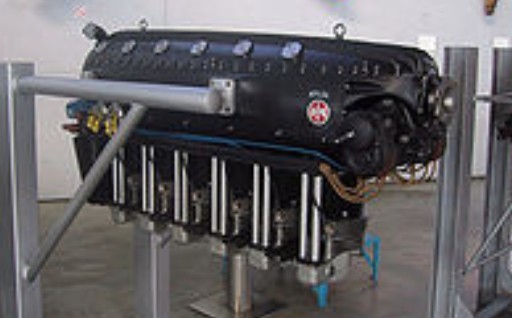
6-cylinder inverted inline 225 hp / 285 hp
6-cylinder inverted inline 225 hp / 285 hp
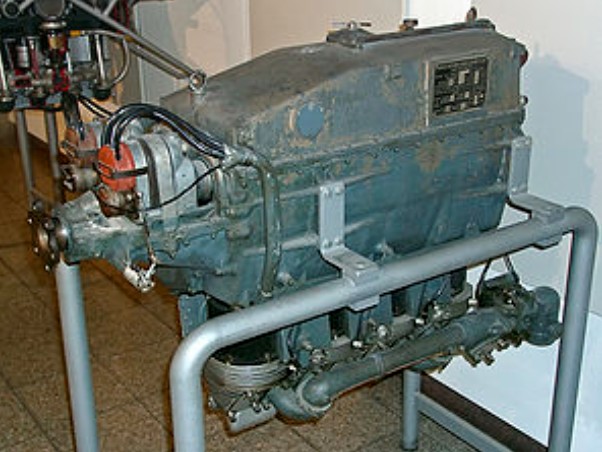
The Argus As 8 was a four-cylinder, air-cooled, inverted inline aircraft engine produced in Germany by Argus Motoren in the 1930s.
Applications:
Albatros L 100
Albatros Al 101
Arado L II
BFW M.23
BFW M.27
BFW M.29
Klemm L 25E
Specifications:
Bore: 120 mm (4.7 in)
Stroke: 140 mm (5.5 in)
Displacement: 6.3 L (386 cu in)
Length: 107 cm (42 in)
Width: 42 cm (17 in)
Height: 89 cm (35 in)
Dry weight: 113 kg (249 lb)
Power output: 80 kW (110 hp) at 2,100 rpm
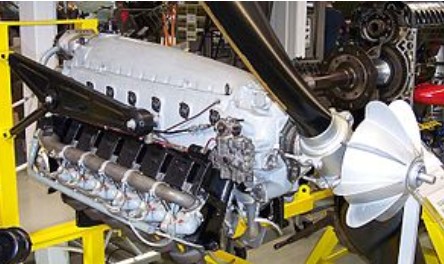
The engine marked a departure from earlier Argus engines in that it had new construction techniques which gave the engine greater operating speeds and power. The engine featured smaller 105 mm x 115 mm cylinders with deep finned steel cooling slots, aluminum heads, geared supercharger,a steel alloy crankshaft and a magnesium alloy crankcase. The engine weighed approximately 315 kg and produced 465 PS (459 hp, 342 kW) at 3,100 rpm. First run in 1937, approximately 28,700 engines were produced.
A distinctive feature is the finned spinner ahead of the propeller. This is driven by the airflow as a windmill, and used to power the actuator of the variable pitch propeller.
The more powerful and refined Argus As 411 was developed from it.
Applications:
Arado Ar 96
Focke-Wulf Fw 189
Pilatus P-2
Argus Fernfeuer
Specifications:
Argus 410
Type: 12-cylinder air-cooled inverted V engine
Bore: 105 mm (4.13 in)
Stroke: 115 mm (4.52 in)
Displacement: 11.9 L (729 cu in)
Dry weight: 315 kg (694 lb)
Fuel system: Carburetor
Cooling system: air
Power output: 465 PS (459 hp, 342 kW) at 3,100 rpm
Argus Motoren was a German manufacturing firm known for their series of small inverted-V engines and the V-1 (flying bomb) pulse jet engine.
Started in Berlin in 1906 as a subsidiary of Henri Jeannin’s automobile business, Argus Motoren company spun off entirely in November 1906. Their early products were car and boat engines, but later that year they were contracted to produce engines for the French airship, Ville de Paris, supplying them with a converted boat motor. They turned increasingly to the aviation market, and were widely used by 1910, receiving an order from Sikorsky for one of his large airplanes under construction in Russia. During World War I Argus produced engines for the German army and air corps.
After WWI the company manufactured automobile engines and acquired a majority interest in Horch Automobile in 1919. In 1926 they resumed aircraft engine design, producing a series of inverted inline and V engines. Although all were at the “low-power” end of the market by the start of World War II, they saw extensive use in training aircraft and other utility roles. Most famous of these designs are the Argus As 10, used in the Fieseler Fi 156 Storch, in the Arado Ar 66 and in the Focke-Wulf Fw 56 Stösser; and the Argus As 410, used on many German trainers, including the Arado Ar 96.
The Berlin-Reinickendorf subcamp of Sachsenhausen concentration camp provided labor for the Argus-Werke.
The firm became defunct at the end of WW2.
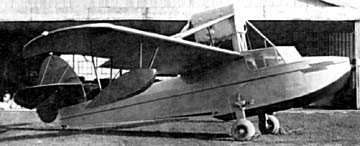
Three-seat monoplane amphibian, with Menasco Pirate engine
Donald G. White of Buffalo, New York, formed a White Aircraft Inc in 1939 to continue production, in modified form, of the Pirate amphibian designed and built previously by Argonaut Aircraft Inc.
The 1934 H-20 Pirate three seater prototype NX14760 c/n H20-100 was powered by a 120hp Curtiss Crusader, later 125hp Menasco and cost $4,975.
The one H-24 Pirate NX/NC15682 c/n H24-500 (ATC 650), designed by Howard J Heindell, was built in 1935 and cost $4,995.
H-20 Pirate
Engine: 120hp Curtiss Crusader, later 125hp Menasco C-4
Wingspan: 35’4″
Length: 26’0″
Useful load: 870 lb
Max speed: 110 mph
Cruise: 100 mph
Stall: 42 mph
Range: 490 mi
Ceiling: 12,000′
Seats: 3
H-24 Pirate
Engine: 125hp Menasco C-4
Wingspan: 42’0″
Length: 27’1″
Useful load: 650 lb
Max speed: 104 mph
Cruise: 89 mph
Stall: 45 mph
Range: 350 mi
Ceiling: 10,500′
Seats: 2
1935 Factory ad shows H-24 Pirate:
Wingspan: 35’4″
Length: 26’0″
Useful load: 680 lb
Max speed: 120 mph
Cruise: 104 mph
Stall: 40 mph
Range: 500 mi
USA
First product (1935) was Pirate three-seat monoplane amphibian, with Menasco Pirate engine. Main use of Menasco engines had previously been in racing aircraft.
Argonaut Aircraft Inc (pres: J Leroy Sutton),
North Tonowanda NY.
USA
c.1938: Acquired by White Aircraft Co, Leroy NY.
Argentina
Established October 10,1927 as Fabrica Militar de Aviones. In 1928 secured license for Avro Gosport (British biplane trainer) and eventually made 33 for Argentine Air Force. In 1931 made to original designs the first of a number of light single-engined monoplanes (Ao.C.1). On October 20,1943 name became Instituto Aerotfcnico. On January 23,1957 became a State enterprise under the title of Direction Nacional de Fabricaciones e Investigaciones Aeronauticas (DINFIA). Reverted to its original name 1968.

The Ar 231 was a small open cockpit single-seat reconnaissance floatplane, built in detachable sections, to be stored on a U-boat. The Ar 231 was a parasol-wing design, but for easier storage the right wing was attached lower than the left wing, and the center section was angled. When dismantled they could be stowed in a tube 6 ft 7 in (2m) in diameter for carriage by the submarine when submerged. The Ar 231 could be stored in six minutes, but only four were built and flight-tested in 1941.
Ar 231 V1 Wn° 2310001, KK + BP,
Ar 231 V2 Wn° 2310002, KK + BQ
Ar 231 V3 Wn° 2310003, KK + BR
Ar 231 V4 Wn° 2310004, KK = BS
Engine: Hirth HM 501A, 160 hp
Propeller: two-blade wooden fixed pitch
Wingspan: 10,17 m
Length: 7,82 m
Height: 3,83 m
Wing area: 15,20 sq.m
Empty weight: 868 kg
MTOW: 1050 kg
Wing loading: 69 kg/sq.m
Power loading: 6,562 kg/hp
Maxspeed: 170 Kmh
Cruise: 130 Kmh
ROC: 1000 m in 6 min
Ceiling: 3000 m
Range: 510 km
Endurance: 4 hours
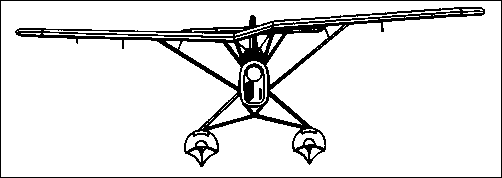
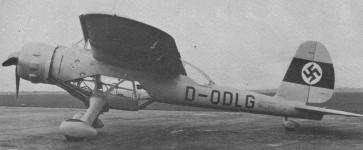
Development of the Arado Ar198 began in 1936 when the RLM issued a specification to the German aircraft industry calling for a plane specially suited to the short-range reconnaissance role. This specification was initially taken up by Arado, Blohm & Voss (Hamburger Flugzeugbau Division), Focke-Wulf, and Henschel. Each of these firms was able to base their design on previous aircraft and experience with this specific aircraft type and they were able to submit designs to the RLM within a short time. The requirement was to replace the Heinkel He 46 already in service with the Luftwaffe by an aircraft designed to make use of the most modern technology. This included the use of a powerful engine, good characteristics over the speed range, optimal vision for the crew and, protective and defensive features for the crew.
After various changes to the basic design, a contract for a pre-production series AradoAr 198A-0 was granted in July 1937.
For the Ar 198 a crew of three, consisting of pilot, gunner/radio operator, and observer, was planned. Due to the required optimal vision and high speed, a fully-enclosed crew compartment was built into the design. Tactical reconnaissance put a high emphasis on ground vision and the observer’s position was positioned below the wing plane for unobstructed vision, while the pilot and rear gunner were enclosed in an extensively glazed cabin above the wing plane. In this generously laid-out crew compartment there was an accessible connection to each crew position which resulted in good communications between crew members.
The entire forward fuselage structure, inclusive of the crew compartment, was of steel tube construction with the engine bearer included in this construction. Formers, light-metal fillets and a light-metal skin allowed for an aerodynamically advantageous shape. The rear fuselage was of an all-metal monocoque construction and purely as a tail-boom with no equipment for tactical missions installed. The Ar 198 had fixed landing gear.
The Ar 198 V1 (D ODLG) making its first flight in March 1938 at the Arado factory airfield at Warnemünde. During the early flights a marked instability in the projected low-speed range about all axes was noticed. It was thought that this was due to the large extension of the lower fuselage and consequently the layout was markedly changed for the second and third prototypes. In order to correct the flight characteristics the wings of the Ar 198 V1 were fitted with automatic slats which resulted in noticeable improvement in flight characteristic which also demanded considerable experience of the pilot.
A joint Ilmavoimat / Maavoimat / VL evaluation team flew this first prototype in July 1938 and generally rated it highly. Althought it demanded considerable experience to fly, performance was excellent, as was visibility.
The assembly process for the aircraft proved complex, with an associated high cost of production. Arado also had insufficient production capacity and this led the RLM to put a halt to the mass-production of the Arado Ar 198. Continued evaluation of the Ar 198 however, was not cancelled by that decision. The second prototype was completed and turned over to the Luftwaffe Flight Test Center at Rechlin. Soon after some very sucessful test flights this aircraft crashed on the landing approach when the starboard automatic slat came off, damaging the wing and forcing the pilot to make an emergency landing on rough ground. Damage to the airframe was such that restoration of the machine was not carried out. The Arado Ar 198 V1, however, after the elimination of a few faults, was flown for a long time with increasing enthusiasm on the part of its assigned crew. The third prototype was only 80 per cent completed and then used for static tests.
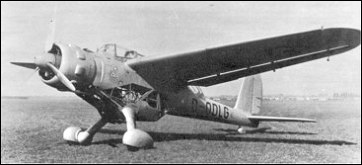
Engine: BMW Bramo Fafnir 323A-1, 900 hp
Wingspan: 14,9 m
Length: 11,8 m
Height: 4,5 m
Empty weight:: 2400 kg
MTOW: 3031 kg
Max speed: 359 kph / 223 mph
Stall speed: 70 mph
Landing speed: 55mph
Service ceiling: 26,250 ft
Range: 1081 km / 672 miles
Required runway TO MAUW: 600 m
Required runway landing MAUW: 510 m
Armament: 2 MG 17 7,92 mm, 1 MG 15 7,92 mm, 4 x 50 kg bombs
Crew: 3
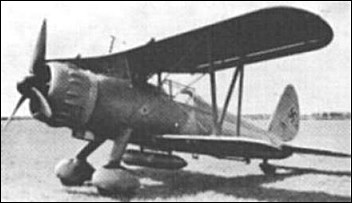
A 1937 single-engined biplane fighter development of the Ar 68 intended for use on aircraft carriers. The Ar 197 was fitted with fixed landing gear and fittings of catapult-launch.
The first prototype had a DB 600 engine, the two others had a BMW 132 radial. There was no production.
Ar 197 V1
Engine: 1 x Daimler Benz dB 600A, 900 hp
Propeller: metal three-blade variable pitch
Wing span: 11,00 m
Length: 9,20 m
Height: 3,60 m
Wing area: 27,75 m²
Empty weight: 1840 kg
MTOW: 2475 kg
Max speed: 400 Kmh at 2500 m
Ceiling: 8000 m
Range: 695 km
Armament: 2 MG 17 7,92 mm, 2 guns MG 20 mm, 4 x of 50 kg bombs
Ar 197 V2
Engine: 1 x BMW 132J, 815 hp
Ar 197 V3
Engine: 1 x BMW 132, 880 hp

