Arado Ar.195

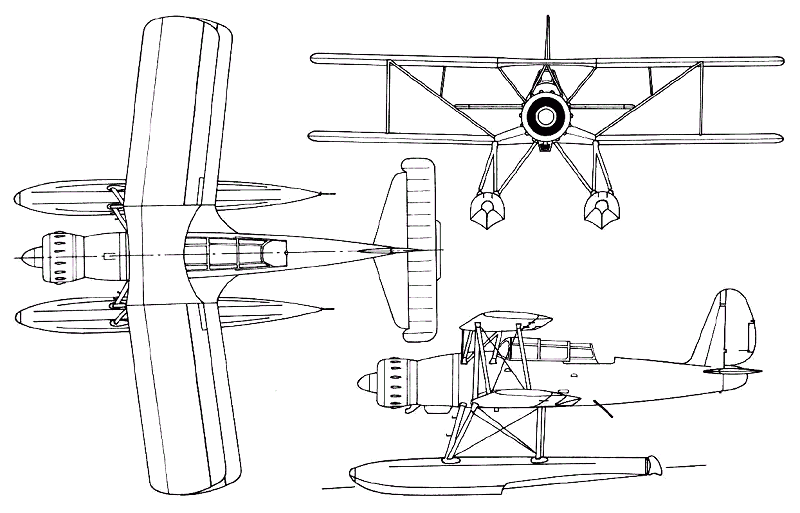
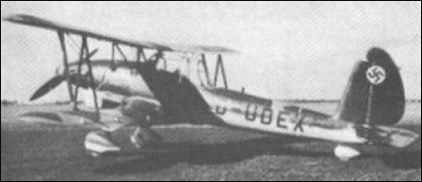
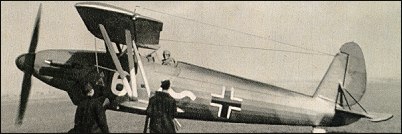
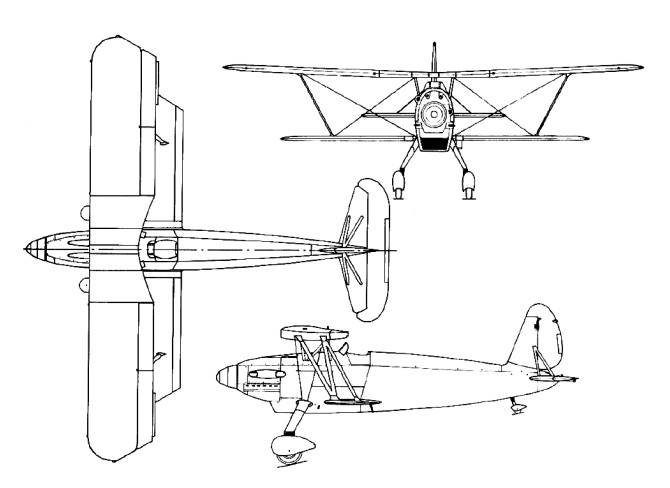
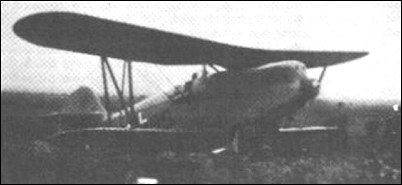
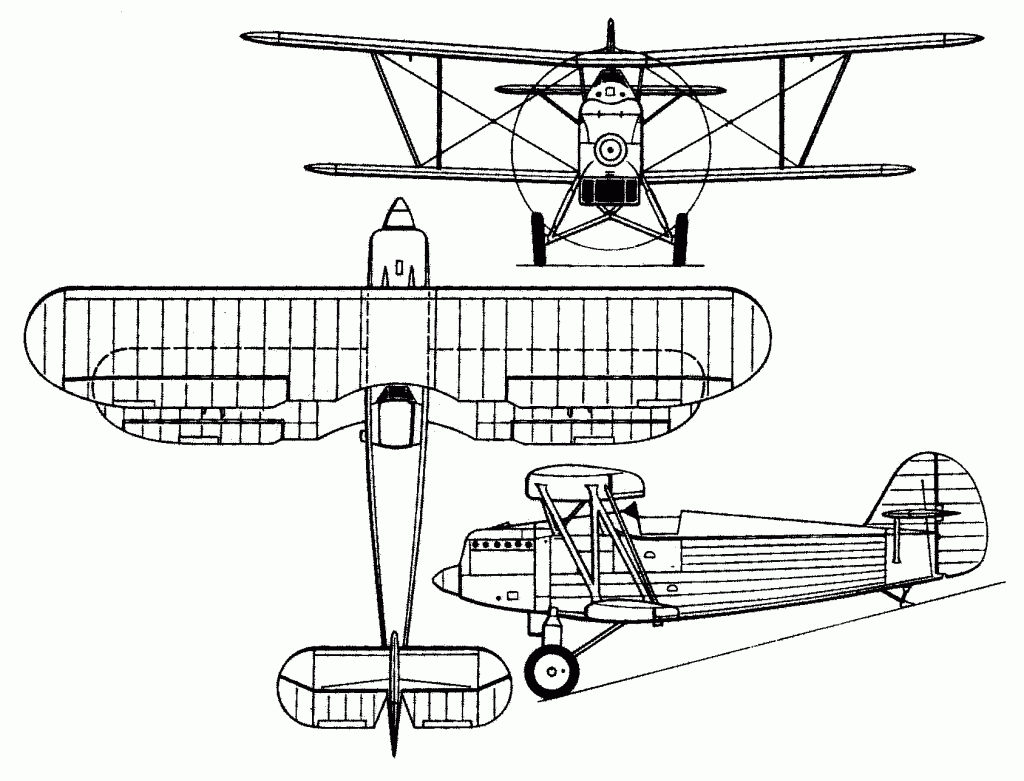
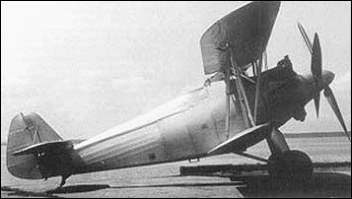
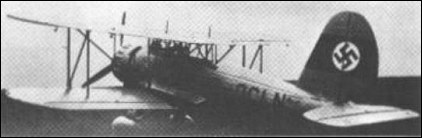
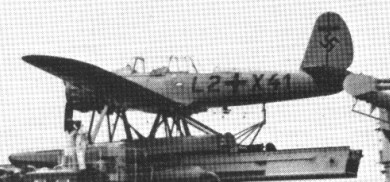
The Arado Ar 195 was prototype design intended for operations from Germany’s first aircraft carrier, the Graf Zeppelin. The aircraft was developed as a carrier-based torpedo.

The Ar 195 was based on the Ar 95 with major differences centreing mainly on a tail arrestor hook for catapult-launching. The Ar 195 featured a single BMW brand 819 horsepower radial engine, biplane wings, and crewed by a pilot and rear gunner. Landing gear was fixed and a single vertical tail surface was at the rear. Armament consisted of a single 7.92mm machine gun in a forward fixed firing position for the pilot and an additional 7.92mm machine gun in a trainable flexible rear gun mount. A single bomb or torpedo could be mounted in an underfuselage rail.

Though the Ar 195 prototype was flying by 1937 only three were built. The type was unsuccessful against the Fieseler-designed Fi 167.

Engine: BMW 132M, 850 hp
Wingspan: 12,50 m / 41.01 ft
Length: 10,50 m / 34.45 ft
Height: 3,60 m / 11.81 ft
Wingarea: 46 sq.m
Empty weight: 2380 kg / 5,247 lb
MTOW: 3745 kg / 8,256 lb
Wing loading: 81,413 kg/sq.m
Power loading: 4,4 kg/hp
Max speed: 175mph / 282kmh / 152kts
Cruise speed: 250 km
Service Ceiling: 19,685ft / 6,000m)
Range: 650 km / 404 miles
Crew: 2
Armament:
1 x 7.92mm MG17 machine gun in fixed forward firing position
1 x 7.92mm MG17 machine gun in flexible rear cockpit mount.
Hardpoints: 1
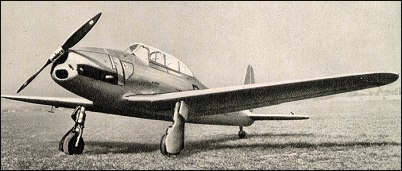
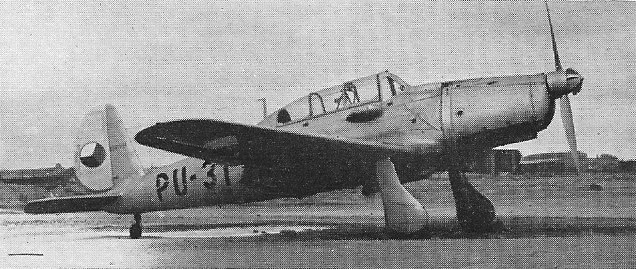
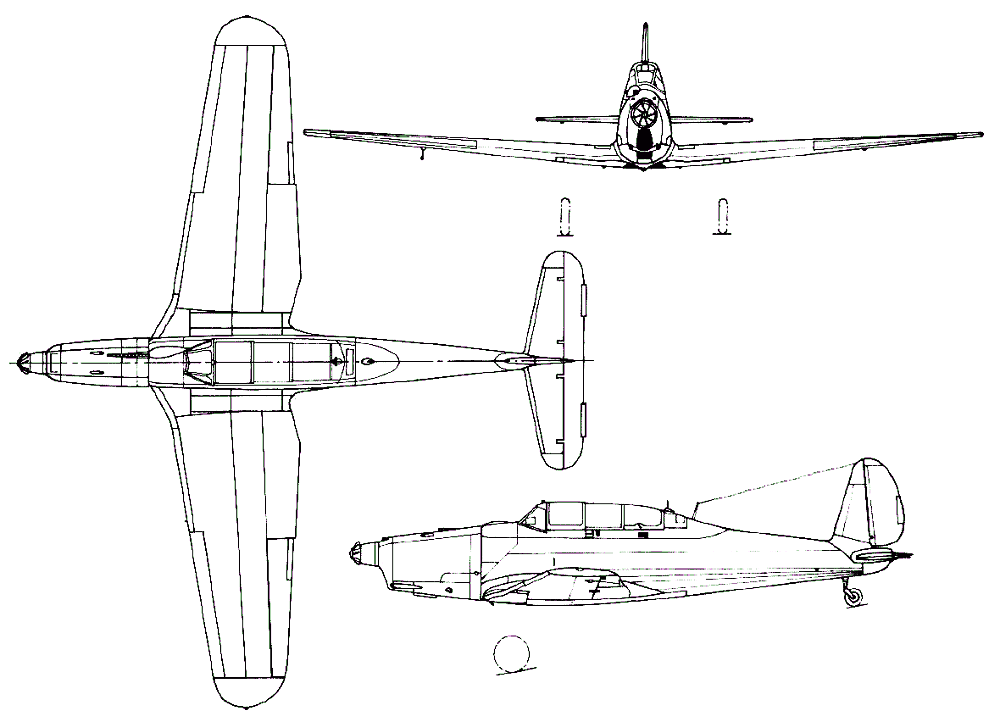
Arado Ar.96 / Avia C.2 / Letov C.2

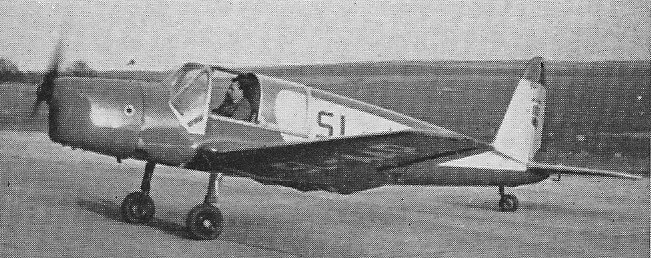
A 1936 tandem two-seat monoplane trainer with retractable landing gear. Powered by one 335kW Argus As.410A engine on Ar.96B production aircraft built from 1940 (prototype had one 179kW Argus As.10C). The Ar.199 was a development of the design.

During the war years, production was transferred to Letov and Avia in Czechoslovakia where manufacturing continued until the end of 1948 as C.2B-1. Letov built the Arado Ar-96B trainer as the C-2A (back designation for wartime production Ar-96 for Luftwaffe), and C-2B (Arado Ar-96B produced for Czech Air Force).

Avia C.2-1

The C.2B-1 was a standard basic trainer in the Czechoslovak Air Force and National Security Guard.

Engine: 1 x As 410A, 340kW
Wingspan: 11.0 m / 36 ft 1 in
Length: 9.1 m / 29 ft 10 in
Height: 2.6 m / 8 ft 6 in
Wing area: 17.1 sq.m / 184.06 sq ft
Take-off weight: 1750 kg / 3858 lb
Empty weight: 530 kg / 1168 lb
Max. speed: 330 km/h / 205 mph
Cruise speed: 275 km/h / 171 mph
Ceiling: 7000 m / 22950 ft
Range w/max.fuel: 990 km / 615 miles
Crew: 2
Armament: 1-2 machine-guns

Ar 96B / Avia C.2B-1
Engine: Argus As 410A, 465 hp
Wingspan: 35 ft 11.5 in
Wing area: 186.22 sq.ft
Length: 29 ft 11.25 in
Height: 8 ft 6 in
Empty weight: 2854 lb
Loaded weight: 3747 lb
Max speed: 219 mph
Cruise: 175 mph
Range: 428 mi

Arado Ar.95

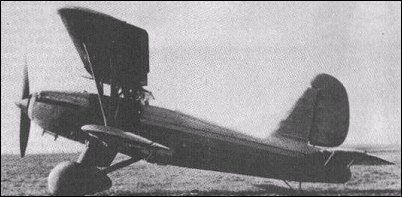
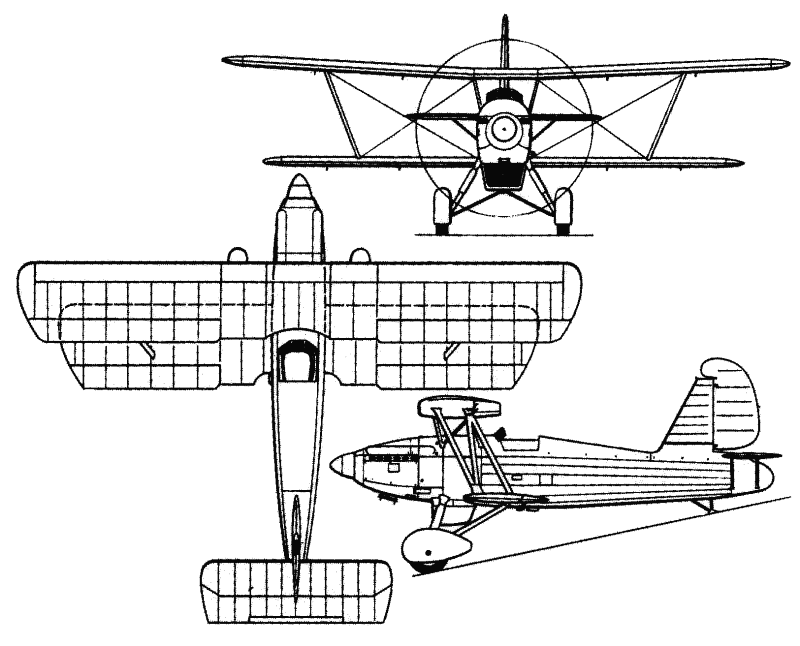
The Ar 95 developed as a naval torpedo-bomber and reconnaissance biplane for use from a proposed German aircraft carrier. The first prototype (built as a twin-float seaplane) first flew in 1936 and was followed by other seaplane and landplane prototypes, differing in engines fitted.

The landplanes featured heavily trousered main landing gear legs. A change of direction led to the delivery of six aircraft to Spain, where they fought during the late stage of the Civil War. Six Ar.95 landplanes and seaplanes were exported to Chile in 1939, and those built for Turkey were retained for use by the Luftwaffe.

Ar 95A
Wingspan: 12.5 m / 41 ft 0 in
Length: 11.1 m / 36 ft 5 in
Height: 5.2 m / 17 ft 1 in
Wing area: 45.4 sq.m / 488.68 sq ft
Take-off weight: 3570 kg / 7871 lb
Empty weight: 2450 kg / 5401 lb
Max. speed: 309 km/h / 192 mph
Cruise speed: 253 km/h / 157 mph
Ceiling: 7300 m / 23950 ft
Range: 1100 km / 684 miles

Arado Ar.81

1934

A two seat biplane dive bomber which competed with the early Ju 87. Three were built, all with different tail configurations; the V3 was considered satisfactory.
The pilot was under a canopy and observer/machine gunner was behind. Construction was and entirely metal fuselage, the aerofoil with a mixed structure with partial coating in fabric.
The prototypes were not followed by series production.

Ar 81 V1:
Engine: Jumo Junkers 210 C, 700 hp
Propeller: three-blade
Wingspan: 11,65 m
Length: 11,25 m
Height: 3,57m
Wingarea: 37,60 sq.m
Empty weight: 1925 kg
MTOW: 3070 kg
Wing loading: 82 Kg/sq.m
Power loading: 4,385 Kg/hp
Max speed: 345 Kmh
Armament: 2 MG 17, 1 MG 15 7,92 mm, plus 500 kg bombs

Arado Ar.79

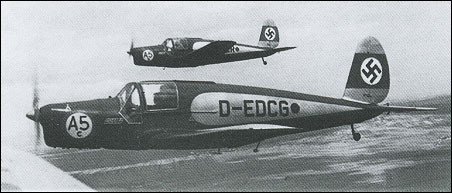
Designed as an aerobatic two-seat training and touring aircraft, the Arado Ar 79 first appeared in 1938, powered by a 78kW Hirth HM 504A-2 engine. The forward fuselage was of welded steel-tube construction, the rear section being a monocoque structure. The wings were of single-spar wooden construction with plywood and fabric covering: The aircraft featured retractable tail-wheel landing gear, the main wheels retracting sideways and inwards into the wing centre section.

Ar 79B

Ar 79s set a number of international class speed records during 1938, including solo 1000km at 229.04km/h on 15 July, and solo 2000km at 227.029km/h on 29 July. Later that year an Ar 79 was prepared for an attempt on the long-distance record, a jettisonable 106-litre fuel tank being fitted under the fuselage and a 520-litre tank at the rear of the cabin. Pilots Oberleutnant Pulkowski and Leutnant Jennett ferried the aircraft from Brandenberg to Benghazi in Libya, the starting point for what was to be a 6303km non-stop flight to Gaya, India, accomplished between 29 and 31 December at an average speed of 160km/h.

Engine: Hirth HM 504A-2, 105 hp
Propeller: two-blade fixed pitch
Wingspan: 10,00 m
Length: 7,62 m
Height: 1,87 m
Wingarea: 14 sq.m
Empty weight: 460 kg
MTOW: 760 kg
Max speed: 230 Kmh
Cruise: 205 Kmh
Ceiling: 5500 m
Range: 1025 Km

Ar 79B
Engine: Hirth H.M.500-A1, 105 hp
Wingspan: 32 ft 9.5 in
Length: 25 ft
Height: 6 ft 10.4 in
Empty weight: 1014 lb
Loaded weight: 1675 lb
Max speed: 143 mph at SL
Cruise: 127 mph
Range: 636 mi
ROC: 1020 fpm

Arado Ar.76

1935

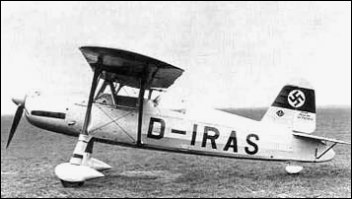
The Ar 76 was a lightweight home-defence fighter and advanced trainer. Single-engined with an open cockpit, The Ar 76 parasol monoplane had a traditional horizontal stabilizer at the extreme back of the fuselage.
Few were built up to the end of 1934, preference being given to the Fw 56.

Engine: Argus Aces 10C, 240 hp
Propeller: two-blade fixed pitch
Wingspan: 9,50 m
Length: 7,20 m
Height: 2,55 m
Wingarea: 13,30 sq.m
Empty weight: 750 kg
MTOW: 1070 kg
Speed: 267 Kmh
ROC: 5000 m in 21 min
Ceiling: 6400 m
Range: 470 km
Armament: 1 MG 17 7,92 mm, or 2 MG 17, plus 3 x 10 kg bombs

Arado Ar.68

Five prototypes of Ar 68 single-seat fighter biplane (the Luftwaffe’s first fighter) appeared in 1933, powered by BMW VI or Junkers Jumo 210 engines. The choice of engine was influenced by the availability. Rethel wanted the Jumo 210 but other manufacturers had claims before Arado so they had to settle on the BMW VI until supplies of the former were more readily available.
Designed to replace the Heinkel He 51, it was sent to Spain for operational evaluation. Three aircraft were sent to La Cenia in January 1937 for use in an experimen¬tal night fighter flight. They were used briefly, but apparently ineffectively, against Republican Potez 540 and Bloch 200/210 bombers.
All three aircraft were painted over¬all RLM 63 gray. In early 1938, the two surviving Arados (coded 9 1 and 9 2) were transferred to the Nationalists, who used them in the 2nd Army Co¬operation Group.

The first version to enter production and service (1936) was the Ar.68F, powered by the BMW engine, followed after a small production run by the improved 514kW Jumo Da- or Ea-engined Ar.68E.
Prototype Ar.65G and H versions were subsequently built, of which only the supercharged 533.4kW BMW 132 Da-engined ‘H’ was fully developed. The Ar68H was flown using the BMW 132Da radial, a license built Pratt and Whitney Hornet, this engine offered a very much improved performance (max speed 400 km/h) but it was all too late. But even this failed to enter production despite having four machine-guns and an enclosed cockpit for the pilot. A few Ar.68 remained operational as night fighters during the first months of World War II and were the Luftwaffe’s last operational biplane fighters.

Engine: 1 X Jumo 210ea, 505kw
Take-off weight: 2020 kg / 4453 lb
Empty weight: 420 kg / 926 lb
Wingspan: 11.0/8.0 m / 36 ft 1 in / 26 ft 3 in
Length: 9.5 m / 31 ft 2 in
Height: 3.3 m / 11 ft 10 in
Wing area: 27.3 sq.m / 293.85 sq ft
Max. speed: 335 km/h / 208 mph
Cruise speed: 280 km/h / 174 mph
Ceiling: 8100 m / 26600 ft
Range w/max.fuel: 500 km / 311 miles
Armament: 2 machine-guns, 60kg of bombs
Crew: 1

Arado Ar 68G
Engine: 1 x BMW VI V-type, 750hp.
Wingspan: 36.09ft (11.00m)
Length: 31.17ft (9.5m)
Height: 10.76ft (3.28m)
Maximum Take-Off Weight: 5,456lbs (2,475kg)
Maximum Speed: 190mph (305kmh; 165kts)
Maximum Range: 258miles (415km)
Service Ceiling: 26,575ft (8,100m)
Armament: 2 x 7.92mm MG 17 forward-firing fixed machine guns.
Crew: 1

Arado Ar.65

Development of the Ar.64 and powered by a 372kW BMW VI inline engine, the first prototype flew in 1931. Delivery of production Ar.65E single-seat fighters began in 1933 and the first Staffel became operational in April 1934.
The Ar.65E was superceeded in production by the slightly heavier Ar.65F, but both versions were transferred to training units from 1935 with the arrival of better aircraft.

Arado Ar.64

Developed from SD.II and SD.III prototypes that Walter Rethel produced at the request of Reichswehrministerium, the Ar 64 was a single-seat biplane fighter intended to succeed Fokker D.XIII. It was a traditional biplane with unequal wings of mixed construction, the aerofoil having a timber structure and the fuselage a metal tubular structure, both fabric covered. The landing gear was fixed, with a split axle.

Versions
Arado Ar 64a: First prototype, powered by a Bristol-built Jupiter VI, 530 hp licensed built by Siemens Halske and with a four-bladed wooden propeller.

Arado Ar 64b: The second and third prototypes, tested with Lipetsk in 1931, were powered by a 12 cylinders BMW VI 6,3 of 640 hp and were used for the development of the Ar 65.

Arado Ar 64c: The last prototype appeared in 1931, and was distinguished from the first by a reinforced structure and a four-bladed propeller of large diameter.

Arado Ar 64D: A production version powered by a Jupiter VI, identifiable with a modified landing gear and a two-bladed propeller. The armament was proposed to be 2 7,9 mm machine-guns but it is very probable that they were not fitted on the 19 aircraft of the DVS during 1934/1935. These aircraft were used as advanced trainer by civil and military pilots.

Arado Ar 64E: The last version, powered by a Jupiter VI. Used by Jagdstaffeln of Fliegergruppe Döberitz and Damm, along with Ar 65.

Users:
Germany:
30 Ar 64 were ordered by Luftwaffe clandestine between 1931 and 1934, including 12 to produce by Focke-Wulf. 6 Ar 64D and 5 Ar 64E were in account at April 1, 1933. The last specimens were delivered during 1934 and, in spite of the arrival of Ar 65, intended to succeed to him, 21 Ar 64 remained in service on July 1, 1936.

Soviet Union:
The first Ar 64 had been used briefly for tests powered by a Rolls-Royce engine before ordering 24 to be delivered at the beginning of 1933, but by April 1936 they had received only 19 planes.