Auster / Taylorcraft Aeroplanes (England)

In 1936 the Taylorcraft Aviation Company was established in the USA to design and built light planes for civil use. In 1938 the company established its Taylorcraft Aeroplanes (England) Ltd as its British subsidiary. British production was mainly of the Plus C and Plus D models, and in 1939 the Royal Air Force impressed 24 of the 32 aircraft for evaluation as observation and artillery spotter aircraft. The evaluation confirmed the soundness of the concept, and a derivative of the Plus D was ordered into production as the Auster Mk 1. This entered service in August 1942.
Taylorcraft Aeroplanes (England), in March 1946, was changed to Auster and the factory transferred from Thurmaston, Leicester, to Rearsby, Leicester.
Became Auster Aircraft Ltd on March 7,1946, by which time it had built more than 1,600 Taylorcraft C, Plus C, Plus D and Auster I, II, III, IV, and V, as well as early Auster J-1 Autocrats and prototype of J-2 Arrow.
Auster name was well established in Second World War by light observation (AOP) monoplanes known as Taylorcraft Austers, and many of these made an important contribution to the development of postwar light aviation. The type mainly concerned was the Auster 5, or Model J, three-seater with Lycoming engine. As war neared its end Taylorcraft designers were already looking to the civil market, and the outcome was the Autocrat, often British-powered and widely used not only for ordinary tasks but also, for instance, to test the Rover TP.90 gas turbine. In the 1950s came the Aiglet and the Autocar, one of the latter being used to test the Saunders- Roe hydro-ski landing gear. The Aiglet Trainer differed greatly from the Aiglet, and the Agricola was an entirely new low-wing agricultural aircraft, first flown December 1955. To supersede the AOP6 the entirely new military AOP9 was tested in March 1954, by which time the British Army and RAF had received nearly 2,000 Austers.
After the war, Auster Aircraft Ltd was formed and commenced a series of variations on the basic theme until 1960 when it was absorbed into Beagle Aircraft Ltd. Production of the basic Auster type continued until the low-wing Pup emerged.
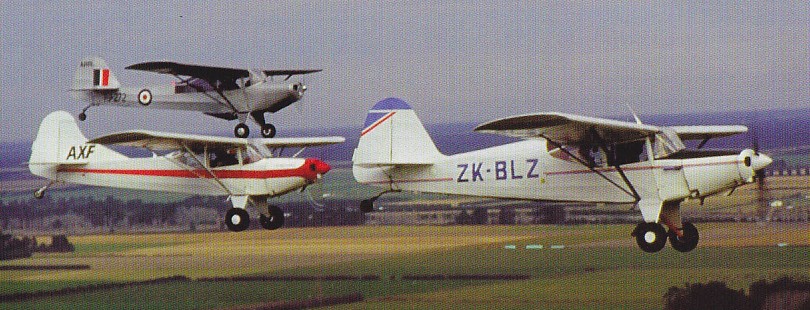
Auster Mk.V on the outer with a J/1 in the middle

All production work on Auster designs finally ceased in 1967 when Beagle sold all rights to Hants and Sussex Aviation. Although there is some conflict in the official records, it is believed that around 3868 Austers (not including licence-built aircraft) had been built.

The Pup evolved into the Bulldog basic military trainer that was taken up by Scottish Aviation Ltd after Beagle went into receivership in 1970 and finally found its last home with British Aerospace.
Aubert-Aviation  / Aubert

Aubert-Aviation was formed 1932 and commenced aircraft design in 1936. In 1938 name was changed to Societe Anonyme des Avions P. Aubert and PA-20 Cigale trainer which, after successful trials, was shown at Paris Salon.

Aubert and undertook considerable work for the nationalised industry. A direct contract for the production of Morane-Saulnier MS.230 trainers was placed with the company by the French Government, but all work ceased with the capitulation of France in June 1940.

After war PA-20 was revived as PA-201 and PA-204 (high-wing cabin monoplanes with cantilever undercarriage; common name Cigale). As Cigale Major PA-204 was certificated in 1951.

Atlantic Aircraft Corp.

Fokker rented the Witteman-Lewis aircraft factory at Teterboro, together with the adjoining airfield at Hasbrouck Heights, New Jersey, USA. Beginning active operations in May 1923, remodeling 100 D.H.4s, and holding patent rights and license to build Fokker aircraft in USA. In May 1924 a new company was formed, the Atlantic Corporation, with Lorillard Spencer as President and Robert B. C. Noorduyn as General Manager.
Largely associated with Anthony Fokker, who went to USA in 1922 and played a part in founding the company at Hasbrouck Heights, NJ. Fokker was also design consultant to other American companies.
The AO-1 was a two-seater of characteristic Fokker biplane form for artillery observation. The XLB-2 (officially prefixed Atlantic-Fokker or Atlantic (Fokker)) of 1927/28 was first twin-engined US Air Corps monoplane bomber. The type not adopted despite Fokker’s experience with large civil monoplanes. The C-2 and C-2A of late 1920s also were typical Fokker-type high-wing cantilever monoplanes.

LACAB T.7

LACAB T-7 OO-ANL

As the Air Force was looking for a new training aircraft, the “Ateliers de Construction Aéronautique Belges” (LACAB) created the T-7. The plane was presented to the authorities on October 17th, 1933, but it is the Avro 626 that won the challenge. In 1934, the LACAB T-7 was bought by the defense ministry and written off on May 31st, 1935. The unique T-7 disappeared completely.

ACAZ C.2

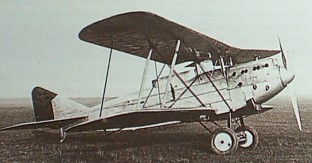
Constructed entirely from Duralumin, the ACAZ C.2 was a two seat fighter reconnaissance aircraft.
All four wings were identical and interchangeable.
The C.2 was evaluated by the Aeronautique Militaire Belge in early 1926.
On 9 March 1928 an attempt was made to fly it to the Belgian Congo.
The aircraft was written off on 25 January 1933.
The design was not put into production.

Engine: 1 x Hispano-Suiza 12.Ga, 450 hp / 336 kW
Wing span: 41 ft / 12.50m
Length: 27 ft / 8.25 m
Height: 11 ft 2 in / 3.40m
Wing area: 436.58 sq.ft / 40.56 sq.m
Empty weight: 2778 lb / 1260 kg
MTOW: 4563 lb / 2070 kg
Max level speed: 155 mph / 250 kph
Climb to 19,685 ft / 6000m: 35 min
Service ceiling; 24,606 ft / 7500m
Endurance: 3.5 hr
Armament: 1 x .303 Vickers mg & 2 x .303 Lewis mg