Licensed in 1930 by Cierva Autogiro Co of UK, the US company itself arranged sub-licences to Pitcairn and Kellett. For three years experimented with own AC-35 Autogiro, a roadable cabin type, delivered to Experimental Development Section of Bureau of Air Commerce in 1937. The folding rotor blades had direct control. (“Autogiro” is spelled with an ” i ” if it is an aircraft of Cierva origin.)
Inter-Wars
Australian Aircraft & Engineering B-6
AA&E built the first passenger aircraft in Australia, the B‑6, a six‑seater powered by a Liberty engine. It failed to attract orders and as the Government would not provide any assistance, AA&E went into liquidation.
Australian Aircraft & Engineering B-4
A light biplane.
Australian Aircraft & Engineering B-2
A light biplane.
Australian Aircraft & Engineering Commercial B-1
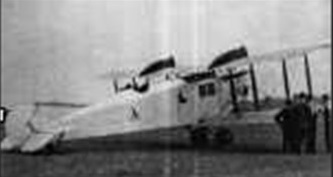
Broadsmith’s project, the design and construction of a six-seat biplane airliner, the B1, was unsuccessful in meeting the Civil Aviation Board’s specifications without re-engining, although the prototype flew successfully Liberty engined. The first civil aircraft built in Australia, the first flight was on 03/02/1923.
Australian Aircraft & Engineering Co / AA&E
Australian Aircraft & Engineering Co. Ltd. was formed in 1919 by N.B. Love, W.J. Warneford and H.E. Broadsmith. The company was registered in Sydney on 1 October 1919 with capital of £50,000 with the intention of manufacturing aircraft in Australia.
The company began flying operations at Mascot, New South Wales on 9 January 1920 following the delivery of 20 Avro 504K aircraft on the ship S.S. Commonwealth.
They fitted a Sunbeam Dyak engine to the first QANTAS Airways Ltd aircraft to replace the original Gnome rotary engine.
Built six Avro 504Ks for the Royal Australian Air Force, as agent for A. V. Roe; Austin Whippet single-seat biplane (33.5 kW; 45 hp Anzani engine) & Co. Also built, to designs of H. E. Broadsmith, a six seat commercial biplane. The Broadsmith-designed Broadsmith B.1 (as AA & E Commercial B1). This aircraft was taken over by the Commonwealth Government, but lack of further support caused the firm to go into voluntary liquidation.
Austin Whippet
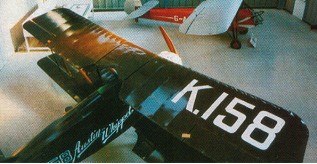
A single-seater, but only five were built
Austin Greyhound
two-seat fighter was flown after the Armistice
Austin Motor Company (1914) Ltd.
The Austin Motor Company Limited was an English manufacturer of motor vehicles, founded in 1905 by Herbert Austin.
Centered at Northfield, Birmingham, Warwickshire, Austin Motor Company (1914) Ltd engineering company became a War Office contractor for airplanes during the First World War, building over 2,000 subcontract aircraft. In 1917 the aircraft department, managed by J. D. North (best known for his later Boulton Paul associations) contemplated aircraft of original design. The Austin-Ball A.F.B.1 (fighter) and Osprey (1918) was a triplane single-seater designed by C. H. Brooks; the Greyhound two-seat fighter was flown after the Armistice; and civil types were the Kestrel side-byside two-seater (awarded 2nd prize in an Air Ministry competition) and the tiny Whippet single-seater, for which high hopes were entertained but only five were built. Aircraft activities ceased 1920, but in 1936 the “shadow factory” scheme ensured that the Austin name once again had aircraft connections. Production of Fairey Battles began October 1937; first aircraft tested July 1938.
In 1952 it was merged with Morris Motors Limited in the new holding company British Motor Corporation (BMC) Limited, keeping its separate identity. The marque Austin was used until 1987. The trademark is currently owned by SAIC after being transferred from bankrupt subsidiary Nanjing Automotive which had acquired it with MG Rover Group in July 2005.
Auster Plus Model D / Taylorcraft Aeroplanes Mk.I
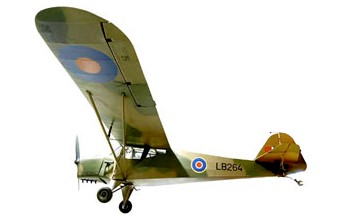
This design originated with a pre-war American light cabin monoplane of 1938 built in England under licence. Successful trials with impressed civilian Taylorcraft Plus D aircraft by the Army for artillery spotting duties led to the introduction of the first fully militarised Taylorcraft, the unarmed two-seat Auster I.
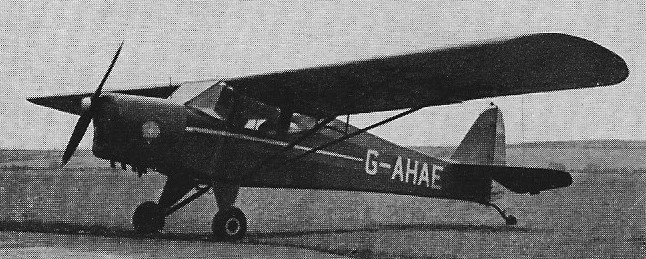
One hundred were built, entering service with No 654 Squadron in August 1942 as the first fixed wing aircraft in British Army service and along with the succeeding Auster marks III, IV and V they served in with the Desert Air Force in North Africa, and in Sicily, Italy, and with the 2nd Tactical Air Force from Normandy to Germany in 1944-45, flown by British Army officers trained by the RAF. The survivors were sold out of front-line service by 1946, though the Fleet Air Arm operated a few in second-line units.
Engine: 90-hp/67-kW de Havilland Cirrus Minor I
Wingspan: 36 ft
Length: 22 ft 11 in
Empty weight: 125 mph
Loaded weight: 1400 lb
Max speed: 125 mph
Cruise: 107 mph
ROC: 1000 fpm

