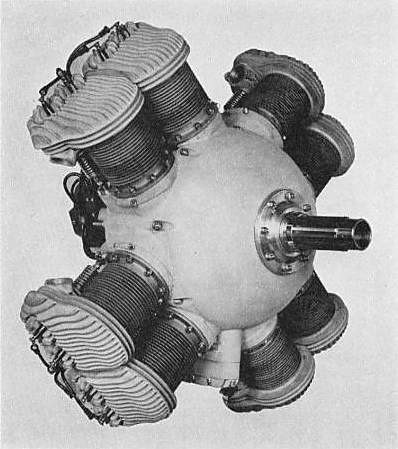
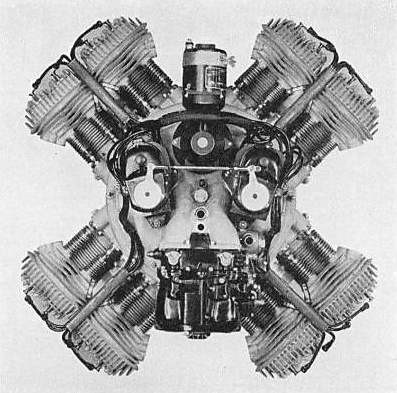
The Bakewell Wingfoot aero radial engine of 1939 consisted of four 90-degree V-twin engines, each with its own crankshaft, which was then geared to a common central propellor shaft. Propellor reduction gearing was fitted, the standard ratio being 1.57 to 1. This form of construction was claimed by the makers to give “inherent balance”.
The Bakewell engine was built by the Shaw-Palmer-Bakewell Co of Los Angeles.
The eight cylinders had a bore of 4in and a stroke of 4.5in, giving a displacement of 452 cu.in. (7407 cc) Output was claimed as 165 HP at 2800 rpm. The compression ratio was 5.4 to 1.
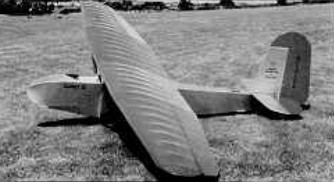
The Cadet was designed in 1929 by Dr. Frank R. Gross, a former member of the Akaflieg Darmstadt, as an improvement offering some soaring capability over the existing primary gliders. Built of steel tube fuselage, wood dual spar/ dual strut wing, wire braced wood tail, all fabric covered. Jack O’Meara, a demonstration pilot for Baker McMillen, flew a Cadet off South Mountain at Elmira, NY for 1 hour and 38 minutes in the summer of 1930 starting what was to become Harris Hill as the home of American gliding. One Cadet even flew on twin floats, and three of them (along with a Sky Gost, another Gross design) were towed at on time by a Goodyear Blimp over Akron, OH. One remained airworthy in the 1990s.
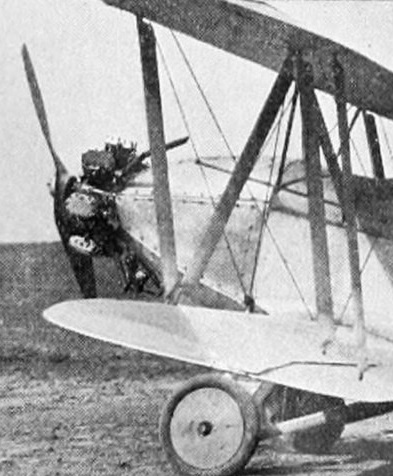
Established in 1922, this company had formerly produced railway equipment. In 1924 it began the production of lightweight sporting aircraft, including the BAG E.1, D.1 and D.11 a, the last being a two-seater with folding wings, allowing it to be stored in a garage.
This company established an aircraft department in 1923 to carry out repairs to seaplanes and flying-boats on behalf of the Italian Air Ministry. Began in the late 1930s to manufacture components for the Italian aircraft industry and to build aircraft under subcontract for the Regia Aeronautica.
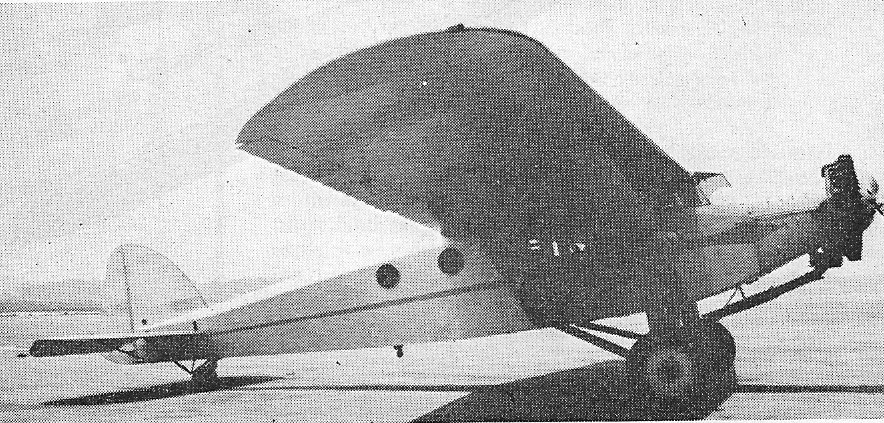
The Morton L. Bach Model T-11-P is believed to be the only one of the thirty tri-motor Model 3-CT-S/’5/’6/’8/’9/’9K and ‘9S six-ten-seaters converted (in the summer of 1934) to a single radial.
Engine: Pratt & Whitney Hornet A, 525 hp AUW: 7000 lb Empty weight: 4175 lb Crew: 2 Passengers: 6-8
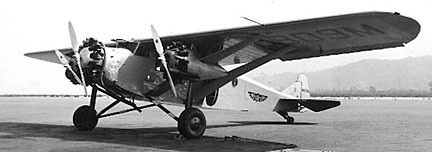
The Bach Air Yacht of 1928 was a three-engined commercial transport with a maximum capacity of two crew and ten passengers.
The first Air Yacht was the 1928 N5082 c/n 1. Three more in the registrations are identified only as Air Yacht with no model designation: N3534 c/n 1 had a J-5 + two Kinners; N3997 c/n 1 had one Wright J-5 + two Siemens; N4184 shows nothing but a c/n 2.
1928 3-CT-2 Air Yacht NC7065 c/n 1 was a 10-place powered by one Wright J-5 + two 100hp Ryan-Siemens.
In 1928 two 3-CT-4 Air Yacht were built; NC7657 c/n 3 and N7658 c/n 4. Powered by one P&W Wasp + two 100hp Ryan-Siemens, both were 10-place.
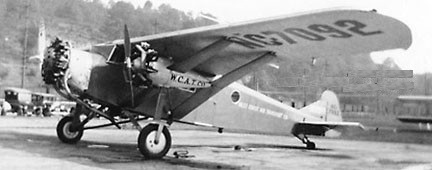
The sole 3-CT-5 Air Yacht, built in 1929, NC7092 c/n 2 received ATC 2-98 and was powered by one 450hp P&W Wasp + two 130hp Comet. It too was 10-place.
Bach 3-CT-5 NC7092
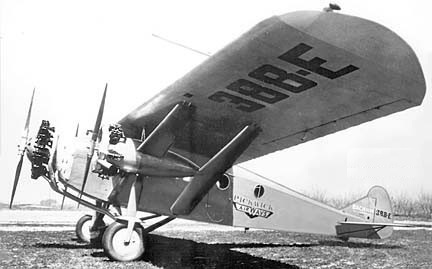
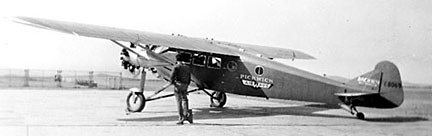
The 1929 3-CT-6 Air Yacht (ATC 114) sold for $39,500 powered by one 525hp P&W Hornet + two 130hp Comet. A 12-place, five were built for Pickwick Airways (N219H c/n 10, N302E c/n 6, N388 c/n 5, NC539E c/n 7, and NC850E c/n 8 c/ns.
N19H and N388 were rebuilt into a single-engine, the latter as a sesqui-wing banana-duster with an added smaller lower wing. Used in 1933 in Honduras by United Fruit Company, registered XH-TRA.
Interesting is that N388E, pictured at top and shown in Summer 1967 AAHS Journal, is not in the registers—that number is worn by an Arrow Sport.
Bach 3-CT-6 Single-engine mod NC219H
Four 10-place 3-CT-8 Air Yacht (ATC 172) were built in 1929 NC53M c/n 16, NC54M c/n 17, NC245K c/n 15, and NC8069 c/n 11. They were priced at $39,500.
Bach 3-CT-8 NC8069
The 1929 10-place 3-CT-9 Air Yacht (ATC 271) was powered by one 450hp P&W Wasp + two 225hp Wright J-6-7 engines and priced at $39,500.
At least three were built; NC511V c/n 21, NC520M c/n 18, and NC809M c/n 19.
ATC 2-175 was for one conversion to 7-pace Special NC809M.
The 3-CT-8 set a new altitude record, and the first ever for tri-motors, on 26 July 1929, carrying a 1000-kilo load (2220 lb) to 20,820′ piloted by Waldo Waterman), and two CTs came in first and second in multi-engine speed competition at the 1929 Nationals, piloted by William Brock and Waldo Waterman.
Bach 3-CT-9 NC809M
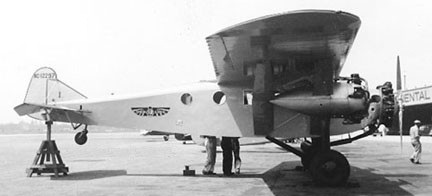
In 1931 two 3-CT-9K Air Yacht (ATC 2-376) were built; NC12206 c/n 22 and NC12297 c/n 23. 10-place, they were powered by one 420hp P&W Wasp B + two 210hp Kinner C-5.
Bach 3-CT-9K NC12297
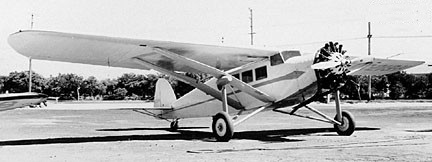
The 1930 3-CT-9S Air Yacht (ATC 299) was a Deluxe “executive” version of 3-CT-9 with cowled engines (PW Wasp + two Wright R-760), wheel pants, and customized interior, priced at $40,000+. ATC 2-179 was superseded by ATC 299. One was built; NC317V c/n 20.
One 3-CTS Air Yacht built in 1930 NC2830 c/n 8 (ATC 2-104), was a 3-CT-8 modified with 450hp P&W Wasp + two 220hp Wright J-5 engines.
Air Yacht Engines: 1 x J-5 + two Kinners
Air Yacht Engines: one Wright J-5 + two Siemens
3-CT-2 Air Yacht Engines: one Wright J-5 + two 100hp Ryan-Siemens Seats: 10
3-CT-4 Air Yacht Engines: one P&W Wasp + two 100hp Ryan-Siemens Seats: 10
3-CT-5 Air Yacht Engines: one 450hp P&W Wasp + two 130hp Comet Seats: 10
3-CT-6 Air Yacht Engines: one 525hp P&W Hornet + two 130hp Comet Wingspan: 58’5″ Length: 36’10” Useful load: 3261 lb Max speed: 154 mph Cruise: 126 mph Stall: 60 mph Range: 600 mi Seats: 12 Price: $39,500;
3-CT-8 Air Yacht Engines: one 525hp P&W Hornet + two 165hp Wright J-6 Wingspan: 58’5″ Length: 36’10” Useful load: 3195 lb Max speed: 157 mph Cruise: 133 mph Stall: 60 mph Range: 590 mi Seats: 10 Price: $39,500
3-CT-9 Air Yacht Engines: one 450hp P&W Wasp + two 225hp Wright J-6-7 Wingspan: 58’5″ Length: 36’10” Useful load: 2990 lb Max speed: 162 mph Ceuise: 136 mph Stall: 60 mph Range: 525 mi Price: $39,500 Seats: 10 3-CT-9K Air Yacht Engines: one 420hp P&W Wasp B + two 210hp Kinner C-5 Seats: 10
3-CT-9S Air Yacht Engines: PW Wasp + two Wright R-760 Useful load 2807 lb Range: 600 mi Price: $40,000+
3-CTS Air Yacht Engines: one 450hp P&W Wasp + two 220hp Wright J-5 Wingspan: 58’5″ Length: 36’10” Seats: 12
1927: (Loyal Morton) Bach Aircraft Co, Clover Field Santa Monica CA USA
Founded in March 1927, the company produced a number of civil aircraft before introducing the Bach Air Yacht in 1928. This was a three-engined commercial transport with a maximum capacity of two crew and ten passengers. Had nose-mounted engine of 220 hp or 400 hp, with one 100 hp or 125 hp engine mounted on the bracing strut beneath each wing.