A development of 1930
A development of 1930

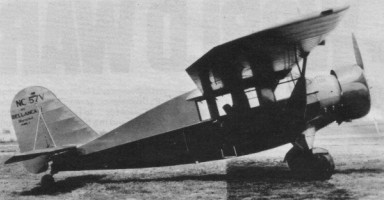
The new company also had two other models that were built for special orders, the Bellanca Model J and the Model K.
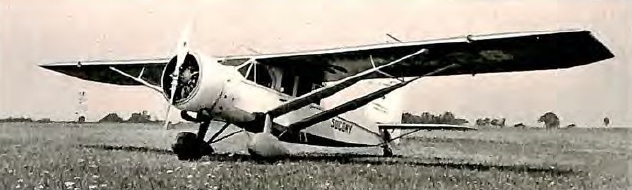
A transatlantic hopeful was the Bellanca K of 1932 which may be considered as the prototype for the P-200 Air bus. The Bellanca K c/n 117 NR4864 was originally named ‘Roma’ in connection with a proposed New York-Rome flight.
For the New York-Oslo attempt of 23 August 1932 the Model K was renamed ‘Enna Jettick’. Leaving New York, at 5.43am ‘Enna Jettick’ (piloted by Thor Solberg and Carl Petersen) reached Harbor Grace, Newfoundland, at 7pmm. The proposed landing for fuel before the transatlantic leg was frustrated by fog and the crew was forced to ditch, without injury, in Darby’s Harbor, 75 miles SW of Harbor Grace, with the loss of the Model K.
Engine: Pratt & Whitney Hornet, 500 hp
Wingspan: 64 ft 6 in
Length: 39 ft 1 in
AUW: 12,000 lb
Cruise: 115 mph
The new company also had two other models that were built for special orders, the Bellanca Model J and the Model K.
J-3-500
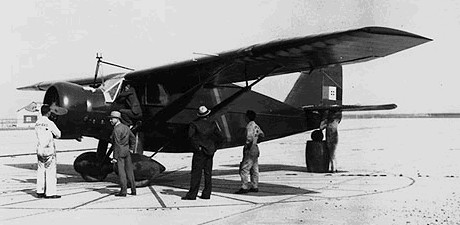
J-300
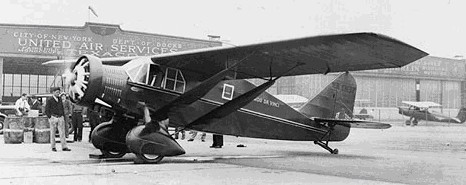

Disappointed because the ‘Columbia’ was not the first aircraft to accomplish the New York to Paris flight, Bellanca severed all relations with Levine, and started his own company, the Bellanca Aircraft Corporation of America, and rented facilities on Staten Island, NY. The new Bellanca model was designated the CH, and was basically a commercial version of the WB-2.
CH-200 Pacemaker
First flown in 1928
CH-300 Pacemaker

First flown in 1929
CH.300 six-seat Iightpiane, Pacemaker six-seater of 1929 and flown 1931 on an 84-hour 33-minute world non-refueled endurance record.
The CH-300, produced between 1928 and 1930, was powered by both the 330 hp Wright Whirlwind and the 450 hp Pratt & Whitney Junior.
The CH-400 was powered by the 450 hp Pratt & Whitney Junior or the 420 hp Wright Whirlwind.
Both Pacemaker and Pacemaker Senior are six-seat cabin monoplanes and generally similar externally.
PM-300 Pacemaker Freighter
E Senior Pacemaker
Senior Pacemaker Srs 8
JE-1
CH-400
Wingspan: 50 ft 6 in
Length: 27 ft 11 in
Empty weight: 3000 lb
Loaded weight: 5350 lb
Max speed: 165 mph
Cruise: 155 mph
ROC: 900 fpm
Range: 1360 mi

During 1926, the WB-2 won two efficiency trophies at the National Air Races in Philadelphia. Wright considered putting the aircraft into production, but decided against it to avoid alienating other aircraft companies that were potential customers for their engines. Disappointed by Wright’s decision, Bellanca left the company and joined with a young businessman named Charles Levine to form the Columbia Aircraft Company. Wright sold the WB-2 and all drawings and production rights to the new company.
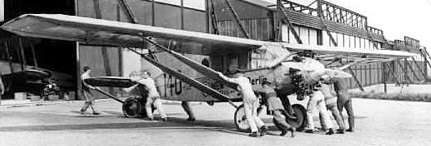
Built for the 1926 Nationals, the WB-2 won all efficiency events and the endurance title in 1927. The WB-2 went on to a long and fruitful flying career starting with establishing a new world’s non-refueled endurance record of 51 hours, 11 minutes, and 59 seconds in April of 1927, piloted by Clarence Chamberlin and Bert Acosta.
In the latter half of 1926, Charles Lindbergh wanted to buy the WB-2, now named the ‘Columbia’, for his proposed flight from New York to Paris. He was rebuffed by Levine who also had designs on the flight and the $25,000 prize money. When company president Charles Levine added a stipulation that he would supply the support crew, Lindy withdrew and went to Ryan Co instead. Lindbergh then went to Ryan for his “Spirit of St. Louis”. Meanwhile Levine, in choosing the crew, managed to promise two seats to three people. So while the Columbia was grounded by a court order brought by the third party, Lindbergh took off on his successful flight to Paris.
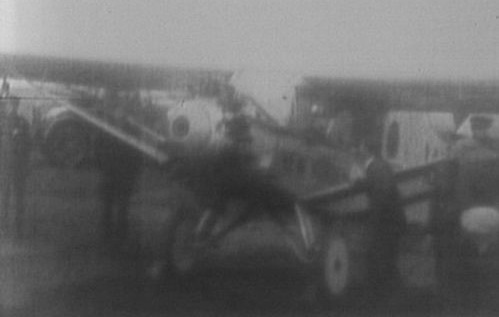
Production rights were reacquired by Bellanca Corp to build NC/NX/NR237 Columbia for the 1927 New York-Berlin flight, piloted by Chamberlin with Charles A Levine, in which the useful load was increased to 3550 lb. Eventually, the ‘Columbia’ was cleared of litigation and took off on its successful transatlantic flight on June 4, 1927. In the cockpit were Clarence Chamberlin, one of the pilots of the endurance record and Charles Levine, who became the first transatlantic passenger. The plan was to fly all the way to Berlin, and Chamberlin had vowed to fly until they ran out of fuel. Forty-three hours later, they landed in Eisleben, Germany, the first of two successful Atlantic crossings for Bellanca’s most famous aircraft.
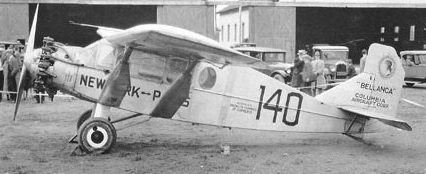
It was destroyed in a 1934 hangar fire.
Engine: 1 x Wright “Whirlwind” J5C, 165kW / 220hp
Wingspan: 14.0 m / 45 ft 11 in
Wing area: 25.3 sq.m / 272.33 sq ft
Length: 27’9″
Useful load: 1604 lb
Max speed: 126 mph
Cruise speed: 180 km/h / 112 mph
Stall: 47 mph
Range: 8050 km / 5002 miles
Crew: 2
Passengers: 4
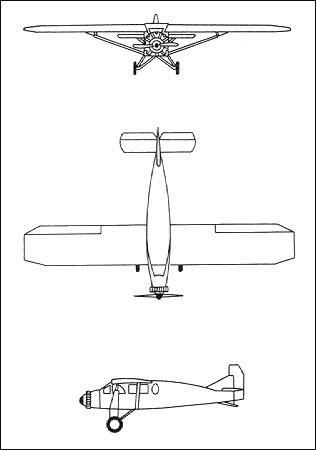
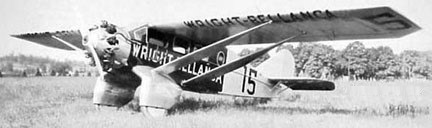
In 1925, Bellanca went to work for the Wright Aeronautical Corporation of Paterson, NJ. His assignment there was to develop an aircraft around the new Wright Whirlwind engine. He already had a design in mind, which was an improved version of the CF, called the CG. This design evolved into the Wright-Bellanca WB-1.
First flying in September 1925 piloted by Lt Fred Becker, the WB-1 enjoyed a short, but successful flying career. The aircraft had already won one race and efficiency contest at the 1925 Nationals, piloted by Becker, before an untimely accident destroyed the craft during preparation for an attempt to break the world’s non-refueled endurance record. It was destroyed in a crash-landing during speed and payload trials in 1926 at Curtiss Field, seriously injuring Becker.
At the time of the crash, Bellanca was already working on an improved version of the WB-1 designated the WB-2.
Engine: Wright J-4, 200 hp
Wingspan: 45’0″
Length: 24’9″
Useful load: 1440 lb
Max speed: 132 mph
Cruise speed: 100 mph
Stall: 45 mph
Seats: 5
In 1921, a group of investors lured Bellanca westward to Omaha, NE, in hopes of establishing that town as a center for aircraft manufacture. Before the aircraft could be built, the company went bankrupt, but construction of the aircraft continued under the financial backing of a local motorcycle dealer named Victor Roos. The resultant aircraft, the Bellanca CF, was called by Janes’s All the World’s Aircraft “the first up-to-date transport aeroplane that was designed, built, and flown with success in the United States.” Among the local people helping to build the aircraft was the daughter of Bellanca’s landlord, Dorothy Brown. Giuseppe and she were married on November 18, 1922.
Despite its advanced design, the Bellanca CF could not compete with the economics of the time. In the days just after World War I, a surplus Curtiss Jenny could be purchased for as little as $250.00. A Bellanca CF, with a price tag of $5000.00, was just too expensive and the aircraft never went into production.
Giuseppe Mario Bellanca was born in 1886 in Sciacca, Sicily. As a young man, he attended the Technical Institute in Milan, graduating with a teaching degree in mathematics in 1908. During his quest for a second mathematics and engineering degree, he became enamoured of aviation, and set out to design and build his own airplane. Bellanca’s first aircraft design was a “pusher” aircraft, somewhat similar to the Wright Flyer. Lacking funds for such an endeavor, he joined with two partners, Enea Bossi, and Paolo Invernizzi. The union of the three produced the first flight of a totally Italian-designed and Italian-built aircraft in December of 1909. Bellanca’s second design, was a tractor-type aircraft. Although the aircraft was successfully constructed, it was never flown due to insufficient funds for an engine.
At the urging of his brother Carlo, who was already established in Brooklyn, New York, Giuseppe Bellanca immigrated to America in 1911. Before the end of the year, he began construction of his third airplane design, a parasol monoplane. After construction was completed, he took the small craft to Mineola Field on Long Island, NY, and proceeded to teach himself to fly. He began by taxiing. He then, taxied faster, which gave way to short hops. The hops got longer, until, on May 19, 1912, there was not enough room to land straight ahead, and Bellanca had to complete a turn in order land safely. Having successfully taught himself to fly, Bellanca then set about teaching others to fly, and from 1912 to 1916, he operated the Bellanca Flying School. One of his students was a young Fiorello La Guardia, the future mayor of New York City. In return for flying lessons, La Guardia taught Bellanca how to drive a car.
In 1917 the Maryland Pressed Steel Company of Hagerstown, MD hired Bellanca as a consulting engineer. While there, he designed two trainer biplanes, the CD, and an improved version, the CE. With the conclusion of WWI, Maryland Pressed Steel’s contracts were cancelled and the company entered into receivership. Thus, the CE never went into production.
In 1921, a group of investors lured Bellanca westward to Omaha, NE, in hopes of establishing that town as a center for aircraft manufacture. Before the aircraft could be built, the company went bankrupt, but construction of the aircraft continued under the financial backing of a local motorcycle dealer named Victor Roos. The resultant aircraft, the Bellanca CF, was called by Janes’s All the World’s Aircraft “the first up-to-date transport aeroplane that was designed, built, and flown with success in the United States.” Among the local people helping to build the aircraft was the daughter of Bellanca’s landlord, Dorothy Brown. Giuseppe and she were married on November 18, 1922.
Despite its advanced design, the Bellanca CF could not compete with the economics of the time. In the days just after World War I, a surplus Curtiss Jenny could be purchased for as little as $250.00. A Bellanca CF, with a price tag of $5000.00, was just too expensive and the aircraft never went into production. After the disappointment of the CF, Bellanca designed wings for the Post Office Department’s DH-4’s. His new wings were a tremendous improvement over the original design, but only a few aircraft were so modified.
In 1925, Bellanca went to work for the Wright Aeronautical Corporation of Paterson, NJ. His assignment there was to develop an aircraft around the new Wright Whirlwind engine. He already had a design in mind, which was an improved version of the CF, called the CG. This design evolved into the Wright-Bellanca WB-1.
The WB-1 enjoyed a short, but successful flying career. The aircraft had already won one race and efficiency contest before an untimely accident destroyed the craft during preparation for an attempt to break the world’s non-refueled endurance record. Fortunately, at the time of the crash, Bellanca was already working on an improved version, of the WB-1 designated the WB-2.
During 1926, the WB-2 won two efficiency trophies at the National Air Races in Philadelphia. Wright considered putting the aircraft into production, but decided against it to avoid alienating other aircraft companies that were potential customers for their engines. Disappointed by Wright’s decision, Bellanca left the company and joined with a businessman named Charles Levine to form the Columbia Aircraft Company. Wright sold the WB-2 and all drawings and production rights to the new company. The WB-2 went on to a long and fruitful flying career starting with establishing a new world’s non-refueled endurance record of 51 hours, 11 minutes, and 59 seconds in April of 1927.
In the latter half of 1926, Charles Lindbergh wanted to buy the WB-2, now named the ‘Columbia’, for his proposed flight from New York to Paris. He was rebuffed by Levine who also had designs on the flight and the $25,000 prize money. Lindbergh then went to Ryan for his “Spirit of St. Louis”. Meanwhile Levine, in choosing the crew, managed to promise two seats to three people. So while the Columbia was grounded by a court order brought by the third party, Lindbergh took off on his successful flight to Paris.
Eventually, the ‘Columbia’ was cleared of litigation and took off on its successful transatlantic flight on June 4, 1927. In the cockpit were Clarence Chamberlin, one of the pilots of the endurance record and Charles Levine, who became the first transatlantic passenger. The plan was to fly all the way to Berlin, and Chamberlin had vowed to fly until they ran out of fuel. Forty-three hours later, they landed in Eisleben, Germany, the first of two successful Atlantic crossings for Bellanca’s most famous aircraft.
Disappointed because the ‘Columbia’ was not the first aircraft to accomplish the New York to Paris flight, Bellanca severed all relations with Levine, and started his own company, the Bellanca Aircraft Corporation of America, and rented facilities on Staten Island, NY. The new Bellanca model was designated the CH, and was basically a commercial version of the WB-2. The new company also had two other models that were built for special orders, the Bellanca Model J and the Model K.
It was not long before Bellanca caught the attention of the Du Pont family of Delaware. They wanted to start aircraft manufacturing in Delaware, and in late 1927, an agreement was made with Bellanca to locate his factory outside of Wilmington. The site was large enough for a first-class airfield, with a seaplane ramp on the nearby Delaware River.
This was a busy time in Bellanca’s life. Along with all that was happening in his professional life, he and Dorothy celebrated the birth of their son August T. Bellanca in March of 1927.
With the exception of a few years immediately before and during the early stages of WWII, Bellanca was President and Chairman of the Board from the corporation’s inception on the last day of 1927 until he sold the company to L. Albert and Sons in 1954. All assets were acquired by Northern Aircraft in 1955 and Bellanca name finally dropped 1959 after merger with non-aviation companies.
After his departure from the company, Giuseppe and his son, August, formed the Bellanca Development Company with the purpose of building a new aircraft. It would have increased performance due to the use of lighter materials for its structure. Work on this aircraft was progressing when Giuseppe Bellanca succumbed to leukemia and died on December 26, 1960. After his father’s death, August continued the project, and under his guidance, the aircraft, a record breaker, first flew in 1973.
Northern Aircraft became Downer, then Inter-Air, and in 1967, Bellanca Sales, a subsidiary of Miller Flying Services. As the company grew, its name became Bellanca Air¬craft Corporation. Champion Aircraft Corporation was merged into it in 1970, adding two place aerobatic, sport and utility aircraft to the line.
1974 closed with the firm still in the busi¬ness only of building Vikings in Alexandria and Champi¬ons in Osceola, Wisconsin, and with sales slowing a bit. In late 1974, Bellanca was forced to suspend production in order to work off an in¬ventory of airplanes.
In 1978 Bellanca became a wholly-owned subsidary of Anderson, Greenwood, of Houston, Texas, subsequently developing the T-250 Aries and Eagle.
Work stopped in 1980 and the firm liquidated in 1981.
Assets were sold to Viking in 1982.
Viking resumed Viking production in 1984. Work stopped in 1988.
The original Bellanca company was restarted by Guiseppe Mario Bellanca and son August in 1968, initially in West Virginia and later Maryland.
Work stopped in 1986.
The firm was resurrected as AviaBellanca.
In 1993, August Bellanca donated his father’s 1920 CF to the Smithsonian along with many personal and corporate papers and correspondence. NASA craftsmen restored the aircraft and it is on display at the Smithsonian Air & Space Museum’s new Steven F. Udvar-Hazy Center near Washington’s Dulles International Airport. The far-sighted, innovative designer and builder of American aircraft, Giuseppe M. Bellanca was enshrined in the National Aviation Hall of Fame in 1993, the Delaware Aviation Hall of Fame in 1999.
1998:
Avia Bellanca Aircraft Corp
11800 Sunrise Valley drive, Suite 322
Reston
Virginia 20191
USA
Larry Bell had been born in Indiana in 1894, but his family moved to California when he was 13. In 1912, he went to work for aviation pioneer Glenn L. Martin, rising to the vice-president position of the Martin firm by 1920. Martin wasn’t the easiest person to work for and Bell knew he’d never get into a partnership position with the company, so Bell quit in 1925. He couldn’t find steady work for three years, but then he landed a job at Consolidated Aircraft in Buffalo, New York, rising to become general manager.
When Consolidated moved its operations to California, Bell decided to stay in Buffalo along with a cadre of like-minded individuals, forming Bell Aircraft in 1935. Later Bell would admit that naming the company after himself wasn’t a good idea, since it made it more difficult to delegate authority and learned that “when your name’s out front, you have to do a lot of things that are a terrible bore.”
The first product built by Bell was an innovative machine, designed by a team under Bell chief engineer Robert Woods, named the “Airacuda”.
Original company of 1935, Bell Aircraft Corporation, responsible for P-39 Aircobra and P-63 Kingcobra of Second World War. Built first U.S. turbojet, the P-59 Aircomet fighter/trainer. Built the rocket-powered Bell X-1, in which USAF pilot Charles Yeager was the first to exceed the speed of sound, on October 14,1947. Subsequent X- 1A flown at 2,655km/h in 1953.
Company subsequently known as Bell Aerosystems, then on July 5,1960 became Bell Aerospace Corporation, a wholly owned subsidiary of Textron Inc., which had acquired the former Bell Aircraft Corporation.
Responsible for:
Bell Model D2127 tilting-duct research aircraft
Two lunar Landing Research Vehicles (LLRV) for NASA to train astronauts to land safely on the moon
Automatic Carrier Landing System (ACLS), used on U.S. Navy aircraft carriers; and was involved with an air-cushion landing system that was expected to enable military transports to land and take off from practically any surface.
Terminated aircraft production.
Circa 1938 Beilgard Mechanical Research Laboratory of Hollywood CA., USA, built a 9-cyl barrel engine, possibly the one reportedly fuelled by butane.

