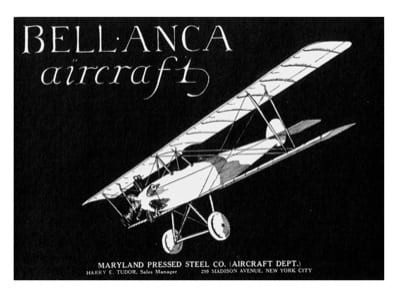
The CE biplane, designed by Guiseppi Bellanca in 1919, was powered by a 35-hp Anzani engine. Two were built, including one by Clarence Chamberlin, who would fly the Atlantic after Lindberg in a later model Bellanca airplane.
Engine: 35-hp Anzani Span: 28 ft Length: 18 ft Empty weight: 470 lb Load: 250 lb Speed: 102 mph.
The 31-55A Senior Skyrocket is generally similar to the Pacemaker but carries a crew of two and six passengers. The Skyrocket was first produced in 1930, and was built with a variety of radial engines in the 450-500 hp range prior to World War 2.
They were built post-war under licence in 1946-7 by North-West Industries Ltd in Canada. Powered by a 500 hp Pratt & Whitney Wasp S3H1, it is otherwise identical to the Model 31-42 Skyrocket of 1935.
31-55A Senior Skyrocket Wingspan: 50 ft 6 in Length: 27 ft 11 in Empty weight: 3760 lb Loaded weight: 6450 lb Max speed: 180 mph Cruise: 160 mph
Col James Fitzmaurice, a colonel in the Irish Air Force entered a Bellanca 28-70 “one off’ named Irish Sweep, in the London Mebourne Centenary Air race in 1934. The aircraft was built to his order and designed by Al Mooney of Mooney aircraft fame, who worked for Guiseppe Bellanca in the Delaware factory at the time. This was M8 in Mooney’s personal model numbering and a P&W Wasp radial of 825 hp was fitted, giving the Bellanca the best power/weight factor of all entries. The com¬mittee refused to allow Col Fitzmaurice to compete with the aircraft’s ‘all-up’ weight of 8,000 lbs.” The full weight had a restricted certificate issued by the US Government which, at the time, did not belong to the ICAN, the interna¬tional controlling body. The Irish entry was withdrawn at the last minute.
The Bellanca Aircruiser and Airbus were high-wing, single-engine aircraft built by Bellanca Aircraft Corporation of New Castle, Delaware. The aircraft was built as a “workhorse” intended for use as a passenger or cargo aircraft. It was available with wheels, floats or skis. The aircraft was powered by either a Wright Cyclone or Pratt and Whitney Hornet engine.
Bellanca P-100 Airbus
The first Bellanca Airbus was built in 1930 as the P-100. An efficient design, it was capable of carrying 12 to 14 passengers depending on the cabin interior configuration, with later versions carrying up to 15. In 1931, test pilot George Haldeman flew the P-100 a distance of 4,400 miles in a time aloft of 35 hours. Although efficient, with a cost per mile figure of eight cents per mile calculated for that flight, the first Airbus did not sell due to its water-cooled engine.
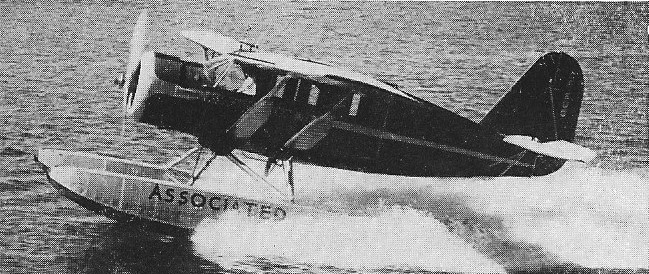
The next model, the P-200 Airbus, was powered by a larger, more reliable air-cooled engine. One version (P-200-A) came with floats and operated as a ferry service in New York City, flying between Wall Street and the East River. Other versions included a P-200 Deluxe model, with custom interiors and seating for nine. The P-300 was designed to carry 15 passengers.
The final model, the “Aircruiser,” was the most efficient aircraft of its day, and would rank high amongst all aircraft designs. With a Wright Cyclone air-cooled supercharged radial engine rated at 715 hp, the Aircruiser could carry a useful load greater than its empty weight. In the mid-1930s, the Aircruiser could carry 4,000 lb payloads at a speed of between 145 and 155 mph, a performance that multi-engine Fokkers and Ford Trimotors could not come close to matching.
C-27A C/N 721
The Airbus and Aircruiser served as both commercial and military transports and in total 23 were built.
Bellanca Aircruiser CF-AWR under restoration at the Western Canada Aviation Museum, Winnipeg, 2006
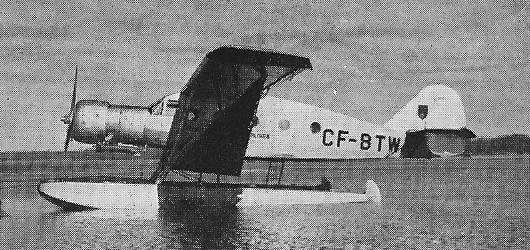
In 1934, United States federal regulations prohibited single-engine transports on United States airlines, virtually eliminating future markets for the Aircruiser. Where the workhorse capabilities of the Aircruiser stood out was in Canada. Several of “The Flying Ws”, as it was commonly dubbed in Canada, were used in northern mining operations, ferrying ore, supplies and the occasional passenger, into the 1970s.
Variants:
Bellanca P Airbus Commercial version of Bellanca K, powered by a 500 hp (370 kW) Pratt & Whitney R-1860 Hornet.
P-100 Airbus 14-passenger monoplane powered by a 600 hp (450 kW) Curtiss Conqueror engine, one built, later converted into a P-200.
P-200 Airbus 12-passenger monoplane, nine built and one converted from P-100.
P-300 Airbus 15-seater monoplane powered by a Wright R-1820 Cyclone engine.
Y1C-27 United States Army Air Corps designation for four P-200 Airbuses powered by 550 hp (410 kW) Pratt & Whitney R-1860 Hornet B engine. All later converted to C-27C.
C-27A Airbus Production version of the Y1C-27 powered by a 650 hp (480 kW) Pratt & Whitney R-1860 Hornet B engine, ten built. One converted to a C-27B the rest converted to C-27Cs.
C-27B Airbus One C-27A re-engined with a 675 hp (503 kW) Wright R-1820-17 Cyclone engine.
C-27C Airbus Four Y1C-27s and nine of the C-27A re-engined with a 750 hp (560 kW) Wright R-1820-25 Cyclone engine.
Aircruiser 66-67 Improved structure modified from a P-200 with a 675 hp (503 kW) Wright SR-1820 Cyclone engine
Aircruiser 66-70 An Aircruiser with a 710 hp (530 kW) Wright SGR-1820 Cyclone engine, five built – exported to Canada. Wingspan: 65 ft 0 in (19.82 m) Wing area: 520 sq ft (48.3 m2) Length: 43 ft 4 in (13.21 m) Height: 11 ft 6 in (3.51 m) Empty weight: 6,072 lb (2,754 kg) Gross weight: 10,000 lb (4,536 kg) Maximum speed: 144 kn (165 mph, 266 km/h) Range: 608 nmi (700 mi, 1,130 km) Service ceiling: 22,000 ft (6,700 m) Crew: one, pilot Capacity: 16 passengers
Aircruiser 66-75 An Aircruiser with a 730 hp (540 kW) Wright Cyclone engine, three built. Wingspan: 65 ft Length: 43 ft 4 in Height: 12 ft Empty weight: 6300 lb Loaded weight: 11,400 lb Max speed: 165 mph Cruise: 137 mph
Aircruiser 66-76 A cargo-version of the Aircruiser with a 760 hp (570 kW) Wright Cyclone.
Aircruiser 66-80 An Aircruiser with an 850 hp (630 kW) Wright Cyclone engine.
Graduating to twins, Bellanca constructed the Tandem, powered by push pull engines and capable of hauling 17,000 pounds at 160 mph. Despite its performance, this radical monoplane never saw production.
Bellanca produced the 14-passenger Airbus, a single engine behemoth that cruised at 150 mph. The Airbus 14-passenger commercial transport that was developed into Aircruiser of early 1930s for commercial and military use