Berliner-Joyce / Berliner Aircraft Co / B/J Aircraft Corporation

Emile, a German immigrant living in Washington D.C., was already a prodigious inventor when he began to dabble in aviation. He received a number of notable patents for substantial improvements he made to the design of gramophones, phonographs, and telephone transmitters. In 1903, he became fascinated with powered flight and experimented with a large rocket-powered model airplane.
In 1907, Emile began work on a helicopter with a tandem intermeshing-rotor system. The father-and-son team of Emile and Henry Berliner became the first Americans to make any significant progress towards the creation of a practical helicopter. Before 1926, they pioneered a number of experimental helicopters with only moderate success.
On July 11, 1908, Berliner’s first “test-rig” helicopter design demonstrated that it had the potential to lift twice its own empty weight.
However, the Berliners’ final versions displayed the best performance of any American helicopter project until Igor I. Sikorsky unveiled his VS-300 fifteen years later.
Emile then constructed a larger version with a 55-hp motor, which he dubbed the Aeromobile. Simultaneously, Berliner cooperated with J. Newton Williams on a coaxial design. Neither effort progressed very far as the demands of operating the Gyro Motor Company distracted Emile’s attention. However, this did not prevent him from conceiving new approaches to the problem of vertical flight. In 1910, Berliner began to consider the use of a vertically mounted tail rotor to counteract torque on his single main rotor design.
In 1923, Henry Berliner left the Air Service becoming sales rep in America for Morane Saulnier, a job that lasted two years. He joined Curtiss Wright as a pilot and three years later, was a test pilot for Vought Aircraft, demonstrating the Corsair to the Mexican gov¬ernment.
Henry Berliner formed the Berliner Aircraft Co. of Alexandria, Pennsylvania, in 1926 and was developing his direct lift machine when Lindbergh made his flight. Suddenly, the world was interested in airplanes – -high wing monoplanes, not things that tried to go straight up. H. A. Berliner was the son of Emile Berliner, designer of an aero engine, a helicopter and a record player.
At this time, Henry Berliner was looking for a partner who could sell his ideas. He found him in Temple Joyce. Berliner was the solid thinker, a man with his feet on the ground; Joyce, the gregarious salesman/pilot. The combination was a natural.

Temple Joyce entered the Air Service soon after graduation and was sent to France but never saw action. At the Air Service base in Issoudun, he served as a test pilot testing both new Allied aircraft and captured enemy aircraft. He was cited by General Pershing in April of 1919 for his excellent work. Before leaving France, he completed a record 300 consecutive loops.

The Berliner/Joyce Aircraft Corp. was organised in 1928 with a capital of $1,000,000 and the assets of the former Berliner Aircraft Co.
By mid 1930, Henry Berliner had left the company, though Joyce remained as an executive test pilot until late in 1934. During the early 1930s, a series of stock manipulations threatened the existence of the company. In 1933, North American Aviation Co., Inc., took over the assets of Berliner/Joyce, changing its corporate name to the B/J Co. At this time, North American did not manufacture any airplanes; it was a holding company division of General Motors which had absorbed Atlantic Fokker as General Aviation.
In December of 1934, Congress passed a law requiring companies to manufacture a product. This was one of Franklin Roosevelt’s lesser known acts aimed at spurring employment. North American, faced with the pros¬pect of having to go to work or go out of business, elected to scrap all B/J activities and relocate in Southern California where the climate was bet¬ter. The B/J Co. ceased to operate.

Henry Berliner was the founder of Berliner Aircraft Company, and founder of Engineering Research Corporation, Riverdale, Maryland, in 1930 – producer of the Ercoupe.

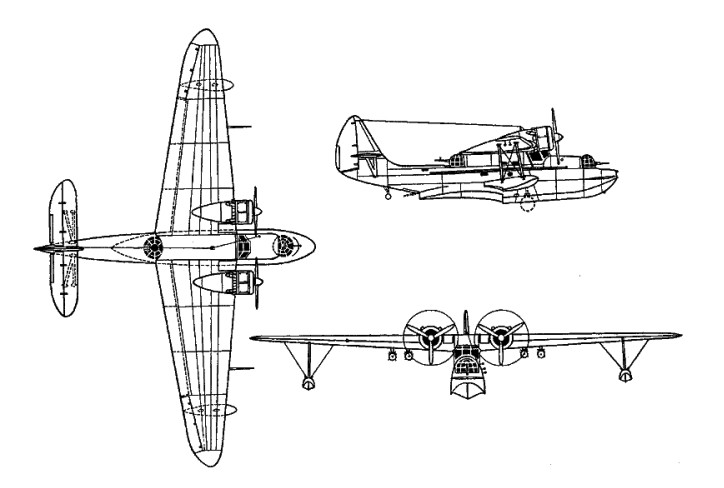
Beriev MDR-5

The first prototype flew as an amphibian in May 1938. The second prototype was built as a flying boat. Only two were built.

Engine: 2 x M-87A, 950hp
Take-off weight: 8795 kg / 19390 lb
Empty weight: 6083 kg / 13411 lb
Wingspan: 25.0 m / 82 ft 0 in
Length: 15.9 m / 52 ft 2 in
Wing area: 78.5sqm / 844.97 sq ft
Max. speed: 350 km/h / 217 mph
Ceiling: 8700 m / 28550 ft
Range: 1150-2415 km / 715 – 1501 miles

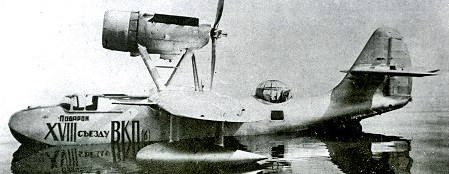
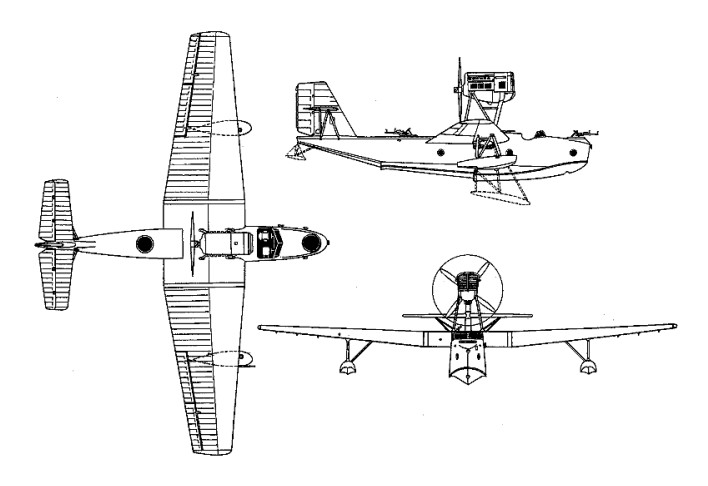
Beriev MBR-2 / MP-1 / Be-2

Georgii Mikhailovich Beriev produced his first original design, Aircraft No. 25, at the Menzhinsky plant in Moscow in 1932. The B.M.W. VIF-powered prototype was transported to Sevastopol on the Black Sea for flight tests, and proving successful the new flying-boat went into production as the MBR-2 (Morskoy Blizhnii Razvedchik, or naval short-range reconnaissance). In production form it was powered by a Soviet-built M-17B inline engine.
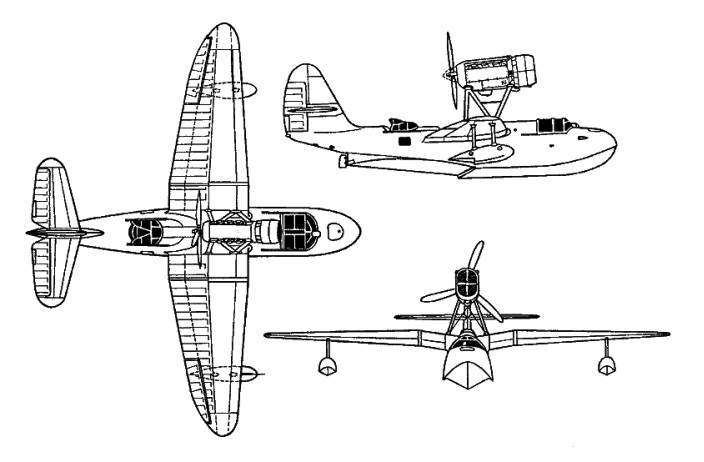
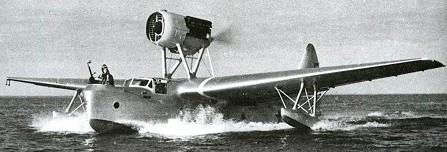
Deliveries of the MBR-2M-17 intended for use in the short-range bombing and maritime reconnaissance roles, began in 1934. It was a shoulder-wing cantilever monoplane, with its M-17B engine mounted on a pair of N-struts over the wing; it had a two-step wooden hull with plywood covering, and the pilot’s cockpit located just in front of the wing. A strut-braced horizontal tailplane was set high on the single fin. Bow and midships gunners each had a single 7.62mm PV-1 machine-gun.

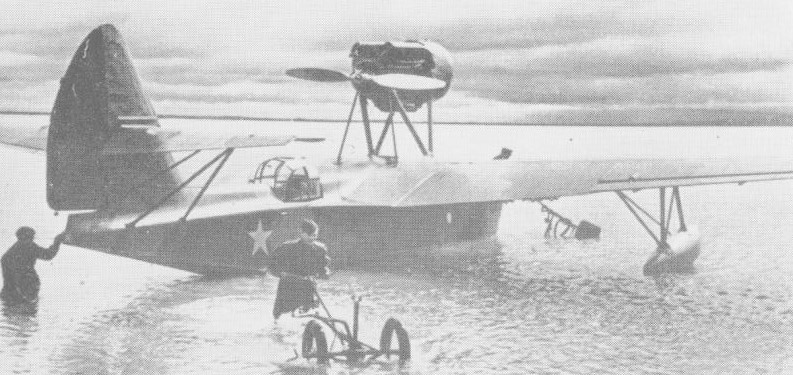
In 1935, with the first production version already in service, Beriev carried out a redesign of the MBR-2. The pilot’s cockpit was fully enclosed, and the midships gunner’s position protected by a glazed cupola. The M-17B engine was replaced by the M-34NB (redesignated AM-34NB in 1937) of 619kW, and a new curved fin and rudder replaced the original angular vertical tailplane. ShKAS machine-guns supplanted the obsolete PV-1s. The new version was placed in large-scale production, which continued until 1942, when 1,300 of all variants had been built. The MBR-2AM-34 served with all four main Soviet fleets and saw considerable service, first during the Winter War of 1939-40 with Finland, and then throughout the Great Patriotic War of 1941-5. It was tough, reliable and could be fitted with wheel or ski landing gear. Post-war, the MBR-2 served for nearly a decade on fishery patrol duties; it received the NATO codename ‘Mote’.

Variants:

Beriev MBR-2AM-34
In 1935, with the first production version already in service, Beriev carried out a radical redesign of the MBR-2. The pilot’s cockpit was fully enclosed, and the midships gunner’s position protected by a glazed cupola; the M-17B engine was replaced by the M-34NB (redesignated AM-34NB in 1937) of 619kW; an entirely new curved fin and rudder replaced the original angular vertical tailplane; and ShKAS machine-guns supplanted the obsolete PV-1s.

Beriev MBR-2M-103
In 1937 a standard MBR-2AM-34 was modified to take a more powerful M-103 engine, but no production of this version was undertaken

Beriev MP-1
This was a civil passenger version of the MBR-2M-17; it carried six passengers in an enclosed cabin, or an equivalent weight of freight; used in some numbers by Soviet Civil Aviation

Beriev MP-1bis
A 1937 civil development of the MBR-2AM-34, with similar capacity to that of the MP-1; one MP-1 bis, piloted by Paulina Osipenka, established a number of women’s world records; between 22 and 25 May 1937 she attained respectively 7605m with a 500kg payload and 7000m with a 1000kg payload; on 2 July the same year she made a non-stop flight of 2416km between Novgorod and Archangelsk.

Specifications:

MBR-2M-17
Engine: 2 x M-17B inline piston, 507kW
Take-off weight: 4100 kg / 9039 lb
Empty weight: 2475 kg / 5456 lb
Wingspan: 19.0 m / 62 ft 4 in
Length: 13.5 m / 44 ft 3 in
Wing area: 55.0 sqm / 592.01 sq ft
Max. speed: 200 km/h / 124 mph
Ceiling: 4400 m / 14450 ft
Range: 650 km / 404 miles
Crew: 4
Armament: 2 x 7.62mm machine-guns, 500kg of bombs

MBR-2AM-34
Max speed: 245km/h
Range: 800km
Service ceiling: 7150m
Empty weight: 2718kg
Loaded weight: 4000kg

MBR-2bis
Engine: 1 x AM-34NB, 860hp
Length: 44.29ft (13.5m)
Width: 62.34ft (19.00m)
Height: 12.47ft (3.80m)
Maximum Take-Off Weight: 9,359lbs (4,245kg)
Maximum Speed: 154mph (248kmh; 134kts)
Maximum Range: 870miles (1,400km)
Service Ceiling: 19,685ft (6,000m)
Armament: 2 x 7.62mm machine gun
Bombload: 661lbs (300kg)
Crew: 4-5
Hardpoints: 2

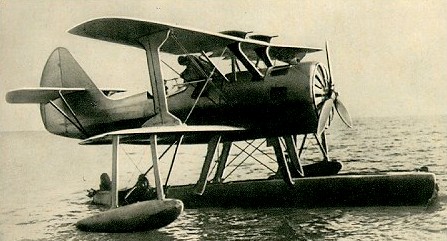
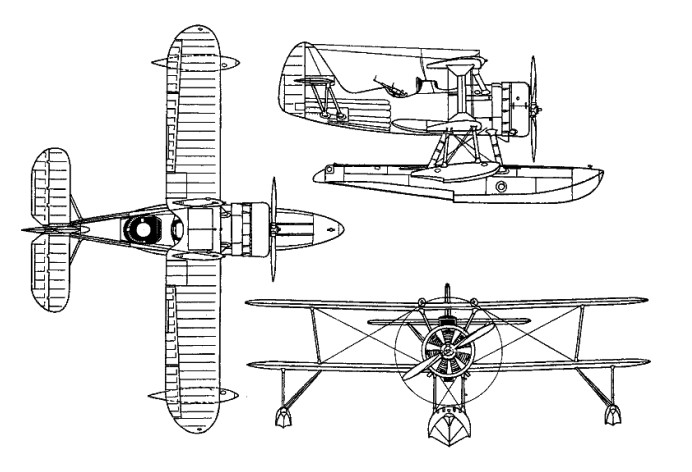
Beriev KOR-1 / Be-2

The Be-2, originally designated KOR-1, was a shipboard reconnaissance seaplane. It was first flown on 4 September 1936 by P O Noman and entered service in 1938.

Engine: 1 x M-25A, 715hp
Take-off weight: 2425 kg / 5346 lb
Empty weight: 1640 kg / 3616 lb
Wingspan: 11.0 m / 36 ft 1 in
Length: 7.1 m / 23 ft 4 in
Height: 4.4 m / 14 ft 5 in
Wing area: 31.8 sq.m / 342.29 sq ft
Max. speed: 277 km/h / 172 mph
Ceiling: 6600 m / 1650 ft
Range: 860 km / 534 miles

Beriev

Starting seaplane design in 1928, Georgi. M. Beriev became the leading designer of Russian waterbased aircraft. Beriev had gained considerable expertise as an assistant to French designer, Paul-Aime Richard, during the latter’s stay in the Soviet Union from 1928 to 1930.
Chief designer of the TsKB seaplane group and the bureau of G M. Beriev, at Taganrog on the Azov Sea.
In 1930, he was responsible for the twin-engined MBR-2 flying-boat, Be-2 reconnaissance seaplane and Be-4 flying-boat. Beriev design bureau became center of Soviet seaplane development in 1945, a major flying-boat project being the twin-jet Be-10. Be-12 twin-turboprop antisubmarine and reconnaissance amphibian manufactured between 1963 and 1973 and used widely by Soviet/Russian Navy until about 1997, when withdrawn; several Be-12s have been modified for civil uses, including transport and firefighting. A-40/Be-40 Albatross Mermaid turbofan-powered intermediate-range antisubmarine, search-and-rescue and patrol amphibian, first flown December 1986 and ordered for the Russian Navy in 1992 but not funded.
An improved search-and-rescue variant became the Be-42 (sometimes referred to in the West as A-45).
A laser-gun test-bed aircraft based on the llyushin II-76 was produced by Beriev and has been flown since 1980s as A-60, while in 1978 the first flight took place of the Beriev A-50 Mainstay airborne early warning and control aircraft, also based on the II-76 and in Russian operational service since 1984. Beriev Be-32 16-passenger twin-turboprop transport (first flown 1976), similar to earlier Be-30 (first flown 1968), was still to enter production in 1998. Be-102 multipurpose amphibian designed in 1993 but remained project in 1998. Be-112 Pelican larger multipurpose amphibian under consideration for development, while Be-200 twin turbofan multipurpose amphibian (initially for firefighting) first flew in 1998. Be-103 six-seat light amphibian, also suited to cargo carrying, survey and other roles, first flew July 1997; has twin piston engines carried on mounts either side of the rear fuselage. Very heavy lift cargo and passenger amphibians have been projected as Be-1200 and Be-2500, possibly to fly next century. Company then named Joint Stock Company “Taganrog Aviation Scientific- Technical Complex named after G.M. Beriev,” and became part of the AVPK Sukhoi organization.

Bergonzi Ardea  

In Italy, Pier Carlo Bergonzi had built the Bergonzi “Ardea” at the factory of Breda. The aircraft was built as a fighter in 1918 and Breda bought the rights from Bergonzi.

The plane flew, exhibited in 1919, and had good characteristics, but was damaged (the wheel fell into a pothole) and was not restored.

Bergamaschi Cantieri, Aeronautici

Originally operator of a flying school and began in 1927 to build single-seat and two-seat training aircraft, the Bergamaschi C-1 and C-2 respectively, which incorporated improvements to facilitate flying training. These included a well-sprung landing gear and aerodynamic features to improve stability. Absorbed into Caproni group 1931 as Caproni Aeronautica Bergamasca.

Benes-Mraz Be-500 Bibi / Be-501 / Be-502

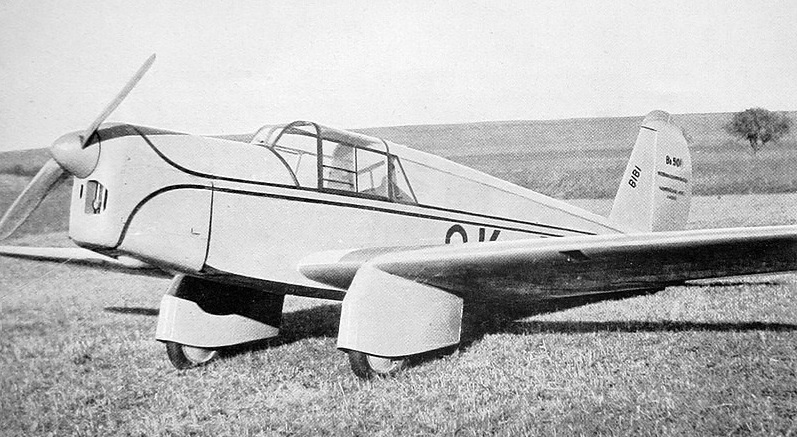
Beneš-Mráz Be-501 Bibi with Walter Mikron II

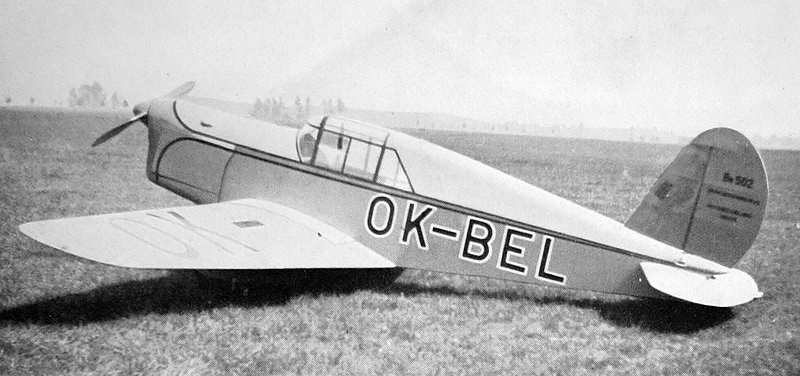
Designed by Pavel Beneš, the Beneš-Mráz Be-500 Bibi, Be-501 and Be-502 were Czechoslovak single-seater sports aircraft which were manufactured by Inž. P. Beneš et al. J. Mráz in 1936, at Choceň.

They were small single-seater aircraft with low fuel consumption. The dimensions differed minimally, and were equipped with different Walter engines. The Walter Atom engine was to be tested on the Be-500 prototype (but the prototype was not completed), the 20 cm longer Be-501 version had the Walter Mikron II engine (modified to fit a cylinder capacity of 2 l) and finally the Be-502 version. of the same length as the prototype Be-500, was equipped with the most powerful Walter Minor 4 engine. Both aircraft were specially built to participate in the 12-hour race in the city of Angers.

Shortly after the completion, the Be-501 and Be-502 successfully participated in the “12 heures d’Angers” race in France, when Josef Kalla and Karel Mareš won in their categories.

The aircraft was designed as a low-wing monoplane with a covered cabin. The self-supporting, wooden wings were complete and were inserted into the lower part of the fuselage. In the wooden, veneered fuselage, the cockpit was located in front of the main wing longitudinal. The cabin was accessible by opening most of the top cover and behind it was space for smaller luggage. The rudders were controlled by ropes, the ailerons by a rigid system of rods. The wide vertical tail surfaces were self-supporting, the rudder of which was somewhat cut above the continuous elliptical horizontal tail surface. The rudder with the keel surface has been moved forward to achieve favorable properties in the corkscrew.

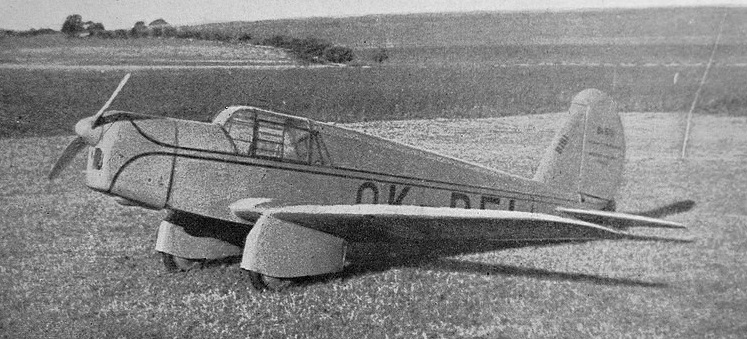
The undercarriage with “trouser” covers, consisting of two separate parts, was fastened to the main wing side member and sprung with rubber cords. The spur was made of steel, leaf springs. Various motors with an output of 20-95 hp (15-70 kW) could be installed in the engine bed of steel tubes.

Walter Minor 4 powered Be-502 Bibi (1936)

First flying in 1936, as of July 1, 1936, the Be-501 Bibi aircraft was assigned the registration mark OK-BEI and the Be-502 Bibi aircraft assigned the OK-BEL mark. In both cases, these were serial numbers 1. Both machines purchased by Aeroklub RČs. successfully participated in the race “12 hours of Angers” (12 heures d’Angers) in speed and reliability, organized by the West French Aeroclub in early July 1936. The machines and their pilots, Major Kalla and Lieutenant Colonel Mareš, gave their best, and they won in their categories. Major gen. no. Josef Kalla on the Be-502 Bibi won in the category of engine capacity up to 4 liters, when he flew 1229.04 km at an average speed of 204.04 km / h, and in the category up to 2 liters with a special Micron II Lt. Col. Karel Mareš on the Be-501 Bibi, when he flew 1001,968 at an average speed of 166,968 km / h. In the overall classification, regardless of the volume of engines, J. Kalla finished in 2nd place and K. Mareš in 6th place.

In May 1937, these aircraft completed high-speed flights of 100 and 1000 km. Pilot stkp. Štěpán with Be-501 on a shorter route reached a speed of 179.229 km / h and on a longer 170,809 km / h, on Be-502 a speed of 220.94 km / h was reached (ing. Šimůnek per 100 km) and 214.174 km / h (Capt. Pupil for 1000 km). In December 1937, Capt. Červinka on the Be-501 international altitude record 4658 m.

Walter Minor 4 powered Be-502 Bibi (1936)

Further development of these aircraft did not continue, because the developers focused on the more advanced type Beneš-Mráz Be-550 Bibi, which was completed in late 1936. After the occupation of Czechoslovakia by Nazi Germany, the aircraft were used in Luftwaffe flight schools.

Be-500
Engine: Walter Atom, 18 kW / 25 hp
Propeller: two-bladed, wooden
Span: 8.5 m
Wing area: 9 m²
Length: 5.86 m
Height: 1.65 m
Empty weight: 170 kg
Max. takeoff weight: 285 kg
Wing load: 31.6 kg / sq.m
Cruising speed: 135 km / h
Max. ground speed: 155 km / h
Landing speed: 57 km / h
Range: 850 km
Ceiling: 4000 m
Climb to 1000 m: 9 min
Crew: 1

Be-501
Engine: Walter Mikron II, 33 kW / 45 hp
Propeller: two-bladed, wooden
Span: 8.5 m
Wing area: 9 m²
Length: 6.02 m
Height: 1.72 m
Empty weight: 340 kg
Max. takeoff weight: 600 kg
Wing load: 66.7 kg / sq.m
Cruising speed: 165 km / h
Max. ground speed: 190 km / h
Landing speed: 73 km / h
Range: 1700 km
Ceiling: 3300 m
Climb to 1000 m: 9 min
Crew: 1

Be-502
Engine: Walter Minor 4, 62 kW / 85 hp
Propeller: two-bladed, wooden
Span: 8.5 m
Wing area: 9 m²
Length: 5.86 m
Height: 1.65 m
Empty weight: 340 kg
Max. takeoff weight: 600 kg
Wing load: 66.7 kg / sq.m
Cruising speed: 200 km / h
Max. ground speed: 230 km / h
Landing speed: 87 km / h
Range: 1900 km
Access: 4000 m
Climb to 1000 m: 7 min
Crew: 1

Benes-Mraz Be.60 Bestiola

Sports Aircraft, Czech Republic, 1935

Engine: Walter Mikron II, 47 hp
Length: 21.818 ft / 6.65 m
Wingspan: 36.745 ft / 11.2 m
Wing area: 163.613 sqft / 15.2 sq.m
Max take off weight: 1080.5 lbs / 490.0 kg
Weight empty: 639.5 lbs / 290.0 kg
Max. speed: 81 kts / 150 km/h
Cruising speed: 67 kts / 125 km/h
Service ceiling: 11155 ft / 3400 m
Wing load: 6.56 lbs/sq.ft / 32.00 kg/sq.m
Range: 254 nm / 470 km
Crew: 2