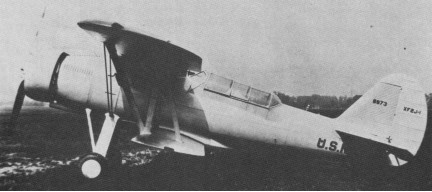
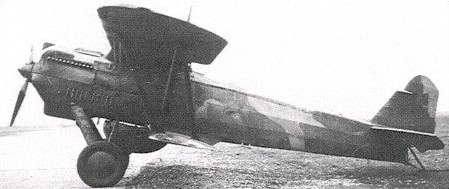
Essentially a navalised P-16, the XF2J-1 two-seat shipboard fighter prototype was ordered by the US Navy on 30 June 1931, but did not fly until 1933. Originally designed for a single-row Pratt & Whitney R-1690C Hornet radial, the XF2J-1 was completed with the experimental two-row 14-cylinder Wright R-1510-92 Whirlwind rated at 625hp at 1830m. The XF2J-1 was a two-seater fighter with a smooth monocoque fuselage. Upper and lower wings were gulled in¬to the fuselage, as in the P 16. As initially flown, the XF2J-1 had tandem open cockpits, but at an early stage in the test programme sliding canopies were fitted. Inadequate visibility for deck landing and inability to compete with the Grumman XFF-1 ended further development of this type. The Navy chose the Grumman and the F2J never went into production.
Take-off weight: 2059 kg/4539 lb Empty weight: 1456 kg/3210 lb Wingspan: 10.97 m/36 ft 0 in Length: 8.78 m/29 ft 10 in Wing area: 28.19 sq.m/303.43 sq ft Max. speed: 315 km/h/196 mph Range: 840 km/522 miles
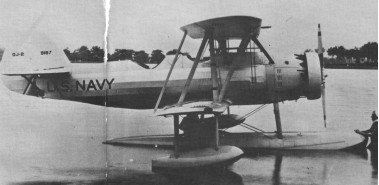
In 1930, Berliner/Joyce came out with the OJ 2, a much more conventional and successful observation airplane for the U. S. Navy. Thirty nine OJ 2 were delivered to Scouting Five and Scouting Six Squadrons, and were operated from catapults on light cruisers until 1935. The OJ 2 was by far, the most successful of Berliner/ Joyce aircraft.
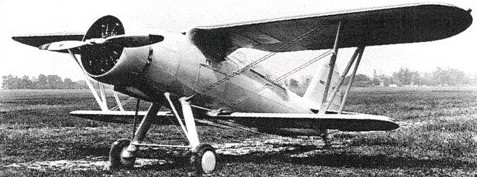
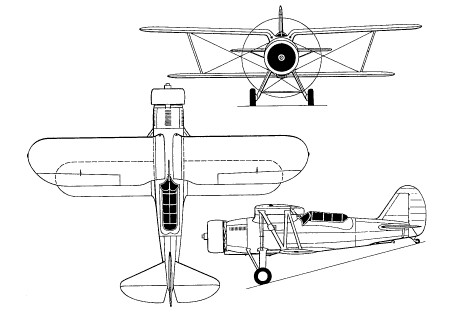
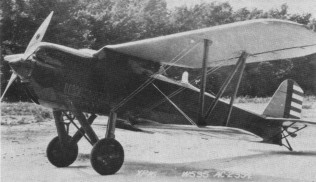
The United States Army Air Corps wrote specs for a two seat fighter, getting a competition held in April, 1929. As per Air Corps specification 1639A, the proposal of the new Berliner/Joyce Aircraft Corp. won out over its competitors, Boeing, Curtiss and Vought. The fighter, officially designated the XP-16, was one of three products of a young company that had come into being in 1928. Two seat fighter concept as envisioned by Air Corps planners required an aft facing gunner.Completed in October 1929, the one and only XP 16 was delivered in October 1930. A supercharged Curtiss V-1570A Conqueror gave it a top speed of 186mph at 5000 feet, and 183 mph at 10,000 ft. The prototype XP-16 was of fabric-covered metal construction with an upper wing of gull configuration. Armament comprised two fixed forward-firing 7.62mm machine guns and a third weapon of similar calibre on a flexible mounting in the rear cockpit. Five 11kg or two 55kg bombs could be carried.Two contracts were issued for a total of 25 service test aircraft as YlP-16s, these being essentially similar to the prototype apart from having the unsupercharged V-1570-25 Conqueror which was also rated at 600hp. The YlP-16s were delivered in 1932 and were later redesignated as PB-1s (pursuit-biplace). These proved to possess insufficient manoeuvrability to oppose single-seat fighters, offered extremely poor visibility for landing and displayed a tendency to nose over. They were withdrawn from USAAC service on 31 January 1934.
P-16 Crew: 2 Engine: 1 x 600hp Ñurtiss V-1570-25 Conqueror Take-off weight: 1813 kg / 3997 lb Empty weight: 1271 kg / 2802 lb Wingspan: 10.36 m / 34 ft 0 in Length: 8.59 m / 28 ft 2 in Height: 2.74 m / 9 ft 0 in Wing area: 25.92 sq.m / 279.00 sq ft Max. speed: 282 km/h / 175 mph Cruise speed: 243 km/h / 151 mph Ceiling: 6585 m / 21600 ft Rate of climb: 654 m/min / 2150 ft/min Range: 1046 km / 650 miles Armament: 3 x 7.62mm
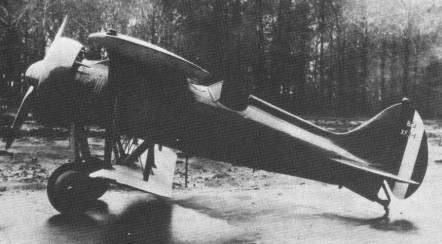
In 1929 the stock market collapsed. Berliner/Joyce set the 29 1 aside and concentrated on a more promising military contract for the XFJ-1, a Navy carrier fighter contract they had gotten in May of that year. The first military design of the new Berliner/Joyce Aircraft Co. was the XFJ 1. Bristol Fighter influence was carried over into the single seater fighter by dropping the lower wing to reduce wing interaction. The upper wing of the XFJ-1 was gulled into the fuselage and the lower wing was dropped sixteen inches below the fuselage. The XFJ 1 did not earn a production contact for Beliner/Joyce. The lower wing, so near the ground, created so much turbulence that it was difficult to keep the airplane from ground loop¬ing. When the Navy lost interest in the XFJ 1, Temple Joyce attempted to interest the Air Corps in it. Fitted first with an anti drag ring and later with wheel pants, it had a top speed of 193mph. In the same year that the XFJ 1 was tested, 1930, Berliner/Joyce came out with the OJ 2.
The first product of the new company was the 29 1, a tandem seat cabin monoplane with a high wing, large windows and a 100 hp Kinner engine. It looked a great deal like a Curtiss Robin; not surprising because Henry Berliner had hired some men away from Curtiss. Temple Joyce first flew the 29 1 in August of 1929. Sales prospects looked good. Two and a half months later, the stock market collapsed. Berliner/Joyce set the 29 1 aside and concentrated on a more promising military contract for the XFJ-¬1, a Navy carrier fighter, a contract they had gotten in May of that year.
The Berliner Aircraft Co. had produced one commercial airplane in addition to the two earlier experimental direct lift machines. The CM 4 Sportster, a high wing parasol aimed at the private pilot market, was powered by an OX 5. One large cockpit seating two was located directly under the large wing. The front end was much like that of the Travel Air 2000, complete with the same rectangular radiator. Landing gear was a split axle type, horizontal surfaces a pleasing elliptical shape and the vertical tail an almost complete circle, though this was later changed to a lozenge shape.
Henry and his father then decided to build a new, lighter helicopter to improve the thrust-to-weight ratio. Completed in 1925, the new design bore a superficial resemblance to the previous model, but it utilized a more efficient biplane configuration. The lower wing relied on a high angle of incidence and large camber to generate some lift from the rotor downwash. The Berliners also enlarged the rotors and added a novel differential collective pitch control system to replace the ineffective louvers. However, even with the reduced weight and aerodynamic alterations, the 1925 model showed only a marginal increase in performance over the triplane version. Frustrated, Henry abandoned his helicopter experiments and became disillusioned with the potential of the helicopter. He went on to establish the Berliner Aircraft Company, and played an important role in the development of the innovative Erco Ercoupe.
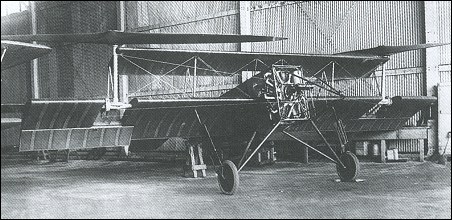
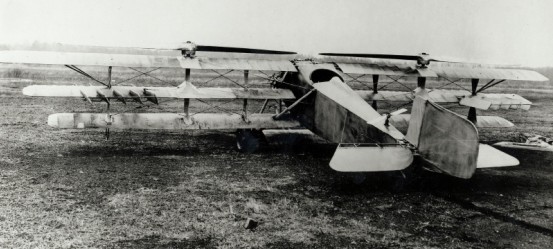
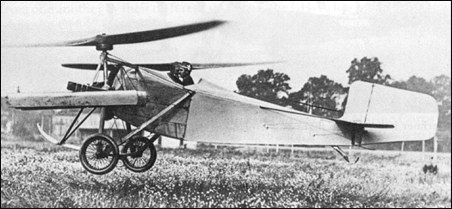
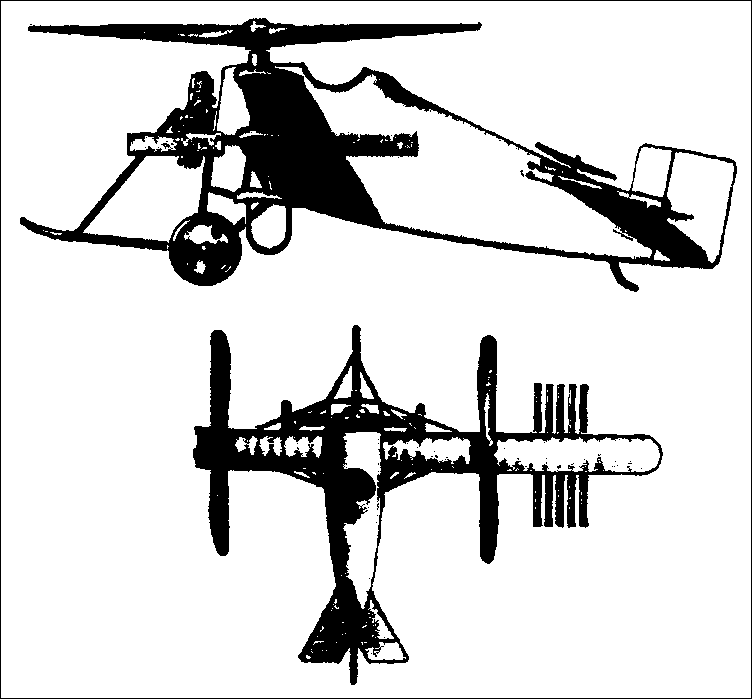
In 1922, Henry ordered a surplus Nieuport 23 fighter fuselage and mounted a Bentley 220 hp engine to the front. He attached a spar mid-way up the fuselage to form the bottom of a truss extending from the sides of the aircraft. The trusses each supported one of the two counter-rotating lifting rotors, which the engine powered through a series of geared shafts. The two rotors could tilt slightly in opposite directions to control yaw. A variable-pitch tail rotor, 76 cm (30 in) in diameter, mounted horizontally in front of the vertical stabilizer, maintained pitch control while hovering. To initiate forward flight, the pilot pushed forward on the stick to increase the pitch of the horizontal tail rotor, which dropped the nose and inclined the lifting propellers slightly to initiate forward flight. The flight controls also connected to elevators and an enlarged rudder on the tail of the fuselage, which helped maintain control at higher forward speeds. Two sets of five 91 cm (36 in) x 20 cm (8 in) louvers, located below each rotor, opened and closed differentially to provide roll control by presenting a flat surface, which reacted against the rotor downwash. In the fall of 1923, Henry decided to mount a set of triplane wings onto the aircraft to allow for a safe glide in case of an engine failure. With the new design, he found he could marginally control the helicopter in a hover and in forward flight at speeds up to 64 kph (40 mph). However, Henry discovered that the helicopter did not have adequate thrust to climb out of ground effect. The roll-control louvers were the weak-point of the control system and lateral handling was poor. On February 23, 1924, the helicopter recorded its best performance when it reached a height of 4.57 m (15 ft) during a one minute, thirty-five second flight. Many observers felt that the airframe was simply too heavy, including an Army engineer sent to observe the tests from McCook Field. It was successfully demonstrated to the US Army in 1924, with several free flights at College Park, Md. Airport. After Emile and Henry completed the testing of their triplane model, the younger Berliner offered it to the Smithsonian Institution. This aircraft is the oldest intact helicopter in the world and was on loan to the College Park Aviation Museum since 1998, appropriately located on the site of the Berliner’s original testing ground.
Wingspan: 11.58 m (38 ft) Rotor Diameter: 4.57 m (15 ft) Length: 5.49 m (18 ft) Height: 2.06 m (6 ft 9 in) Weight: Empty, 748 kg (1,650 lb) Gross, 870 kg (1,918 lb) Engine: Bentley BR-2 Rotary, 220 hp
Berliner used the fuselage of a Nieuport biplane with a 4.5m rotor mounted on an outrigger on either side of and slightly forward of the cockpit. Control vanes, similar to those used on their 1919 coaxial machine, were used in the slipstream. Longitudinal control was by a small variable pitch lifting propeller near the tail. Hovering up to 3.3m was accomplished in June 1922, and flew about 90m. Despite the fact that overall performance was unsatisfactory, the Smithsonian Institute considers the Berliner machine as the first helicopter to make a controlled flight on the basis of these tests. Berliner continued his efforts and built two additional machines, but they were short take-off convertaplanes incapable of vertical flight.
Emile’s business concerns and deteriorating health prevented him from pursuing improved designs. However, his son Henry, was also a superb engineer and wanted to continue his father’s work. In 1919, after a short stint in the Army Air Service as an aerial photographer, Henry moved to Washington D.C. to construct a helicopter under his father’s guidance.
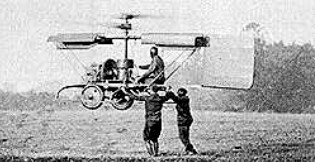
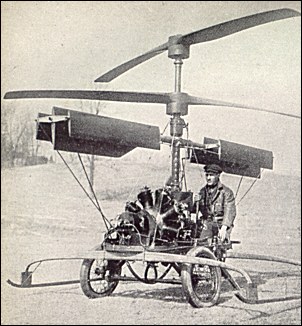
Henry’s first effort was a coaxial design mounted on a two-wheeled test stand. He soon transformed this model into a manned version, powered by an 80 hp Le Rhône engine with two co-axial propellers with vanes to vector the downwash for pitch control. It was able to lift Henry, and make the transition from a hover to forward flight, but its control was so poor that assistants running alongside had to steady it. Henry decided to take a new approach and adapt his experience with conventional airplanes to the control problem.