Founded in January 1923 by M. Blanchard, a designer who had worked for the Farman brothers and Georges Levy. Specialized in the construction of flying-boats. A single-seat racing monoplane was designed to take part in the 1924 Schneider Trophy Contest, which was canceled because there were not sufficient aircraft ready to compete.
Inter-Wars
Blanch Biplane / Experimental
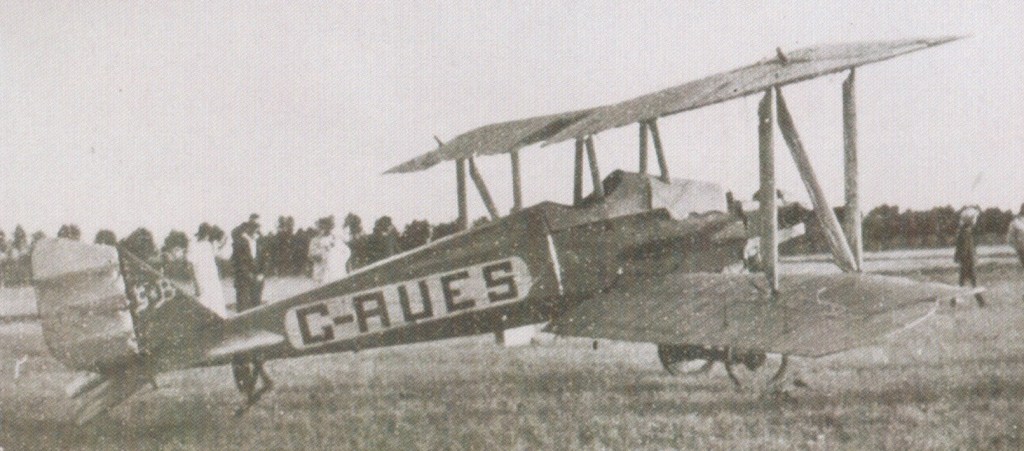
The Blanch Biplane, also known as the Blanch Experimental, was designed and constructed by Mr William James Blanch in the 1920s near Armadale, WA., Australia. Mr Blanch was an engineer who migrated to Australia following the conclusion of World War I. His aim was to design and construct a light biplane demonstrating the feasibility of producing an aircraft with a low powered engine which could be constructed cheaply and sold to future aviators. He was interested in aviation and began construction of a single-seat light biplane for which Certificate of Registration 106 and registration G-AUES (c/n 1) were allotted but not taken up. It was of wooden construction with fabric covering and was to be powered by a 19.3 kw (26 hp) Morehouse engine produced by the E B Heath Company of Chicago, USA, this company also building the popular, at the time, Heath Parasol monoplane.
The Australian Civil Aviation Branch (CAB) was approached by Mr Blanch in 1922 to inform them that material for construction had been ordered and he was founding a business to build and develop the aircraft, being backed for the for the construction of the prototype by Messrs Gordon and Clark who operated as Gordon Motor & Cycle Co of Perth, WA. Construction took place in the rear of a soft-drink shop in Third Avenue, Armadale. The CAB was supplied with technical data, calculations and drawings. In July 1922 Captain Frank Barnwell (1880-1938), Chief designer of the Bristol Aeroplane Company, made a structural analysis of the design. Estimated performance included a speed of 97 km/h (60 mph).
CAB inspections were made in January 1923 of the aircraft and the work was said to be highly creditable but detail workmanship was not up to the standard required for a Certificate of Airworthiness. Further CAB inspections in May and September 1923 required major changes to the construction, including the re-design of the wing with the original solid spars replaced by built-up units. At the latter inspections the fuselage, tailplane and elevators were covered and the fuel tank, instruments, controls and engine were installed but work on the wings had not advanced far.
The wings were completed by June 1924 and the CAB inspector stated the workmanship was in advance of anything done up to that time. By January 1925 the uncovered wings were attached to the fuselage and all controls connected. The aircraft was moved to Cullen’s Field off Railway Avenue where taxiing trials were commenced but it was found the engine would not exceed 1,150 rpm and thus not supply sufficient power.
Mr Blanch then applied to the CAB for £3,000 ($6,000) to set up a facility to build the design but this was not forthcoming. He was offered a 21.6 kw (29 hp) Morehouse engine built in the United States by Wright. In the event this engine was not imported and consideration was given to a chain driven converted Henderson motor-cycle engine. Certificate of Registration No 106 was then allotted. Further modifications to the aircraft were made, including installation of a new carburettor and strengthening of the undercarriage.
Soon after, financial support for the aircraft was withdrawn by the backers and the aircraft was left under a tree on Sherwood Estate. The wings were removed and placed in the loft of a barn but the fuselage suffered some damage from vermin and had to be moved to a shed at Maddington. It seems the aircraft was complete and ready for flight but was never flown.
The Civil Aviation Branch suggested an ABC Scorpion engine be procured to be installed at its cost, which could later be used in the Branch’s de Havilland DH.53s but this did not occur. The aircraft was still in existence during World War II but its final fate is not known. Mr Blanch died in about 1929.
Engine: One 19.3 kw (26 hp) Morehouse two-cylinder horizontally-opposed
Wingspan: 7.92 m (26 ft)
Length: 6.4 m (21 ft)
Max speed: 97 km/h (60 mph)
Initial rate of climb: 61 m/min (200 ft/min)
Loaded weight: 295 kg (650 lb)
Blake Bluetit
W.H.C. Blake and his brother built the little Bluetit monoplane from Simmonds Spartan Two Seater G-AAGN c/n 14, Simmonds Spartan Three Seater G-AAJB c/n 19 and some Avo 504 parts.
It was built at Winchester, UK, in the mid-1930s, powered by a 32 hp Gnat engine. It is not known if it ever flew.
It survived the war and later became part of the Shuttleworth Collection. Allocated BAPC.37 it was stored at Old Warden.
Blackhawk Aircraft Model M
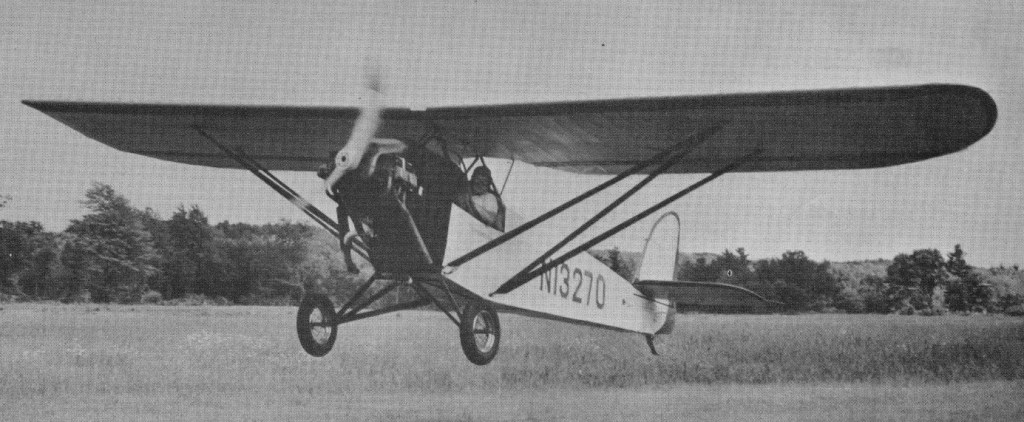
The Blackhawk Aircraft partners Slower and Rheinhardt second model, the Model M, serial 2, featured wooden wings, tubular steel fuselage and tail, with a 60 hp Anzani engine.
The first flight was on 3 August 1933.
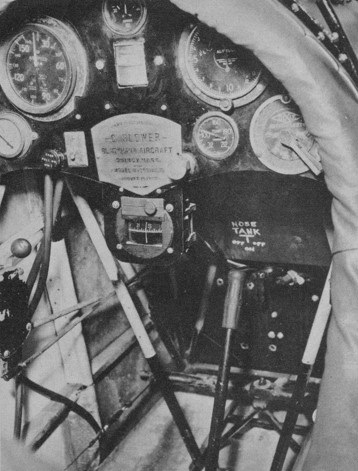
Stored in a garage, the Model M was re-discovered by Elden Langley of Norfolk, Massachusetts. Langley restored to one-of-a-kind which flew again on 13 June 1964. Unable to locate a workable Anzani a Franklin 90 hp was installed. The cost of acquiring and rebuilding, including the replacement engine, was $2000.
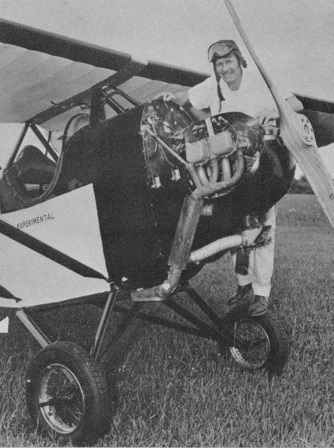
Engine: Franklin 90 hp
Span: 30 ft
Airfoil: USA 35A mod
Wing chord: 65 in
Length: 17 ft
Height: 6 ft 2 in
Empty weight: 840 lb
Gross weight: 1200 lb
Top speed: 70 mph
Cruise: 65 mph
Landing speed: 30 mph
Endurance: 3 hr 30 min
TO to 50 ft: 1000 ft
Blackhawk Aircraft
Quincey
Massachusetts
USA
The Blackhawk Aircraft partners Slower and Rheinhardt created their first craft in 1929 as an all wood aircraft. It was completed but never flew.
The next was the Model M serial 2.
Burney & Blackburne Thrush
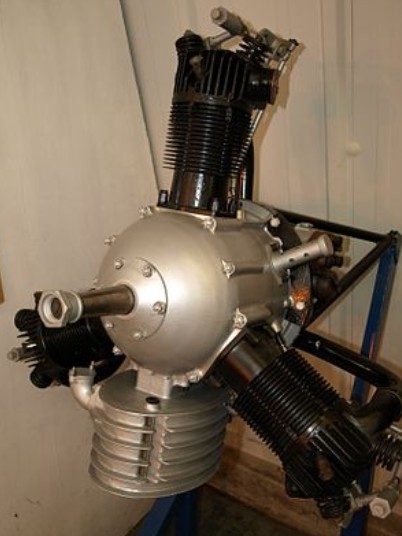
The Blackburne Thrush was a 1,500 cc three-cylinder radial aero-engine for light aircraft produced by Burney and Blackburne Limited. Burney and Blackburne were based at Bookham, Surrey, England and was a former motorcycle manufacturer.
First produced in 1926 the engine was based on an earlier 1924 design with improvements to allow use on light aircraft.
Applications
ANEC IV
Blackburn Bluebird
Clarke Cheetah
Cranwell CLA.4
Parnall Pixie
Supermarine Sparrow
Vickers Vagabond
Westland Widgeon
Specifications:
Type: 3-cylinder air-cooled radial
Bore: 3.16 in (81 mm)
Stroke: 3.78 in (96.8 mm)
Displacement: 88.97 cu in (1.5 L)
Dry weight: 132 lb (60 kg)
Valvetrain: Overhead poppet valve
Cooling system: Air-cooled
Power output: 35 hp (26 kW)
Power-to-weight ratio: 0.26 hp/lb
Burney & Blackburne Tomtit
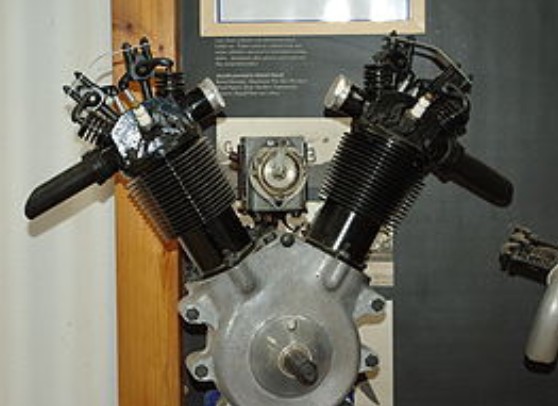
The Blackburne Tomtit was a 670 cc V-twin aero engine for light aircraft that was designed and produced by Burney & Blackburne Limited. Burney and Blackburne were based at Bookham, Surrey, England and was a former motorcycle manufacturer.
The Blackburne Tomtit engine was developed from Blackburne’s motor-cycle engines. The first one adapted to aircraft use was the best performing engine at the Lympne light aircraft trials of 1923, despite the lack of refinement. The Tomtit was a modified version of the Lympne 696 cc V-twin, marketed specifically for flight.
The Tomtit could run upright or inverted and was the first British engine to fly inverted, in the ANEC I. The inverted configuration was more common, but the Avro 558 used it in the upright arrangement, and the Avro 560 flew with both upright and inverted Tomtits.
Applications:
ANEC I
Avro 558
Avro 560
BICh-3 (the world’s first flying wing)
Darmstadt D-11 Mohamed
de Havilland Humming Bird
Gloster Gannet
Gnosspelius Gull
Handley Page H.P.23
Heath Parasol
Parnall Pixie II
Reid biplane
Short Cockle
Wheeler Slymph
Specifications:
Type: Vee twin four stroke piston engine
Bore: 71 mm (2.80 in)
Stroke: 88 mm (3.46 in)
Displacement: 696 cc (42.5 cu in)
Dry weight: 34 kg (75 lb)
Power output: 16 hp (12 kW) at 2,400 rpm
Specific fuel consumption: 0.58 pint (0.33 litre) per hp per hour
Oil consumption: 0.035 pint (0.02 litre) per hp per hour
Blackburn Alula Semiquaver
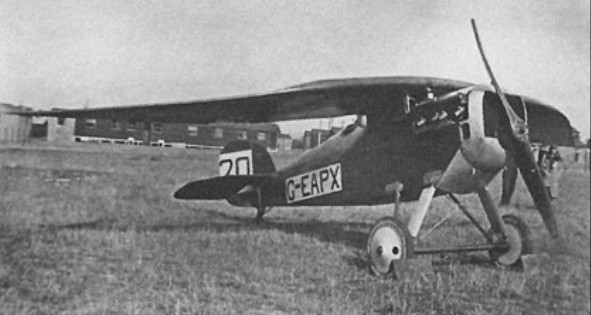
In 1921, one Martinsyde Semiquaver fuselage was fitted with the later Alula experimental wing.
Blackburn Alula D.H.6
A 1921 single-engine experimental wing conversion of a de Havilland DH.6
Blackburn F.3
A 1934 single-engine single-seat biplane fighter, built but never flown.

