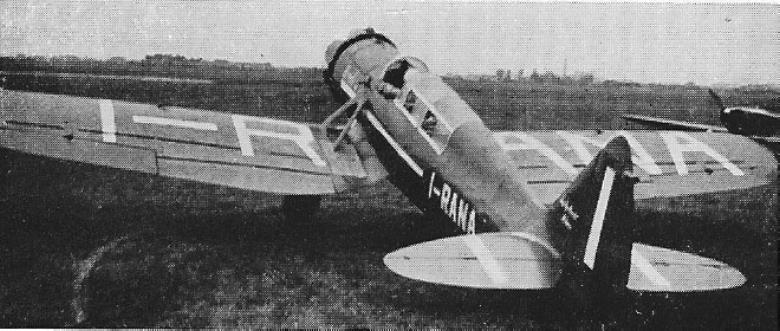
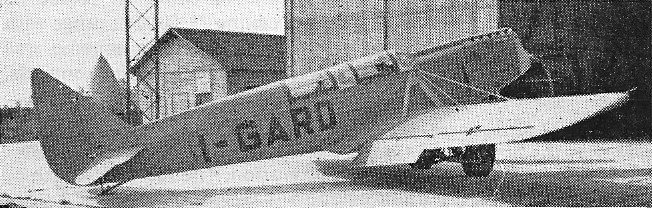
A 1936 single-engined high-wing cabin monoplane. The basic Ba.79 model, I-ABFU, was powered by one 200 hp Alfa-Romeo 115 air-cooled 6-cyl inline engine. With one crew and room for three passengers, the wing span was 11.61 m
At least 2 examples of Ba.79S, I-ABFT and I-ABFZ, were built.
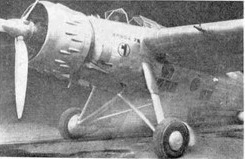
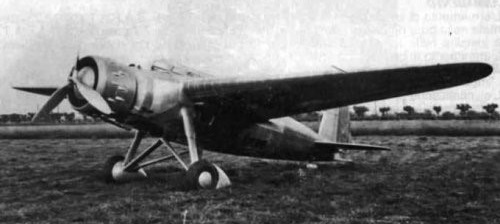
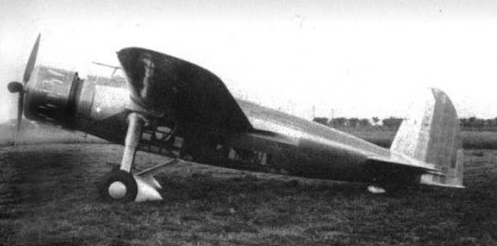
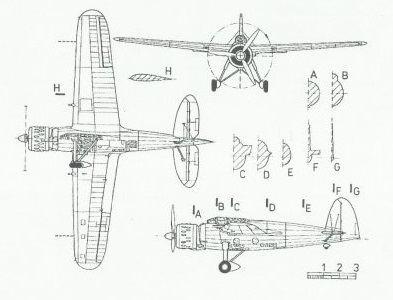
The Ba 75 was an experimental prototype produced in 1939 for both the reconnaissance and ground attack roles. Bearing a family resemblance to the Ba 65, the Ba 75 was a shoulder-wing monoplane with a stalky, fixed and liberally strutted undercarriage, powered by the 900-hp (670kW) Isotta-Fraschini K.14 radial.
The bottom and lower sides of the fuselage were glazed to allow observation of the ground.
One prototype was built, intended to use structural components of the Ba.65. The only Ba.75 was built and test flown in 1939.
Engine: 900-h.p. Isotta-Fraschini K.14 Wing span: 15.60m Length: 11.20 m Height: 3.00 m Wing area: 36.15 m² Empty Weight: 2600 kg Takeoff Weight: 4600 kg Maximum speed: 375 km/h Cruising speed: 300 km/h Range: 1700 km Ceiling: 7000 m Crew: 2-3
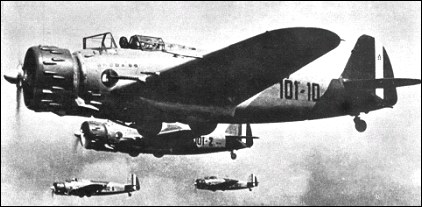
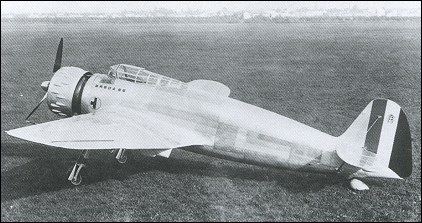
By the time the Ba.64 had entered service, work had already begun on a more powerful evolution of the system which delivered the prototype for the much improved Ba.65 fighter-bomber. The prototype first flew in September of 1935, went into series production that same year and were essentially copies of the prototype version. The Italian Isotta-Fraschini license-produced the French Gnome-Rhone K-14 engine of 700 horsepower and the early Ba.65 production forms all were fitted with the type.
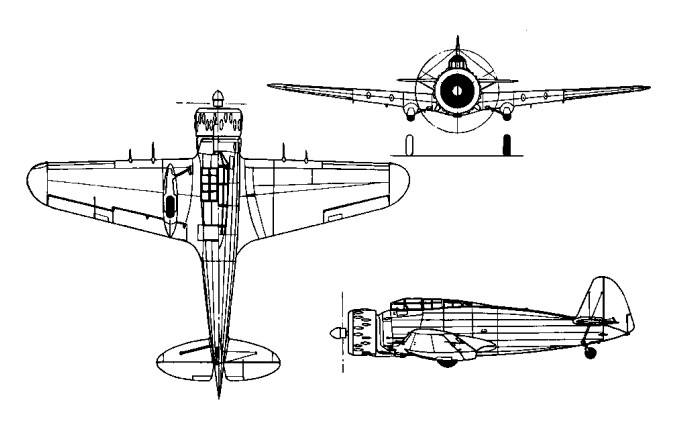
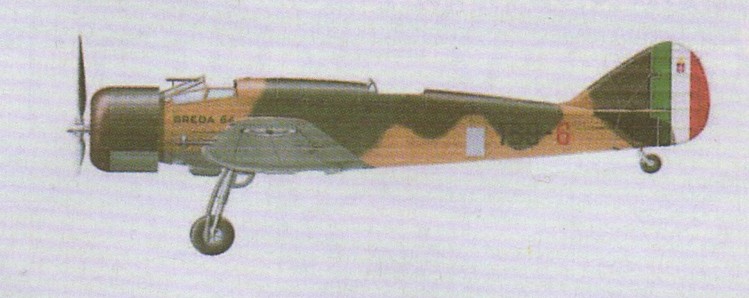
Design of the Breda Ba.65 was the engine in a forward compartment along the airframe with an identifiable oversized cowling. The cockpit was situated directly behind the engine and fitted well forward of the aircraft’s center. Wings were of a low-set monoplane design and their bulk fitted ahead of amidships, each wing sporting well-rounded tips. The fuselage was stout in appearance and tapered off gently to become the empennage. The tail was topped with a single, rounded edge vertical tail fin and a pair of high-set horizontal planes, these also well-rounded at their tips. The undercarriage consisted of two main landing gear legs and a tail wheel. Each leg was affixed with a single wheel and the main legs recessed rearwards though only partly under each wing, the wheels half-exposed during flight. The tail wheel unit remained lowered at all times, even during flight.
Armament for the Ba.65 was all contained in the wings and was primarily a mix of machine gun systems. These consisted of 2 x 12.7mm Breda-SAFAT heavy machine guns joined by a pairing of 7.7mm Breda-SAFAT general purpose machine guns. For its intended ground attack role, the Ba.65 could be fitted with up to 1,102lbs of conventional drop ordnance. Categorized a ground attack aircraft, the Ba.65 was the only such Italian aircraft to serve in this role during World War 2.
A second series of 137 aircraft was built by Breda (80) and Caproni-Vizzola (57), before production ended in July 1939. They differed from the first production batch by having Fiat A.80 RC.41 18-cylinder, twin row, air-cooled engine was introduced from the 82nd production airframe onwards, driving a three-bladed propeller. The Fiat engine improved output to a relatively impressive 1,000 horsepower. Six Fiat-powered Ba.65s and four more of the Gnome-Rhone-powered version were sent to the Aviazione Legionaria in Spain in 1938. Experience in Spain indicated that the Ba.65 was suited only to the attack role, and the type served with most of the eight squadriglie attached to the two Regia Aeronautica assault stormi (wings), the 5° and 50°.
Production of the Ba.65 would last until 1939 to which all were officially retired from 1941 onwards, the aircraft now being wholly outclassed by newer and better breeds of aircraft and limited the Ba.65 to the ground attack role when possible.
A large number of the Ba.65s serving with Italian units were of two-seat configuration, with an observer/gunner in an open cockpit above the trailing edge of the wing. A smaller number of the type had a Breda L type turret, but in either case the observer/ gunner operated a single 7.7mm machine-gun. While offensive armament could theoretically comprise up to 1000kg of bombs, the load usually carried was up to 300kg in the fuselage bomb bay or, alternatively, up to 200kg on underwing racks.
Following Italy’s entry into World War II in June 1940, Ba.65s were involved in the fighting in North Africa against the British. They had a low serviceability rate in desert conditions and the last serviceable aircraft was lost during the British offensive in Cyrenaica in February 1941.
Of 218 Ba.65 aircraft completed and delivered for use, exports included 25 Fiat-powered Ba.65 two-seaters to Iraq in 1938, two of them dual-control trainers and the remainder with Breda L turrets; 20 Ba.65s with Piaggio P.XI C. 40 engines to Chile later in the same year, 17 of them single- seaters and three dual-control trainers; and 10 Fiat-powered two-seater Ba.65 bis with Breda L turrets to Portugal in November 1939 (Fiat A.80 RC.41). A single Fiat-powered production aircraft was tested with an American Pratt & Whitney R-1830 engine in June 1937 in anticipation of an order from the Chinese Nationalist government, but this failed to materialize. The Iraqi Ba.65s saw limited action against the British during the 1941 insurrection in that country.
Ten were exported to the Soviet Union in 1939. Aviazione Legionairia Ba.65s were a mix of K.14- and A.80-powered types. Spain: 1939, 11 surviving Ba.65s* (of 23) transferred to Ejercito del Aire. But at least some (eg #551) were ‘doppio comando’ dual-control trainers.
The Ba.65 designation was used to signify the definitive single-seat production version while Ba.65bis marked both a two-seat bomber variant and its similar two-seat trainer derivative.
Ba.65 K.14 Engine: Isotta-Fraschini K.14, 900 hp Armament: 2 x 7.7mm + 2 x 12.7mm Breda-SAFAT Seat: 1
Ba.65 A.80 Engine: 1 x Fiat A.80RC.41 radial, 1,000 horsepower. Wingspan: 39.70ft (12.10m) Length: 30.51ft (9.3m) Height: 10.50ft (3.20m) Maximum Speed: 267mph (430kmh; 232kts) Maximum Range: 342miles (550km) Service Ceiling: 20,669ft (6,300m; 3.9miles) Armament: 2 x 12.7mm Breda-SAFAT heavy machine guns in wings. 2 x 7.7mm Breda-SAFAT machine guns in wings. Up to 661lbs of internal ordnance in bomb bay and 441lbs of external ordnance held underwing. Accommodation: 1 Hardpoints: 2 Empty Weight: 5,291lbs (2,400kg) Maximum Take-Off Weight: 6,504lbs (2,950kg) RAI Ba.65 A.80s were re-engined with 14-cyl. Isotta-Fraschini K.14s
Ba.65 bis 2-seat version with open gun position, increased fuel capacity
Ba.65 bis L 2-seat version equipped with enclosed Breda L dorsal turret
Ba.65 Dive-bomber conversions of 40 Ba.65bis by Caproni Vizzola
The 1934 Breda Ba.64 ground attack aircraft saw only a few years of service beginning in 1937 before being replaced in 1939 by the improved Ba.65.
1st prototype MM 249 700 hp AR Pegasus 4-blade prop 2-seat fixed u/c
2nd prototype MM 250 700 hp Pegasus single-seat semi-retractable u/c
1° serie 1936 combine MM 249’s open gun position & MM 250’s u/c 42 built
Engine: 1 x Alfa Romeo 125 RC.35 radial, 650 hp Wingspan: 39.70ft (12.10m) Length: 31.89ft (9.72m) Height: 10.30ft (3.14m) Empty Weight: 4,475lbs (2,030kg) Maximum Take-Off Weight: 6,689lbs (3,034kg) Maximum Speed: 217mph (350kmh; 189kts) Maximum Range: 559miles (900km) Service Ceiling: 22,966ft (7,000m; 4.3miles) Armament: 4 x wing-mounted 7.7 mm Breda SAFAT mgs
Ba.64 dc: Doppio Comando pilot trainer conversion incl. 2nd prototype, MM.250 Armament: 2 x 12.7mm Breda-SAFAT heavy machine guns 3 x 7.7mm Breda-SAFAT general purpose machine guns. Up to 1,200lbs of munitions. Accommodation: 2 Hardpoints: 2
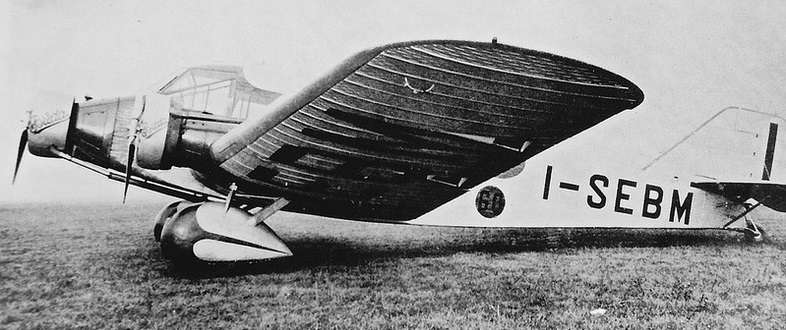
The sole 1934 Ba.46 three engined low-wing monoplane bomber/transport I-SEBM was designed to carry 12 troops or a 2200 lb bombload. It was created based on the transport aircraft Breda Ba.32.
With fixed spatted main undercarriage, the Ba.46 was first flown with 3 x 320 hp P&W Wasp Junior air-cooled radials and NACA cowls in 1932.
It was modified to 3 x 500 hp IF Asso 500 liquid-cooled V-12s, and some sources say 3 x 650 hp AR Pegasus (possibly a third re-engining)
The aircraft successfully underwent testing; however, its flight characteristics were not militarily satisfactory and it was soon dismantled.
Engines: 3x Isotta-Fraschini Asso 500, 500 hp Span: 28.80 m Length: 10.60 m Wing area: 108.20 sq.m Empty weight: 5600 kg Normal takeoff weight: 8200 kg Maximum speed: 272 km/h Cruising speed: 226 km/h Service range: 840 km Service ceiling: 6000 m Crew: 5 Armament: 3x 7.7 mm machine guns
Developed from the Ba.39, the Ba.42 was powered by a 180 hp Fiat A.70 S radial, and slots replaced slats. It used the Breda-Mazzini “wing-valve”. A slot in front of the ailerons and flaps which, operating in conjunction with the trailing edge flaps, is closed by a movable section of the wing which lowers to act as an airflow deflector.
Built for the 1934 Challenge de Tourisme International, registrations: I-GOGA, I-OMBO
Ba.42 Engine: 180 hp Fiat A.70 S Wingspan: 33 ft 1 in Wing area: 170 sq.ft Length: 25 ft 7 in Empty weight: 1232 lb Loaded weight: 2002 lb Max speed: 163 mph Cruise: 138 mph Seats: 2
The 1932 Breda Ba.39 was a 2-seat low-wing braced-monoplane tourer, 10.40m span. An enlarged version of the Ba.33, powered by a 130hp Colombo S63 inline, 60 were built.
The Ba.39 Metr: Metropolitano, was a military version intended for home use. 20 were built.
The Ba.39 Col: Coloniale, military version was intended for use abroad. 20 were built.
Three Ba.39 S 3-seat version were built in 1934 (MM55848 / I-LUDA, I-LUDO, I-VICE).
I-SEBM c/n: 3232001 Ministero Aeronautica /Centocelle 17 June 1932
A 1931 trimotor low-wing monoplane light airliner
The Breda Ba.32 was an Italian three-engine medium civil/transport aircraft, which had room for 8/10 passengers or freight. The maiden flight was in 1931. Only one aircraft was built known to have gone in June 1932 to the Ministero Aeronautica and it was powered by 3 x 320 hp P&W Wasp Junior and demolished in March 1940.
Other sources record I-ADDB as registered on 3-12-34 to SAI, Torino, and it had gone to Militar Aviation August 1935, it should have Fiat engines.
The Ba.28 training biplane was similar to the Ba.25 except that power was provided by a 380 hp / 290kW Piaggio Stella VIIZ (Gnome-Rhone K-7) radial engine.
Built in both single- and two-seat configurations, the Ba.28 had ailerons on both wings, a cowl, spinner, and larger Ba.25 I-style rudder.
The Ba.28 idro twin float version was exported to Norway.