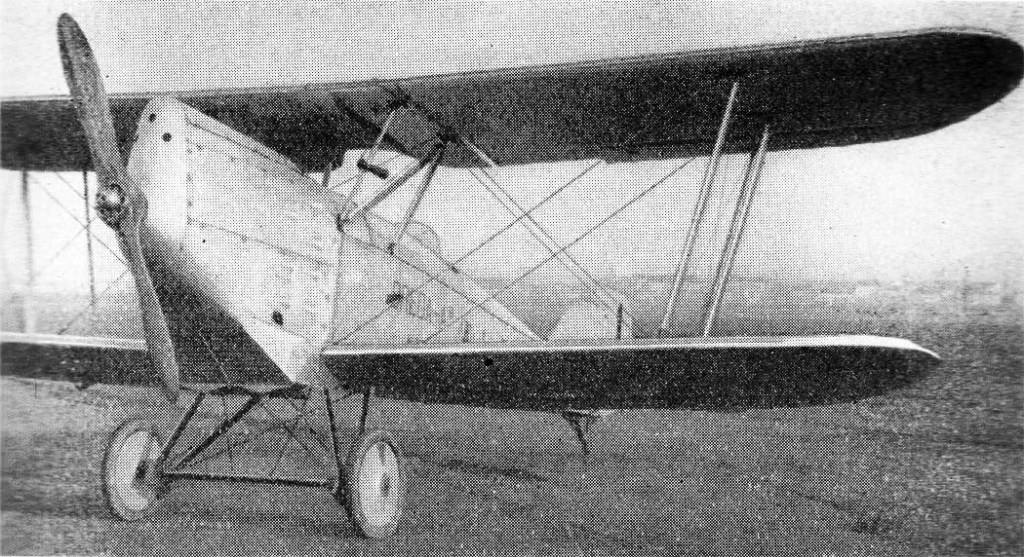
Breda Ba.27 Metallico

Prototype

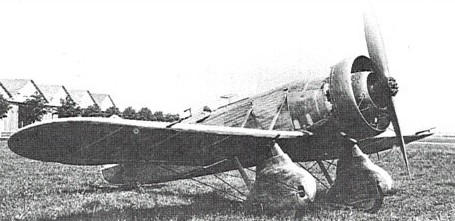
Designed by Cesare Pallavicino, the unsatisfactory characteristics of the Breda 27 low-wing braced monoplane fighter prototypes led, in late 1933, to the complete redesign of the fighter by engineers Parano and Panzeri, and the construction of a further prototype. The first prototype, MM.216, powered by a 530 hp Alfa Romeo Mercury VI, originally was fitted with a 2-blade prop, later replaced by 3-blade metal prop.

The fuselage was of welded steel tube with corrugated light alloy skinning and the wing was of wood. Proposed armament comprised two 12.7mm synchronised machine guns.

Two prototypes were built, flight testing commencing early 1933, and the second prototype, MM.217, flying from Milan to Rome-Montecelio on 10 July of that year in 90 min at an average speed of 334km/h. The second prototype differed from the first in several respects, additional bracing struts being introduced between the wing and fuselage, and struts added to increase the rigidity of the tailplane. The tailplane enlarged compared with MM.216.

The characteristics were generally unsatisfactory, the poor view from the cockpit being the subject of particular criticism, and, Ing Pallavicino having meanwhile left Breda, a total redesign of the fighter was undertaken by engineers Parano and Panzeri as the Breda 27 Metallico, in late 1933, and the construction of a further prototype.
Breda 27 Metallico

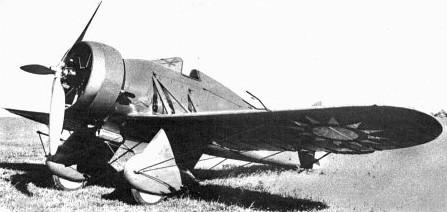
Unlike preceding Breda 27s, the new prototype (I-BAWA / MM.218) was entirely of metal construction, the wing being of steel and duralumin with duralumin skinning, and the corrugated skinning of the fuselage gave place to a smooth duralumin covering. Criticism of forward view for take-off and landing was answered by moving the cockpit bodily forward and raising it by deepening the fuselage. The 540hp Alfa Romeo-built Mercury IVA engine was retained, but the two-bladed wooden propeller gave place to a three-bladed metal propeller. The new prototype was flown in June 1934, and in September of that year it was ferried from Milan to Oslo (for demonstration to the Norwegian air arm) at an average speed of 283km/h, being exhibited at the Salon de l’Aeronautique in Paris in November.

The fifth example was purchased by Italy’s Ministero dell’Aeronautica.

Similar to the redesigned third prototype, the series version was designated Breda 27 Metallico (signifying that it was of all-metal construction) and 18 were ordered by China. In the event only 11 were delivered (in 1936), these being assigned to the 29th Pursuit Sqn at Canton. An armament of two 12.7mm machine guns was carried.

The prototype was obtained by the Regia Aeronautica, serving with the 86a Squadriglia, 5° Stormo Assalto, until December 1937.

Breda Ba.27
Take-off weight: 1903 kg / 4195 lb
Wingspan: 10.68 m / 35 ft 0 in
Length: 7.75 m / 25 ft 5 in
Height: 3.40 m / 11 ft 2 in
Wing area: 19.60 sq.m / 210.97 sq ft
Max. speed: 385 km/h / 239 mph

Breda Ba.25

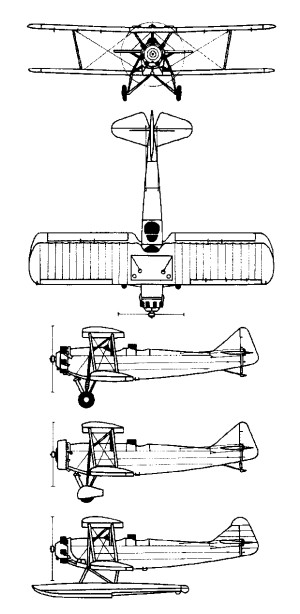
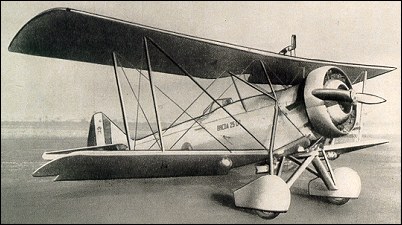
Evolved from the Ba.19A, the Ba.25 training biplane was powered by a Lynx or Castor engine. The Ba.25 was operated by the Regia Aeronautica as a landplane and as a twin-float seaplane.

Ba.25 Prototype
Wingspan: 10m
Wing chord: 719 mm
Seats: 1

Ba.25/D2
Engine: 1 x Alfa Romeo D-2 C.30, 250 hp / 175kW
Take-Off Weight: 1038 kg / 2288 lb
Loaded Weight: 790 kg / 1742 lb
Wingspan: 9.8 m / 32 ft 2 in
Length: 7.8 m / 25 ft 7 in
Height: 2.8 m / 9 ft 2 in
Wing Area: 25.0 sq.m / 269.10 sq ft
Cruise Speed: 195 km/h / 121 mph
Ceiling: 7500 m / 24600 ft
Range W/Max.Fuel: 500 km / 311 miles
Crew: 2

Ba.25/Lynx
Prod. version,
Engine: 215 hp Alfa Romeo Lynx
Seats: 2

Ba.25/Mezzo-Asso
Engine: 250 hp Isotta Fraschini Asso 200

Ba.25 Ridotto
Aerobatic vers. with reduced wingspan

Ba.25 I
Twin-float seaplane, enlarged rudder
42 built

Ba.25 bis
1932 improved vers.

Breda Ba.19

A 1930 aerobatic biplane, single- and 2-seaters, 9 m span.

Forty-one production aircraft were built.

Variants:
Ba.19: Prototype, 1 x 200 hp Armstrong-Siddeley Lynx radial

Ba.19: Production vers. (early) 1 x 240 hp Walter Castor radial

Ba.19: Production vers. (late) 1 x 215 hp Alfa Romeo Lynx
23 built

Ba.19 bis: Improved vers. 1- and 2-seaters, 215 hp AR Lynx
18 built

Ba.19 ter: 2-seat vers, 1 x 260 hp AS Cheetah IIA radial
1 built

Breda Ba.15

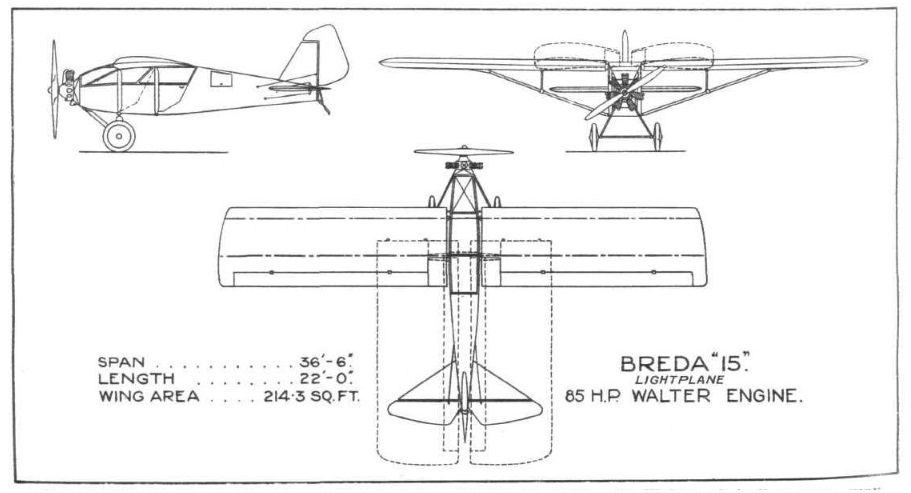
The Italian Air Ministry put forward a programme for the encouragement of Civil Aviation, with the result that the ” light ‘plane “, or medium-powered touring aeroplane, as it is classed in Italy, received a large share of attention from aircraft designers. Several were produced by various firms in Italy, among them the Breda Co., with the Breda 15.

The Breda 15 is a high wing monoplane, equipped with an 85 h.p. Walter air-cooled radial engine, although other power plants of similar horse-power can be installed. It is a two-seater tandem machine with an enclosed roomy cabin, formed by extending the top of the fuselage from the tail up to the level of the wings, the roof, front and sides, in the vicinity of the seats being composed of windows. The seats are designed that parachutes can be carried without discomfort. Access to the cabin, which is 2 ft 3 in. wide, and 4 ft. high, is by way of two doors in the side of the fuselage. Empty weight is 926 lb.

Construction is a combination of wood and steel tubing, emboding several features of previous Breda practice, incorporating many interchangeable parts. The wing has a factor of safety of 7. The incidence of the ailerons may be varied independent of and without interfering with their normal duties of lateral control.

The Breda patent dual control is fitted, in which the pilot, who normally occupies the rear seat, can disconnect the front controls during flight.

The cabin instruments include air speed indicator, revolution counter, compasses, altimeter, petrol and oil gauges, fire extinguishers, etc. Complete equipment for night flying is also fitted, including the regular four navigation lights, landing head light and cabin lighting, all supplied by a dynamo with ” buffer ” battery.

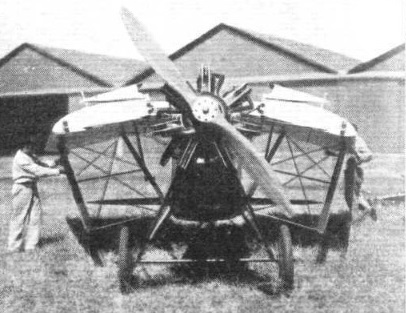
Gloster modified one Breda 15 with a variable-camber wing.

Variants:

Ba.15
1928 2-seat tandem high-wing monoplane light cabin a/c, 10.80 span
Engines: Cirrus III, DH Gipsy, Colombo S.63, Walter Mars, IF Asso

Ba.15 idro
Desig. for 1928 Ba.15 versione idro mounted on twin floats

Ba.15N
1937, I-APOL, I-AAAR

Ba.15S
New elliptical wing; Walter 85, Venus, Colombo 118, 115 hp IF 8T

Ba.15S idro
1931 twin-float equipped Ba.15S

Ba.15ter
1933 improved version, I-ACQB, I-ACQD, I-ACQE, I-ACQS

Breda A.9

A.9

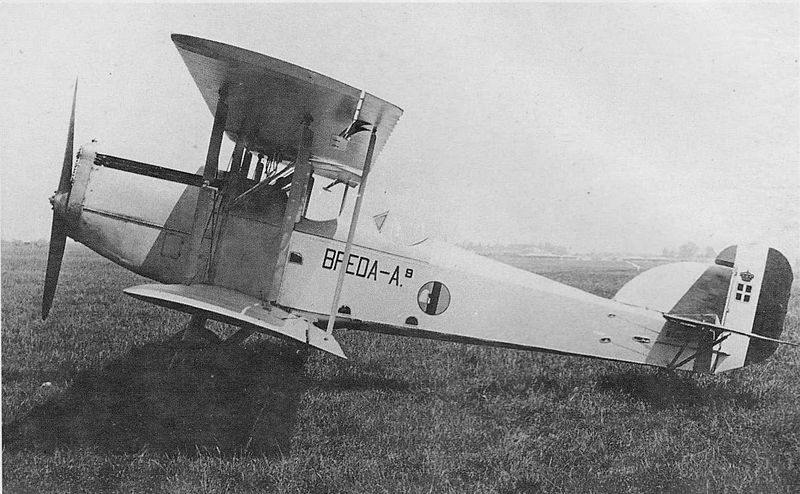
The Breda A.9 was a biplane trainer produced in Italy in 1928 for the Regia Aeronautica. Conventional in design, it featured a single-bay, unstaggered wing cellule and fixed tailskid undercarriage. The student and instructor sat in tandem, open cockpits.

A.9 I-BAZP was registered in 1927, before flying in 1928.

A slightly smaller version, designated A.9-bis was developed for use in Italy’s aeroclubs. The A.9 bis of 1930 was a reduced span (8.72 m) single-seat aerobatics trainer.

A.9bis

Gallery

A.9
Engine: 1 x Isotta-Fraschini Asso 250, 250 hp / 190 kW
Propeller: 2-bladed fixed pitch propeller
Wingspan: 9.32m (30 ft 7 in)
Wing area: 27 m2 (290 sq ft)
Length: 7.95 m (26 ft 1 in)
Height: 2.97 m (9 ft 9 in)
Empty weight: 770 kg (1,698 lb)
Gross weight: 1,050 kg (2,315 lb)
Wing loading: 39 kg/m2 (8.0 lb/sq ft)
Maximum speed: 185 km/h (115 mph; 100 kn)
Cruising speed: 152 km / h
Stall speed: 75 km/h (47 mph; 40 kn)
Range: 800 km (497 mi; 432 nmi)
Endurance: 3 hours
Service ceiling: 6,000 m (20,000 ft)
Power/mass: 0.196 kW/kg (0.119 hp/lb)
Seats: 2
No built: 36

A.9 bis
Engine: 1 x Isotta-Fraschini Asso 250, 250 hp / 190 kW
Wingspan: 8.72 m
Empty weight: 720 kg
MAUW: 940 kg
Seats: 2