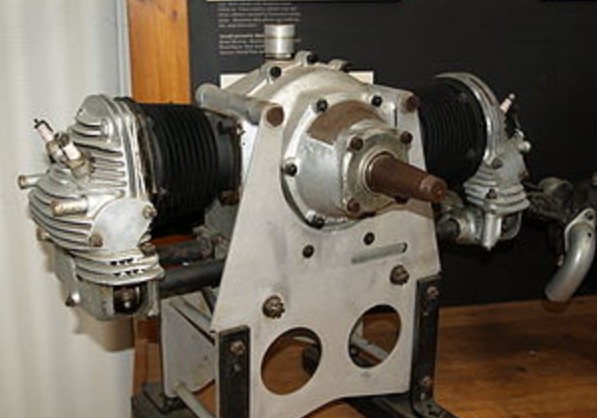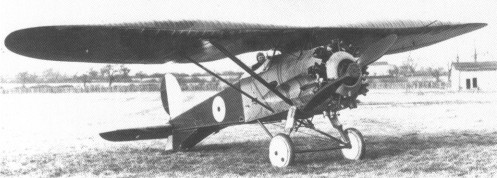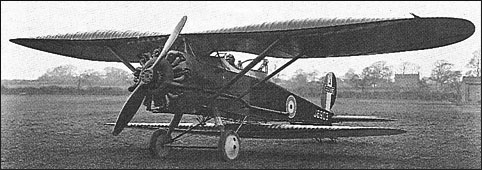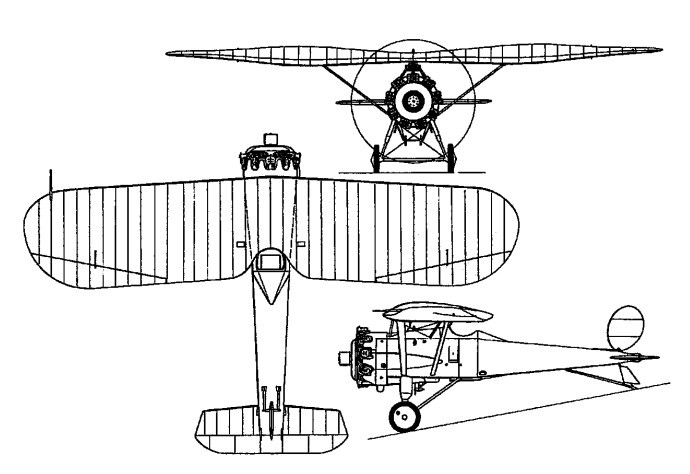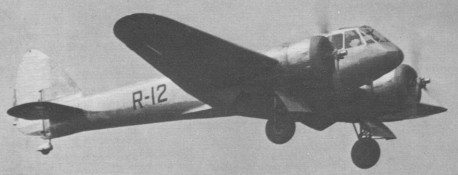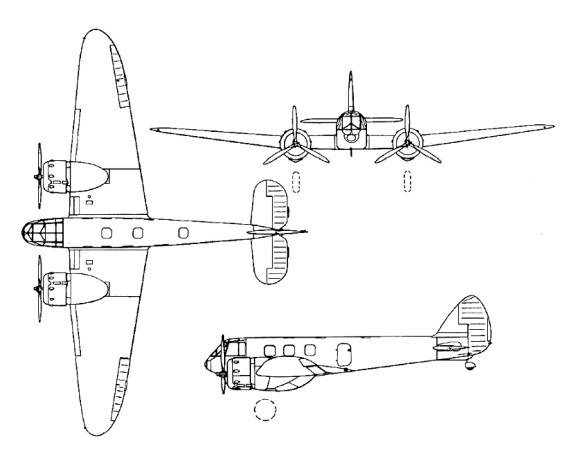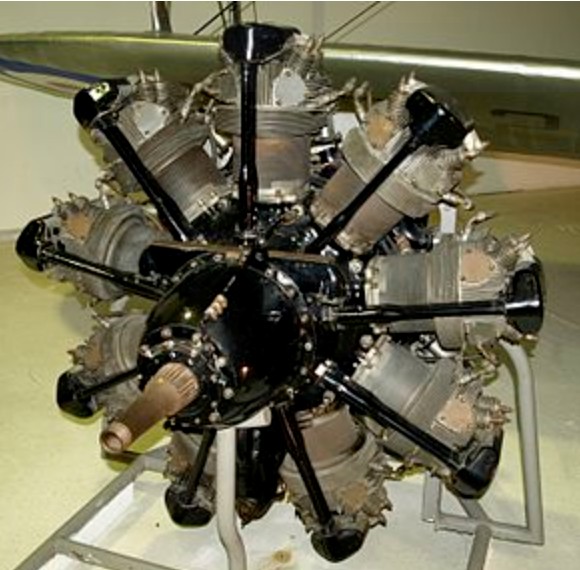
Bristol Mercury / Alfa Romeo Mercurius

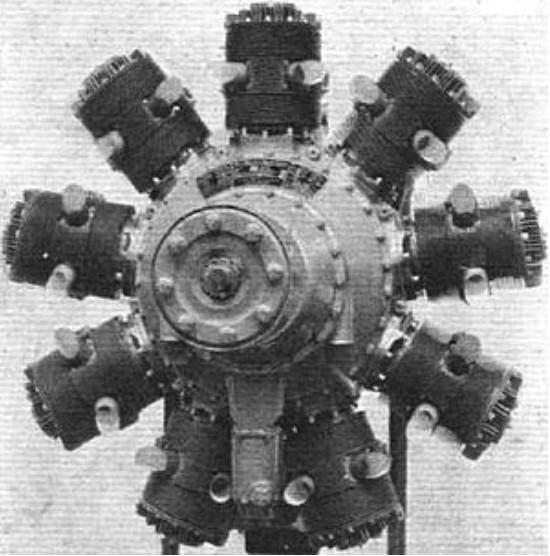
The nine-cylinder, air-cooled, single-row, piston radial Mercury was developed by the Bristol Aeroplane Company in 1925 as their Bristol Jupiter was reaching the end of its lifespan. Although the Mercury initially failed to attract much interest, the Air Ministry eventually funded three prototypes and it became another winner for the designer Roy Fedden.

With the widespread introduction of superchargers to the aviation industry in order to improve altitude performance, Fedden felt it was reasonable to use a small amount of boost at all times in order to improve performance of an otherwise smaller engine. Instead of designing an entirely new block, the existing Jupiter parts were re-used with the stroke reduced by one inch (25 mm). The smaller capacity engine was then boosted back to Jupiter power levels, while running at higher rpm and thus requiring a reduction gear for the propeller. The same techniques were applied to the original Jupiter-sized engine to produce the Pegasus.

The Mercury’s smaller size was aimed at fighter use and it powered the Gloster Gauntlet and its successor, the Gloster Gladiator. It was intended that the larger Pegasus would be for bombers but as the power ratings of both engines rose, the Mercury found itself being used in almost all roles including twin-engine light bomber, Bristol Blenheim.

In 1938 Roy Fedden pressed the Air Ministry to import supplies of 100 octane aviation spirit (gasoline) from the USA. This new fuel would allow aero engines to run at higher compression ratios and supercharger boost pressure than the existing 87-octane fuel, thus increasing the power. The Mercury XV was one of the first British aero engines to be type-tested and cleared to use the 100-octane fuel in 1939. This engine was capable of running with a boost pressure of +9 lbs/sq.in and was first used in the Blenheim Mk IV.

The Mercury was also the first British aero engine to be approved for use with variable-pitch propellers.

The Bristol company and its shadow factories produced 20,700 examples of the engine. Outside the United Kingdom, Mercury was licence-built in Poland and used in their PZL P.11 fighters. It was also built by NOHAB in Sweden and used in the Swedish Gloster Gladiator fighters and in the Saab 17 dive-bomber. In Italy, it was built by Alfa Romeo as the Mercurius. In Czechoslovakia it was built by Walter Engines. In Finland, it was built by Tampella and mainly used on Bristol Blenheim bombers.

Variants:

Mercury I
(1926) 808 hp, direct drive. Schneider Trophy racing engine.

Mercury II
(1928) 420 hp, compression ratio 5.3:1.

Mercury IIA
(1928) 440 hp

Mercury III
(1929) 485 hp, compression ratio 4.8:1, 0.5:1 reduction gear.

Mercury IIIA
Minor modification of Mercury III.

Mercury IV
(1929) 485 hp, 0.656:1 reduction gear.

Mercury IVA
(1931) 510 hp.

Mercury IVS.2
(1932) 510 hp.

Mercury (Short stroke)
Unsuccessful experimental short stroke (5.0 in) version, 390 hp.

Mercury V
546 hp (became the Pegasus IS.2)

Mercury VIS
(1933) 605 hp, see specifications section.

Mercury VISP
(1931) 605 hp, ‘P’ for Persia.

Mercury VIS.2
(1933) 605 hp.

Mercury VIA
(1928) 575 hp (became the Pegasus IU.2)

Mercury VIIA
560 hp (became the Pegasus IM.2)

Mercury VIII
(1935) 825 hp, compression ratio 6.25:1, lightened engine.

Mercury VIIIA
Mercury VIII fitted with gun synchronisation gear for the Gloster Gladiator

Mercury VIIIA
535 hp, second use of VIIIA designation, (became the Pegasus IU.2P)

Mercury IX
(1935) 825 hp, lightened engine.

Mercury X
(1937) 820 hp.

Mercury XI
(1937) 820 hp.

Mercury XII
(1937) 820 hp

Mercury XV
(1938) 825 hp, developed from Mercury VIII. Converted to run on 100 Octane fuel (previously 87 Octane).

Mercury XVI
830 hp.

Mercury XX
(1940) 810 hp

Mercury 25
(1941) 825 hp. Mercury XV with crankshaft modifications.

Mercury 26
825 hp. As Mercury 25 with modified carburettor.

Mercury 30
(1941) 810 hp, Mercury XX with crankshaft modifications.

Mercury 31
(1945) 810 hp, Mercury 30 with carburettor modifications and fixed pitch propeller for Hamilcar X.

Applications:
Airspeed Cambridge
Blackburn Skua
Boulton Paul P.108
Bristol Blenheim
Bristol Bolingbroke
Bristol Bulldog
Bristol Bullpup
Bristol Type 101
Bristol Type 118
Bristol Type 133
Bristol Type 142
Bristol Type 146
Bristol Type 148
Breda Ba.27
Fairey Flycatcher
Fokker D XXI
Fokker G.1
General Aircraft Hamilcar X
Gloster Gamecock
Gloster Gladiator
Gloster Gauntlet
Gloster Gnatsnapper
Gloster Goring
Hawker Audax
Hawker F.20/27
Hawker Fury
Hawker Hart
Hawker Hind
Hawker Hoopoe
Hawker F.20/27
IMAM Ro.30
Koolhoven F.K.52
Miles Martinet
Miles Master
PZL P.11
Saab 17
Short Crusader
Supermarine Sea Otter
Valmet Vihuri
Vickers Jockey
Westland Interceptor
Westland Lysander

Specifications:

Mercury VI-S
Type: Nine-cylinder, single-row, supercharged, air-cooled radial engine
Bore: 5.75 in (146 mm)
Stroke: 6.5 in (165 mm)
Displacement: 1,520 in³ (24.9 L)
Length: 47 in (1,194 mm)
Diameter: 51.5 in (1,307 mm)
Dry weight: 966 lb (438 kg)
Valvetrain: Overhead valve, 4 valves per cylinder – 2 intake and 2 sodium-filled exhaust
Supercharger: Single-speed centrifugal type supercharger
Fuel system: Claudel-Hobson carburettor
Fuel type: 87 Octane petrol
Cooling system: Air-cooled
Reduction gear: Farman epicyclic gearing, 0.5:1, left hand tractor
Power output:
612 hp (457 kW) at 2,750 rpm for takeoff
636 hp (474 kW) at 2,750 rpm at 15,500 ft (4,730 m)
Specific power: 0.4 hp/in³ (18.35 kW/L)
Compression ratio: 6:1
Specific fuel consumption: 0.49 lb/(hp·h) (300 g/kWh)
Power-to-weight ratio: 0.63 hp/lb (1.04 kW/kg)
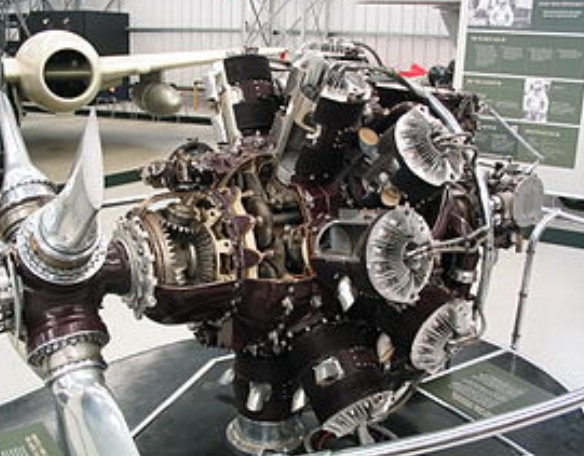
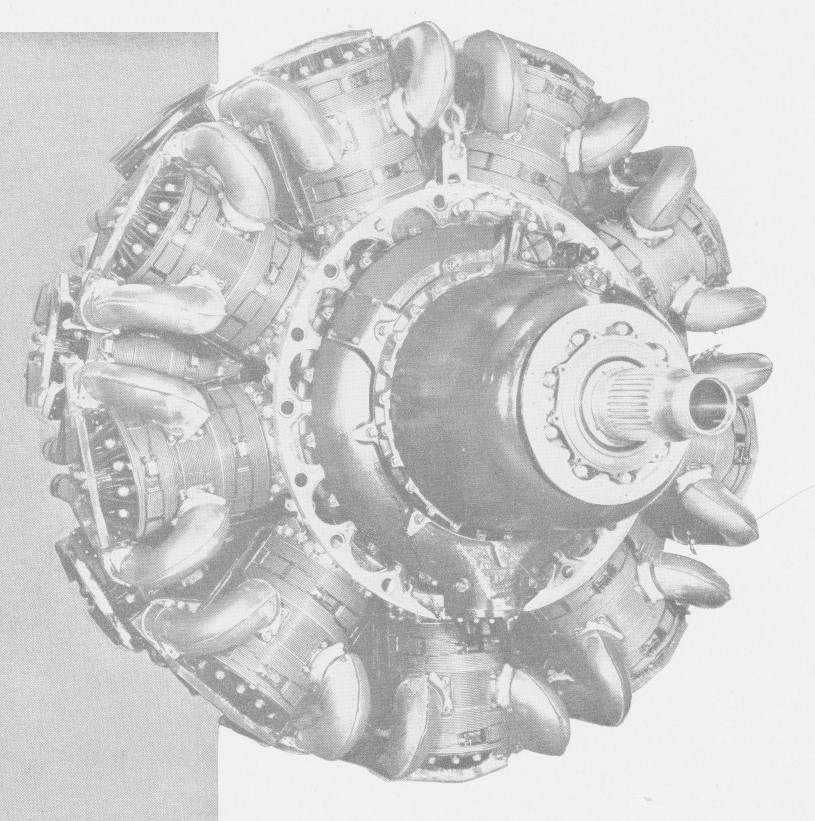
Bristol Hercules / SNECMA Hercules

The rationale behind the single sleeve valve design was two-fold: to provide optimum intake and exhaust gas flow in a two-row radial engine, improving its volumetric efficiency; and to allow higher compression ratios, thus improving its thermal efficiency. The arrangement of the cylinders in two-row radials made it very difficult to utilise four valves per cylinder, consequently all non-sleeve valve two- and four-row radials were limited to the less efficient two-valve configuration. Also, as combustion chambers of sleeve-valve engines are uncluttered by valves, especially the hot exhaust valves, being comparatively smooth they allow engines to work with lower octane number fuels using the same compression ratio. Conversely, the same octane number fuel may be utilised while employing a higher compression ratio, or supercharger pressure, thus attaining either higher economy, or power output. The down-side was the difficulty in maintaining sufficient cylinder and sleeve lubrication.

Bristol Hercules Article

Bristol had introduced their first sleeve-valve designs in the 750 horsepower (560 kW) class Perseus and the 500 hp (370 kW) class Aquila that they intended to supply throughout the 1930s. Aircraft development in the era was so rapid that both engines quickly ended up at the low-power end of the military market and, in order to deliver larger engines, Bristol developed 14-cylinder versions of both. The Perseus evolved into the Hercules (First run in January 1936), and the Aquila into the Taurus.

In 1937 Bristol acquired a Northrop Model 8A-1, the export version of the A-17 attack bomber, and modified it as a test bed for the first Hercules engines.

The first Hercules engines were available in 1939 as the 1,290 hp (960 kW) Hercules I, soon improved to 1,375 hp (1,025 kW) in the Hercules II. The major version was the Hercules VI which delivered 1,650 hp (1,230 kW), and the late-war Hercules XVII produced 1,735 hp (1,294 kW).
The Hercules powered a number of aircraft including Bristol’s own Beaufighter heavy fighter design although it was more commonly used on bombers. The Hercules also saw use in civilian designs, culminating in the 735 and 737 engines for such as the Handley Page Hastings C1 and C3 and Bristol Freighter. The design was also licensed for production in France by SNECMA. Except for the 2000 hp-range versions in the 1950s until there were lubricating oil improvements, it was considered to be one of the more reliable aircraft engines of the era.

A total of over 57,400 Hercules engines were built.

Applications:
Armstrong Whitworth Albemarle
Avro Lancaster B.II
Avro York C.II
Bristol Beaufighter
Bristol Freighter
Bristol Superfreighter
Breguet 890 Mercure
Fokker T.IX
Folland Fo.108
Handley Page Halifax
Handley Page Hastings
Handley Page Hermes
Nord Noratlas
Northrop 8A (One Swedish 8A-1 was bought by Bristol to test the engine)
Northrop Gamma 2L
Saro Lerwick
Short S.26
Short Seaford
Short Solent
Short Stirling
Vickers Valetta
Vickers Varsity
Vickers VC.1 Viking
Vickers Wellesley
Vickers Wellington

Specifications:

Hercules II
Type: 14-cylinder, two-row, supercharged, air-cooled radial engine
Bore: 5.75 in (146 mm)
Stroke: 6.5 in (165 mm)
Displacement: 2,360 in³ (38.7 L)
Length: 53.15 in (1,350 mm)
Diameter: 55 in (1,397 mm)
Dry weight: 1,929 lb (875 kg)
Valvetrain: Gear-driven sleeve valves with five ports per sleeve — three intake and two exhaust
Supercharger: Single-speed centrifugal type supercharger
Fuel system: Claudel-Hobson carburettor
Fuel type: 87 Octane petrol
Cooling system: Air-cooled
Reduction gear: Farman epicyclic gearing, 0.44:1
Power output:
1,272 hp (949 kW) at 2,800 rpm for takeoff
1,356 hp (1,012 kW) at 2,750 rpm at 4,000 ft (1,220 m)
Specific power: 0.57 hp/in³ (26.15 kW/l)
Compression ratio: 7.0:1
Specific fuel consumption: 0.43 lb/(hp•h) (261 g/(kW•h))
Power-to-weight ratio: 0.7 hp/lb (1.16 kW/kg)

Bristol Draco

The Bristol Draco was an air-cooled 9-cylinder radial engine from the British manufacturer Bristol Aeroplane Company. It was essentially a version of their Pegasus converted to use a fuel injection system.

The carburettor had only a simple butterfly valve, while two injection pumps supplied the cylinders with fuel, one handling four cylinders and the other, five. Injection was into the manifold before they split into the two intake valves for each cylinder. First run in 1935, the engine was flight tested in a Westland Wapiti. Since the expenditure did not bring considerable improvements the development was stopped.

Draco
Type: Nine-cylinder air-cooled radial engine.
Bore: 5.75 in (146 mm)
Stroke: 7.5 in (190 mm)
Displacement: 1,753 cu in (28.7 L)
Length: 43.5 in (1,105 mm)
Diameter: 55.5 in (1,410 mm)
Dry weight: 1,093 lb (495.8 kg)
Designer: Roy Fedden
Valvetrain: Overhead valve
Supercharger: Medium supercharged
Fuel system: Fuel injected
Cooling system: Air-cooled
Reduction gear: Geared epicyclic, reduction ratio 0.5:1, left hand tractor
Power output: 570 hp at 2,000 rpm
Compression ratio: 5.3:1
Power-to-weight ratio: 0.52 hp/lb

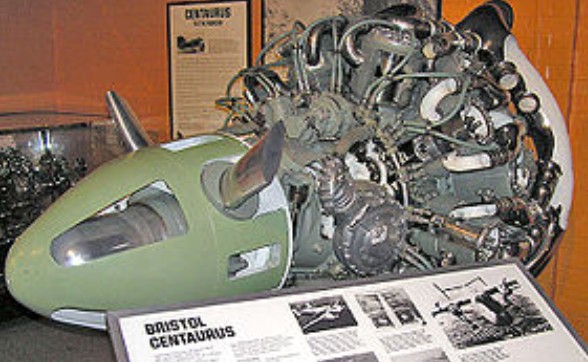
Bristol Centaurus

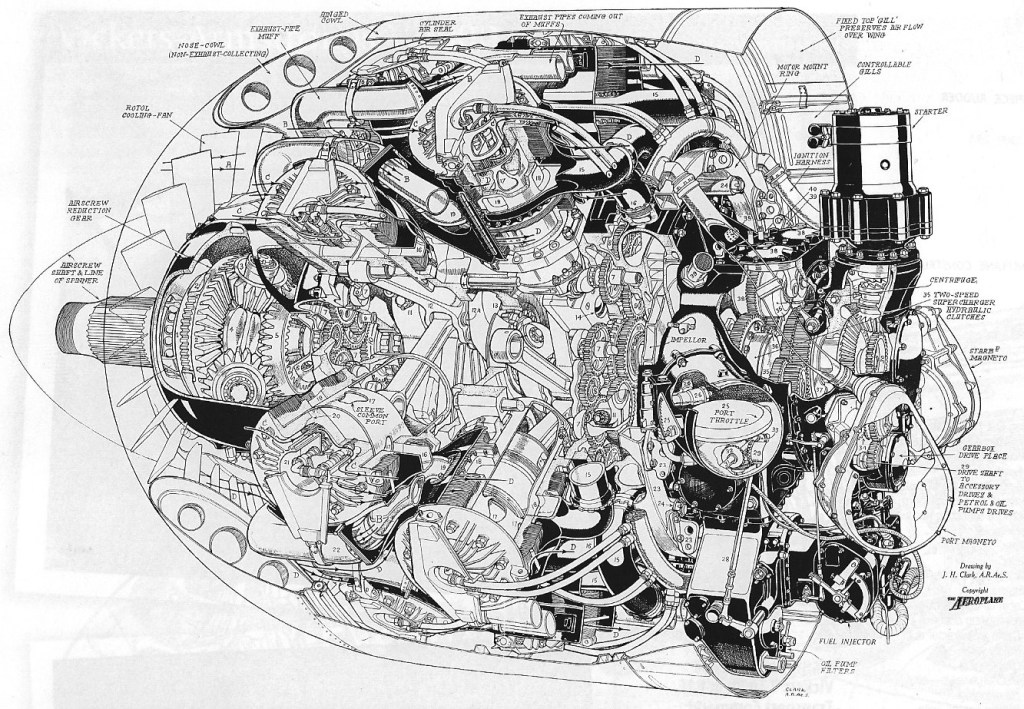
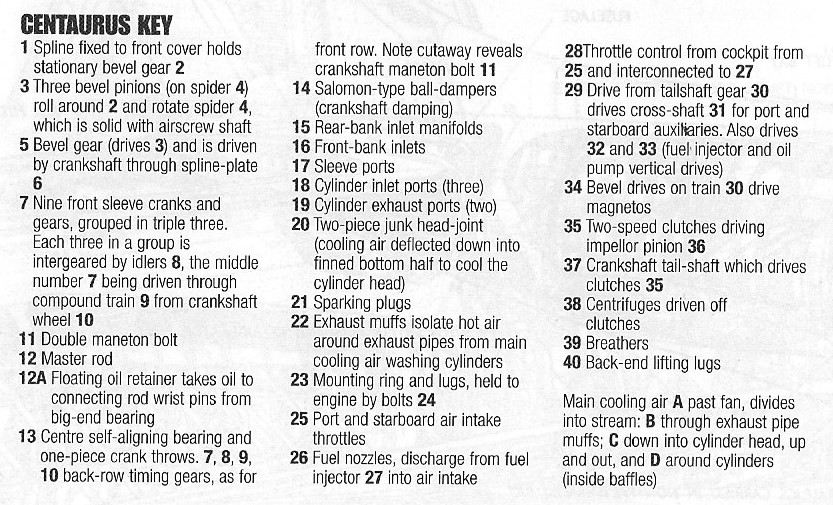
The sleeve valve Centaurus was based on the mechanicals of the 5.75 in (146 mm) piston from the original 1918 Jupiter. The Jupiter piston was still in use in the contemporary 14-cylinder Hercules, which was being brought into production during the design of the Centaurus. The Centaurus had a cylinder capacity of 3,270 in³ (53.6 lt), making it one of the largest piston aircraft engines to enter production, while that of the Hercules was 2,364 cubic inches (38.7 l). The nearly 40% higher capacity was achieved by increasing the stroke from 6.5 to 7 in (170 to 180 mm), and by changing to two rows of nine cylinders instead of two rows of seven, but the overall diameter of the Centaurus was only just over 6% greater.

While Bristol maintained the Centaurus dated from July 1938 (when it was originally type-tested), production could not start until 1942 owing to the need to get the Hercules into production and improve the reliability of the entire engine line. Nor was there any real need for the larger engine at this early point in the war, when most military aircraft designs were intended to mount engines of 1,000 hp or a little more. The Hercules’ approximately 1,500 hp was simply better suited to the existing airframes then in production.

In fact, the Centaurus did not see any use until near the end of the war, first appearing on an upscaled version of the Vickers Wellington, the Warwick. Other wartime, or just-postwar, applications included the Bristol Brigand and Buckmaster, Hawker Tempest and Sea Fury, and the Blackburn Firebrand and Beverley. The engine also saw post-war use in civilian airliners, including the ill-fated Bristol Brabazon.

By the end of the war in Europe, around 2,500 examples of the Centaurus had been produced by Bristol.

A projected enlarged capacity version of the Centaurus was designed by Roy Fedden, cylinders were produced for this engine but it was never built. Known as the Bristol Orion (a name used previously for a variant of the Jupiter engine, and later re-used for a turboprop one) this development was also a two-row, 18 cylinder sleeve valve engine with the displacement increased to 4,142 cubic inches (67.9 l).

The Centaurus was produced in 34 distinct variants ranging from the 2,000 hp (1,490 kW) Centaurus I to the 2,405 hp (1,793 kW) Centaurus 663 for the Airspeed Ambassador airliner. The most powerful variants were the 2,625 hp (1,957 kW) Centaurus 170, 173, 660, 661 and 662.

Applications:
Airspeed Ambassador
Blackburn Beverley
Blackburn Firebrand
Blackburn Firecrest
Breda BZ.308
Bristol Brabazon
Bristol Brigand
Bristol Buckingham
Bristol Buckmaster
Fairey Spearfish
Folland Fo.108
Hawker Fury
Hawker Sea Fury
Hawker Tempest
Hawker Tornado
Short Shetland
Short Solent
Vickers Warwick

Centaurus VII
Type: 18-cylinder, air-cooled, two-row radial engine
Bore: 5.75 in (146 mm)
Stroke: 7 in (177 mm)
Displacement: 3,270 in³ (53.6 l)
Diameter: 55.3 in (1,405 mm)
Dry weight: 2,695 lb (1,223 kg)
Valvetrain: Sleeve valve, four ports per sleeve
Supercharger: Two-speed centrifugal, single stage
Fuel system: Injection
Fuel type: 100/130 Octane petrol
Oil system: Direct-pressure lubrication
Cooling system: Air-cooled
Power output: 2,520 hp (1,880 kW) at 2,700 rpm
Specific power: 0.77 hp/in³ (35.1 kW/l)
Compression ratio: 7.2:1
Power-to-weight ratio: 0.94 hp/lb (1.54 kW/kg)

Bristol Aquila

The Aquila was developed two years after the larger Perseus, both being sleeve valve designs. The primary difference was in size, the Perseus was based on the 5.75 by 6.5 in (146 by 170 mm) cylinder used in the Mercury engine, while the Aquila used a new and smaller 5 by 5.375 in (130 by 136.5 mm) sized cylinder. The result was a reduction in displacement from 1520 to 950 cubic inches (24.9 to 15.6 L).

First run in 1934, the first Aquila engine delivered 365 horsepower (272 kW) but soon developed into more powerful versions as improvements were worked into the line and by 1936 it had improved to 500 hp (370 kW). This would have made it an excellent replacement for the Bristol Jupiter, which ended production at 590 hp (440 kW) three years earlier, but by this time almost all interest was on ever-larger engines. The Aquila was never used in production, but further developments led to the Bristol Hercules, Bristol Taurus, and Bristol Centaurus.

Applications:
Bristol Bulldog
Bristol Bullpup
Bristol Type 143
Vickers Venom

Aquila I
Type: Nine-cylinder single-row naturally aspirated air-cooled radial engine
Bore: 5 in (130 mm)
Stroke: 5.375 in (136.5 mm)
Displacement: 950 cu in (15.6 L)
Length: 41 in (1,000 mm)
Diameter: 46 in (1,200 mm)
Dry weight: 776 pounds (352 kg)
Valvetrain: Sleeve valve
Supercharger: Medium supercharged
Fuel system: Claudel-Hobson carburettor
Fuel type: 73 octane rating petrol
Cooling system: Air-cooled
Reduction gear: 0.5:1 turning a Hamilton Standard variable pitch propeller
Power output: 493 hp (368 kW) at 2,600 rpm for takeoff
Specific power: 0.52 hp/in³ (23.59 kW/l)
Compression ratio: 7.3:1
Specific fuel consumption: 0.46 lb/(hp•h) (282 g/(kW•h))
Oil consumption: 0.21 oz/(hp•h) (8g /(kW•h))
Power-to-weight ratio: 0.64 hp/lb (1.05 kW/kg)

Bristol Cherub

The Bristol Cherub is a British two-cylinder, air-cooled, aircraft engine designed and built by the Bristol Aeroplane Company. Introduced in 1923 it was a popular engine for ultralight and small aircraft in the 1930s.

Variants:

Cherub I
Initial direct drive version introduced in 1923. Bore and stroke of 3.35 by 3.8 inches (85 mm × 97 mm) for a displacement of 67 cu in (1.095 L). 32 horsepower (24 kW) at 2,500 rpm.

Cherub II
Geared down (2:1) version of the Cherub I.

Cherub III
An improved and slightly larger (1.228 L) direct drive version introduced in 1925.

Applications:
Avia BH-2
Avro Avis
Beardmore Wee Bee
Bristol Brownie
Cranwell CLA.2
Cranwell CLA.3
Cranwell CLA.4
Dart Pup
Granger Archaeopteryx
Halton Mayfly
Halton Minus
Hawker Cygnet
Messerschmitt M17
Meyers Midget
Mignet HM.14 Pou-du-Ciel
Parnall Pixie
Powell Racer
RAE Scarab
RAE Hurricane
Short Cockle
Short Satellite
Supermarine Sparrow
Vickers Vagabond
Westland Woodpigeon
Westland-Hill Pterodactyl

Specifications:

Cherub III
Type: 2-cylinder air-cooled, horizontally opposed, left-hand tractor
Bore: 3.54 in (90 mm)
Stroke: 3.8 in (96.5 mm)
Displacement: 75 in³ (1.228 L)
Width: 25.6 in (650 mm)
Dry weight: 98 lb (39.5 kg)
Valvetrain: Overhead valve
Oil system: Dry sump
Cooling system: Air-cooled
Power output: 36 hp (24 kW) at 3,200 rpm
Compression ratio: 5.75:1
Fuel consumption: 2.5 imp. gallons per hour
Power-to-weight ratio: 0.36 hp/lb

Bristol MF / Bullfinch

Bullfinch Mk.1

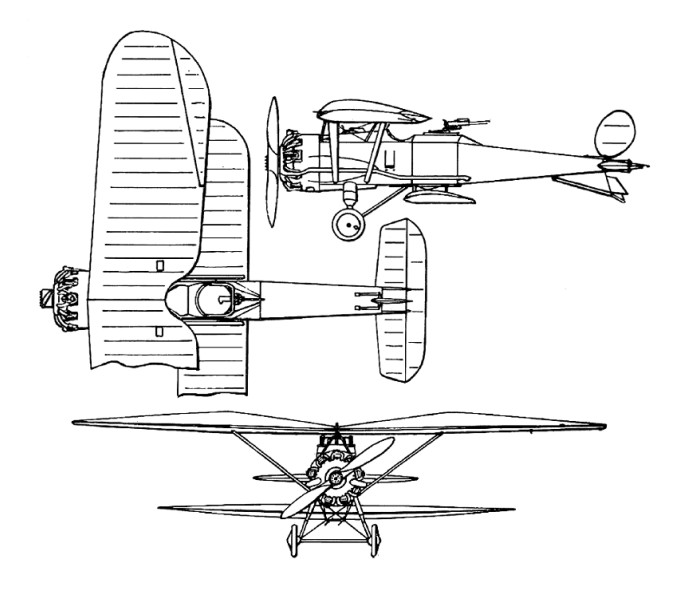
Captain Frank Barnwell designed the MF as an all-metal parasol-wing monoplane that could be flown as the MFA single-seat fighter or MFB two-seat reconnaissance plane. The latter had an extra fuselage section behind the cockpit for the gunner’s position and, below this on a short cabane arrangement, a cantilever second wing. In April 1921 the Air Ministry ordered three prototypes with wooden wings. Bristol proposed the name Pegasus, but this did not conform with current British practise and the two MFAs became Bullfinch Mk Is while the sole MFB became the two-seat Bullfinch Mk II.
By March 1922, when the name Bullfinch was officially adopted, the decision had been taken to complete two of the prototypes as single-seaters, these being delivered in April 1923. Armed with two 7.7mm Vickers machine guns, the Bullfinch single-seaters were flown experimentally by the RAF and were found to offer a relatively good performance on the 425hp of a Bristol Jupiter III radial, but no production order was forthcoming.
The Mk II was first flown on 15 February 1924 and delivered in March 1924. The Bullfinch II differed from the single-seat model primarily in having a 91.4cm section housing a self-contained gunner’s cockpit inserted in the fuselage immediately aft of the pilot’s cockpit and beneath which was attached a cantilever lower wing, the resultant shift of the centre of pressure compensating for the change in the CG. The only other change consisted of the repositioning of the main undercarriage members farther aft. The rear cockpit was fitted with a Scarff-mounted 7.7mm Lewis gun, and structural weight was increased by 145kg. The 425hp Jupiter III engine was insufficiently powerful to cater for the additional 400kg of the two-seater in fully loaded condition and the performance of the Bullfinch II suffered.
Both variants were fully evaluated, but no orders followed.

Bullfinch II

Principal versions – Bullfinch Mk I (single-seat fighter prototype) and Bullfinch Mk II (two-seat reconnaissance prototype).

Bullfinch Mk.I
Engine: one 450-hp (336-kW) Bristol Jupiter III radial
Maximum speed 135 mph (217 km/h) at 15,000 ft (4,570 m)
Srvice ceiling 22,000 ft (6,705 m)
Endurance 4 hours 0 minutes.
Empty weight 2,175 lb (987 kg)
Maximum take-off weight 3.205 lb (1,454 kg).
Wing span 38 ft 5 in (11.71 m)
Length 24 ft 5 in (7.44 m)
Height 10 ft 9 in (3.27 m)
Wing area 267.0 sq ft (24.80 sq.m).
Armament: two 0.303-in (7.7-mm) fixed machine guns.

Bullfinch Mk.II
Engine: 425hp Jupiter III
Take-off weight: 1854 kg / 4087 lb
Empty weight: 1132 kg / 2496 lb
Wingspan: 11.71 m / 38 ft 5 in
Length: 8.38 m / 27 ft 6 in
Height: 3.28 m / 10 ft 9 in
Wing area: 36.32 sq.m / 390.94 sq ft
Max. speed: 193 km/h / 120 mph

Bristol Bullfinch I
Bristol Bullfinch II

Bristol B.146      

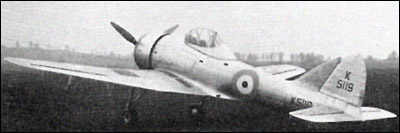
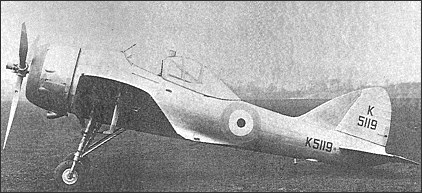
Embodying the lessons learned from the Type 133, the Type 146 was a single-seat eight-gun all-metal fighter of monocoque construction with stressed duralumin skinning. Intended to meet the requirements of Specification F.5/34, the Type 146 was designed for a fully supercharged Bristol Perseus radial of 835hp, but the sole prototype completed was fitted with an 840hp Mercury IX owing to the non-availability of the intended power plant. Armament comprised four 7.7mm Browning machine guns in each wing. Delayed in completion through its low development priority, the Type 146 was finally flown on 11 February 1938, but was already out-dated by the Merlin-engined Hurricane and Spitfire. After trials at Martlesham Heath, it was returned to the manufacturer to participate in a local RAF display, where it collided with a display set-piece while landing and was scrapped forthwith.

Engine: Bristol Perseus, 835hp/622kW.
Take-off weight: 2086 kg / 4599 lb
Empty weight: 1489 kg / 3283 lb
Wingspan: 11.89 m / 39 ft 0 in
Length: 8.23 m / 27 ft 0 in
Height: 3.15 m / 10 ft 4 in
Wing area: 20.44 sq.m / 220.01 sq ft
Max. speed: 462 km/h / 287 mph

Bristol B.142 Britain First

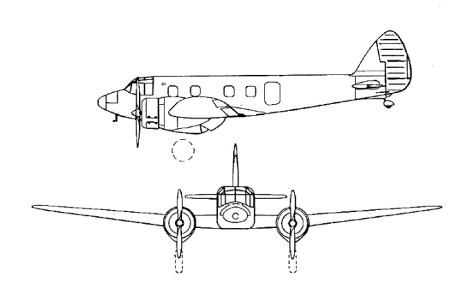
In the early 1930s, a design for a fast twin engined monoplane transport, in which use was made of stressed skin construction, attracted the interest of the then Lord Rothermere. He agreed to sponsor the construction of a development of the design, known as the Type 142 ‘Britain First’ as his personal high speed transport and first flying on 12 April 1935. Powered by two 485kW Bristol Mercury VIS engines, during official trials in 1935 this monoplane achieved a top speed of 307 mph 50mph faster than any fighter then in service. When the Air Ministry asked to retain the aircraft for evaluation as a bomber, Lord Rothermere presented it to the Air Council and thereafter the development of the Type 142 into the military Blenheim proceeded rapidly. Within three months of the Type 142M acceptance trials in June 1935, Filton had received an order for 150 Blenheims.

B.142 Britain First
Engines: 2 x 650hp Bristol Mercury VIS 2
Take-off weight: 4248 kg / 9365 lb
Empty weight: 3097 kg / 6828 lb
Wingspan: 17.17 m / 56 ft 4 in
Length: 12.12 m / 39 ft 9 in
Height: 3.91 m / 12 ft 10 in
Wing area: 43.57 sq.m / 468.98 sq ft
Max. speed: 494 km/h / 307 mph
Range: 1610 km / 1000 miles
Crew: 2
Passengers: 4