During the 1920s six other designs appeared: the Varuna, Vista, Vanessa, Velos, Vigil, and Vancouver. Of these, only the Varuna (eight) and Vancouver (six) flying-boats went into production.
Inter-Wars
Canadian Vickers Vista
During the 1920s six other designs appeared: the Varuna, Vista, Vanessa, Velos, Vigil, and Vancouver. Of these, only the Varuna (eight) and Vancouver (six) flying-boats went into production.
Canadian Vickers Varuna
During the 1920s six other designs appeared: the Varuna, Vista, Vanessa, Velos, Vigil, and Vancouver. Of these, only the Varuna (eight) and Vancouver (six) flying-boats went into production.
Canadian Car & Foundry FDB-1 Gregor Fighter
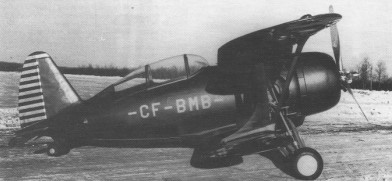
Can Car’s final attempt to produce its own design was the FDB 1, the so called ‘Gregor Fighter’, named after Michael Gregor, the chief aeronautical engineer who preceded Miss MacGill. The FDB 1 was designed as a highly manoeuvrable, biplane fighter/dive bomber with retractable undercarriage and powered by a Pratt & Whitney R 1535 SI34 G Twin Wasp Junior. The fuselage was of stressed skin construction while the wings were fabric covered metal structures with trailing edge flaps on upper and lower planes and automatic leading edge slots on the former. Port and starboard sections of the upper wing were separate, joining the fuselage in a modified gull wing form, which helped to improve forward visibility.
Despite the excellent manoeuvrability of the prototype, which first flew on 17 December 1938 at Fort William, Ontario, its speed was considerably less than had been predicted and there were problems with controls and flaps. Aircraft of this type were rapidly becoming outdated and, since by this time CCF had become involved in what was to be its most successful contract, the Gregor Fighter was placed in storage at Cartierville, Quebec, where it was burned in 1945.
Canadian Car & Foundry Maple Leaf II
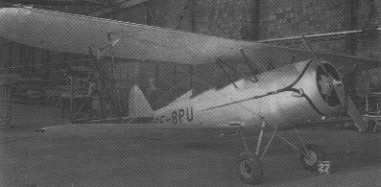
The Maple Leaf I was followed by the Maple Leaf II, which, despite the name, had little more than the empennage in common with its predecessor. The design and engineering team, led by Miss E G MacGill, at that time the only female chief aeronautical engineer in Canada, had the prototype ready for its first flight in the fall of 1939. Although it gave creditable performances in tests by the Department of Transport and the RCAF, the Maple Leaf II never reached the production line, mainly because at that time the company had already committed its Fort William plant to the production of the much needed Hurricane. The prototype, along with various components and parts of at least two partly finished aircraft, was eventually exported to Mexico.
Canadian Car & Foundry Maple Leaf I
In mid 1937, Can Car took over the design for a two seat trainer, which became known as the Maple Leaf I. The prototype flew in April 1938, but by June of that year work on it was discontinued when its performance failed to meet expectations.
Canadian Car & Foundry / Cancargo Aircraft Manufacturing Co Ltd
The Canadian Car and Foundry Company Ltd, called CCF and later Can-Car, was established in 1909 as a manufacturer of railway rolling stock, with its head office in Montreal and production facilities in several other locations.
In 1937 acquired license to build Grumman GE-23 (FF-1) two-seat biplane fighters, in factory at Fort William, Ontario. Built prototype of FDB-1 fighter biplane in 1938. Orders for large numbers of Avro Ansons, Hawker Hurricanes, Avro Lancasters, and Curtiss Helldivers were received. Seven new factories opened by mid-Second World War.
Early post-war obtained Canadian license for Burnelli “lifting fuselage” designs; flew prototype CBY-3 (twin Wasp engines) August 1945. Accommodation was three crew plus 38 passengers or 22 passengers and freight. Development of CBY-3 by subsidiary Cancargo. In 1947 acquired assets of Noorduyn Aviation Ltd.; continued manufacture of Mk V Norseman and variants until early 1950s; resold it to its designer in 1953. In early 1950s designated products “Can-Car,” beginning with North American Harvard Mk 4s built under license at Fort William for RCAF and NATO air forces. Gained contract to build 100 BeechcraftT-34A Mentor piston-engined trainers in 1952-1953 for USAF and also for RCAF. Retitled Canadian Car Company Ltd in mid/late 1950s.
Canadair
Canadian Vickers Ltd was established 1911 at St Hubert, Montreal, as subsidiary of Vickers Ltd. Aircraft division formed 1922; first Canadian company to build aircraft commercially. First contract was for six U.K.-designed Viking IV amphibians for Canadian Air Force. These followed from 1924 by 61 Vedette single-engined flying-boats and amphibians, its most successful product, designed in Canada by W.T Reid. During the 1920s six other designs appeared: the Varuna, Vista, Vanessa, Velos, Vigil, and Vancouver. Of these, only the Varuna (eight) and Vancouver (six) flying-boats went into production. In the 1930s the company license-built Fairchild and Fokker designs and Northrop Deltas. During the Second World War built 40 Supermarine Stranraer flying-boats for the RCAF, 230 Consolidated OA-10 Catalinas for the USAAF, and 149 Canso amphibians for the RCAF, plus hulls for 600 more Catalinas and fuselages for 40 Handley Page Hampden bombers. Took over Canadian Associated Aircraft in 1941, and in following year moved to government factory at Cartierville, near Montreal. In December 1944 became a separate autonomous company under new name of Canadair Ltd.
Formed December 1944 at Cartierville, Montreal, from Aircraft Division of Canadian Vickers Ltd., as a “Crown Company.” Purchased 1946 by Electric Boat Company of New York; later that year became a subsidiary of General Dynamics Corporation. First contract (1944) to build the DC-4m (Merlin-engined version of the Douglas DC-4) for the RCAF. Eventually built 71, including commercial versions, and converted many wartime C-47s into postwar commercial DC-3s. Since 1949 has license-built more than 1,900 North American F-86 Sabre jetfightersforthe RCAF and the U.S. Military Assistance Program; more than 700 Lockheed T-33 SilverStar jettrainers; 200 Lockheed F-104 Starfighters for the RCAF; and 240 Northrop F-5s for the Canadian Armed Forces and Royal Netherlands Air Force.
Products of its own design have included the CL-28 Argus Maritime patrol aircraft (32 built); CL-41 jet trainer/ground-attack aircraft (210 for Royal Canadian and Malaysian Air Forces); 39 CL-44 Yukon and 44 military/civil transports; three prototypes of the CL-84 tilt-wing VTOL research aircraft; CL-215 twin piston-engined firefighting and utility amphibian (first flown October 1967) and its CL-215T twin-turboprop reengined derivative (first flown June 1989); and Challenger 600 wide-body business jet (first flown November 1978) and 601 follow up. Company was repurchased by the Canadian government in December 1975. Other programs included the CL-89 battlefield reconnaissance RPV, major subcontract work for the U.S. Navy’s P-3C Orion and its Canadian derivative, the CP140 Aurora, and manufacture of components for other companies.
Canadair became part of Bombardier Aerospace Group in December of 1986, renamed Bombardier Inc. Canadair.
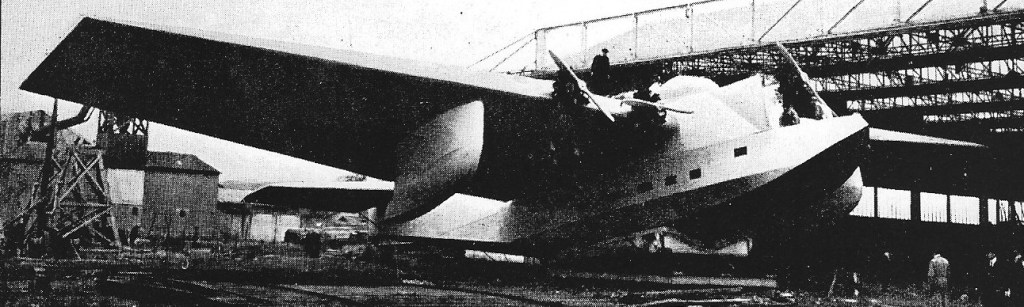
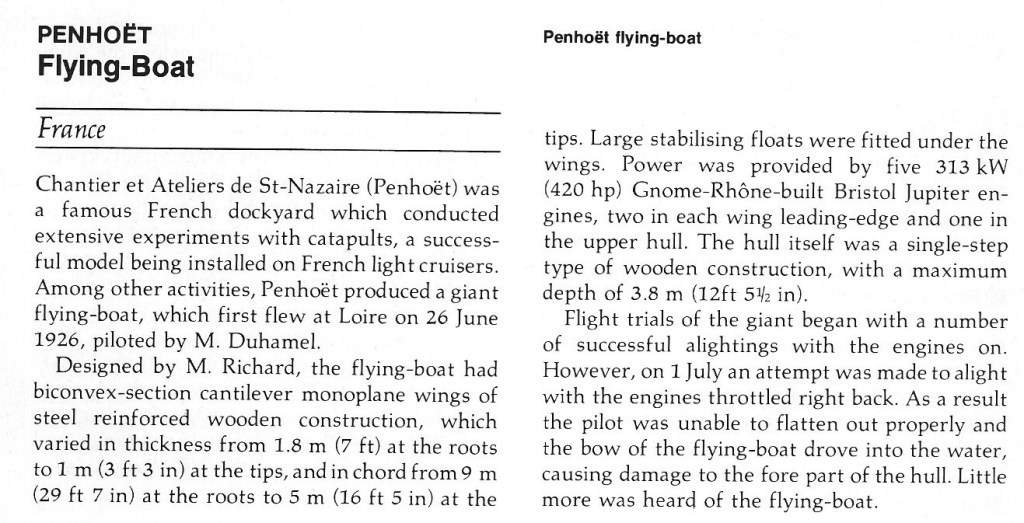
Penhoet Flying Boat
CAMS 55
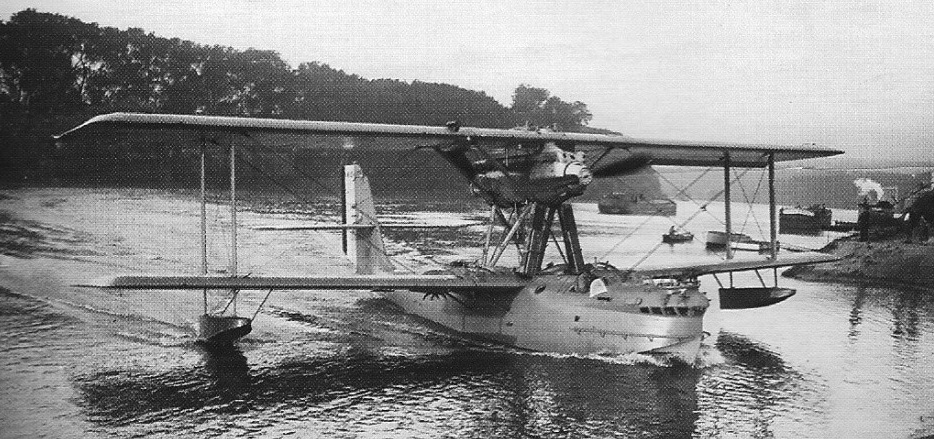
The CAMS 55 design was derived from the unsuccessful CAMS 51 and followed the familiar Chantiers Aéro-Maritimes de la Seine (CAMS) formula of a conventional biplane flying boat configuration with tandem tractor-pusher engines mounted in the interplane gap. The cockpit was open, and there were open gun positions in the bow and amidships. The bow also incorporated an observation balcony with windows sloped to afford a good downward view.
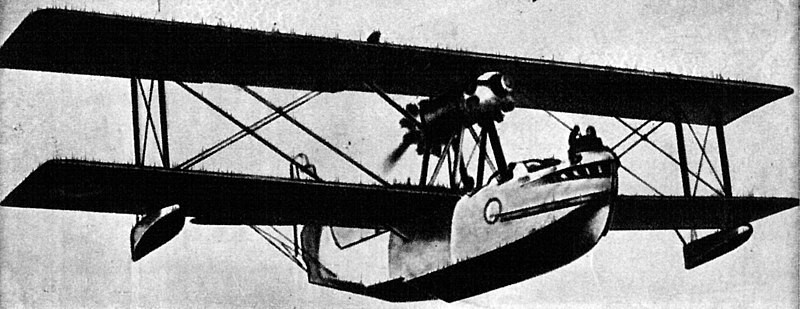
A single prototype was followed by two aircraft to compare different engine installations, one with air-cooled radials and the other a liquid-cooled V engine; in the end, the French Navy ordered some of each. Eventually, 15 escadrilles were equipped with CAMS 55s of various subtypes, replacing the Latham 47 in some units, and in turn being relegated to secondary duties when the Breguet Bizerte became available in 1936. Twenty-nine remained in service at the outbreak of World War II, with the last examples serving with Escadrille 20S in Tahiti until January 1941.
Variants:
55.001 – prototype with Hispano-Suiza 12Lbr engines (one built).
55J – engine test version with Gnome et Rhône licence-built Bristol Jupiter engines (two built).
55H – engine test version with Hispano-Suiza 12Lbr engines (two built).
55/1 – production version with Hispano-Suiza 12Lbr engines (43 built).
55/2 – production version with Gnome et Rhône licence-built Bristol Jupiter engines (29 built).
55/3 – version with all-metal hull for French Navy requirement for long-range flying boat. Prototype destroyed early in test programme (one built).
55/6 – version with all-metal hull and floats, saving 400 kg (882 lb) of structural weight; deemed too expensive to produce (one built).
55/10 – version with geared Gnome et Rhône Jupiter engines and increased fuel tankage (32 built, including four tropicalised machines).
Powerplant: 2 × Gnome et Rhône 9Kbr, 370 kW (500 hp) each
Propeller: 4-bladed fixed pitch
Wingspan: 20.4 m (66 ft 11 in)
Wing area: 113.45 m2 (1,221.2 sq ft)
Length: 15.03 m (49 ft 4 in)
Height: 5.41 m (17 ft 9 in)
Empty weight: 4,590 kg (10,119 lb)
Gross weight: 6,900 kg (15,212 lb)
Maximum speed: 195 km/h (121 mph, 105 kn)
Cruise speed: 150 km/h (93 mph, 81 kn)
Range: 1,280 km (800 mi, 690 nmi)
Service ceiling: 3,400 m (11,200 ft)
Rate of climb: 2.2 m/s (430 ft/min)
Crew: 4
Armament: 4 × trainable 7.5 mm (0.295 in) machine-guns
Bombload: 2 × 75 kg (165 lb) carried under lower wing
55/11 – long-range patrol version (one built).
55/14 – version with all-metal hull (one built).

