twin-float three-engined monoplane, 1935.
Inter-Wars
Cant Z.504
two-seat fighter biplane flying- boat 1935
Cant Z.501 Gabbiano
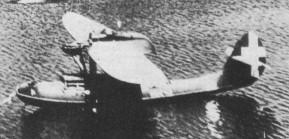
In 1931 the Cantiere Navale Triestino company acquired the services of Filippo Zappata, and also changed its name to Cantieri Riuniti dell’Adriatico, under which a number of civil and military seaplanes and land based aircraft were subsequently produced. The first Zappata designed prototype aircraft from the CRDA was a single engined flying boat, designed as a maritime reconnaissance bomber. Designated Z.501 and named Gabbiano (seagull), it flew for the first time at Monfalcone, Trieste, in 1934. With the civil registration I-AGIL, it set up an international distance record for seaplanes in October 1934, flying non stop for 4120 km (2560 miles) from Monfalcone to Massawa in Eritrea. A short time later a French aircraft took the record, but the Gabbiano reclaimed it in July 1935 with a 4957 km (3080 mile) flight from Monfalcone to Berbera in Somaliland.
It was in its designed role that the Z.501 entered service with the Squadriglie da Ricognizione Marittima (marine reconnaissance squadron) of the Regia Aeronautica (Italian air force) in 1936, after an order for production aircraft had been placed; an eventual total of 445 were built. In full military condition, the Gabbiano’s maximum range was 2400 km (1490 miles). The flying boat was of wooden construction, with fabric covered wings and tail, and was powered by a 900 hp Isotta Fraschini Asso XI R2 C15 12 cylinder V type engine mounted above the centre section of the parasol wing mounted on struts up high and away from the fuselage. It carried a normal crew complement of four or five men. Initial armament was three 7.7 mm (0.303 in) Breda SAFAT machine guns, one in an open position above the nose and the other two in semi enclosed positions in the middle of the fuselage and in the rear of the over wing engine nacelle. Racks attached to the inner¬ wing bracing struts could carry a variety of small bombs up to a maximum load of 640 kg (1410 lb), typical combinations including two 250 kg (551 1b), four 160 kg (353 1b) or four 100 kg (220 1b) bombs. Romania purchased a few Z.501s in 1937 38, and some saw service on the rebel Nationalist side in the Spanish civil war of 1936 39.
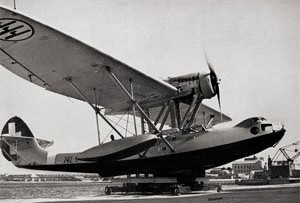
When Italy entered the Second World War in June 1940, the Regia Aeronautica had 202 Z.501s in front line service with maritime reconnaissance squadrons, air/sea rescue and other units. During the following year the nose gun was removed, to allow for an enclosed observer’s cockpit in that position. At the Italian armistice in September 1943 the Gabbiano was still in use; about 20 continued serving with the co belligerent Italian forces and others with the pro German Aviazione della RSI (the airforce of Mussolini’s short¬lived Italian Social Republic set up after the armistice), until the end of the war, and a few survived with the Italians until 1950. The Z.501 finished the war without a single air-to-air kill.
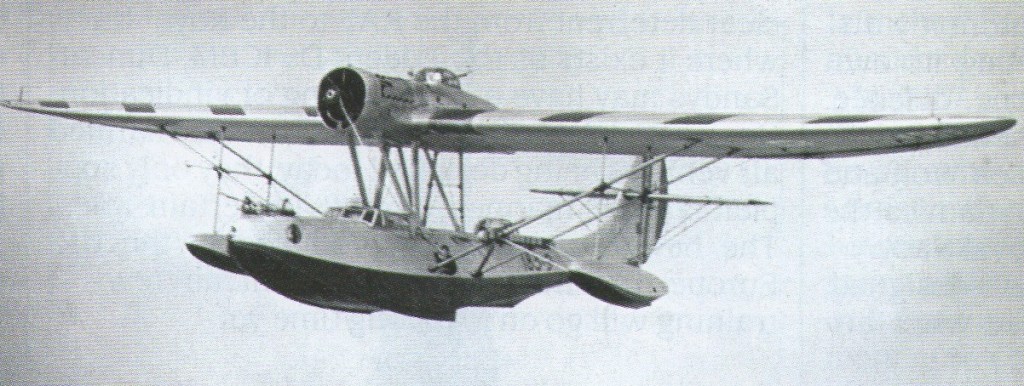
CANT Z.501 Gabbiano (Gull)
Engine: 1 x Isotta Fraschini Asso XI R2C.15 12-cylinder, 900hp.
Length: 46.92ft (14.3m)
Wing span: 73.82ft (22.50m)
Wing area: 667.368 sq.ft / 62.0 sq.m
Cruising speed: 130 kts / 240 km/h
Cruising altitude: 6562 ft / 2000 m
Wing load: 23.17 lb/sq.ft / 113.0 kg/sq.m
Height: 14.44 ft (4.40m)
Maximum Speed: 171mph (275kmh; 148kts)
Maximum Range: 1,491miles (2,400km)
Range (max. weight): 540 nm / 1000 km
Rate-of-Climb: 820ft/min (250m/min)
Service Ceiling: 22,966ft (7,000m; 4.3miles)
Armament: 3 x 7.7mm machine gun
Up to 1,411lbs (640 kg) of bombs.
Structure:
Accommodation: 4 to 5
Hardpoints: 2
Empty Weight: 8,488lbs (3,850kg)
Maximum Take-Off Weight: 15,543lbs (7,050kg)
Cant 25
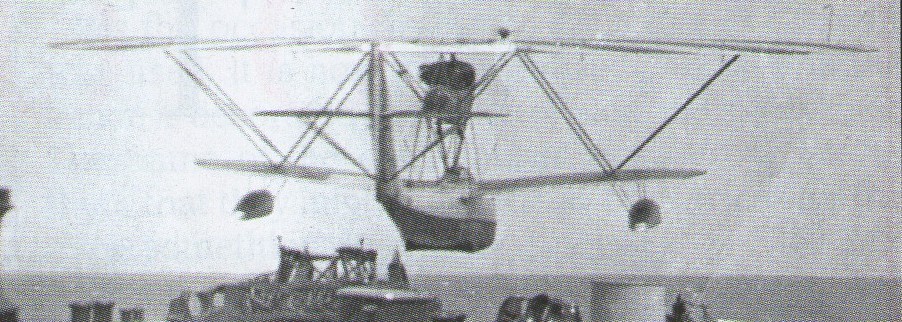
Single-seat flying-boat fighter. Appearing in 1921, this first 25M version of the fighter had distinctive Warren bracing and a 410 h.p. Fiat A.20 engine.
Cant / Cantieri Navale Triestino / Cantiere Riuniti dell’Adriatico
Italy
Company originally called Cantieri Navale Triestino created 1923 as subsidiary of Cantieri Navali di Monfalcone to manufacture civil/military marine aircraft. Most designs produced between 1923-1930 were work of R. Conflenti, including such flying-boats as Cant 6 three-engined biplane bomber; Cant 6 ter, commercial transport version; Cant 7, 7 bis and 7 ter single-engined trainer biplanes; Cant 10 and 10 ter five/six-seat single-engined light transport biplanes; Cant 18 trainer; Cant 22 three-engined eight/ten-seat commercial transport; Cant 25 single-seat fighter. Landplanes included Cant 23 transport and Cant 36 trainer.
Company changed its name in 1931 to Cantiere Riuniti dell’Adriatico. Chief designer Filippo Zappata (formerly of Bleriot) completely reorganized the company 1933/1936. From 1934 most aircraft had Z prefixes, marine aircraft being numbered in 500 series, beginning with Z.501 Gabbiano biplane reconnaissance/bomber first flown 1934. Followed by Z.504 two-seat fighter biplane flying- boat and Z.505 twin-float three-engined monoplane, both 1935. Latter developed into Z.506 (1936), built as reconnaissance/ bomber/ASR for Regia Aeronautica (Z.506B Airone) and as commercial transport for Italian airlines (Z.506A and C). Landplane version built by Piaggio. Built Z.508 and Z.509, monoplane flying-boat bombers, and world’s largest floatplane: Z.511 four-engined trans- Atlantic mail/freight variant, first flown 1943. The Z.515 twin-engined twin-float monoplane (coastal reconnaissance), built 1938-1939.
Landplanes (designated in 1000 series) included Z.1007 and 1007 bis Alcione three-engined bomber; Z.1011 twin-engined medium bomber/transport; Z.1012 three-engined transport; Z.1015 three-engined derivative of Z1017 bis, first flown January 1939 and used in torpedo trials early in the Second World War. Final type was Z.1018 Leone, twin-engined medium bomber intended to replace Alcione, probably Italy’s best wartime design but too late to see service. Did not continue aircraft manufacture in the post-war period.
CANSA C.5
single-engined one/two-seat training biplane (Fiat or Alfa Romeo engine), built in some numbers in late 1930s for civil market.
CANSA / Costruzioni Aeronautiche Novaresi SA / Gabardini Sa / Aeronautica Gabardini SA
Gabardini Sa manufactured a 80 hp rotary-engined two-seat monoplane at Novara in 1913, used for a non-stop flight between Milan and Venice. Company subsequently opened factory at Cameri in 1914 to build a military version of this monoplane, powered by a smaller engine. Also built biplane trainers. Nothing more heard of company until it produced a two-seat light cabin monoplane, the Lictor 90, in 1935.
Name of Costruzioni Aeronautiche Novaresi SA assumed May 1, 1936 by former Aeronautica Gabardini SA. Head office and factory at Cameri; began with repair and maintenance work on aircraft and engines. First product was C.5 single-engined one/two-seat training biplane (Fiat or Alfa Romeo engine), built in some numbers in late 1930s for civil market. The C.6 was a less successful development. CANSA then became subsidiary of Fiat, producing small numbers of F.C.12 fighter/trainer monoplane (first flown 1940) and also the F.C.20 twin-engined ground- attack aircraft.
Canadian Vickers Vancouver
During the 1920s six other designs appeared: the Varuna, Vista, Vanessa, Velos, Vigil, and Vancouver. Of these, only the Varuna (eight) and Vancouver (six) flying-boats went into production.
Canadian Vickers Vigil
During the 1920s six other designs appeared: the Varuna, Vista, Vanessa, Velos, Vigil, and Vancouver. Of these, only the Varuna (eight) and Vancouver (six) flying-boats went into production.
Canadian Vickers Velos
During the 1920s six other designs appeared: the Varuna, Vista, Vanessa, Velos, Vigil, and Vancouver. Of these, only the Varuna (eight) and Vancouver (six) flying-boats went into production.

