Caproni

One of the companies form¬ing part of the industrial empire founded by Count Gianni Caproni in 1908 was Caproni Vizzola, originally an important pilot training school, but from 1934 a design and construc¬tion organization as well.
Company’s founder, Count Gianni Caproni di Taliedo, built and flew his first aircraft in May 1910. Count Gianni Caproni di Taliedo designed his first heavy bomber in 1913. Caproni’s big biplane bombers had a demoralizing effect on ground troops during the Austro-Italian conflict, more by virtue of their size and threatening ap¬pearance than their destructive power, and led to a series of immense triplane bombers during World War I. The first was de¬signed in mid-1915 and was designated Caproni Ca. 40. A later development, the Ca.42.
At one time, largest aircraft manufacturer, the Caproni group comprised more than 20 companies, of which the principal aircraft building members were Aeroplani Caproni Trento, Caproni Aeronautica Bergamasca, Caproni Vizzola SpA, Compagnia Nazionale Aeronautica, Aeronautica Predappio SpA, and Officine Meccaniche Reggiane SpA. The Isotta-Fraschini aero- engine company was also part of the group.
The most prolific company in the group was the Compagnia Aeronautica Bergamasca, which began aircraft design in 1927, joining the Caproni group in the ‘thirties. The chief designer was Cesare Pallavicino, formerly chief designer to Ernesto Breda, and initially the original designs produced by Bergamasca were given Caproni-Bergamaschi designations, but later “Berga- maschi” was dropped and aircraft emanating from the Bergamo works could only be identified by their type numbers, which were in the 300 series.

After formation of Regia Aeronautica in associating with various partners until First World War. 1923 Caproni achieved success with such military aircraft as the Ca 1 -Ca 5 series of large tri-motor biplane and triplane bombers
During the 1920s, a retrospective series of manu¬facturer’s designations was applied to war¬time Caproni designs, in an endeavour to clarify different variants. Under this system the prototype Ca.1 was designated Ca 31 and the Fiat engined Ca 1 was allocated Ca 32; to avoid confusion between the two systems.
Achieved an international reputation with the Ca 36, Ca 73 and Ca 74. The following decade produced the Ca 101, Ca 111, and Ca 133 range of aircraft and a series of multipurpose reconnaissance/light bomber/transport types, production of which was shared with the Bergamasca subsidiary.
Early post-war publicity gained by Ca 60, an enormous eight-engined ‘triple-triplane’ of 1921, intended to carry 100 passengers, which was shared with the Bergamasca subsidiary.
Cantieri Aeronautici Bergamaschi had been absorbed by Caproni in 1931. Initially built Ca 100 and Ca 101, then built the new aircraft to the designs of Ing Cesare Pallavicino.

In the mid ‘thirties Caproni-Vizzola activities were expanded and a fully-equipped factory built. The plant was primarily engaged on sub-contract work building the Breda Ba 65 attack aircraft, but in 1938 its first original designs, the F.4 and F.5 single-seat fighters appeared, powered respectively by the 1,025-h.p. Isotta-Fraschini Asso 121 R.C.40 and the 840-h.p. Fiat A.74 R.C.38 radial. Designed by Ing. Fabrizi, a pre-production batch of fourteen of the radial-engined F.5 fighter was built immediately prior to Italy’s entry into the war, but like most of Italy’s fighters of this period the F.5 was under-powered (maximum speed being 326 mph) and under-armed (two 12.7-mm. guns). Nevertheless, a squadron was equipped with the F.5 for a short period and employed for the night defense of the area surrounding Rome.

One of the fourteen F.5 fighters was re-engined in 1941 with a 1,050-h.p. DB 601 engine. This conversion was designated F.6, but the most interesting development was the F.6Mz powered by the 1,250-h.p. Isotta-Fraschini Zeta engine (which was also to have been installed in the Reggiane Re 2004). The F.6Mz flew for the first time late in 1942 and was to have carried an armament of four 12.7-mm. guns or two 12.7-mm. and two 20-mm. guns. Maximum speed was 404 mph, but the Zeta engine was insufficiently developed for operational service, and the F.6Mz progressed no further than the prototype stage.

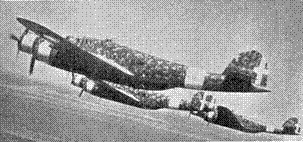
Major production types during 1934-1944 were A.P.1 single-seat fighter, followed by the family of multi-purpose twin-engined aircraft: Ca 309 Ghibli; Ca310/310 bis Libeccio; Ca 311 Libeccio; Ca 312 bis Libeccio; Ca 314, and 316.
More than 2,500 examples of the Ca 100 training/touring biplane were built during the 1930s; the Ca 161 bis, a single-seat single-engined biplane, set an international altitude record of 17,083m that remains unbeaten today in its class. The Caproni-Campini CC-1 of 1940 was Italy’s first and the world’s second aircraft to fly by jet propulsion, though it was not powered by a turbine. During the Second World War the company was chiefly concerned with the production and development of the Ca 310-Ca 314 multipurpose twin-engined aircraft and with the Reggiane Re. 2000-Re 2005 series of single- seat fighters. During the lifetime of the group some 180 different types were built, in addition to licensed construction of almost as many by other designers.
The parent company went bankrupt in 1950. Aeroplani Caproni Trento survived the bankruptcy and in May 1952 flew Italy’s first postwar jet light aircraft, the F.5, designed by Dott Ing Stelio Frati.
In 1969, Caproni – Vizzola began producing in his workshops 30,000 m² located near the airport of Milan – Malpenza.

Caproni Vizzola Costruzioni Aeronautiche SpA was formerly the Scuola Aviazione Caproni, the oldest flying school in Italy, and became the last surviving part of the company until bought by Agusta in 1983, producing the Calif series of sailplanes and finally the C22J Ventura two-seat very light basic trainer with two Microturbo turbojet engines, first flown 1980. Earlier it remodeled the Ca 133 for ambulance and military transport duties and assisted in production of the Breda Ba 65. Its first original design had been the F.4 single-seat fighter designed by Ing F Fabrizi, flown in 1940. Prototype F.6 had more powerful engine.
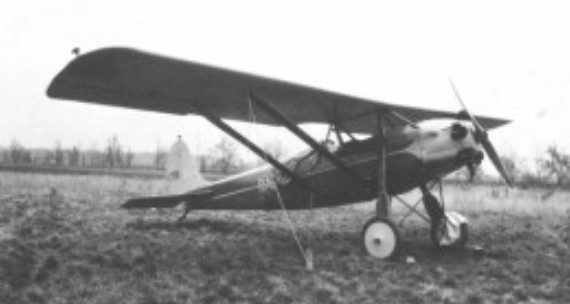
Capital Aircraft Air Trainer / Royal Air Trainer / Derickson Air Trainer

The aircraft was designed by Prof. Peter Altman of the University of Detroit. At that time it was named the Derickson Air Trainer.

John and Donalt Thomas acquired the design rights in 1928 and formed a company under the name Capital Aircraft Corporation located in Lansing, Michigan.

They built only one aircraft, registration number X795K. The airframe was initially built as a seaplane powered with a 60 hp LeBlond 5-D engine, which was exchanged with a 90 hp 7-D when later converted as a landplane. Span was 34 ft, length 25 ft, useful load 535 lbs, Vmax 105 mph, Vc 85 mph, Vso 30 mph, and range 400 miles.

In 1929 Capital Aircraft Corporation was relocated in Royal Oak, Michigan, and was renamed the Royal Aircraft Corporation.

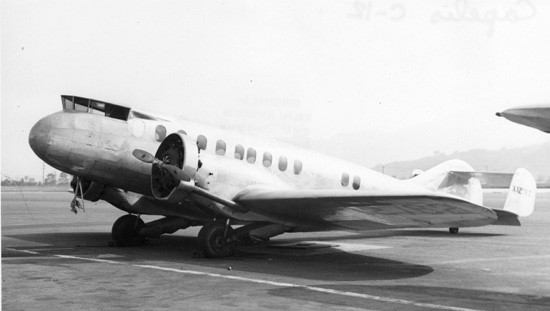
Capelis XC-12   

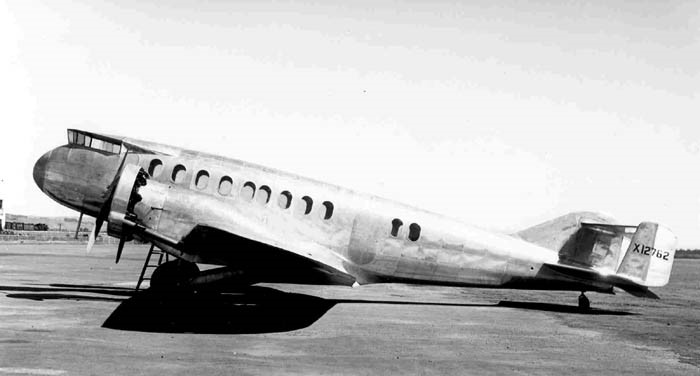
The Capelis Safety Airplane Company Ltd XC-12 was a 1933 aircraft design that most notably was used as a prop in the films Five Came Back, The Flying Tigers, The Falcon in Danger, and Immortal Sergeant. The aircraft featured unusual twin horizontal tail structures supported by three vertical tail surfaces. Construction and finishing methods involved using sheet metal screws which ultimately led to the abandoning of the project.

The original design by Socrates H. Capelis was issued U. S. patent #1,745,600 in 1930. The patent comprised a modified application with a half-span dorsal wing mounted rearward on top of the cabin and two additional engines mounted on the wings. The project was funded by local Greek restaurateurs as a promotional aircraft; it was constructed with help from University of California students.

A less radical design by Dr. John E. Younger featured all-metal construction; the aircraft was built as an all-metal, low-wing, retractable gear, twin engine transport with a triple vertical tail supporting a dual (biplane arrangement) horizontal stabilizer. The wing used a large box-spar construction with corrugated skin panels. The partly retracting landing gear extended automatically when the throttle was closed.

Following a 1938 incident, the XC-12 was modified at Glendale, California: The forward slanting eight-piece windshield was modified to a four piece that slanted rearward, and the passenger windows were squared off to look more like a Douglas DC-3.

On April 15, 1938, the XC-12 suffered minor damage from a forced landing after running out of fuel while flying over Fresno, California. The main wing spar construction was bolted together, and many of the metal skin panels were attached with P-K sheet metal screws rather than with permanent rivets. These tended to vibrate loose, requiring tightening or replacing every few flights, constituting a safety hazard that would later ground the aircraft. With promotional tours abandoned after the 1938 crash, the aircraft’s flying career was over.

The aircraft was purchased by RKO in March 1939, after which the studio’s insurance company permanently grounded the aircraft. Used as a full-size prop, the transport appeared only in ground roles in RKO’s feature films made during World War II; flying sequences used a scale XC-12 shooting miniature. The aircraft became an RKO back lot relic, falling into worse repair during the 1940s until it was completely scrapped some time around 1950. The XC-12 miniature continued to be used in later feature films.

The aircraft was featured as a prop in Five Came Back (1939), The Flying Tigers (1942), and Immortal Sergeant (1943). In RKO’s Dick Tracy’s Dilemma (1947) the XC-12 was shown somewhat dismantled, and in Daredevils of the Clouds (1948), after which it was apparently scrapped.

Filmography:

Five Came Back (RKO) 1939 (aircraft and model)

Flying Blind (Paramount) 1941 (model)

King of the Zombies (Monogram) 1941 (model and disassembled fuselage)

Flying Tigers (Republic) 1942 (aircraft and model) John Wayne guides in a crippled XC-12 with an engine on fire, and later uses it as an improvised bomber

Invisible Agent (Universal) 1942

Immortal Sergeant (20th Century Fox) 1942/1943 (aircraft and model)

Adventures of the Flying Cadets (Universal) 1943 (model)

Night Plane from Chungking (Paramount) 1943

The Falcon in Danger (RKO) 1943 (while a Lockheed Model 10 Electra aircraft model is used for the in-flight scenes, the full-size aircraft appears as a wreck)

Wings Over the Pacific (Monogram) 1943 (model)

The Purple V (RKO) 1943

Action in Arabia (RKO) 1944

Passport to Destiny (RKO) 1944

Jungle Queen (serial) (Universal) 1945; re-edited into Jungle Safari a 1956 feature film

Dick Tracy’s Dilemma (RKO) 1947 The aircraft is shown somewhat dismantled in this movie, but not scrapped

Daredevils of the Clouds (Republic) 1948 (model)

Jungle Goddess (Lippert Pictures) 1948 (model)

Tarzan’s Magic Fountain (RKO) 1949 (model)

On the Isle of Samoa (Columbia) 1950 (model)

China Gate (Globe Enterprises) 1957 (model)

Specifications:
Powerplant: 2 × Wright Cyclone R-1750, 525 hp (391 kW) each
Propeller: 2-bladed
Wingspan: 55 ft (17 m)
Wing area: 500 sq ft (46 m2)
Airfoil: Modified USA 45
Length: 42 ft (13 m)
Height: 12 ft (3.7 m)
Empty weight: 6,500 lb (2,948 kg)
Gross weight: 9,500 lb (4,309 kg)
Fuel capacity: 145 gal
Maximum speed: 190 kn (220 mph, 350 km/h)
Cruise speed: 170 kn (190 mph, 310 km/h)
Stall speed: 53 kn (61 mph, 98 km/h)
Service ceiling: 28,000 ft (8,500 m)
Capacity: 12

Canterbury (NZ) Aviation Co Biplane

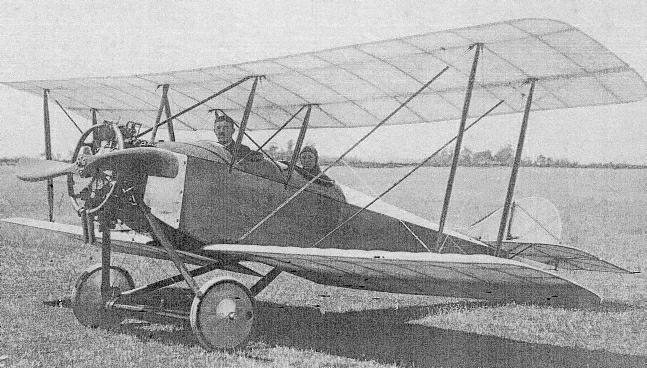
The first NZ designed and built land-biplane, strongly reminiscent of a Sopwith Tabloid, was designed and built at the Canterbury (NZ) Aviation Co Ltd workshops at Sockburn, near Christchurch, the two persons most concerned with the construction being Mr C M Hill, the company’s chief flying instructor, and Mr J G Mackie, the engineer.

The working drawings for this unnamed biplane were chalked out on the black-painted wall of one of the early Sockburn hangars, which full size drawings was apparently quite satisfactory as the biplane performed well in the air. The drawings were so “permanent” that they could still be seen, according to Mr W S Dini, as late as 1938 when he left the RNZAF after 14 years’ service. Cupboards had been built along the rear wall of the hangar in later years, and these helped in no small measure to preserve the drawings.

The aeroplane was rolled out of its hangar on 17th January 1919, and was a two-seater fitted with a 30 h.p. Anzani radial motor which was originally used to power one of the School’s Caudron biplane trainers. Main spars were of ash and the wing struts were of cedar, with bracing wires encased in cedar streamlines. Ailerons were fitted (instead of the Caudrons’ wing-warping and the wings had a slight dihedral. The aircraft, according to the Lyttelton Times of 18th January’ was “produced with little or no effort”. Wings and fuselage were fabric-covered.

Mr Hill made the first solo flight in the biplane on 17th January and found that it had a good rate of climb and was light on the controls. It also had a shallow gliding angle for its type, and Mr Hill predicted that it would be suitable for aerobatics. He said on landing that he had never before tested an aeroplane in which everything was so satisfactory, and he praised Mr Mackie’s work in high terms. The only alteration he recommended after the first flight was a small one to the control circuits to enable the aeroplane to be flown hands-off in level flight. He found that, trimmed hands-off, it tended to climb slightly. A very short landing was made after that first flight, another good feature.

Plans were then made for a flying tour to Invercargill, the aeroplane to be flown by Mr Hill and demonstrations and passenger flights to be given at selected centres. Passengers would also be booked between several of the towns to be visited, and it was thought that with a full tankage of 27 gallons of petrol, two people could be carried about 200 miles in still air.

The longest passenger flight in NZ on record, according to the Lyttelton Times, was made on 18th January 1919 when Mr Hill took off from Sockburn for a 28 minute flight over Christchurch and New Brighton, with Mr E S Fleming as passenger. This presumably would be the longest passenger flight made by an aircraft of the Canterbury (NZ) Aviation Co.Ltd. Mr Fleming, of the Riccarton Flour Mills, was a brother of Mr W H P (Herby) Fleming of Gore, who had also booked a flight between Gore and Invercargill during the forthcoming tour. Mr E S Fleming’s flight was made at between 2 and 3,000 feet, and there were “no engine troubles”. Later flights the same day were made with passengers Mr A V Smith and Mr Notman.

The southern flight was never made as the biplane was completely wrecked and Mr Hill killed on 1st February. It had been the custom for an aeroplane of the Canterbury (NZ) Aviation Co. Ltd to make a flight over the Racecourses at Addington and Riccarton on Race days, and Mr Hill had been requested to fly over the Riccarton meeting on the 1st. The Hon. H F Wigram, chairman of the Company, asked the Chairman of the Jockey Club if he would like to have an exhibition flight over the Racecourse that Saturday afternoon as an added attraction, and so it was arranged with Mr Hill. Mr Hill took off from Sockburn at 3.11 pm and set course for the Racecourse’ where he appeared just as the Lyttelton Plate was being run. He circled twice, and finally flew low over the course, where he was cheered by the crowd as he went past.

Mr Hill waved to the crowd, and then circled again to get more height. Another wide sweep over the course was made at a height of 2000 feet, and then the aeroplane disappeared into cloud. On his reappearance, he dived the aeroplane and came over in a loop. It would appear that the aircraft had some difficulty in going over the top, and soon went into another dive. This final dive was made towards the crowd, and as the aircraft climbed into its second loop, a distinct crack was heard and the port wings collapsed. Mr Hill tried to hold the aircraft straight but this was impossible and the aeroplane then disappeared from sight behind a belt of trees.

When members of the public arrived at the scene of the crash Mr Hill was dead and the aeroplane completely wrecked. At the subsequent inquest and investigation it was found that a flying wire had broken and this in turn had caused the other flying wire to break. The main spars had then cracked and the whole port wing assembly folded up. It was said that ordinary piano wire had been used for the flying wires, instead of cable.

Mr Hill had not previously attempted any aerobatics with the aeroplane and indeed had not permitted anyone else to fly it until he had completely tested it to his satisfaction. It had only made a very few flights at the time of the accident and it was fortunate that no passenger was being carried at the time.

The Coroner, Mr T A B Bailey SM, found “That on 1st February, while the deceased was making an exhibition flight over the Riccarton Racecourse, and attempting to loop the loop, one wing of the machine collapsed and the machine fell to the ground, the deceased being killed as a result of the fall, The collapse of the wing appears to have been due to the breaking of one of the flying wires. The machine was built under the personal supervision of the deceased, who was a competent mechanic and he expressed himself satisfied with the machine”.

Engine: 30 h.p. Anzani
Wingspan: 23 ft 6 in
Length: 20 ft
Wing area: 220 sq.ft
All-up-weight: 500 lbs
Fuel capacity: 200 lbs
Seats: 2

Cant Z.1007 Alcione

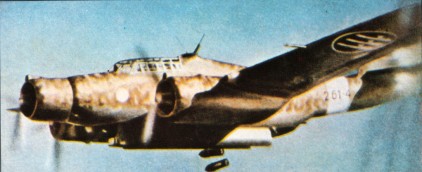
The Alcione (Kingfisher) was an Italian bomber of the Second World War, designed by the CRDA Cant, it was the company’s first landplane, and stemmed directly from the Z.506 Airone. The pro¬totype, flown in late 1937, had three Asso liquid cooled engines in annular cowls, but all production machines had radials, usually the 1000 hp Piaggio P.XIbis RC40.

Cant Z.1007 Alcione Article

First prototype of the Z.1007

Of all wooden construction, the Alcione had a long bomb bay under the wing able to carry up to 2000 (4410 lb). There were manual gun positions at front and rear of this bay (often the front position was used solely for bomb aiming) and most Alciones had a dorsal turret and two beam guns. The guns were at first all 7.7 mm, but by 1940 the dorsal and ventral guns were 12.7 mm. When Italy entered the war in 1940 there were 87 in service, and the type was being built by Cant, Piaggio and IMAM Meridionali. In 1941 the Z.1007bis appeared, with the fuselage 244 cm (96 in) longer, span 83 cm (33 in) greater and stronger landing gear. Many of these had twin fins.

Z.1007bis

The Alcione operated from Tunisia to the Soviet Union, often carrying two 450 mm (1000 lb) torpedoes or in the strategic recon¬naissance role. A few Z.1007ter, with 1175 hp Piaggio P.XIX engines, entered service in 1942. Cant tried to improve performance by fitting the 1500 hp Piaggio P.XIX engine, and at the very end of Italian participation in the war produced the Z.1018 Leone (Lion).

Gallery

CANT Z.1007bis Alcione (Kingfisher)
Engines: 3 x Piaggio P.XI RC.40 radial piston, 1,000 horsepower
Length: 60.20ft (18.35m)
Wing span: 81.36ft (24.80m)
Wing area: 807.300 sqft / 75.0 sqm
Wing load: 37.31 lb/sq.ft / 182.00 kg/sq.m
Height: 17.13ft (5.22m)
Maximum Speed: 301mph (485kmh; 262kts)
Maximum Range: 1,115miles (1,795km)
Range (max. weight): 945 nm / 1750 km
Service Ceiling: 24,606ft (7,500m; 4.7miles)
Armament: 3 x 12.7mm Scotti OR SAFAT heavy machine gun, 2 x 7.7mm SAFAT machine guns
Up to 2,645lbs of internal stores and up to 2,200lbs of external stores OR 2 x 1,800lb torpedoes.
Accommodation: 5
Hardpoints: 2
Empty Weight: 20,715lbs (9,396kg)
Maximum Take-Off Weight: 30,029lbs (13,621kg)

Cant Z.506 Airone

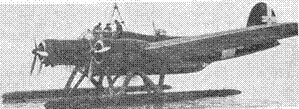
The Z.505 was developed into Z.506 (1936), built as reconnaissance/ bomber/ASR for Regia Aeronautica (Z.506B Airone) and as commercial transport for Italian airlines (Z.506A and C). Designed and produced by the C.R.D.A. the Z.506B Airone tri-motor, twin-float reconnaissance-bomber seaplane which was developed in 1936 as a military version of the Z.506 commercial floatplane (the Z.509 was a further commercial development differing from the Z.506 in having 1000-h.p. radials), and the Monfalcone factory had produced ninety-five Z.506B float-planes by the time Italy entered the war.

Production began in 1935 and, with accommodation for up to 16 passengers, the type served with Ala Littoria and with the military. Production was subsequently undertaken by Piaggio as a landplane version.

CANT Z.506 prototype I-CANT set several international seaplane records in 1936 before being delivered to the Italian Air Ministry as MM291.

The Z.506B was employed primarily far maritime reconnaissance, bombing and torpedo attacks on shipping around Italy’s coasts. The Z.506S was an ambulance and air-sea rescue version built by Piaggio. The Airone largely replaced the earlier Z.501 single-engined high-wing flying- boat, although some of these obsolescent machines were operated throughout the war.

Z.506B

CRDA Cant C. 506 Airone
Engine: 3 x Alfa Romeo 126 RC 34, 740 hp
Length: 63.156 ft / 19.25 m
Height: 24.278 ft / 7.4 m
Wingspan: 86.942 ft / 26.5 m
Wing area: 936.468 sqft / 87.0 sqm
Max take off weight: 27121.5 lbs / 12300.0 kg
Weight empty: 18301.5 lbs / 8300.0 kg
Max. speed: 197 kts / 365 km/h
Cruising speed: 175 kts / 325 km/h
Service ceiling: 26247 ft / 8000 m
Wing load: 28.91 lb/sq.ft / 141.0 kg/sq.m
Range: 1482 nm / 2745 km
Armament: 2x MG 7,7mm, 1x MG 12,7mm, 1200kg Bomb. / Torp.