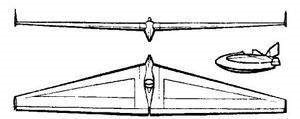
In 1931 – 1932 B. I. Cheranovski developed two other gliders based on the trapezoidal wing design of the BICh-8. The Cheranovski BICh-12 (Russian: Черановский БИЧ-12) experimental glider was similar to the BICh-11, but with greater wingspan, built in 1932 to test the influence of wing lengthening on the performance of flying wings. Unlike the prototype, these gliders had differentiated ailerons and elevator rudders.
The main objective of the construction of the BICh-12 was to test the influence of wing lengthening on the performance of a glider without tail.
The BICh-12 was conceived as a single-seater experimental glider built entirely of wood. The cantilever and high-set wing had a trapezoidal shape and a three-spar structure. This wing was conceived in three sections: a central one forming an integral part of the fuselage and the long wing consoles with rudders at the ends. The union of the consoles to the centroplane was made by means of some steel pieces.
The straight trailing edge featured control surfaces along the entire span, located on a bar on the soffit of the wing, just below the trailing edge. In the external part the ailerons were located and something more inside the elevator. In the inner part were the adjustable stabilizers on the ground.
The fuselage was covered with plywood. The landing gear was composed of two independent wheels and a tail skid.
The pilot was located in a closed cockpit forward, located on the longitudinal axis.
The Cheranovski BICh-12 participated in the IX National Sailing Competitions held in Koktebel.
BICh-12 Wingspan: 14.20 m Length: 3.2 m Height: 1.65 m Wing area: 20.10 m² Empty weight: 100 kg Accommodation: 1
The first flying wing project with wingspan of 1.5 was presented by BI Cheranovski to the TsAGI in 1921, being categorically rejected. Many professionals of this institution objected against the informality of the concept. Despite this, the tests in the wind tunnel of some scale models demonstrated the feasibility of the flying wing.
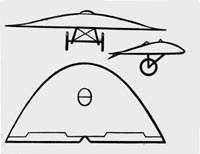
After the results obtained, Cheranovski decided to begin, with the help of his brother and other members of the “Paryashi Popiot” group, the construction of an experimental glider with this design. The works were carried out in the workshops of the Air Fleet Academy, where the glider received the consecutive AVF-12, although its designer named it BICh-1 (after its initials) and it was popularly known as “Parabola” (Russian: Черановский БИЧ-1 “Парабола”).
The BICh-1 glider was made entirely of wood, with a textile covering. This model featured a thick cantilever wing with a parabola-shaped leading edge and a thin trailing edge with ailerons and elevons across the entire span of the trailing edge. These moving surfaces performed both the functions of ailerons and elevator.
The pilot was located in a cockpit in the frontal region of the model, practically hidden within the thick 0.45 meter wing profile. Access was from below, through an opening in the wing intrados. The landing gear featured two large spoke wheels linked by a common axle.
Only one was built, which participated without great success in the First National Sailing Competitions held in Koktebel that same year. In some literature it has claims that during the competitions it would make a single flight before being destroyed and that the pilot VF Denisov managed to escape unharmed. Other sources suggest that the glider simply failed to take off, due to a poorly designed angle of attack. In any case, the BICh-1 was not a successful model, but it would create the basis for the development of later models that would present excellent flight characteristics.
Cheranovski BICh-1 Wingspan: 5.70 m Wing area: 12:00 m² Wing aspect ratio: 7.4 Length: 2.85 m Height: 1.20 m Empty weight: 30 kg Wing loading: 8.5 kg / m² Accommodation: 1
The Cheranovski BICh “KIM-2” (Russian: Черановский АВФ-12 “КИМ”) experimental glider was designed by Boris Ivanovich Cheranovski as a single-seater training glider. The cantilever wing had a parabolic shape in the plane, but unlike the AVF-12, installed high on the wide fuselage. The trailing edge maintained control surfaces throughout the span.
This glider featured large tail stabilizers with pronounced sagging and large area elevators.
The fuselage had a fusiform shape and smoothly ended at the rudder, without a differentiated empennage. The underside was reinforced to allow the glider to land on its belly.
The pilot was located in an open cockpit in the bow of the glider.
Built in 1924 by a group of enthusiasts from the Communist Youth Institute (KIM) located in the Jamovnich region, near Moscow, under the direction of Cheranovski. In general, it was a development of the AVF-12 “KIM”.
The BICh “KIM-2” glider was entered in the III National Sailing Competitions held in Koktebel. On 30 September 1925 it crashed on landing, losing the tail. The pilot was unhurt.
The Cheranovski AVF-12 “KIM” (Russian: Черановский АВФ-12 “КИМ”) experimental glider was designed as a single-seat training glider under the direction of Cheranovski. The cantilever wing had a parabolic shape in the plane and medium implantation. The trailing edge featured control surfaces throughout the span.
This glider featured large tail stabilizers with marked sagging and large area elevator rudders.
The fuselage had a fusiform shape and smoothly ended at the rudder, without a differentiated empennage. The underside was reinforced to allow the glider to land on its belly.
The pilot was located in an open cockpit in the bow of the glider.
The AVF-12 was built by a group of enthusiasts belonging to the circle of interest of the Central Club of the Communist Youth Institute (KIM) located in the Jamovnich region, in Moscow, under the direction of BI Cheranovski. The construction was developed in the workshops of the Air Fleet Academy (AVF) in 1924.
The AVF-12 was entered in the II National Sailing Competitions held in Koktebel. After a successful 11-second flight the glider lowered its wing and fell to the ground in an inverted position. The pilot was not injured. The glider was destroyed.
Wingspan: 12.00 m Wing area: 19.5 m² Length: 5.8 m Height: 1.10 m Stabilizers surface: 1.4 m² Elevator area: 0.8 m² Rudder surface area: 0.7 m² Spoiler area: 4.5 m² Empty weight: 72 kg Wing loading: 7.4 kg / m²
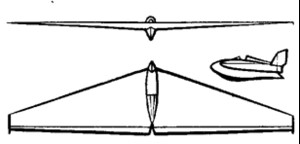
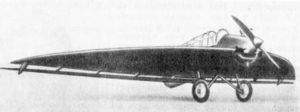
The BICh-11 appeared in 1932 as a continuation of the trapezoidal wing design started with the BICh-8 glider. Its construction was developed in the TsAGI workshops. The Cheranovski BICh-11 (RP-1) (Russian: Черановский БИЧ-11 (РП-1)), conceived in 1931, became the world’s first experimental aircraft in a flying wing configuration designed to use a reactive power plant. Problems with the development of the reactor made it necessary to equip the BICh-11 with a low-power engine in pusher configuration.
In practice, the BICh-11 had been conceived to test in flight the OR-2 liquid propellant rocket engine developed by FA Tsander, which weighed only 18 kg and was capable of developing a thrust of 0.62 kN. The funds for the modification of the model and the installation of the reactive power plant were approved by OSOVIAJIM on February 25, 1932. The installation of this engine was just behind the cabin. The fuel and oxidizing agent tanks were designed in fairings located on the wings, on both sides of the central fuselage.
The BICh-11 was conceived as a single-seater experimental glider, built entirely of wood. The cantilever and high-set wing had a trapezoidal shape and a three-spar structure. This wing was conceived in three sections: a central one forming an integral part of the fuselage and the long wing consoles with the rudders at the ends. The union of the consoles to the centroplane was made by means of some steel pieces. In the centroplane, they conceived some fairings that contained the chemical components necessary to make the OR-2 liquid reactive engine functional.
The entire leading edge was covered with a 1mm thick plywood sheet. The straight trailing edge featured control surfaces along the entire span, located on a bar on the soffit of the wing, just below the trailing edge. In the external part the ailerons were located, also used as elevator rudders. On the inside were the adjustable stabilizers on the ground and a little further inside the elevator. Adjustable stabilizers on the ground were located on the inside.
The fuselage was covered with plywood. The landing gear was composed of two independent wheels and a tail skid.
The pilot was located in a closed cockpit at the nose.
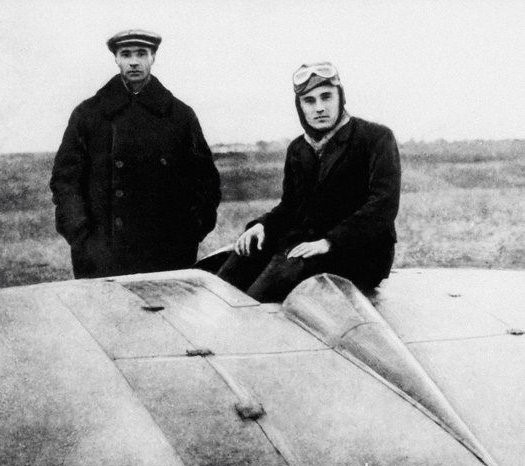
In mid-February 1932 the BICh-11 was transported to the GIRD and on February 22 it was flown in the form of a glider by Sergei Koroliov. Also in glider form, the BICh-11, piloted by Koroliov, flew in the IX National Sailing Competitions held in 1933.
The first tests work jet engine OR-2 began the 18 of March of 1933, but only 10 days after FA Tsander died and with him the work of building the rocket plane – 1 (RP-1), assigned name to the project.
Given the lack of a power plant, the BICh-11 was modified to use a 27 hp ABC Scorpion piston engine driving a propeller, with which the tests were continued. In this configuration the BICh-11 flew satisfactorily, becoming one of the first airplanes in a flying wing configuration with a trapezoidal ground plan to do so.
In the version with a piston engine, some modifications were made to the wing plan and its control surfaces. The ABC Scorpion power plant was located at the end of the fuselage fairing as an extension of the cabin and powered a two-bladed wooden propeller.
BICh-11 Engine: 27 hp ABC Scorpion Wingspan: 12.10 m Wing area: 20.00 m² Length: 3.25 m Empty weight: 200 kg Accommodation: 1
Cheranovski BICh-11 glider
Cheranovski RP-1 with wing fairings for liquid reactive engine fuel
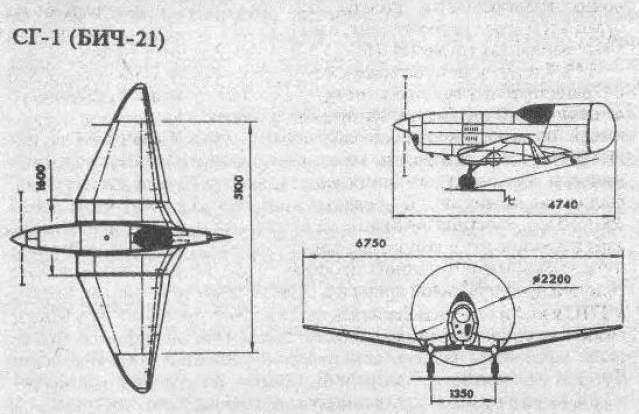
During the design of the new SG-1 racing aircraft (SCR-21), designer Boris Ivanovich Cheranovsky applied a trapezoidal wing shape but with a broken leading edge. The center-wing was straight and the outer had a swept 25º. By the front view, the wing was a “reverse gull”, and tailless.
The very short fuselage had a length with a rudder of no more than 4,74 m. The drop-shape of the pilot’s cabin, along with the fuselage with a hexagonal cross section in the cockpit area, was continued back to the wedge-shaped vertical tail.
The take-off weight of the SG-1 was 643 kg with empty 526 weight. The take-off and landing characteristics turned out to be outstanding. The “screen” effect reduced the landing speed to 80 km / h, and the take-off and landing respectively 110 and 100 m. It was calculated with the forced motor MB-6А (240 hp) to reach 424 km / h.
Such unusually large numbers caused a critical attitude to the project of some aerodynamics and designers. The plane was predicted of a fiasco, but some experts gave positive feedback, among them – Brig. VS. Pyshnov Mr. I rank engineer A.S. Yakovlev.
Due to the complexity of the engine supercharging system, its power, like that of the serial MB-6, was only 220l.s., and on flight tests it was possible to achieve 417 km / h. But this is only 7 less than the estimated speed. SG-1 tests were completed by the summer of 1941.
The BICh-7 (Russian: Черановский БИЧ-7) appeared as an enlarged BICh-3 development with a more powerful 100 hp Bristol Lucifer engine and the fuselage featured two open cockpits in tandem.
At the wingtips, on the upper surface, rudders were located with a curved leading edge.
The landing gear featured a single center wheel with skids on the tail section and near the wingtips. This landing gear proved ineffective, as did the dolphin-fin rudder.
Designed by Boris Ivanovich Cheranovski the BICh-7 was built at the Air Fleet Academy in 1929.
As a result, the plane did not take off. After several unsuccessful attempts, the model would be modified to give rise to the BICh-7A.
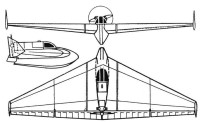
Based on the unsuccessful BICh-7, Cheranovski modified the cell to become a two-seater with a closed cabin. The rear cockpit fairing made a smooth transition to a rudder, which was very effective in this version. The BICh-7A (Russian: Черановский БИЧ-7A) signified the continuation of the development of the original Cheranovski parabolic scheme.
Cheranovski BICh-7A
Like most of Cheranovski’s designs, the BICh-7A was built entirely of wood with a fabric covering.
The cabin on this model appears closed and ends at the rudder. The wing, with a thick profile, presented an area increased to 30 m².
Another notable feature was the modification of the landing gear to a conventional two-wheel configuration with independent landing gear and tail skid.
The wing profile was also slightly modified and the system of ailerons and elevons installed on a bar located near the trailing edge of the wing intrados was introduced. This configuration had been successfully tested on the BICh-5 during the experiments carried out in the TsAGI wind tunnel and resulted in an increase in the effectiveness of these surfaces and in the maneuverability of the aircraft.
Cheranovski BICh-7A.
The BICh-7A was completed by 1932. The tests carried out in 1932 confirmed the expectations of its builder. The flights carried out by the pilot NP Blagin showed that the new airplane responded positively to the controls and presented good stability both longitudinally and during turns. These flights reached a maximum speed of 165 km / h with a ceiling of 5000 meters. Landing speed remained in the range of 70 – 75 km / h.
The main problem with the BICh-7A was its engine. Attempts to install a more powerful 140 hp three-cylinder Bristol Lucifer unit brought no improvement. During the flights the pilot was forced to adjust the power to 100 hp due to the appearance of strong vibrations. Low engine power and the use of an imported engine limited the model’s production possibilities. The M-11 domestic engine was never tested in the BICh-7A.
The excellent results of the BICh-7 would lead Chizhevski to develop in the Bureau of Special Constructions (BOK) a model of a flying wing that was known as BOK-5.
BICh-7 Engine: 1 Bristol Lucifer 100 hp Wingspan: 12.20 m Wing área: 30.00 m² Length: 4.74 m Empty weight: 612 kg Maximum takeoff weight: 865 kg Wing loading: 29.0 kg / m² Power load: 8.7kg / hp Fuel capacity: 93 kg Payload capacity: 253 kg Maximum speed: 165 km / h Landing speed: 70 km / h Seats: 2
BICh-7A Engine: 1 Bristol Lucifer 100 hp Wingspan: 12.20 m Length: 4.74 m Height: 2.40 m Wing area: 30.00 m² Empty weight: 627 kg Maximum takeoff weight: 880 kg Wing loading: 29.3 kg / m² Power load: 8.8kg / hp Fuel capacity: 93 kg Payload capacity: 253 kg Maximum speed: 165 km / h Cruising speed: 138 km / h Landing speed: 70 km / h Practical range: 200 km Practical ceiling: 5000 m Seats: 2
B. I. Cheranovsky was born on either 1 or 13 July 1896 in Pavlovychi, Volhynian Governorate, Russia. By profession he was painter and sculptor, but in 1920 became interested in aviation. From 1924 to 1927 he studied at the Air Force Academy. From 1922 on he engaged in the design and construction of airframes and aircraft of the flying wing configuration. Notable for creating aircraft with a characteristic tailless parabolic wing. — the BICh-1 and BICh-2 gliders from 1924, and the powered BICh-3 later. For his services to the aviation industry, Cheranovsky was awarded the Order of the Red Star. He died in Moscow, Soviet Union, on 17 December 1960.
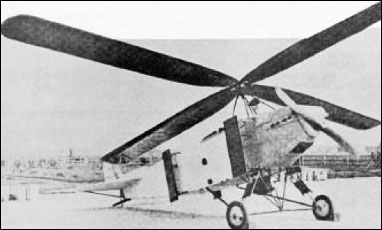
Lucien Chauviere, a propeller designer, built a machine dubbed the Gyroptere in 1927, based on the principles of a patent he had filed ten years earlier. It used a 170kW Renault engine to drive a four-blade rotor with flapping hinges and clutched to power a tractor propeller at the nose. To counter torque while the rotor was powered, control flaps mounted vertically on the fuselage sides vectored the slipstream. Testing of the 1,372kg aircraft did not progress very far before his available finances were expended.
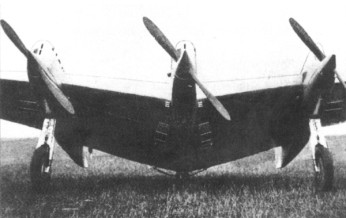
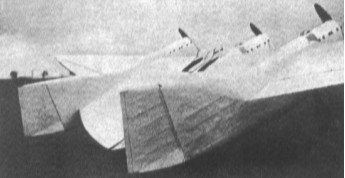
In April 1929, French engineer Jean Charpentier deposited a patent for a twin-engine craft he had named ” plane-aile”. This was followed by a second patent in June 1931, for a twin-engine of transport. These machines remained projects, unlike the following C-1, whose prototype was construct. Having obtained an order from the French government, Charpentier began building the C-1 at the Caudron establishments, in Issy-Les-Moulineaux. The craft was powered by three 6-cylinders Hispano-Suiza line of 100 hp, each with a fixed two-bladed propeller. The C-1 was two-seater, each pilot in a separated open cockpit. The C-1 was damaged during taxy tests at Stamps-Mondésir, in October 1933. Repaired, it took off for the first time in January 1935 with the hands of the Poivre staff sergeant, but crashed almost at once. Extensively damaged, it was not rebuilt.
Wing span: 15.00 m Length: 5.30 m Wing area: 24.00 sq.m Max. gross weight: 2000 kg