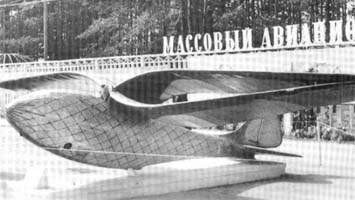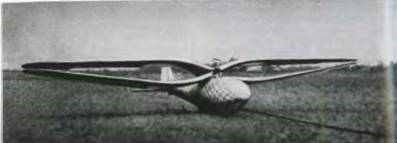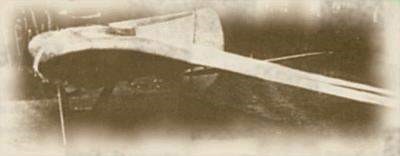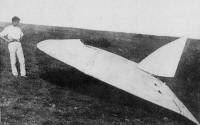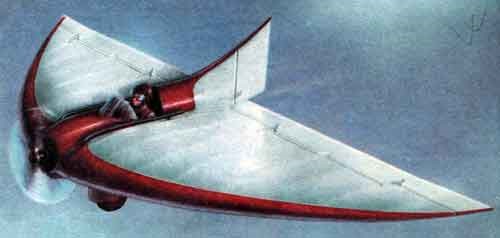
Cheranovski BICh-3         

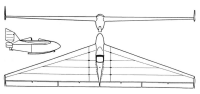
Shortly after the completion of the BICh-2, BI Cheranovski began developing a powered version that would receive the designation BICh-3(Russian: Черановский БИЧ-3).

The BICh-3 was basically a BICh-2 with the central axis installation of a Blackburn Tomtit engine of only 18 hp. Like its predecessor, it was conceived entirely of wood, with a textile coating, being quite light.

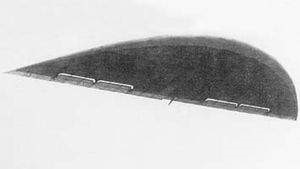
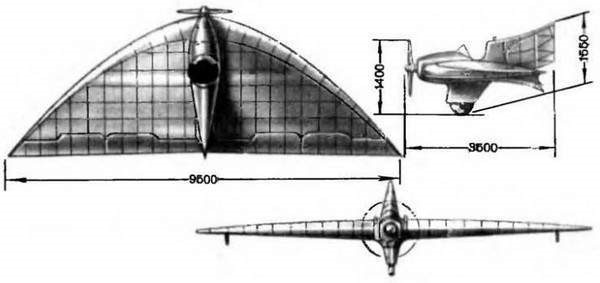
Characteristic of Cheranovski designs , the BICh-3 featured a thick wing with a parabolic leading edge and a slim straight trailing edge with control surfaces along the entire span. These surfaces, made up of ailerons and elevons, were capable of guaranteeing control of the aircraft’s flight.
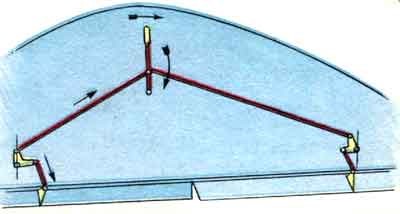
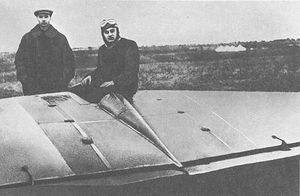
Detail of the flight control system on the Cheranovski BICh-3.

The pilot was located in a cockpit located behind the power plant, practically hidden within the thick wing profile. The open cockpit was protected by a windshield and ended in a fairing that smoothly ended at the rudder. This rudder, blown by propeller flow, was highly effective.

In the lower center of the plane a wheel was fixed, which guaranteed the necessary angle of attack to allow takeoff.

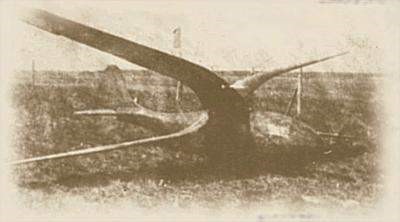
The BICh-3 was successfully tested at the end of January 1926. Several flights performed by BN Kudrin showed that the aircraft was not very stable, but was easy to control in the air. The longest flight was made on February 3 and lasted 8 minutes.
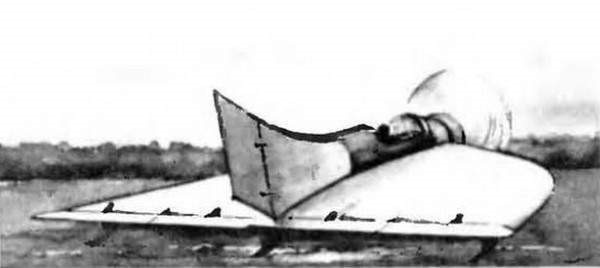
The scheme had proven its worth. The BICh-3 went down in history as the first engine-powered flying wing to fly successfully. Its design would be continued in the Cheranovski BICh-7 of 1929 and in the successful BICh-7A of 1932, with a more powerful powertrain.

BICh-3
Engine: Blackburn Tomtit, 18 hp
Wingspan: 9.50 m
Wing area: 20 m²
Length: 3.50 m
Empty weight: 140 kg
Takeoff weight: 230 kg
Fuel capacity: 10 kg
Payload capacity: 90 kg
Wing loading: 11.5 kg / m²
Power load: 12.8kg / hp
Maximum speed: about 100 km / h
Landing speed: 40 km / h
Accommodation: 1
Cheranovski BICh-18 Muskulolet

In 1921, 1934 and 1937 Boris Cheranovski developed experiments related to the construction of ornithoptera or flap-wing aircraft. The third of his designs was the BICh-18(Russian: Черановский БИЧ-18).

The BICh-18 was designed as a biplane with pivoting wings driven by the energy of its pilot. On the fuselage, the wings were fixed to the same joint, on which the movement was carried out according to the double scissors system. The movement was carried out by means of the variation generated by the wings when approaching and moving away.

The wingspan of the planes reached 8 meters with a wing area of 10 m². The surface of both planes was similar. The relative load on each square meter of the wing did not exceed 13 kg.

The control surfaces of the BICh-18 were of the classic type. Control was carried out by means of a steering pole. The wings were put in motion by the push made by the pilot on the pedals.

The tests of the BICh-18 were carried out according to a special program, which initially conceived its flights in the form of a glider and the subsequent step to the tests as an ornithopter.

On August 10, 1937, the Muskulolet BICh-18 made its first flight. On that day the pilot RA Pishuyev made four flights. During these glider flights the aircraft demonstrated excellent stability conditions, regardless of the position of the wings.

The second stage of testing went smoothly, but the flapping wings were shown to barely improve glider flight. Among the main causes were the fixed angle of curvature of the wings during movement and their strict aerodynamic profile.

Later a set of improvements such as the installation of new elastic wings were introduced, but during the flight tests significant vibrations were appreciated.

The tests of the BICh-18 were never completed. It has been said that the BICh-8 managed to fly up to 430 meters with the energy generated by the feet of its pilot.

BICh-18 Muskulolet
Wingspan: 18.00 m
Wing area: 10.00 m²
Length: 4.48 m
Empty weight: 72 kg
Maximum take-off weight: 130 kg
Wing loading: 13 kg / m²
Accommodation: 1
Observed range: 430 m

Cheranovski BICh-16

As early as 1920 B. I. Cheranovski had registered a patent for an aircraft with flap wings and had attempted to build it in 1921. The development of the BICh-16 (Russian: Черановский БИЧ-16) was a continuation of this original idea.

An ornithopter (also known in Russia as Majoliot) is a heavier-than-air flying machine that is set into motion in the air from the force generated by flapping its wings.

The BICh-16 was built using wood and fabric. In this case, the wings had a marked curvature and were connected to a system that made them move up and down from the muscular strength of the pilot’s legs. Ailerons were located on the wing trailing edge, which were also used as elevator rudders.

The crew member was located in a closed cabin located in the aerodynamic fuselage. The landing gear consisted of a ski braced by studs.

Construction of a prototype was completed in 1934. The BICh-16 was initially flown as a towed glider, but the stability proved poor, ending the flight program. Human-powered flights are not known to have been performed on this aircraft.

BICh-16
Wingspan: 8 m
Wing area: 8 m²
Empty weight: 34 kg
Accommodation: 1

Cheranovski Trapetsia

Aerodynamic investigations carried out at TsAGI at the end of the 1920s showed that the parabolic wing did not have great advantages in relation to flight characteristics and that the construction was quite complex.

In view of this Cheranovsky would decide to try a different wing composition on his new models. The triangular configuration with high elongation and vertical rudders at the ends was selected.

The first model to use this configuration would be the “Trapetsia” (Trapeze), (Russian: Черановский “Трапеция”) which was built in 1924 in the NKPS circle of interest.

The “Trapetsia” was conceived as an experimental glider to study the behavior of the new wing configuration. It was a flying wing with a trapezoidal shape in the plane.

Wing shape aside, its construction was generally similar to that of previous parabola-wing models.

This model participated in the III National Sailing Competitions, but in the presence of construction problems it was not allowed to fly.

Cheranovski BICh-9 Gnom

The BICh-9 Glider, called “Gnom” (Gnome), (Russian: Черановский БИЧ-9 “Гном”) was built in Moscow in 1929 with the aim of participating in the VI National Sailing Competitions.

The BICh-9 was the smallest glider of all those presented in the contest. The pilot, VA Stepanchonok, made three flights with a total duration of 17 minutes. The flights were not continued because it was considered that the glider had problems with the selection of its center of gravity and the ailerons had little travel.

The BICh-9 was designed as a high-wing monoplane built entirely of wood. The wing had a structure with a paraboidal leading edge and a totally straight trailing edge. The entire coating was made with plywood sheets.

The tail planes and the empennage also had curved leading edges. The fuselage featured a plywood-covered wooden frame. At its bottom was the landing gear in the form of a ski with air cushioning using an inflated bicycle chamber between the fuselage and the lander.

The pilot was located in an open cockpit forward, just in front of the wing leading edge.

Cheranovski BICh-8

In parallel with the development of the BICh-7, the construction of a new glider model began in the workshops of the Air Fleet Academy. The Cheranovski BICh-8 (Russian: Черановский БИЧ-8) was the first Cheranovski design to move away from the parabolic wing pattern.

Unlike previous Cheranovski models, the BICh-8 device featured a triangular-shaped wing on the plane, which is why it was nicknamed “Triugolnik” (Triangle).

The BICh-8 was designed as a single-seater experimental glider built entirely of wood. The first thing that stood out was the simplicity of its construction and its low weight.

The cantilever wing and high implantation, had a triangular shape and a structure of three spars. This wing was conceived in three sections: a central one forming an integral part of the fuselage and the long wing consoles with the rudders at the ends. The union of the consoles to the centroplane was made by means of some steel pieces. The entire leading edge was covered with a 1mm thick plywood sheet.

The entire leading edge was covered with a 1mm thick plywood sheet. The straight trailing edge featured control surfaces along the entire span, located on a bar on the soffit of the wing, just below the trailing edge. In the interior part and in order to achieve the necessary longitudinal balance when displacement of the center of gravity occurs, some adjustable stabilizers were located on the ground. The wingtip rudders functioned unconventionally, only operating outward and independently.

The fuselage was covered with plywood. The landing gear, located in the lower part of the fuselage, following the longitudinal axis of the glider, was made up of a ski. Payback was obtained by inserting an inflated bicycle tube between the ski and the fuselage. The wingtips served as stabilization skids.

The pilot was located in a cockpit forward. His cabin was narrow and not very comfortable. The control lever had a low stroke, especially in relation to the handling of the ailerons.

Construction was completed too late in 1929 to allow it to participate in the National Sailing Competitions. For this reason, the glider spent almost a year out in the open and without care, before being flown for the first time, shortly before the competitions the following year.

Cheranovski next to the BICh-8 during testing

In the BICh-8 glider, 7 races and 12 flights were carried out, of which the final four were carried out from the heights of the Moscow gliding station “Piervomaiskaya” (MOAJ), being flown by RA Pishuchiev and MF Romanov. During the first flights this glider showed a marked tendency to lower the nose, for which it was necessary to add a small weight in the tail section. The BICh-8 glider stood out for its good stability, both longitudinal and transverse, but it was very sensitive to rudder movements, not accepting sudden reactions. The landing had to be done carefully.

The descent speed, measured on September 29 with a stopwatch by ground observers, was in the range of 22 – 25 m / s, quite good for a device of its kind. The results could have been superior, but the long time without care in the open slightly deteriorated the coating of the glider.

A certain level of vibrations that appeared during flight number 12 and the poor performance led to the abandonment of the tests.

In 1931 the BICh-8 was flight tested by SP Koroliov, who valued the model positively.

BICh-8
Wingspan: 10.80 m
Wing area: 14.00 m²
Length: 2.92 m
Empty weight: 60 kg
Maximum takeoff weight: 130 kg
Wing loading: 9.3 kg / m²
Glide ratio: 18
Stabilizer surface: 1.84 m²
Ailerons surface: 1.68 m²
Accommodation: 1

Cheranovski BICh-6

The BICh-6 “Drakón” (Russian: Черановский БИЧ-6 “Дракон”) was a single-seater glider designed by BI Cheranovski and built in 1927 in Moscow.

The BICh-6 was conceived as a cantilever high-wing monoplane built entirely of wood. The wing had a three-spar structure and a curved leading edge with the trailing edge completely straight. The coating of the leading edge and the ailerons was made with sheets of plywood.

The tail planes and empennage also had parabolic leading edges. The fuselage had a wooden structure covered with plywood. In its lower part was the landing gear in the form of a ski.

The pilot was located in an open cockpit forward, just in front of the wing leading edge.

The manufacture was carried out with great pressure because the glider was intended to participate in the competitions that year in Crimea, so the quality of the finish was poor.

The glider was presented at the IV National Sailing Competitions in Koktebel, being piloted by Sergei Korzinschikov. In 1928 it would also be flown by Sergei Koroliov. Despite its poor build quality, the flight tests carried out with this glider showed satisfactory performance.

BICh-6
Wingspan: 16.00 m
Wing area: 14 m²
Length: 6.00 m
Height: 1.65 m
Empty weight: 131kg
Wing loading: 14.7 kg / m²
Elevator area: 2 m²
Empennage surface: 0.3 m²
Rudder surface area: 0.55 m²
Ailerons surface: 2 m²
Accommodation: 1

Cheranovski BICh-4         

Encouraged by the results of his first successful model, Cheranovski set out to design a sport glider. The new BICh-4(Russian: Черановский БИЧ-4)

The 1925 BICh-4 repeated the layout of the previous BICh-2, except for the removal of the empennage, which in the previous model had been very ineffective.

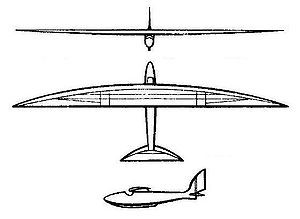
The BICh-4 glider was designed as a single-seater flying wing built entirely of wood, with a textile coating. The thick wing featured parabolic in-plane shape and a thin trailing edge with control surfaces along the entire span, on which the elevons were located, capable of acting as ailerons and elevator rudders.

The wing construction maintained the same characteristics of the BICh-2 with a structure of 10 x 8 mm pine slats crossed and joined by glue and nails. To facilitate movement, the wing structure was divided into three sections. Final assembly and fabric coating were done at the flight site.

The pilot was located in an open cockpit inserted within the front region of the wing,

The landing gear featured a single wheel located in a fairing in the lower center of the wing. Small curved skids were located at the wing ends and a conventional tail skid at the lower rear.

The BICh-4 was completed in 1925 and was sent to the III National Competitions held in Koktebel in that year together with the “Trapetsia” and KIM-2 models, also built by Cheranovski. At the pageant it was flown successfully, piloted by P. Berzhbitski.

BICh-4
Wingspan: 11.40 m
Empty weight: 50 kg
Wing loading: 6.8 kg / m²
Glide ratio: 16
Accommodation: 1

Cheranovski BICh-13

The Cheranovski models BICh -4 and BICh-13 kept the parabolic wing scheme of the BICh-2, but in both the rudder was eliminated, which had proved very ineffective during flight tests. The main difference of the new BICh-13 model (Russian: Черановский БИЧ-13) was that, unlike the BICh-4 where roll control was achieved through the use of ailerons, now this control was achieved through the differential operation of the rudders located on the outer wings.

The BICh-13 glider was conceived as a single-seater flying wing built entirely of wood, with a textile covering. The thick wing featured a parabolic in-plane shape and a thin trailing edge with control surfaces along the entire span, on which the elevons were located.

As in the BICh-4 the rudder disappeared, but in this model small control surfaces with parabolic leading edge were introduced, located at the wing tips. These surfaces operated as ailerons and as aerodynamic brakes and their operation was linked to the cockpit pedals.

The wing construction kept the same characteristics as the previous models, with a structure of 10 x 8 mm pine slats crossed and joined by glue and nails. To facilitate movement, the wing structure was divided into three sections. Final assembly and fabric coating were done at the flight site.

The pilot was located in an open cockpit in the front.

The landing gear featured a single wheel located in a fairing in the lower center of the wing. Small curved skids were located at the wing ends and a conventional tail skid at the lower rear.

Firt flying in 1932, as a result of the tests, developed during the IX National Sailing Competitions by pilots N. Baruzdin and Zh. Puantis, the BICh-13 glider received a positive rating. During the flight, turns were executed at different heights and it was not possible to find any effect that would differentiate the “Parabola” from the more conventional gliders.

BICh-13
Wingspan: 14.30 m
Wing area: 20.00 m²
Length: 3.15 m
Height: 1.20 m
Empty weight: 96 kg
Accommodation: 1

Cheranovski BICh-2 / AVF-15

The Cheranovski BICh-2 (Russian: Черановский БИЧ-2) was the second glider of the “Parabola” family designed by BI Cheranovski. Generally similar to the previous BICh-1, it featured a larger wing area and an empennage directly behind the cockpit.

A slightly larger version, the new glider was built in the workshops of the Air Fleet Academy where it was given the sequential number AVF-15 and its designer would call it BICh-2.

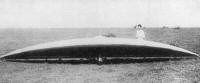
The BICh-2 glider was designed as a single-seater flying wing built entirely of wood, with a textile covering.
Like Cheranovski’s first design, the BICh-2 featured a thick wing (400mm at its thickest) with a parabolic leading edge and a thin trailing edge with control surfaces along the entire span, made up of elevons. As a fundamental difference with the first model, we can highlight the increase in the wing area by more than 1.5 times and the introduction of a vertical tail with rudder, just behind the cockpit and on the longitudinal axis of the aircraft. The wing was built using Pr-385 and Pr 436 profiles on a 10 x 8 mm pine slat structure. These slats formed a crossed lattice, fixed by glue and nails.

To facilitate movement, the wing structure was divided into three sections. Final assembly and fabric coating were done at the flight site.

The rudder was retained more out of a problem of tradition than necessity, as the ailerons provided all the necessary steering control.

The pilot was located in a cockpit in the frontal region of the model, practically hidden within the thick wing profile.
In the lower center line of the glider, a single wheel was fixed on a fairing pile, which guaranteed the necessary angle of attack to allow takeoff. Small curved skids were located at the wing ends and a conventional tail skid at the lower rear.

Only one was built, which participated in the Second National Sailing Competitions held in Koktebel in 1924 and it demonstrated good handling and stability. During the competitions and piloted by BN Kudrin, it made 27 flights, of which the most successful took place on September 20 with a maximum duration of 1 minute and 20 seconds.

The glider in the tests demonstrated ease in handling. On launching from the low heights of the lift, the Kara-Oba easily detached from the ground, glided downward at low speed and settled smoothly. Despite this, the pilots had doubts about the behavior of the BICh-2 in more complex maneuvers and its structural resistance, which is why it was never launched from the heights of the Uzun-Cyrt mountain. In this event the “Parabola would receive the award for the originality of its construction.

BICh-2
Wingspan: 10.00 m
Wing area: 20 m²
Length: 3.75 m
Height: 1.28 m
Rudder surface area: 0.8 m²
Aileron surface: 5 m²
Empty weight: 50 kg
Wing loading: 6 kg / m²
Accommodation: 1