Chevrolair / D-333 / D-4 / D-6 / Martin D-333

D-4

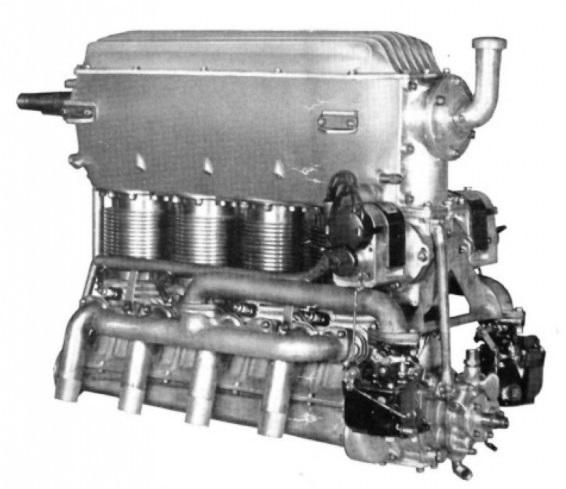
The Chevrolair was not – as is often claimed – a car engine adapted for aviation use. It was a purpose-designed aero-engine by the Chevrolet Brothers Aircraft Company. This engine was designed and Chevrolet Brothers

Around 1925 Louis Chevrolet started taking a deeper interest in aviation, attending air shows in and around the Indianapolis area. In 1926 he entered into negotiations with a group of Ohio businessmen who were looking to develop a new airplane engine. In the spring of 1927, the Chevrolet brothers completed their first aviation engine, an air-cooled, single-overhead-cam, 4-cylinder engine. This engine was installed in a biplane built by the Moundsville Aircraft Corp of West Virginia. There are photos of Charles Lindbergh inspecting the engine in that airplane in the summer of 1927. On the plane’s maiden flight, it was forced to make an emergency landing because of engine trouble (thankfully nobody was hurt). The Chevrolet brothers went back to the drawing board, and news of their venture quickly disappeared from the public eye. In late 1927 or early 1928 the brothers had a heated argument, split up, and did not talk to each other for several years to follow. Given the failure of the first aero engine, and the events that took place in early 1928, it would appear that the argument stemmed from the design of their airplane engine.
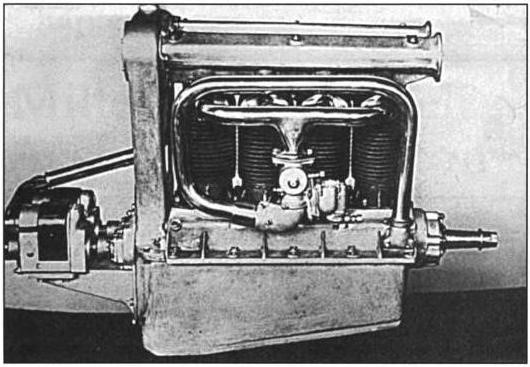
Arthur Chevrolet’s 1928 Engine

In the spring of 1928, Louis left the Chevrolet Brothers Manufacturing Company and started a new company called the Chevrolet Aircraft Corporation. Louis then spent the next year developing his new engine with Charles Merz (veteran of the 1st Indy 500). Arthur continued working on the old airplane engine, modifying the design, and photos from September 1928 show a similar style engine but with a double overhead cam set up.
Louie’s new airplane engine was an inverted design with the crankshaft on top, and the cylinder heads and valve train components on the bottom of the assembly. Louis then sought out new investors to take his idea from paper into production.

Art’s modified engine design apparently wasn’t successful, and he then designed a completely new engine in the spring of 1929 called the Chevolair. The Chevolair was an inverted engine, using four valves per cylinder, with intake and exhaust valves staggered on each side of the cylinder head. The staggered valve pattern necessitated the use of intake and exhaust manifolds on each side of the engine. Art built both a 4-cylinder and a 6-cylinder engine in the summer of 1929. The 6-cylinder was tested by the Bureau of Aeronautics, and it received Approved Type Certificate No. 56 in July 1930. This same 6-cylinder engine was used by Walter Beech in the Travel Air Mystery Ship for the 1929 National Air Races, but it did not perform very well. A 4-cylinder Chevolair engine was used in a Travel Air biplane for some time. A couple of other planes used the Chevolair engine including a Laird Aircraft, and a Robin Aircraft. Art’s company lost traction after the stock market crash of 1929, and went into receivership in 1932. Very few Chevolair engines were made, and none are accounted for today.
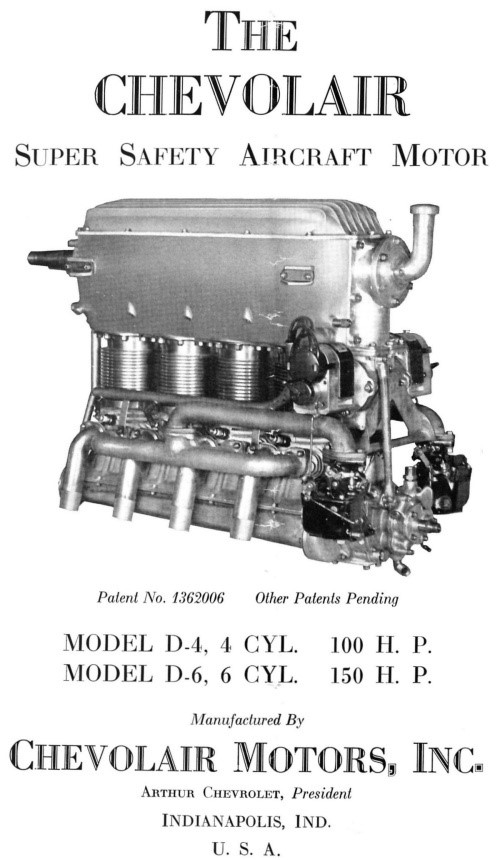
Designated Model D-4, the engine was certificated in December 1929, and became known as the Chevrolair. A D-4 engine powered Travel Air low-wing aircraft won first place in its class at the September 1930 Cleveland National Air Races.

The D-333 4-cylinder engine was installed in an interesting variety of aircraft, including biplane, monoplane, seaplane, and even an autogiro. Additionally, there is correspondence in the War Department files that Louis’s engine was being considered for use in the TC-14 blimp project.
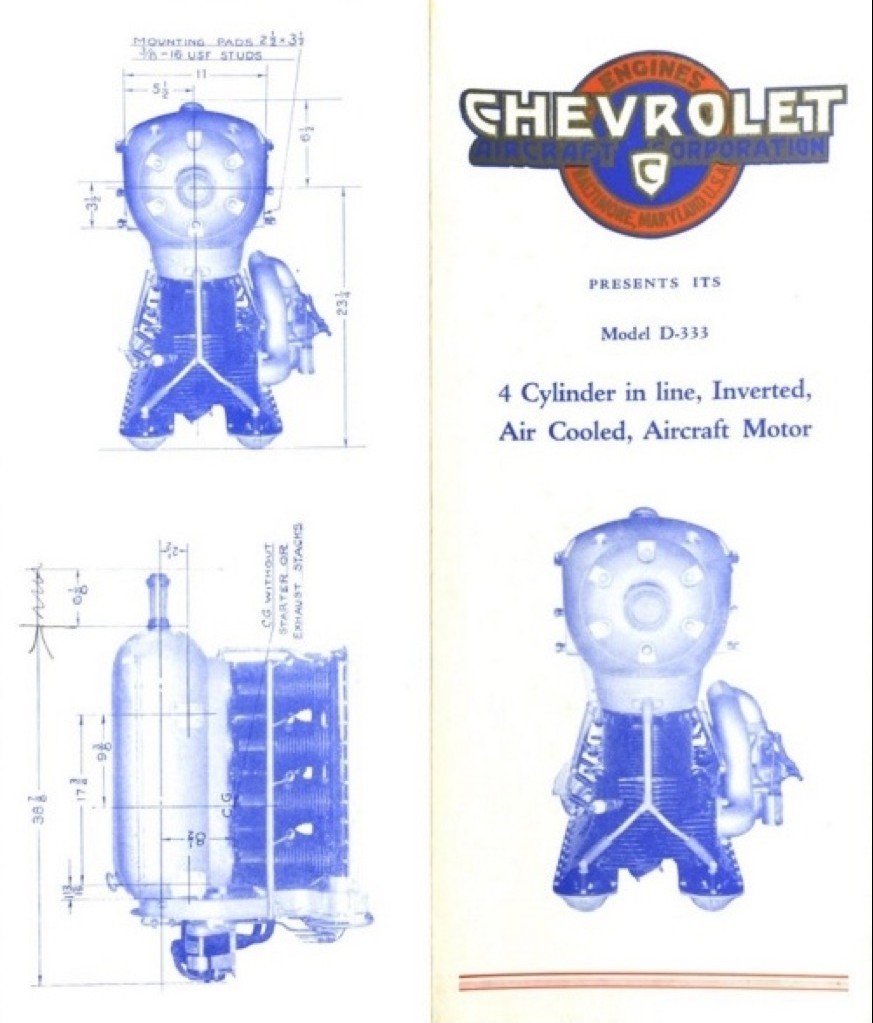
Chevrolet Martin Phillips Aircraft Engine

A few airplanes that used Louis’ engine have survived. A Waco ENF is still around, and it was the original test mule for Louis’ engine. A Granville Brothers “Gee Bee Model A” biplane is now in Oregon, and it once had a Chevrolet engine in it. Finally a Martin seaplane has been restored, and is hanging in the Baltimore Museum of Industry (it is the only known aircraft that retains a Chevrolet engine).

Subsequently, the Chevrolet Brothers Aircraft Company failed and the engine design sold to the Glenn L. Martin Company of Baltimore, Maryland. Uprated and renamed Martin 333, it was recertificated in July 1930, and powered the Martin 162A Tadpole Clipper and various Driggs aircraft.
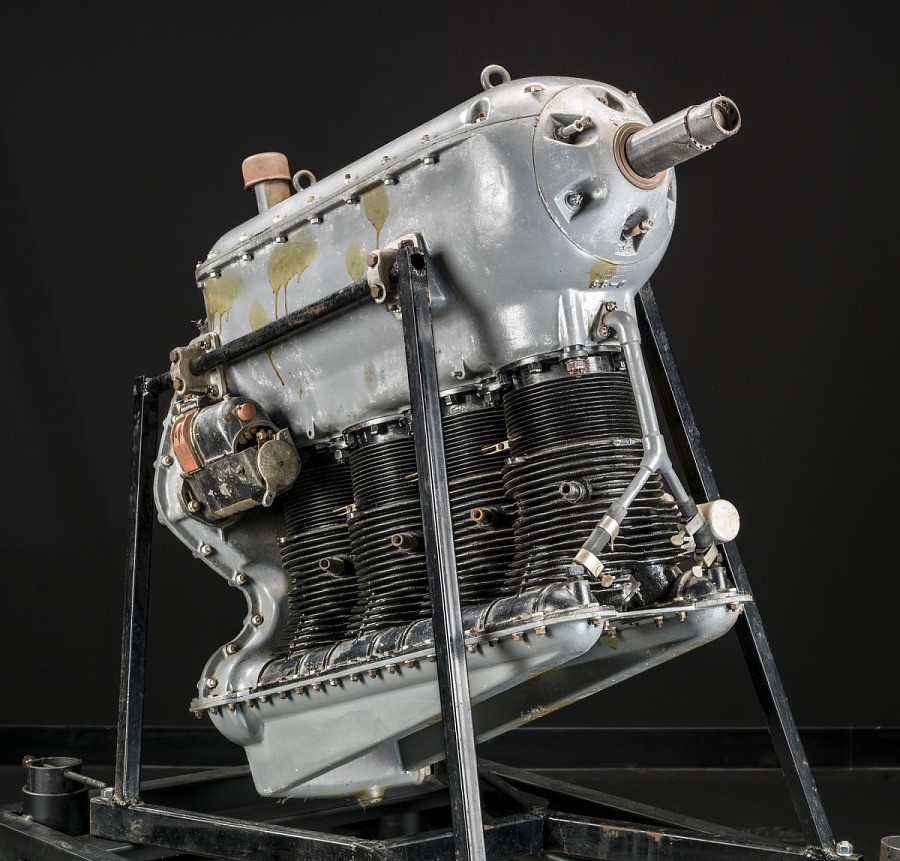
Martin 4-333, Inverted In-line 4 Engine

Gallery

Type: Reciprocating, In-line, Inverted, 4 cylinders, Air-cooled
Power: 89.5 kW (120 hp) at 2,100 rpm
Displacement: 5.47 L (333.98 cu in.)
Bore and Stroke: 114 mm (4.5 in.) x 133 mm (5.25 in.)
Weight: 120 kg (265 lb)
Length 116. 2 cm (45.75 in.),
Width 45.09 cm (17.75 in.),
Height 87.00 cm (34.25 in.)
Aluminum, Steel, Paint, Phenolic, Rubber, Magnesium
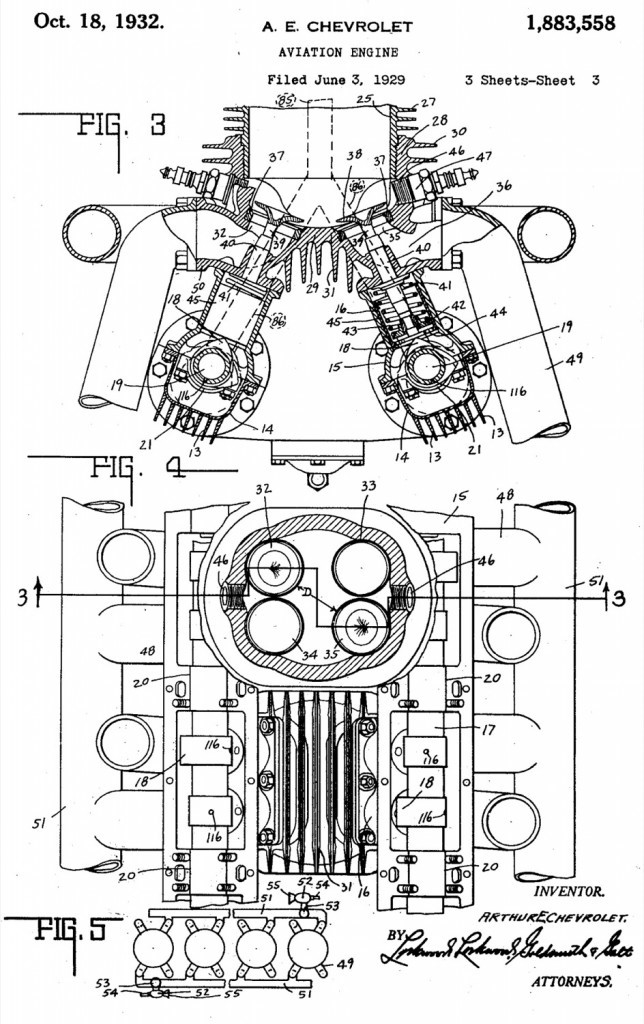
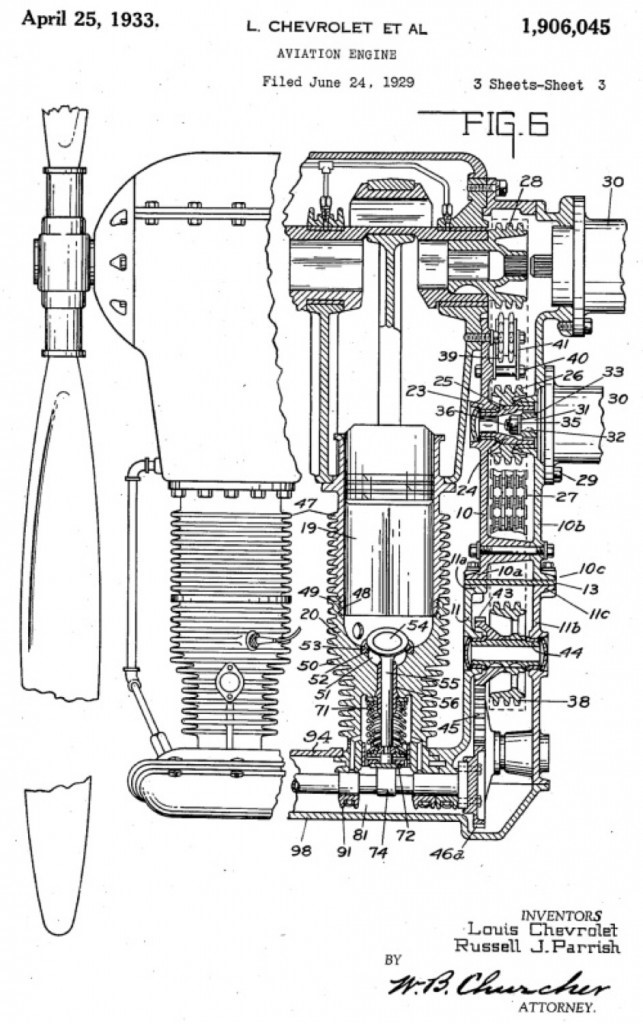
Chevrolet Martin Phillips Aircraft Engine Patent

Chevrolet Brothers Aircraft Co

The Chevrolet Brothers Aircraft Company firm started after Arthur and Louis Chevrolet had left the automotive industry. Louis Chevrolet and his younger brother Arthur built cylinder heads and aftermarket speed equipment for Model T Fords in the 1920s. Around 1925 Louis started taking a deeper interest in aviation, attending air shows in and around the Indianapolis area. In 1926 he entered into negotiations with a group of Ohio businessmen who were looking to develop a new airplane engine.

In the spring of 1927, the Chevrolet brothers completed their first aviation engine, an air-cooled, single-overhead-cam, 4-cylinder engine. This engine was installed in a biplane built by the Moundsville Aircraft Corp of West Virginia. There are photos of Charles Lindbergh inspecting the engine in that airplane in the summer of 1927. On the plane’s maiden flight, it was forced to make an emergency landing because of engine trouble. The Chevrolet brothers went back to the drawing board, and news of their venture quickly disappeared from the public eye. In late 1927 or early 1928 the brothers had a heated argument, split up, and did not talk to each other for several years to follow. Given the failure of the first aero engine, and the events that took place in early 1928, it would appear that the argument stemmed from the design of their airplane engine.

In the spring of 1928, Louis left the Chevrolet Brothers Manufacturing Company and started a new company called the Chevrolet Aircraft Corporation. Louis then spent the next year developing his new engine

In late 1928, Louis sold a 90% interest in the Chevrolet Aircraft Corporation to Glenn L. Martin, and he was retained by Mr. Martin to be president of the company.

In January of 1931 Martin changed the name of the company to the Glenn L. Martin Motors Corporation, and Louis’ title was changed to VP and General Manager. The economic depression was drying up capital, and sales took a nose dive. Louis ultimately resigned from the Martin Company in December of 1931, but he did hold onto his stock. When the Glenn L. Martin Company had its initial Public Offering in 1934, Chevrolet and Martin were the only stockholders of the company, Louis still owning 1,000 shares (Martin half a million shares). In 1939 Martin sold the patent rights, and existing inventory of engines and spare parts to the Phillips Aviation Corporation.

The new company was overtaken by its creditors who sold rights to the engine to the Glenn L. Martin Company.

For a long time there has been confusion regarding these engines, some sources calling Louis’ a Chevolair, and so forth. Likewise there have been misunderstandings over the names of the two different companies. When Louis left his brother Arthur in late 1927, Art retained ownership of the Chevrolet Brothers Manufacturing Company. Louis then filed articles of incorporation for the Chevrolet Aircraft Corporation. In the fall of 1928, Art changed the name of the Chevrolet Brothers Mfg Co to the Chevrolet Aviation Motors Corporation. Complicating matters was the fact that Louis’ contract with Glenn L. Martin called for the exclusive use of the “Chevrolet” name. The brothers then had a hearing before the Indiana Secretary of State over the use of the name. Following that hearing Art changed the name of his company in early 1929 to the Arthur Chevrolet Aviation Motors Corporation. Later that year, the name of Art’s company was changed for a third time to the Chevolair Motors Corporation. Muddying the waters further, Glenn L. Martin (for reasons unknown) changed the name of the Chevrolet Aircraft Corporation to the Glenn L. Martin Motors Corporation in January 1931.

1927: Louis and Arthur form the Chevrolet Brothers Manufacturing Company, but their engine proves faulty. Louis exits the venture in late 1927, leaving Arthur full ownership of the firm.
1928: Louis files articles of incorporation for the Chevrolet Aircraft Corporation (fall of 1928).
1928: Arthur changes name of the Chevrolet Brothers Manufacturing Company to the Chevrolet Aviation Motors Corporation.
1929: Arthur changes name of Chevrolet Brothers Manufacturing Company to Arthur Chevrolet Aviation Motors Corporation as a result of a legal dispute with Louis. Apparently, Louis’ contract with his partner – Glenn L. Martin – in the Chevrolet Aircraft Corporation, called for the exclusive use of the Chevrolet name. Arthur changed the name of the original company as a result of a hearing before the Indiana Secretary of State.
1929: later this year, Arthur changes the name of his company once again (a third time) to the Chevolair Motors Corporation.
1931: for reasons unknown, Glenn L. Martin changes the name of the Chevrolet Aircraft Corporation to Glenn L. Martin Motors Corporation in January 1931.

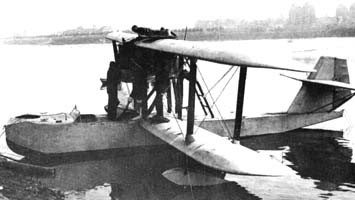
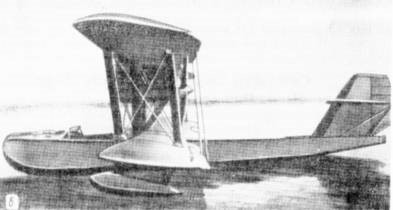
Chetverikov MR-5bis

The Grigorovich MR-5 flying boat was built at Factory No.22 and in the summer of 1929 it was sent to Taganrog for testing. During its development it was found that the hull behaved correctly in the water, but during takeoff operations a large curtain of water formed in front of the plane, which made the process difficult. The take-off run distance was also getting too long. The commission that studied the possible destiny of the model concluded on December 1, 1929, that the problems were due to a bad design of the bow section of the hull.

Grigorovich had been arrested, so trying to save the model, the development was transferred at the beginning of 1930 to the construction bureau OPO-4, directed by the Frenchman Paul Aimé Richard . The development was included in the KB ‘s work plan for the year, but very little attention was paid there to improving one design created by another, so finally, at the time of Richard ‘s departure from the USSR , the MR-5 had received no attention.

The need for reconnaissance flying boats was great so in 1931 the MR-5 was delivered to the new TsKB of Factory No.39, where the head of the naval department IV Chetverikov was in charge of the modifications to achieve better behavior in the water.

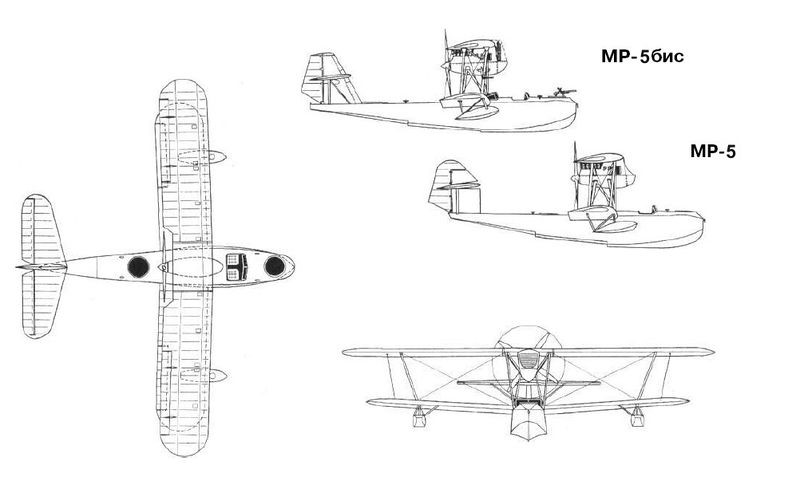
For this purpose Chetverikov decided to build a new wooden hull with better lines and the empennage underwent modifications, increasing its area. The new model was numbered 10 within the TsKB designations, but was generally known as the Chetverikov MR-5bis (Russian: Четвериков МР-5бис/ЦКБ-10).

In January 1932 Chetverikov read a report that the tests of the TsKB-10 had started, but at that time it referred only to the tests on skis. The complete cycle of tests was completed by the summer of 1932, being developed in the section of the Moscow River where the Gorky Central Park of Culture and Rest (TsPKO) is located today.

In these tests, the hull behaved positively, noting a noticeable decrease in splashes. Despite this, the long-awaited serial production was not approved. The Italian Savoia S-62 flying boat, which had entered service with the VVS RKKA under the designation MR-4, was successfully produced in the Taganrog workshops. Only the on MR-5bis was built.

The MR-5bis differed fundamentally from the original model in its new hull

In some sources Grigorovich ‘s original model has been named as MR-3 and Chetverikov’s version as MR-3bis. This presumably constitutes an error, which has become widespread on multiple sites on the internet that reference these sources. The searches carried out by the Soviet researcher M. Maslov in the original documents of the time show that the term MR-3 was used only to designate the reconnaissance flying boat ROM-1 and MR-3bis designated the improved version ROM-2.

Type: MR-5bis
Powerplant: 1 x 680/500 hp M-17
Wingspan: 15.60m
Wing area: 53.00 m²
Length: 11.40m
Empty weight: 2050kg
Maximum takeoff weight: 3100 kg
Wing loading: 59.0 kg/m²
Power Load: 6.2kg/hp
Fuel + oil load: 440+30 kg
Full load capacity: 1050kg
Top speed: 190km/h
Cruising speed: 162km/h
Landing speed: 85km/h
Practical range: 720 km
Endurance: 4 hours
Practical ceiling: 4000 m
Landing Time: 22s
Take off time: 35s
Accommodation: 2

Chetverikov ARK-3 / MP-2            

ARK-3-1

As early as 1933, while still working at OSGA, Chetverikov had begun the development of a hydrofoil designed to patrol the Arctic areas. As there was no defined technical task, Chetverikov set the goal of obtaining a speed of 300 km / h and a range of 3000 km. Around 1936 the GlavsievMorPuti became interested in this development and decided to contract Chetverikov for its construction. This event marked the emergence of the ARK-3. The objective of the model was Arctic exploration and patrol, liaison with ships, and the transfer of personnel and assets north.

Chetverikov received the necessary funds for development, the allocation of his own production base in Sevastopol and a major change of subordination, moving from the civil structure of the GVF to work under the direction of the State Directorate for the Aeronautical Industry (GUAP).

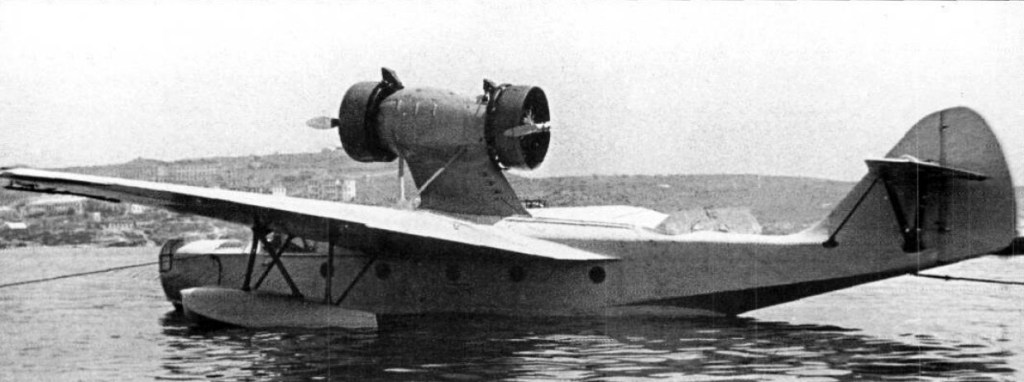
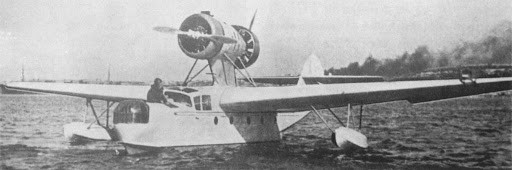
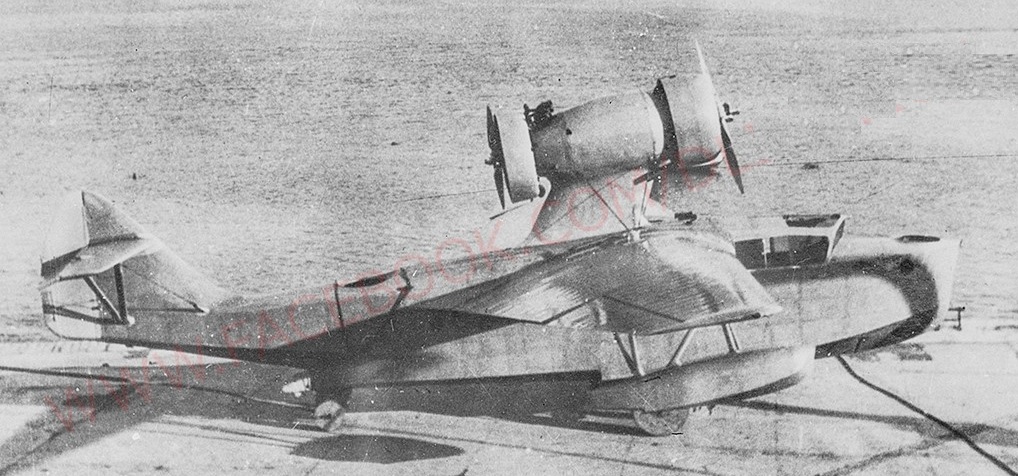
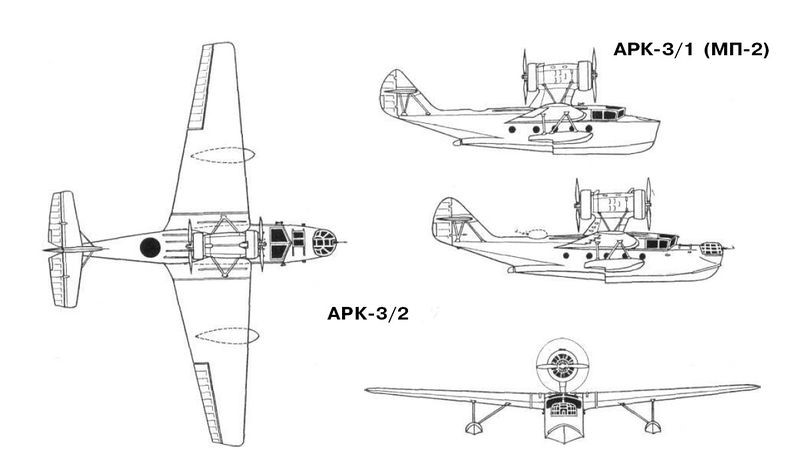
The Chyetverikov ARK-3 (ARKtichyeskii – arctic) was a multi-role flying boat designed for Arctic operations. It featured a conventional flying boat hull, with high cantilever wings equipped with floats at mid-span. The two piston engines were mounted in tractor-pusher fashion on a pylon above the fuselage.

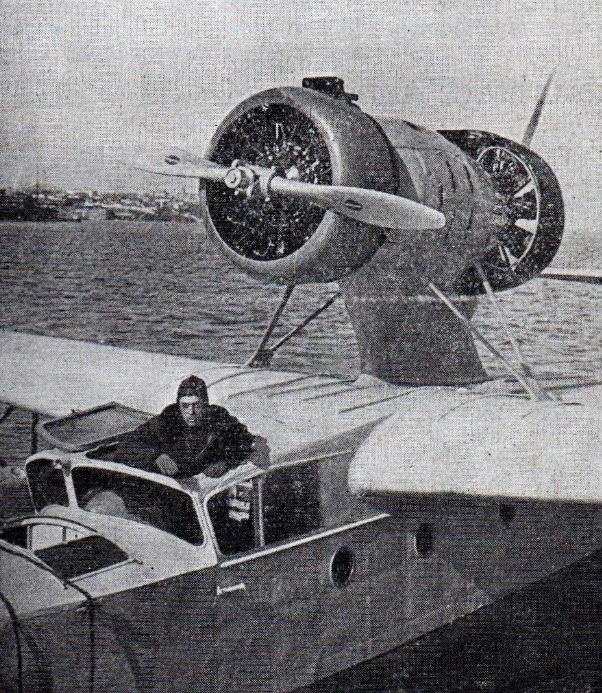
The ARK-3 was designed as a cantilever high-wing hydrofoil with two Shvetsov M-25 635 hp engines installed in tandem on a pylon located in the center, braced by struts, which were later replaced by rigid uprights. The two engines powered variable pitch VISh (Hamilton Standard) propellers.

The ARK-3 was of mixed construction, with a 14-metre (45.9 ft) long Duralumin stressed skin fuselage; wooden wings of MOS-27 aerofoil section and set at 5° angle; duralumin tubing tail surfaces; and ailerons with fabric covering. The dual control enclosed cockpit housed two pilots sided by side with two gunners/observers in bow and dorsal positions where a 7.62 mm machine gun could be installed. In the first prototype built these areas were simply left open. The second prototype built installed turrets in both positions. Strut-supported wooden floats, at approximately half-span; and a pylon-supported engine nacelle housing tandem radial engines with Townend ring cowlings; completed the structural elements, built with a safety factor of 5.5.

At the beginning of 1936, the construction of the first АРК-3 prototype was finished in Sevastopol Factory No.45, which was tested in the summer of that year, showing quite acceptable results. The tests culminated in September, achieving a speed at sea level of 252 km / h and 2600 meters reached 308 km / h. The flight ceiling was above 7600 meters. Shortcomings were also highlighted: poor design of the bow splash deflectors, weakness in the powertrain. Even a small 0.25 meter wave ran across the entire bow in front of the cockpit and the splashes reached the propellers.

This was considered to be due to the short length of the bow and its narrow width of only 1.7 meters. There were hardly any problems for take-off, but during the landing on the water there were commonly waves that swept over the bow.

Performance was deemed to be good, prompting an order for a second prototype with the fuselage lengthened by 60 centimetres (24 in) to 14.6 metres (47.9 ft) and a slightly enlarged wing chord; this was designated ARK-3-2 and the first prototype was re-designated ARK-3-1 or MP-2 (Mosrkoi Passazhirski or Naval Passenger Transport). The second prototype ARK-3 featured more powerful engines, longer hull, and manual guns fitted in a manual gun turret in the bows and a dorsal sliding hatch. The APK-3/2, already equipped with weapons, was released in May 1938 with two M-25A engines. The weight of this model increased by 400 kg. A production order for five aircraft was placed, with production commencing immediately.

This first model was modified in order to eliminate the defects indicated. Splashes were considerably reduced with the installation of deflector blades forward. The fastening straps of the driving nacelle were replaced by rigid supports.

25 April 1937 Russian pilot A.V. Erchov

On 25 April 1937 Russian pilot A.V. Erchov reached a height of 9160 meters with a payload of 1000 kg in the Crimea with a Chetnerikov A.R.K. 3 twin-engine flying boat, so he surpassed the existing world record, which was still held by the Frenchman Bourdin, who took off in 1933 with a load of 1000 kg 8864 m high.

On 14 July 1937 the ARK-3-1 was destroyed following a structural failure when after a sudden landing the engine fell forward causing the death of the pilot; the ARK-3-2 lost its tail in flight and was destroyed exactly one year later.

At that time, five other copies were found in a different state of completion in addition to the prototypes, and the programme was cancelled.

The ARK-3 formed the basis for the MDR-6 (Che-2) hydrocanoa.

Gallery

ARK-3-1 / MP-2
The first prototype ARK-3 renamed after the second prototype was ordered
Engines: 2 x M-25, 710 hp takeoff / 630 nominal hp
Wingspan: 20.00 m
Length: 14.60 m
Wing area: 59.5 m²
Wing profile: MOS-27
Empty weight: 3,242 kg
Normal takeoff weight: 4787 kg
Overloaded weight: 5800 kg
Oil weight: 150 kg
Fuel weight: 870 kg
Total load capacity: 1545 kg
Wing loading: 83 kg / m²
Power load: 3.4kg / hp
Maximum speed at sea level: 252 km / h
Maximum speed at 2,600 meters: 308 km / h
Landing speed: 105 km / h
Practical ceiling: 7600 m
Range: 3000 km
Endurance: 7 hours
Ascent time to:
1000 m – 3.5 min
2000 m – 7.0 min
3000 m – 10.0 min
4000 m – 14.0 min
5000 m – 18 min
Accommodation: 3

ARK-3-2
The second prototype ARK-3.
Engine: 2 × Shvetsov M-25A, 544.36 kW (730 hp) takeoff / 650 hp nominal
Wingspan: 20 m (65 ft 7-1/4 in)
Wing area: 59.5 m2 (640 ft2)
Length: 14.6 m (47 ft 11 in)
Empty weight: 3,642 kg (8,029 lb)
Normal takeoff weight: 4787 kg
Overloaded weight: 5800 kg
Fuel weight: 820 kg
Oil weight: 160 kg
Total load capacity: 1958 kg
Wing loading: 94 kg / m²
Power load: 3.8kg / hp
Maximum speed at sea level: 260 km / h
Maximum speed at 2600 m: 320 km/h (199 mph)
Landing speed: 110 km / h
Endurance: 7 hours
Range: 3000 km
Ascent time to:
1000 m – 3.5 min
2000 m – 7.0 min
Service ceiling: 8,500 m (27,890 ft)
Rate of climb: 4.76 m/s (937.4 ft/min)
Crew: 4
Capacity: 10 pax
Armament: 2 x 7.62 mm machine gun
Bombload: 1,100 kg

ARK-3 MP2
Designation of the five production aircraft and the initial designation of the first prototype.

Chetverikov SPL / Gridro-1

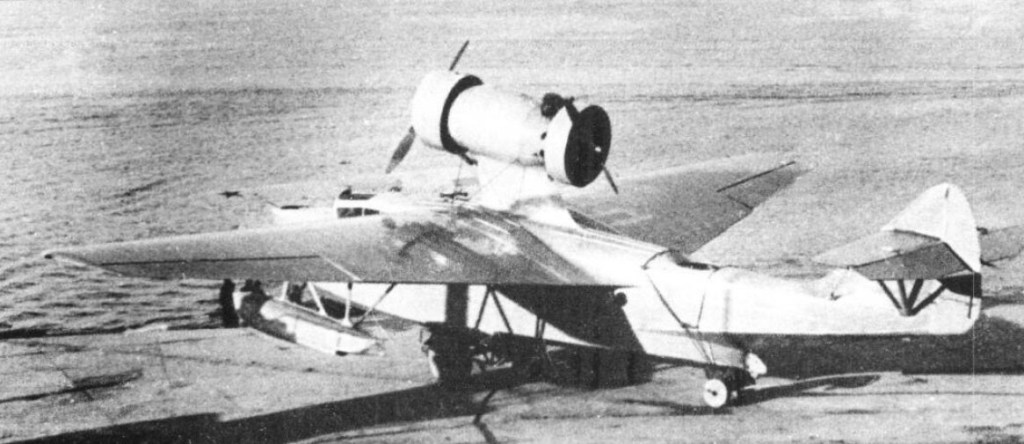
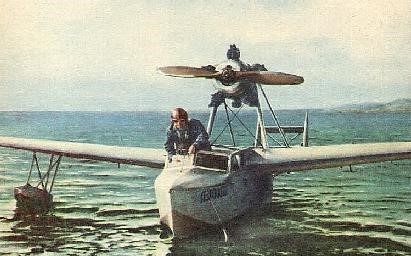
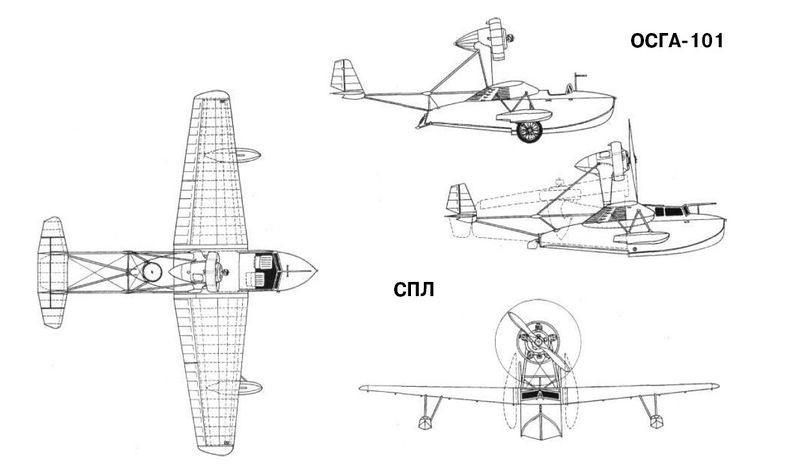
The development of an aircraft to carry out operations from submarines was taken over by IV Chetverikov in 1931. In its design, Chetverikov decided to start from the already proven design used in the OSGA-101 light flying boat. The new model was known as SPL (Russian: Четвериков СПЛ), after the acronym for Samoliet Podvodnoy Lodki or Airplane for submarines.

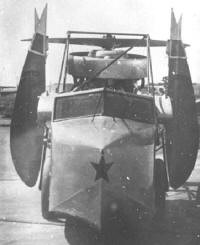
As fundamental differences, the general dimensions were reduced in order to allow the aircraft to be accommodated in a sealed hangar of only 2.5 x 7.5 meters. Systems were also developed that would allow the wing, the power plant and the stabilizer consoles to be transformed, using quick-action fixing screws instead.

The decision to build a flying boat of minimum dimensions also had its cost. The tail had very little area, so the flying boat had little stability. The visibility of the cabin was poor, especially for the observer, since the crew was forced to position themselves towards the center of gravity of the aircraft in order to reduce the length. To reduce the weight, the flying boat did not have the possibility of carrying any type of armament. The resulting aircraft looked more like a sports competition model than a military aircraft.

The SPL was designed as a high-wing monoplane flying boat. The wing, similar to that used on the OSGA-101, featured a three-spar configuration with a trunk frame and wooden construction. The areas on the outside of the wings between the leading edge and the intermediate spar were covered with plywood. The rest of the wing presented fabric covering, sewn with thread to the ribs.

Unlike the OSGA-101, on the SPL there were no fasteners on the first and third stringers. In this way the force of the support was exerted only on the central beam. In the extended position, the wing was secured by a quick-release fastener located at the top of the center spar. At the bottom was a gimbal that was inserted into a cavity in the centroplane. To pick up the wing, it was enough to release the fixator, rotate the wing console around the axis of the spar and move them towards the sides of the hull.

The SPL wing was designed using the MOS-27 airfoil with a relative thickness of 18% at the root section and 12% at the tips. This fact, together with a considerable narrowing of the wing, made it possible to obtain a break in the flow at the wing tips when operating with large angles of incidence. For this reason, it was enough for the pilot to pull the stick a little hard on landing so that the plane began to dive on the wing. At that time, the phenomenon of wingtip vortices was little studied, so the fault for this behavior was attributed to the poor transverse stability of the model. Attempts were made to cure this problem by increasing the wing’s wing gradient to about 5°, but the effect was nil. According to Chetverikov himself the problem could be compensated thanks to the great effectiveness of the ailerons.

The large-area wings occupied the entire trailing edge of the consoles and featured two sections: an inner or root section and an outer section. The inner sections could be used as flaps during landing. The wings were made of wood and featured fabric-covered box-type spars. The leading edge was covered with plywood.

The underwing floats had a wooden structure with frames and braces, covered with plywood. In the SPL, unlike the OSGA-101, the construction of these floats was simplified.

The hull of the SPL was similar to that of the OSGA-101 and featured all-wood construction. The structure had several frames with stringers and braces and plywood sheathing. The hull design demonstrated excellent hydrodynamic qualities, which was necessary for the operation of the model in the open sea. The large angle of the keel reduced the overloads when riding the waves and the high rails ensured a smooth takeoff and landing in tidal conditions.

The three-sided tail beam was made of steel tubes and its rigidity was ensured by means of cable-stayed straps. The control cables for the rudders were routed inside the tubes of the structure. The empennage was built on a fabric-covered welded steel tube structure. The keel spars and stabilizers as well as the ribs and leading edges were constructed from thin steel tubing. Unlike the OSGA-101, in the SPL the stabilizers had a biplane structure in order to reduce their wingspan.

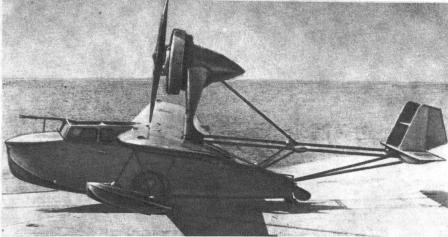
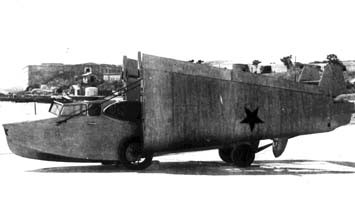
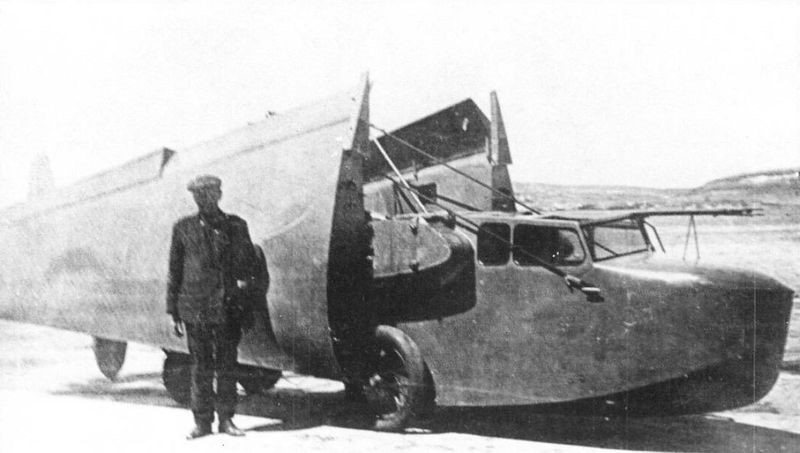
The SPL lacked its own landing gear and for operations on land, removable wheels were used whose axles were fixed to a tube that passed through the hull from side to side.

The power plant selected was the excellent 100 hp M-11 driving a two-bladed, fixed-pitch wooden propeller. This propeller had a diameter of 2.3 meters. Originally, an annular Townend-type hood made of aluminum was installed, but it was soon found that the aerodynamic improvements of its use on the M-11 engine they were not considerable, reason why it was eliminated. The engine was located on a high pile conceived of welded steel tubes and designed to prevent water splashing on the propeller during takeoff and landing operations. To facilitate its packing inside the narrow container, the engine lay down backwards. To achieve this in the SPL the drive location was slightly rearward, the strut could pivot and the rear mount base was moved rearward by the main tail tube. The motor control was carried out by sheathed cables that were collected along with it.

The optimum position on takeoff and landing ensured a wing angle of incidence of 6º, but during flight the optimum angle was 2º. For this reason, in flight, the nose of the flying boat was inclined slightly downwards, while the engine was at that moment totally in line with the flow of navigation.

In the motor gondola there was a 10-liter tank for oil and another 20-liter tank for fuel. The main fuel tanks were located in the hull.

The dimensions of the SPL once folded were only 7.45×2.12×2.35 meters. Flight readiness was achieved in 4-5 minutes and after the mission the wings, tail and engine could be folded in 3-4 minutes.

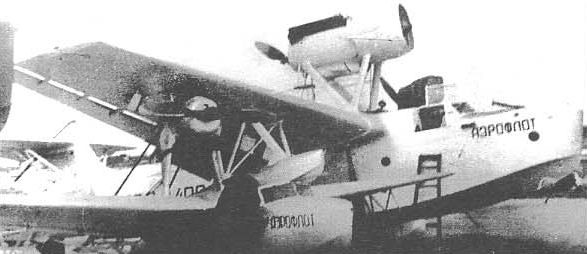
The SPL was fully painted silver. Originally it had no markings or symbols, but later on its nose and wings, above and below, the characteristic red stars were painted. The Gidro-1 example, which was shown at the Milan fair, featured Aeroflot symbols in blue on both gunwale and lacked the red stars.

The SPL was built in the workshops of the Sled and Hovercraft Building Department (OSGA), subordinate to the NII GVF. The prototype was finished by December 1934 and moved to Sebastopol to carry out sea trials, which were completed on August 29, 1935. Its realization was in charge of the test pilot of Factory No.45 AV Krzhizhevski.

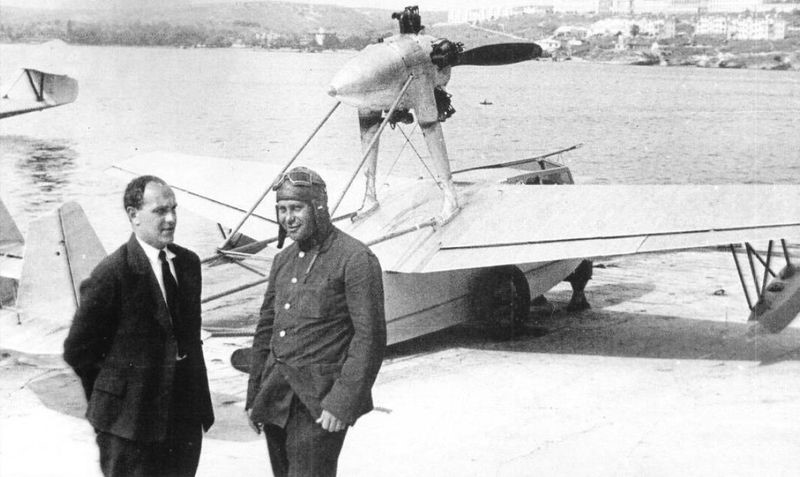
Designer Chetverikov and test pilot KrZhizhevski during SPL tests at Sevastopol Factory No.45.

The tests demonstrated the feasibility of the packing and unpacking operation of the aircraft in the submarine in a time of 4-5 minutes, its possible take-off and its effective recovery after the flight. The authors of the project managed to obtain a container only 7.45 meters long and with a diameter of 2.5 meters. In general, the SPL showed acceptable performance in the water, but its seaworthy conditions were not good, especially in the open sea. It was clear that very little more could be asked for an aircraft of this type, but in these conditions the aircraft was not very attractive to the military.

The Gidro-1 next to an MP-1bis with the colors of Aeroflot to participate in the fair in Milan in 1936.

In 1936 the SPL with the Aeroflot symbols and Gridro-1 denomination, participated in the Milan Fair, receiving a positive evaluation.

Gidro-1 tests on water.

On September 21, 1937, in this plane, the pilot AV KrZhizhevski established a world speed record of 100 km, reaching 170.2 km/h, and on October 7 of that year, he established a new distance record for aircraft of its category. when reaching 480 km and high when setting 5400 meters. Despite these results, the model did not have further development.

Documentary references to a flying boat built by Chetverikov have been found at Sevastopol Factory No.45. It could be a second issue of the SPL, but this is just conjecture.

SPL
Power plant: М-11, 100 hp
Wingspan: 9.6m
Wing area: 13.4 m²
Length: 7.4m
Height: 2.72m
Empty weight: 592kg
Weight with normal load. 800kg
Maximum takeoff weight: 879kg
Fuel weight: 60kg
Oil weight: 10kg
Total load capacity: 208 kg
Wing loading: 59.7 kg/m²
Overloaded wing loading: 65.7 kg/m²
Power load: 8kg/hp
Overloaded power load: 8.8 kg/hp
Maximum speed at sea level: 186 km/h
Cruising speed: 174km/h
Landing speed: 85km/h
Endurance: 2 hours
Range: 480km
Practical ceiling: 5400 m
Time to 1000m: 3.9min
Time to 2000m: 8.7min
Time to 3000m: 15.3min
Time to 4000m: 25.5min
Time to 5000m: 50.0min
Accommodation: 2

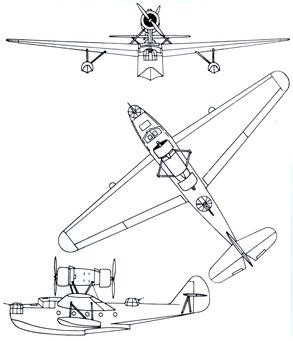
Chetverikov SPL and OSGA-101 three views, showing main differences

Chetverikov MDR-3 / TsKB-11

In the experimental construction plan of the naval department of the TsKB a new task of development of a naval reconnaissance flying boat was introduced, which received the 11th number in the row of this institution. Based on its function, the new model was designated MDR-3 or TsKB-11 (Russian: Четвериков МДР-3 (ЦКБ-11)), according to the acronym for Morskoi Dalni Razvietchik or Long-Range Maritime Reconnaissance Aircraft.

The department, under the direction of IV Chetverikov, decided to use the wing, tail unit and other components of the Grigorovich TB-5 heavy bomber as a way to accelerate development. Despite this, the TsKB-11 included in its conception a series of novel ideas.

Chetverikov for the first time decided to build the hull similar to that of sharp-edged ships, which was a departure from the traditional flat shapes used in the USSR since the introduction of the Dornier Wal,

To verify the results of the new design, a scale model was created and for the first time in the USSR in January 1931, tests of the behaviour of an aeronautical design in water were carried out. These tests allowed to determine that the hull lines of the new model had been successfully designed.

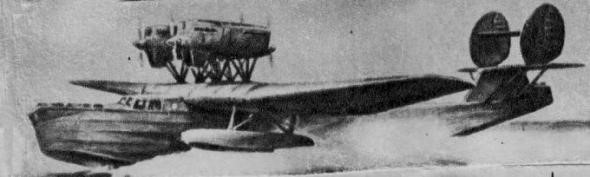
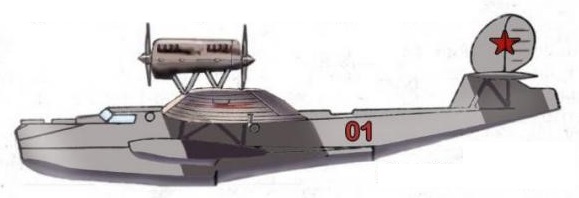
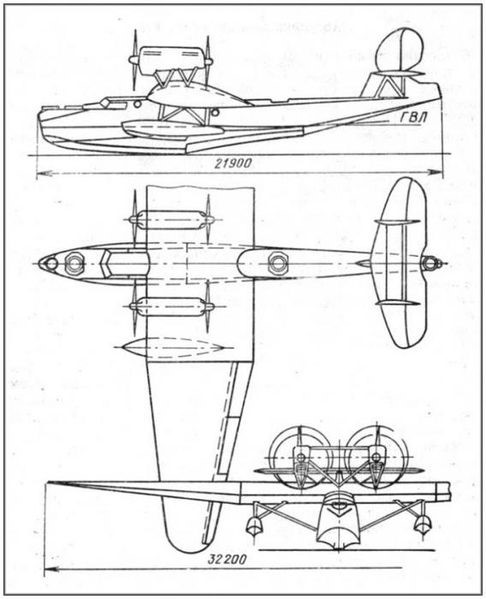
The MDR-3 was built entirely of metal and had two pairs of liquid-cooled engines mounted in tandem, fixed above the wings by struts. It was conceived as a braced high-wing monoplane with the stabilization floats located in the midplane, quite close to the fuselage.

The wing was similar to that used on the TB-5 bomber, but with a slightly increased span. The construction was similar, but the covering of the centroplane was made with corrugated metal, so that it could be walked. In the midplane an exit hatch was opened and in the lower part the fixing points for the stabilization floats with a volume of 3 cu.m were created.

The hull was designed in a similar way to that of the ROM-2 but incorporated a transverse forward groove, new bulwarks and an external brace.

The tail unit had a characteristic configuration. A short empennage towered over the rear of the fuselage and supported the large area stabilizers, braced by N-studs to the structure. In the upper part there were two rounded-shaped keels with the rudders and a rigid joint support between them.

The power plant consisted of four BMW-VI engines located in two pairs in tandem. The selection of liquid-cooled linear motors significantly increased the weight of the aircraft, but Chetverikov knowingly decided to take the risk. The two engines of each installation shared a single radiator located in the lower part of the front-mounted one and were supported on a structure of rigid supports, facilitating access for service and maintenance. The fuel tanks were made of duralumin, being located in the centroplane.

The crew consisted of 7 people. The pilots were located in a closed cabin, with seats side by side. The navigator and gunners were located in positions similar to those of the TB-5. In the bow area, a watertight department was prepared to store cargo and equipment.

Defensive armament was generally similar to that of the bomber and consisted of eight Degtyaryov light machine guns for aircraft in four paired installations located in turrets. The MDR-3 could carry two 250 kg bombs hung on the rails, between the centerplane bracing supports.

The construction of the model took place in the spring of 1931 and the prototype was found finished for the month of December. Unarmed it was sent to Sevastopol, where the first flight was made on January 14, 1932, with the pilot BL Buxgolts at the controls. Engineer A. Dnieprov and Chetverikov himself also participated in this flight.

About this flight Chetverikov wrote: – “Let’s go” – said Buxgolts and accelerated. We moved forward, the plane lifts its nose easily, begins to glide without splashing, increases its speed easily and smoothly takes off from the water. All good!

At an altitude of 600 meters we make the first turn, then a circle over the bay, planing and a gentle landing. “I have no markings,” said Buxgolts. As we headed into the Dnieprov bay he began to look to see if there was any water on the hull. – “Surely everything is excellent – said Dnieprov upon returning – Just hurry up guys, quickly to the shore or we will sink! There are leaks at the bottom and the apartments are taking on water pretty fast. If we take longer than necessary, we will sink in front of the public.”

This was expected. The hull took 10 months to build and was finished without checking its tightness.

The next flights were delayed due to the sealing work on the hull. Taking into account that the production base was very far away, these jobs were not easy at all.

Finally the boat was ready and the flights could continue. Three – four short flights were made to define the small defects and familiarize the pilot with the model. On one of these flights we made the landing outside the bay, with considerable waves, and we verified that the plane did not deceive us in relation to its seaworthy behavior. We can start with the test flights.

The next flight was intended to define the flight ceiling, the rate of climb and the maximum speed. After a good takeoff the plane began to gain altitude. Initially it was found that the rate of climb was lower than calculated. After an hour of flight the plane had only managed to rise to about 2000 meters.

During this flight, creaking noises were observed in the rear area of the flying boat. The tail began to vibrate and move from side to side. Continuing the flight was dangerous, so it was decided to return.

Later tests showed the appearance of important vibrations that started from the tail towards the nose. The cause of this phenomenon was attributed to the action of the propellers of the tandem drive installations. After replacing the propellers with ones from a Dornier Wal, the vibrations practically disappeared, but the total solution of the problem required a radical redesign of the tail area.

The tests were carried out until March 25 and during their execution a speed of 210 km/h was achieved and excellent seaworthy conditions were demonstrated. As a positive aspect, the excellent autonomy and the great range of the model were pointed out. As negative aspects, the poor rate of ascent and the low ceiling, which only reached 2,200 meters, were pointed out.

The studies carried out showed that the fundamental cause of the poor performance lay in the inefficient engine configuration selected and the poor aerodynamics of the model: poor design of the underwing stabilizers with circular fronts, absence of aerodynamic fairings for the supports and structures, poor design of the radiators, located on the wing in a way that diminished its effectiveness, a terrible solution for the location of the 250 kg bombs on the sides. To all this were added the finishing problems and a series of details that affected the lines of the fuselage.

As a consequence of these deficiencies, the result of the tests was assessed as negative. The MDR-3 failed to meet the requested specifications.

Taking into account the great need for aircraft of this type, the commissioners of defense and heavy industry approved the continuation of the development of the model, correcting the deficiencies that affected the aerodynamics. A short time later the plans and calculations of the MDR-3 were delivered to AN Túpolev in the KOSOS TsAGI to work on the solution to the indicated problems. Tupolev decided not to waste time on modifications to the flying boat and to design a new model. Based on the MDR-3, in 1933 the brigade led by II Pogosski designed the flying boat MDR-4 (ANT-27). The new flying boat retained only the hull lines of the previous model. The new configuration included a high cantilever wing, three engines and a monoplane tail with a single tail.

MDR-3
Engines: 4 × 500/680 hp BMW-VI
Wingspan: 32.2m
Wing area: 153.00 m²
Length: 21.9m
Height: 7.0m
Empty weight: 8928 kg
Maximum takeoff weight: 13973 kg
Wing loading: 91.5 kg/m²
Power Load: 5.1kg/hp
Fuel load: 3300 kg
Total load capacity: 5044 kg
Maximum speed at sea level: 210 km/h
Landing speed: 110km/h
Practical range: 1600 km
Autonomy: 9 hours
Practical ceiling: 2200 m
Take off time: 36s
Accommodation: 7
Armament: 8 Degtyaryov 7.62 mm machine guns
Bombload: two 250 kg

Chetverikov

USSR
A 1928 graduate of Leningrad Institute of Transport Engineering, I. V. Chetverikov worked briefly with D. P. Grigorovich before joining the Tsentralnoe Konstruktorskoe Byuro (Central Design Bureau; TsKB). From 1931 -1933 was in charge of seaplane development section; responsible for designing MDR-3 reconnaissance flying-boat, OSGA-101 light amphibian, and related SPL submarine-borne small floatplane. His ARK-3 flying-boat was a failure, but the three-seat MDR-6 (or Che-2) of 1937 was produced for Soviet Naval Aviation, 50 being built at Taganrog between 1939 and German invasion of Crimea in 1941. Development, but no further production, of MDR- 6 continued during Second World War; after completion in 1947 of three prototypes of the eight-passenger TA-1 flying-boat, this bureau was closed down in 1948 and Chetverikov became a lecturer.

Chester Goon / Special 2

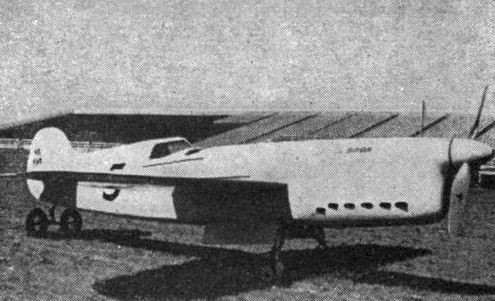
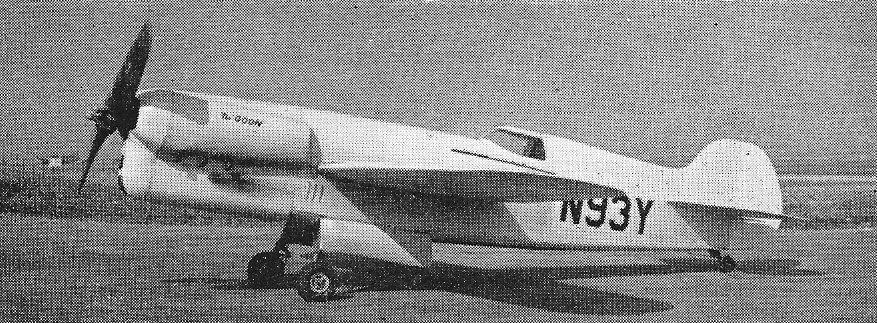
Art Chester followed on his successful air racer the “Jeep”” with the Goon. “Goon”, like “Jeep” was named after characters in Popeye cartoons and comic strips.

The Goon was built with a conventional welded steel tube frame and fabric covering. The wings used spruce spars and plywood covering. The mid-wing taildragger aircraft featured short-legged retractable landing gear. The engine was prepared to turn clockwise (as normal for some British inlines of the era) in anticipation of mounting a custom French propeller, but the propeller was also customized for American engines, and the engine needed to be modified again to rotate normally.

The Chester Goon aka The Chester Special #2 was built for the 1938 National Air Races.

Placed second in the Greve Trophy Races of the 1938 National Air Races with a speed of 250.42 mph (403 km/h).
1938 Thompson Trophy – Has to drop out after failure of prop.
1939 National Air Races – First place at 263.39 mph (424 km/h), winning $9000.
1939 Thompson Trophy – Dropped out with engine trouble.

In 1939 20th Century Fox featured the Goon in the movie series Tailspin Tommy. By 1956, the Goon was purchased in unflyable condition. During the 1956 rebuild, a 190 hp Lycoming O-435-1 engine was installed in place of the Menasco, including a cut down Beech-Roby propeller and wheel brakes.

Lycoming powered

On December 23, 1957, the rebuilt Goon was test flown by Harvey Mace at Sacramento, California.

The Goon was purchased in 1991 by the Crawford Auto-Aviation Museum and was awaiting restoration in Macedonia, Ohio.

Powerplant: 1 × Menasco C-6-S Buccaneer, 450 hp (340 kW)
Propeller: 2-bladed French Ratier Controllable
Wingspan: 18 ft 6 in (5.64 m)
Length: 20 ft 6 in (6.25 m)
Crew: One

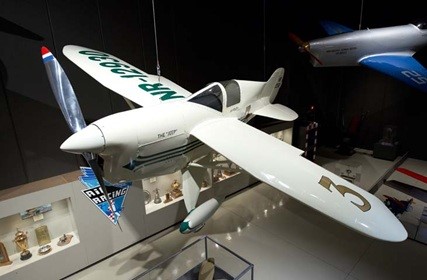
Chester Special / Jeep

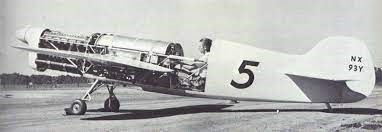
Arthur Chester designed and built the Chester Special in his garage in the early 1930s. The racer was completed in 1932, but was not fully tested by the time of the 1932 National Air Races.

The Special N12930, later called the “Jeep,” was tested on August 14, 1932. Flight tests proved the aircraft was unsatisfactory for competition and major changes were made before entry in the 1933 races. The 1932 version had a semi-open cockpit with a rather flat windscreen. The airframe was stripped for extensive modifications, including shortening the wings by two feet and chopping the length by 23 inches. The bay behind the cockpit was eliminated and 18 pounds of lead were required to correct the balance. A hatch was installed over the cockpit and the cowling was changed.

The fuselage was constructed of welded steel tubing with plywood fairing aft of the cockpit and covered in fabric. The wings were made of birch spars and plywood ribs with spruce cap strips. The leading edges were plywood covered and the rest of the wing was covered with fabric. The Chester Special was powered by a 185 hp Menasco C4S engine.

Art first competed with his Special in the 1933 National Air Races, where he won one first and four fourths, with his best speed reaching 155 miles per hour. At the 1936 National Air Races the Chester Special appeared under the new name “Jeep,” taken from a character in the famous Popeye comic strip. Chester raced his Special until 1937, reaching an overall best speed of 235 miles per hour and always taking home at least a little prize money.

The Jeep was later sold to Tom Stauch, who intended to fly it at the 1939 National Air Races, but failed to file the paperwork on time. The Special didn’t reappear until 1947 when it participated in the Goodyear Races after a complete rebuild. The engine was switched to an 85 hp engine and the airplane was so revamped that it could hardly be called a Chester racer, only the license number and tail section remained unchanged.

William T. Flack – 1947 Goodyear

Bill Flack of Warwick, New York, rebuilt the ‘Jeep’ for the 1947 Goodyear races and was the winner of the consolation race.

Art Kilps acquired the Jeep, which he donated to the EAA AirVenture Museum in 1977. Before the racer was put on display, EAA Member Henry Proescher took on the project of restoring the Chester Special to its 1936-37 racing configuration. The restoration took over six years to complete, after which, the historically accurate racer was put on display in the AirVenture Museum.

Engine: 185 hp Menasco C4S
Wing Span: 16 ft. 8 in.
Length: 15 ft. 1 in.
Height: 4 ft. 10 in.
Wing Area: 48 sq. ft.
Empty Weight: 765 lbs.
Gross Weight: 1150 lbs.
Fuel Capacity: 30 USgal.
Maximum Speed: 255 mph
Cruise Speed: 219 mph
Range: 325 mi.