USA
Subsidiary of Fairchild formed February 10,1938 under presidency of Harold Clark. He developed Duramold process of constructing fuselages in molded halves of a plastic compound material, joined along top and bottom centerlines. Production of prototype Clark F-46A three/four-seat monoplane followed, using this technique, at Fairchild’s Hagerstown, Maryland factory.
Inter-Wars
Clancey Skybaby
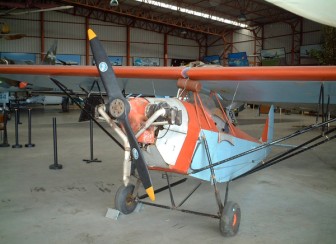
The Skybaby was a fully-acrobatic, single seat light aircraft with a strut-braced, parasol wing. It was of all wooden construction and covered with lrish linen. The fuselage was a Pratt truss with 3/4 inch square longerons with l/8-inch ply gussets, and weighed just 16 lb bare. The wing employed a Gottingen 426 airfoil, and had a l/2-degree dihedral. The spars were “I” beams with 9/16-inch by 1/2 inch flanges and l/8-inch ply webs. The aircraft had a divided undercarriage with hard tyres, and a tailskid. Before long, the main wheels were replaced with balloon tyres on 5-inch by 4-inch hubs (the same as the tailwheel on Kingsford Smith’s Lockheed Altair).
The Henderson engine, in it’s original side valve configuration, ran at its maximum of 3,000 rpm and suffered overheating problems. Bill Clancy replaced the top half of the engine with new cylinders and alloy pistons, increasing the bore by 9/16 inch to 3-1/8-inch Overhead valves of increased diameter were fired in well finned heads cast in bronze for better heat dissipation and to eliminate the need for valve seat inserts.
A full dual ignition system was fitted and, in its modifed form, the engine delivered 38 brake horsepower at 2550 rpm The compression ratio was increased to 5:1 and it cruised smoothly at 2200 rpm. An extension shaft was bolted to the crankshaft flywheel flange. This shaft was tapered to fit the propeller hub (which was turned down from a Model T Ford rear wheel hub) and carried a shoulder to accommodate a ball thrust bearing in the nose cone, which was fabricated from mild steel sheet. Later models had a Praga “B” 40hp flat twin engine.
Gross-Weight 560 lb
Empty Weight 330 lb in original form 350 lb when modified
Span 25 feet 6 inches
Length 16 feet 2 inches
Wing Area 104 square feet
Wing Loading 5.4 Ib/sq.ft
Span Loading 22.2 Ib/ft
Power Loading 14.7 Ib/hp
Cruising Speed at 2200 rpm 55 mph.
Stalling 8peed 30 mph.
Fuel 31/2 Imp Gals at 13/4 Imp gph.
Propeller 60 inch by 36 inch
Differential brakes, 5-inch by 4-inch tyres, coil springs in telescopic landing gear legs.
Clancey Brothers
Australia
Jack Clancy was the youngest of the three Clancy brothers who burst into prominence in 1931 with the Skybaby, a single-seat light aircraft they had designed and built themselves. In the era of the Depression, it was the highly successful Skybaby which led them into aviation and an escape from infrequent and poorly paid jobs.
Bill Clancy was the talented designer of the Skybaby. He went on to a career as a noted engineer with the railways. During World War Two he played an important role in the Beaufort construction program.
Allan Clancy became a popular and respected flying instructor with the Kingsford Smith Flying School and later served in the RAAF. After the war he worked for Butler Air Transport but his flying career ended following an unfortunate accident in a DCA aircraft in 1951.
CKD-Praga E-214

The Praga E.214 of 1936 was a four seat high wing monoplane, powered by a Pobjoy R engine of 75 hp.
CKD-Praga E-114 Air Baby / E.115 / Hilton Praga
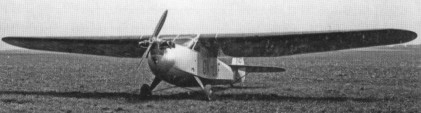
The 40 hp Praga B powered prototype, OK-PGA, first flew in Seqtember 1934 and was Praga’s first civil project.
Sixty-three were built.
Following a demonstration tour in the UK in 1935, F.Hills & Sons on Manchester, acquired a licence to build the E.114 as the Hillson Praga. The first Hills & Sons Ltd licence-built Praga E.114 was sold to Australia, and the second registered G-AEEU became the company’s demonstrator in April 1936. Total production by Hills amounted to twenty-eight aircraft, plus seven uncompleted during 1936 and 1937, selling for £385-435.
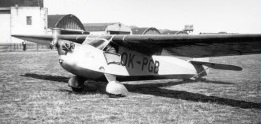
In 1936 H.L.Brook set a new Lympne to Cape Town record of 16 days in one of the British built examples.
The E.114bis was fitted with a 65 hp Praga D engine. The prototype E.114bis, OK-PGF, was flown before the Second World War, as was the E.115, an improved version with a shorter wing.
After the war, the Air Baby was relaunched as the E.114D.
CKD-Praga E.114 Air Baby
Engine: Praga B, 29 hp
Length: 21.654 ft / 6.6 m
Wingspan: 36.089 ft / 11.0 m
Wing area: 163.613 sqft / 15.2 sqm
Max take off weight: 1080.5 lb / 490.0 kg
Weight empty: 639.5 lbs / 290.0 kg
Max. speed: 94 kts / 175 km/h
Cruising speed: 79 kts / 147 km/h
Service ceiling: 11483 ft / 3500 m
Wing load: 6.56 lb/sq.ft / 32.00 kg/sq.m
Range: 297 nm / 550 km
Crew: 2
CKD-Praga E.114 Air Baby
Engine: Praga D 1, 75 hp.
E.114bis
Engine: 65 hp Praga D
CKD-Praga E-111 / BH-111
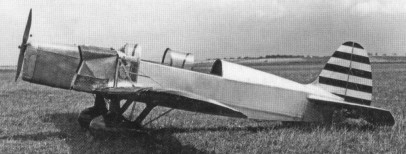
The E.111 (or BH.111) of 1932 was a two seat low wing monoplane tourer powered by a 110 hp de Havilland Gipsy III engine.
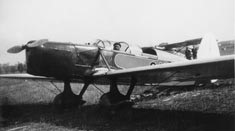
A two-seat lower-wing strutted type used by Flying Clubs. The BH-111 had wooden wing and tailpane covered by plywood, and tube framed control surfaces by fabric. The wood-framed fuselage was covered by plywood and fabric. Sheet metal plate cowling. Fixed undercarriage, wooden two-blade propeller.

One built in 1932 for Air Racing with rearwards folded wings.
Engine: de Havilland Gipsy III, 110 hp
Wingspan: 10.5 m
Length: 7. 4 m
Empty weight: 470 kg
Maximum speed: 230 kph
Climb 3000m: 15 min 45 sec
CKD-Praga E-45
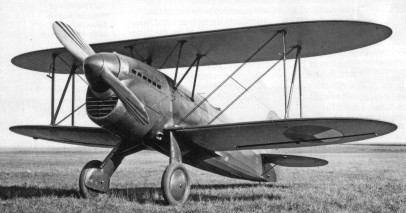
The Praga E.45 of 1934 was a single seat biplane fighter fitted with a 600 hp Rolls-Royce Kestrel VI or Hispano-Suiza 12Ybrs engine, and reported capable of 250 mph).
CKD-Praga E-44 / BH-44
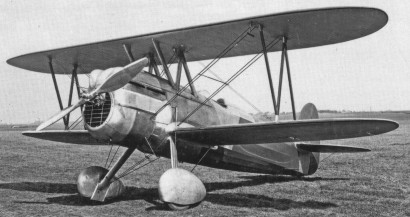
The E.44 (or BH.44) single seat biplane fighter of 1931 was powered by a 550 hp Praga ESV engine and was fitted with two forward firing machine guns. The BH designation denoted a design by Benes and hahn, formerly with Avia.
CKD-Praga E-41 / BH-41
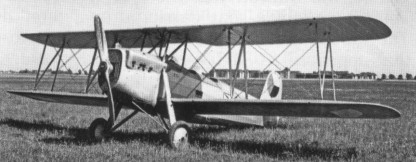
The E.41 (or BH.41) two seat advanced trainer of 1931 was an improved and slightly larger version of the E.39, and was powered by a 300 hp Hispano-Suiza engine.
CKD-Praga E-39 / BH-39
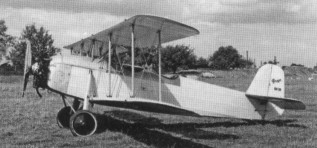
In several cases the code name of BH-39 after her designers Benes and Hajn is used for this type.
The prototype (designated BH.39NZ) first flew in 1931 with a 120 hp Walter NZ nine-cylinder radial engine. The 1936 next 8 built used 140 hp Walter Gemma radials (designated BH.39G). After this the 160 hp Armstrong Siddeley Genet Major was fitted (designated BH.39AG of 1937).
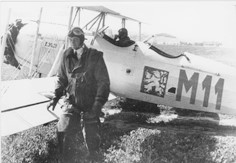
Praga E-39.21, the 21st production one, was powered by a Walter Gamma engine.
A total of 149 aircraft appears to have been built with 125 used by the Luftwaffe as primary trainers during WW2. No mention of cross bracing while later models had ‘N’ shape interplane struts, cross-braced layout, while the rest on the paint guides had ‘N’ shaped struts.
BH.39NZ
Two seat primary trainer
Engine: 120 hp Walter NZ
BH.39G
Engine: 150 hp Walter Gemma
BH.39AG
Engine: 150 hp Armstrong Siddeley Genet Major 1A
BH.39RS
Span: 10.00m
Length: 7.00m
Height: 2.57m

