1928-1929 Columbia Aircraft Corp produced the Triad high-wing wheel/float amphibian
Inter-Wars
Columbia Aircraft Corp / Columbia Airliners Inc
USA
During 1928-1929 produced the Triad high-wing wheel/float amphibian at Valley Stream, Long Island, NY, at which time the company was known as Columbia Airliners Inc. Name changed to Columbia Aircraft Corp and later built 330 Grumman J2F-6 Ducks for the USN. Two Grumman designed XJL-1 (Duck replacement) prototypes were built. The company was taken over in early 1946 as part of the Commonwealth Aircraft Corporation; it went into liquidation in 1948.
Collier CA-1 Ambassador
A two-seat light trainer biplane
Collier Aircraft Corp
USA.
Formed by W. S. Collier in 1939 to build CA-1 Ambassador two-seat light trainer biplane.
Cockatoo Codock
In 1933 Cockatoo Dockyard & Engineering designed and built a twin-engined monoplane, the Codock, for Sir Charles Kingsford-Smith, who had made the first Pacific air crossing in 1928. A six-seat monoplane of the cantilever-wing Fokker type, it was powered by two 165 hp Napier Javelin engines.
Cockatoo Dockyard & Engineering Co Ltd
Australia
Cockatoo Dockyard & Engineering Co Ltd. opened an experimental aviation department in the early 1930s, under the guidance of Wg. Cdr. L. J. Wackett, formerly in the RAAF. In 1933 designed and built a twin-engined monoplane, the Codock, for Sir Charles Kingsford-Smith, who had made the first Pacific air crossing in 1928. A six-seat monoplane of the cantilever-wing Fokker type, it was powered by two 165 hp Napier Javelin engines.
IAR IAR-37 / IAR-371 / IAR-38 / IAR-39
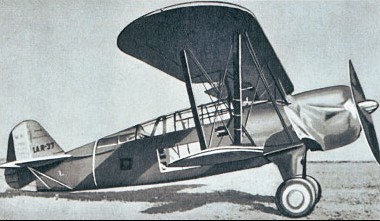
The I.A.R.37 prototype was built to the design of engineers Grossu-Vizuru and Carp. Flown for the first time in 1937 by company pilot Max Manolescu, it was intended to meet an official requirement for a tactical bombing and reconnaissance aircraft. An unequal-span biplane, the I.A.R.37 had fixed main landing gear and was powered by an I.A.R. K.14 radial engine. Its three-man crew was accommodated beneath a continuous glazed canopy, the observer seated between pilot and gunner and provided with full dual controls, a Romanian-designed Estopey bomb-sight, radio and a camera. Defensive armament comprised four machine-guns and the offensive load 12 50kg bombs or six 100kg bombs on underwing racks.
The I.A.R.37 entered production.in late 1938 and was built in small numbers before being succeeded in 1939 by the interim I.A.R.38, which differed mainly in its powerplant.
An attempt to modify an IAR 37 into a dive bomber was made in the summer of 1940. No 5, redesignated IAR 371, performed the Romanian dive bombing premiere on July 16 with a test diving from 4,000ft (1,200m), piloted by Emil Droc, test pilot of the IAR factory. Several modifications (including the cockpit canopy and fuselage side glazing) were made to the IAR 37 design before it was fitted with a German BMW 132A radial engine, giving birth to the more reliable IAR 38.
In January 1939, even before all 50 examples of the –37 had been completed production was shifted in favour of the IAR 38. The last IAR 37, No 47 was first flown on June 16, l939.
The final number of IAR 38s actually manufactured is still unclear, the existence of a photograph depicting ‘Red’ 89 suggests that possibly 90, even up to 120, such aircraft could have been finally produced at Brasov.
The -38 was soon displaced on the production line by the I.A.R.39.
The increased fuel consumption of the more powerful IAR K1 4 engine installed in the IAR 39s decreased the aircraft’s range to 350nm (650km), equal to the similarly equipped IAR 37.
Of the total production of 325 I.A.R.37, 38 and 39 aircraft, over 200 were I.A.R.39s, 96 built under sub-contract by the S.E.T. company and over 100 by I.A.R.
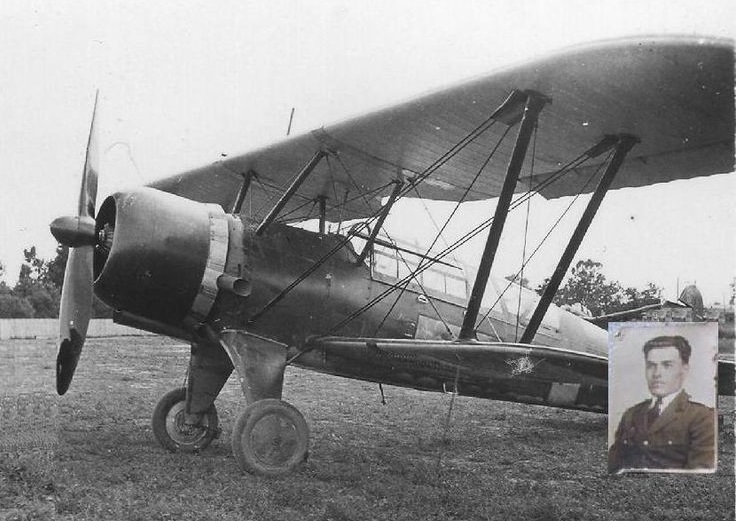
By the end of 1940 the I.A.R. biplanes were in large-scale service with Fortelor Aeriene Regal ale Romania (Royal Romanian Air Force) or FARR. They equipped a number of squadrons attached to the various army corps and by June 1941, when Romania supported the German offensive against the Soviet Union, the three reconnaissance flotile of the FARR had 18 eskadrile, 15 of which were equipped with I.A.R. biplanes. In July 1942 the air expeditionary force in the Soviet Union had been re-formed as Corpul I Aerian and had several groups equipped with the I.A.R.39. Eleven reconnaissance eskadrile were operating with the army co-operation flotile during the 1944 offensive in the Ukraine, most of them with I.A.R.39s on strength. Post-war the new Communist republic was declared at the end of 1947, and the reorganised air arm, known as the FR-RPR (Fortele Aeriene ale Republicii Populare Romania) had a small number of I.A.R.39s for training and liaison duties for several years.
The last member of the IAR 37/38/39 family was withdrawn from service in mid 1960s.
IAR-37
Engine: I.A.R. K.14-II C32, 649 kW (870 hp)
Empty weight: 4,892 lb (2,219kg)
Crew: 3
50 built (IAR)
IAR-38
Engine: BMW 132A, 522 kW (700 hp)
Empty weight: 5,070 lb (2,300kg)
Taller tail.
75 built (IAR).
IAR-39
Engine: 1 x IAR K.14-IV C32, 16 kW (960 hp)
Wingspan: 13.10 m / 42 ft 11.75 in
Length: 9.60 m / 31 ft 6 in
Height: 3.99 m / 13 ft 1 in
Wing Area: 40.30 sq.m / 433.79 sq ft
Take-Off Weight: 3085 kg / 6801 lb
Loaded Weight: 2177 kg / 4799 lb
Max. Speed: 336 km/h / 209 mph / 182 kn
Service Ceiling: 8000 m / 26245 ft
Range: 1050 km / 652 miles / 567 nmi
Armament: 3 x FN (Browning) 7.92mm machine-guns
Bombload: 288kg (635lb) or 144 air-grenades
Crew: 3
255 built (95 at IAR and 160 at SET).
IAR IAR-36 / ICAR Comercial / ICAR M 36 / Messerschmitt M 36 / BFW M 36
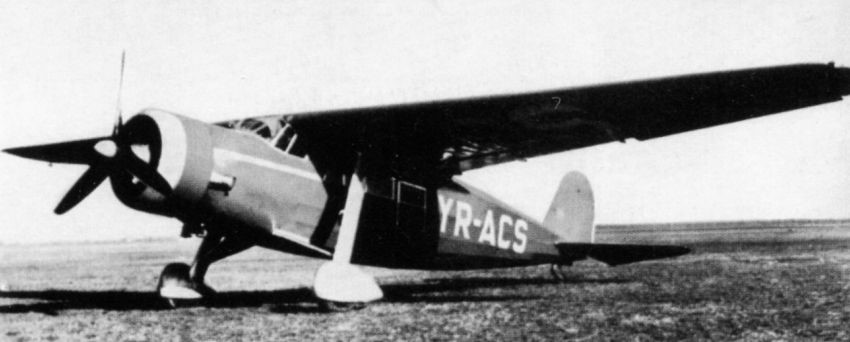
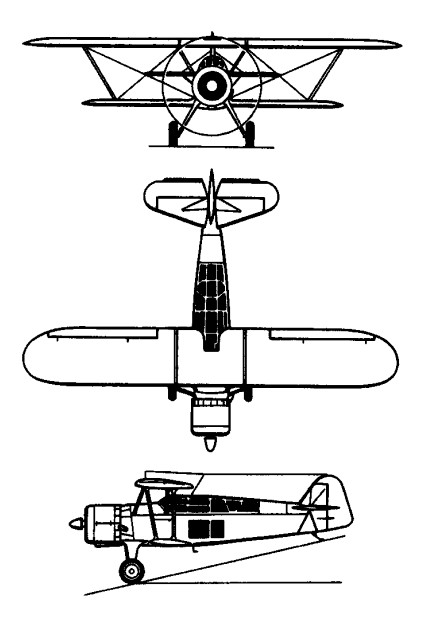
BFW negotiations with the Romanian company ICAR (Intrepindere Pentru Constructii Aeronautice) led to a contract for the development by ICAR of an M-36 transport aircraft for 6 passengers. ICAR designated it the ICAR 36; Messerschmitt, working at BFW referred to it as the M 36. According to the project, the Messerschmitt designed aircraft was to be equipped with a French Gnome et Rhone 14 K engine with 450 hp. However, in order to save money, the Romanians chose a less powerful Armstrong Siddeley Serval (350 hp).
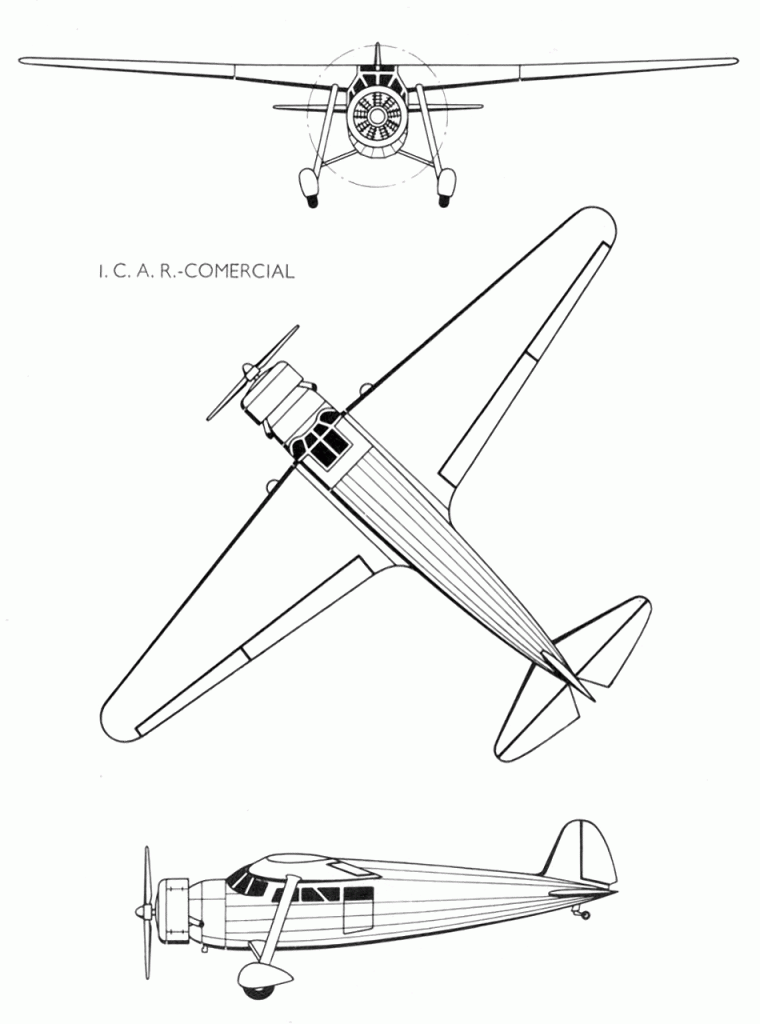
The ICAR 36 was a high-wing cantilever monoplane of mixed construction, with a closed cockpit, single engine, and fixed landing gear. It had a welded steel tube fuselage, covered with plywood, and tapered single-spar, plywood-covered wings. The crew of two sat in the cockpit, forward of the wing, which was equipped with a radio and could be fitted with twin controls. The cabin for six passengers, with wide rectangular windows and access doors at the rear, was aft and below the cockpit / wings. There were also two baggage compartments.
The aircraft successfully completed tests at the end of 1934 after some modifications. Possibly six aircraft were built.
One example was built for the LARES airline on the domestic routes of Romania including the Bucharest to Cernauti. The aircraft (YR-ACS) was built, later modified with a cabin for five passengers and two luggage compartments. Initially fitted with a 280 kW (380 hp) Armstrong Siddeley Serval I ten-cylinder radial engine in a NACA cowling, which was, in turn, replaced with a 220 kW (300 hp) Lorraine 7M Mizar 47, driving a three-bladed propeller. The fixed landing gear was supported by long faired vertical struts to the wings, with teardrop spats over the mainwheels and a tailwheel at the end of the fuselage.
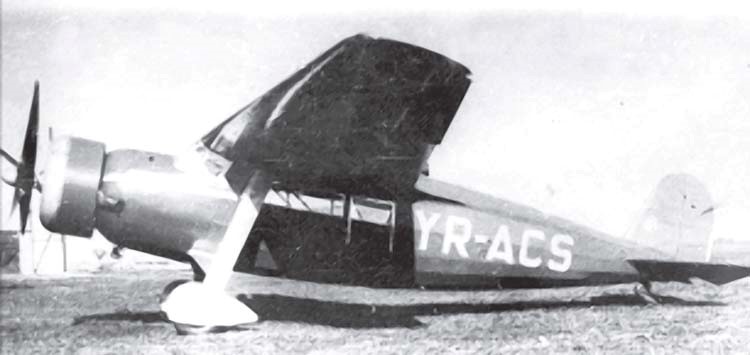
I.C.A.R. 36 Comercial
Engine: 1 × Armstrong Siddeley Serval I, 250 kW (340 hp)
Wingspan: 15.4 m (50 ft 6 in)
Wing area: 30.50 m2
Length: 9.8 m (32 ft 2 in)
Height: 2.8 m (9 ft 2 in)
Empty weight: 1,320 kg (2,910 lb)
Gross weight: 2,250 kg (4,960 lb)
Maximum speed: 235 km/h (146 mph, 127 kn)
Cruise speed: 220 km/h (140 mph, 120 kn)
Stall speed: 89 km/h (55 mph, 48 kn)
Range: 700 km (430 mi, 380 nmi)
Service ceiling: 4,500 m (14,800 ft)
Crew: two
Capacity: six / 960 kg (2,120 lb) payload
IAR IAR-27
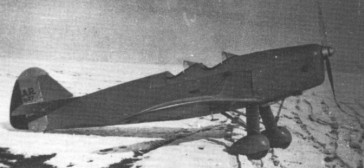
The unnumbered prototype of the IAR 27 trainer made its debut on June 8, 1937. A two-seat basic trainer, low-wing monoplane, metal construction, power was a 180 hp IAR 6 GI (licenced DH Gipsy 6), and a 9.10 m span.
Series production totalled 80 aircraft, 30 built by SET in 1941. The wheel covers were not employed on series production airframes.
IAR IAR-23 / IAR-24
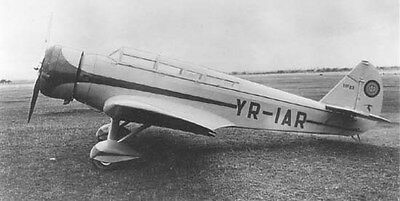
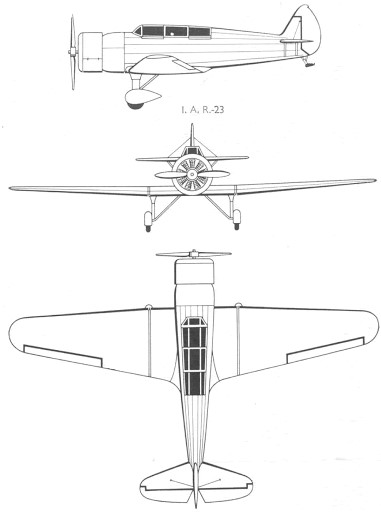
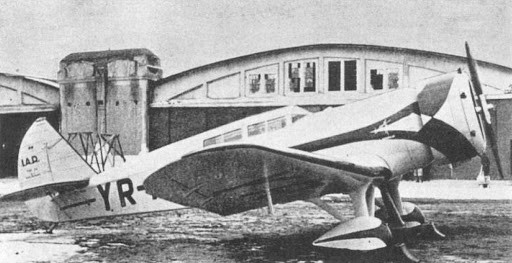
The IAR-23 was created in 1934 by the Romanian company Industria Aeronautică Română (IAR) as an attempt to design a next-generation fighter for the Royal Romanian Air Force, but because its low power, it was classified only as a civilian touring aircraft. However, it contained many advanced features for its time, including uniquely designed wings. After the installation of additional fuel tanks, it turned into a long-haul touring plane, with a maximum range of 2300 km.
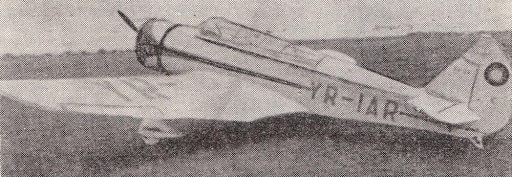
The sole IAR-23 built was registered YR-IAR. and delivered to Major G. Bănciulescu in September 1934, who undertook several cross-country flights with the aircraft through Europe (from Bucharest to Warsaw, Prague and Vienna). The next year, the IAR-23 was flown to Tel-Aviv and back.
An improved version, the IAR-24 YR-ACI, was created in 1935. It used the same airframe, but had a modernized cockpit and a slightly more powerful engine that yielded a higher cruising speed.
IAR-23
Powerplant: 1 × Hispano-Suiza 9Qa, 253 kW (340 hp)
Wingspan: 12.00 m (39 ft 4 in)
Wing area: 22.30 m2 (240.00 sq ft)
Length: 8.35 m (27 ft 5 in)
Height: 2.70 m (8 ft 10 in)
Empty weight: 980 kg (2,156 lb)
Gross weight: 1,920 kg (4,224 lb)
Maximum speed: 245 km/h (153 mph, 133 kn)
Cruise speed: 215 km/h (134 mph, 116 kn)
Range: 2,300 km (1,437 mi, 1,249 nmi)
Service ceiling: 4,100 m (13,670 ft)
Crew: 2 pilots
Capacity: 4 passengers
IAR-24
Engine: Gnome-Rhone 7 Kd, 350 hp
Wingspan: 12.00 m
Length: 8.35 m
Height: 2.70 m
Wing area: 22.30 sq.m
Empty weight: 1180 kg
Normal takeoff weight: 2030 kg
Maximum speed: 280 km / h
Cruising speed: 230 km / h
Practical range: 2300 km
Rate of climb: 200 m / min
Service ceiling: 4500 m
Crew: 2