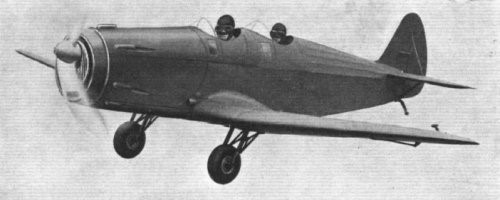
The Comper Kite was a single-engine, two-seat touring monoplane built in the UK, derived from the contemporary Comper Streak racer. Only one was built.
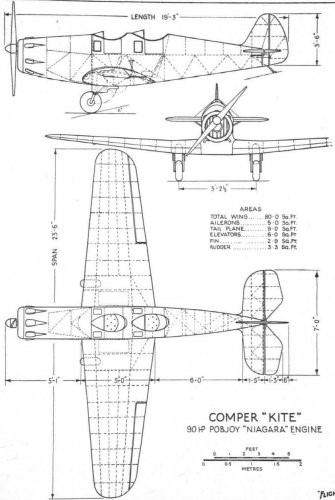
The Comper Kite was a single-engine, two-seat touring monoplane built in the UK, derived from the contemporary Comper Streak racer. Only one was built.
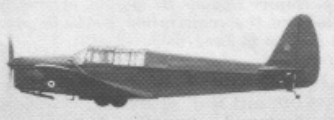
The Comper Mouse was a 1930s British three-seat cabin monoplane designed by Nicholas Comper, and built by the Comper Aircraft Company at Heston Aerodrome in 1933.
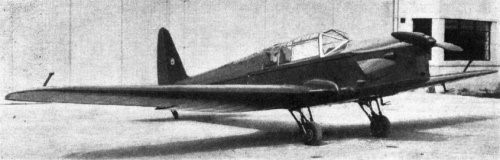
Only one Mouse was built; G-ACIX.
The company’s first product was the C.L.A. 7 Swift, a single-seat high-wing sporting aircraft, which was first flown in spring 1930 and built between 1930 and 1934 (one was owned by the Prince of Wales, later Edward VIII).
Teething problems necessitated fitting early production Swifts with the Salmson A.D.9 radial, the prototype having flown with a 40 hp ABC Scorpion.
Production commenced in 1930, thirty-seven Swifts being built. The majority powered by the 75 hp Pobjoy R, but three were fitted with 120 hp DH Gipsy III.
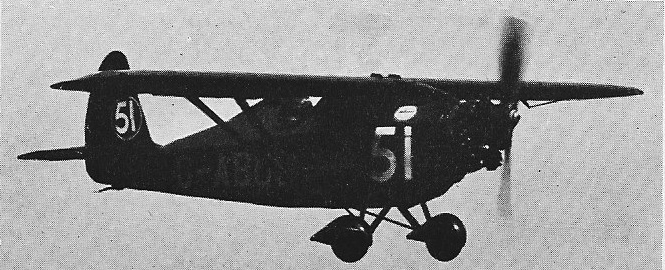
Engine: Pobjoy R, 75 hp
Wingspan: 24 ft
Length: 17 ft 8.5 in
Height: 5 ft 3.5 in
Empty wight: 540 lb
Loaded weight: 985 lb
Max speed: 140 mph
Cruise: 120 mph
ROC: 1400 fpm
Service ceiling: 22,000 ft
Range: 600 mi
The company was formed at Hooton Park, Cheshire, on March 14,1929 by Fit. Lt. Nicholas Comper and others. Formerly with Airco, Comper had also been responsible for the Cranwell Light Aeroplane Club series of amateur built lightplanes, the C.L.A. 2, 3, and 4A. The company’s first product was the C.L.A. 7 Swift, a single-seat high-wing sporting aircraft, which was first flown in spring 1930 and built between 1930 and 1934 (one was owned by the Prince of Wales, later Edward VIII). The company moved to Heston, Middlesex, in 1933; the one-off three-seat Mouse and single-seat Streak monoplanes were built in that year, followed by a single Kite two-seat tourer developed from the Streak.
When the company folded in March 1934, Heston Aircraft Company Ltd was formed from its assets.
In 1935 the Chief General Manager of Broken Hill Proprietary (BHP), Essington Lewis, visited Europe and formed the view that war was probable. On his return to Australia, concerned at the lack of manufacturing capabilities there and at the possibility of aircraft not being available from ‘traditional’ (i.e. British) sources during wartime, he commenced a lobbying campaign to convince the Australian Government to establish a modern aircraft industry. The government required little persuasion and encouraged negotiations between a number of Australian companies. The outcome of these negotiations, begun in August 1935, was the formation of CAC the following year. Initially the companies involved were BHP, General Motors-Holden Ltd., and Broken Hill Associated Smelter Pty. Ltd. These were joined by Imperial Chemical Industries of Australia and New Zealand Ltd., the Orient Steam Navigation Company Ltd. and the Electrolytic Zinc Company of Australasia Ltd. at the time of CAC’s formation (the company was incorporated in Melbourne on 17 October 1936). By September 1937 a factory had been completed at Port Melbourne.
Shortly after the establishment of CAC, Mascot-based Tugan Aircraft was purchased. This led to Lawrence Wackett joining the company; he immediately became the General Manager. In 1935 Wackett had led a technical mission to Europe and the USA to evaluate modern aircraft types and select a type suitable to Australia’s needs and within Australia’s capabitities to build. The mission’s selection was the North American NA-16; with CAC’s modifications this became the Wirraway. CAC also undertook production of the Pratt & Whitney R-1340 engine used in the Wirraway and also built some propellers when supplies from alternative sources became problematic. The North American NA-33, built under license as CA-1 to CA-16 Wirraway for RAAF, starting in July 1939.
Followed by Wackett-designed prototype CA-2 Wackett two-seat trainer, production version designated CA-6.
Company also produced the only Australian-designed fighter to serve in Second World War, the CA-12,13, 14, 19 Boomerang.
CAC Melbourne Sept 1940 – Dec 1945 Gallery
Later designs during World War II were the sophisticated Woomera and CA-15, however these types were destined to fly only in prototype form. Postwar products included the prototype CA-22 and production CA-25 Winjeel trainer for the RAAF, the CA-28 Ceres agricultural aircraft, and over 200 North American Mustangs built as CA-17 and 18.
Other, jet-powered aircraft designs in the 1950s and 1960s did not even leave the drawing board, however in 1951 CAC was given the go-ahead to design and manufacture a version of the F-86 Sabre with a Rolls-Royce Avon turbojet and armament. The Sabre was developed and produced concurrently with the indigenous Winjeel trainer, with Sabre manufacture coming to an end in 1961.
In 1964 after a large amount of political lobbying CAC began producing components for the Sabre’s replacement, a version of the Dassault Mirage III, as a subcontractor to the Government Aircraft Factory (GAF). In 1967 CAC commenced licence production of a version of the Aermacchi MB-326 optimised for Australian conditions as Aermacchi M.B. 326H, this programme ended in 1972.
In 1971 CAC joined the small number of aircraft manufacturers which have built both fixed- and rotary-winged aircraft, when it began production of a variant of the Bell Kiowa for the Australian Army and Royal Australian Navy, the last of these was delivered in 1977. The same year CAC embarked on a Life Of Type Extension (LOTEX) programme for the Macchi, which was suffering fatigue problems. The LOTEX programme lasted until 1984. Other contracts included workfor Boeing, Sikorsky, Pratt & Whitney and Hawker Siddeley. Finally specialized in the manufacture and repair of gas turbine engines.
Became a public company in 1975 and CAC became a fully owned subsidiary of Hawker de Havilland in 1985 and was renamed Hawker de Havilland Victoria Limited in 1986. The Commonwealth Aircraft Corporation was renamed AsTA (Aerospace Technologies of Australia) in 1986. This company was purchased by Boeing Australia in 2000.
The Kiowa was the last type built by CAC. The company was part of the Australian Aircraft Consortium which designed the A10 Wamira, but this programme was cancelled in 1985 shortly after the prototype was completed. At the time of purchase by Hawker de Havilland, CAC had begun delivering components for the GAF-built version of the F/A-18 Hornet.
During its existence the Commonwealth Aircraft Corporation produced over 1700 aircraft of all types, including prototypes and aircraft assembled locally from imported components. Of these, almost 550 were examples of aircraft types wholly designed by the company. The designations used by CAC reflected production or design work in fulfillment of different in-house projects or government contracts rather than different types produced (for instance the different designations for the Wackett and Winjeel prototypes compared to their production versions). Early types were given consecutive manufacturer’s construction numbers (c/nos.), while later types (beginning with the production version of the Winjeel) were given c/nos. with the model number as a prefix. Construction numbers 1210 to 1224 appear not to have been assigned. The list of company designations and construction numbers is:
CA-1 First Wirraway production contract; 40 built (c/nos. 1-40).
CA-2 Wackett prototypes; two built (c/nos. 101, 102).
CA-3 Second Wirraway production contract; 60 built (c/nos. 41-100).
CA-4 Woomera prototype; one built (c/no. 435).
CA-5 Third Wirraway production contract; 32 built (c/nos. 103-134).
CA-6 Wackett production contract; 200 built (c/nos. 235-434).
CA-7 Fourth Wirraway production contract; 100 built (c/nos. 135-234).
CA-8 Fifth Wirraway production contract; 200 built (c/nos. 436-635).
CA-9 Sixth Wirraway production contract; 188 built (c/nos. 636-823).
CA-10 Proposed Wirraway variant not built
CA-11 Woomera production contract for 105 aircraft. Contract cancelled, only one aircraft flew (101 c/nos. assigned, 1225-1325).
CA-12 First Boomerang production contract; 105 built (c/nos. 824-928).
CA-13 Second Boomerang production contract; 95 built (c/nos. 929-1023).
CA-14 Experimental Boomerang fitted with turbocharger; one built (c/no. 1074).
CA-15 Single-seat fighter; one built (c/n 1073).
CA-16 Seventh (and final) Wirraway production contract; 135 built (c/nos. 1075-1209).
CA-17 First Mustang production contract; 80 assembled from imported components (c/nos. 1326-1405, 1326-1345 also assigned North American c/nos. NA110-34366 to -34385).
CA-18 Second Mustang production contract; 120 built, production of a further 50 cancelled (c/nos. 1406-1525).
CA-19 Third (and final) Boomerang production contract; 49 built (c/nos. 1024-1072).
CA-20 Contract to modify Wirraways for use by the RAN (see CAC Wirraway); 17 modified.
CA-21 Third (and final) Mustang production contract for 100 aircraft; contract cancelled, none built.
CA-22 Winjeel prototypes; two built (c/nos. 1526, 1527).
CA-23 Designation of a two-seat twin-engined supersonic jet fighter design. None built.
CA-24 Contract for production of 72 of variant of the Hawker P.1081; none built.
CA-25 Winjeel production contract; 62 built (c/nos. CA25-1 to -62).
CA-26 Sabre prototype; one built (c/no. 1528).
CA-27 Sabre production contract; 111 built (c/nos. CA27-1 to -111).
CA-28 Ceres production, built as private venture; 21 built (c/nos. CA28-1 to -21).
CA-29 Production sub-contract for wings, fins, rudders, tailcones and engines of GAF-built variant of Mirage IIIE; 101 airframe shipsets and 140 engines built.
CA-30 Macchi production contract; 20 assembled from imported components plus 77 built (c/nos. CA30-1 to -97, CA30-1 to -13 and -15 to -21 also assigned non-consecutive Aermacchi c/nos. between 6351 and 6395)
CA-31 Jet trainer design; none built (Macchi built instead).
CA-32 Kiowa production contract; 12 assembled from imported components plus 44 built (c/nos. CA32-13 to -56, all 56 aircraft also assigned Bell c/nos. 44501-44556).
CA-33 Contract for modifications to the RAAF fleet of Lockheed P-3C Orions; installing the Barra Sonobuoy system (developed for the RAAF and Royal Air Force by the Defence Science and Technology Organisation (DSTO)) and associated systems after delivery of each aircraft from the USA; 20 aircraft modified (contract completed as HdHV).
CA-34 Designation used for CAC’s participation in the A10 Wamira project.
CA-35 Contract for modifications to a Fokker F27 Friendship (registration VH-EWP) to install the LADS system developed by the DSTO (contract completed as HdHV).
CA-36 Production sub-contract for the wing pylons, engine access panels, aft nozzle fairings, aircraft-mounted accessory drive gearboxes and engines for the GAF-built version of the F/A-18 Hornet; 73 airframe shipsets and 158 complete engines built, plus parts of another 17 engines (contract completed as HdHV).
Engine types produced by CAC include the:
Pratt & Whitney R-1340 built for the Wirraway.
Pratt & Whitney R-1830 built for the Boomerang, Woomera and DAP Beaufort.
Rolls-Royce Merlin built for the GAF Lincoln.
Rolls-Royce Nene built for versions of the de Havilland Vampire manufactured by de Havilland Australia.
Rolls-Royce Avon built for the Sabre and GAF Canberra.
SNECMA Atar built for the Mirage.
Bristol Siddeley Viper built for the Macchi.
General Electric F404 built for versions of the F/A-18 Hornet manufactured by the Government Aircraft Factory/Aerospace Technologies of Australia.
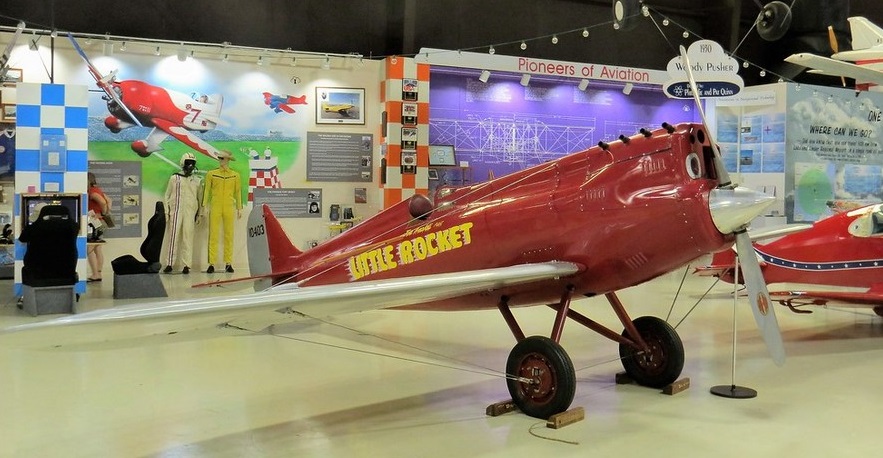
Command-Aire built one little Rocket Racer. The Rocket was built to compete in the 1930 All American Derby. Equipped with a super-charged 90 hp Cirrus and Lee Gelbach at the controls, running a race course that spanned most of Mid-America, the little Rocket repeatedly recorded ground speeds of 215 mph, its average point-to-point time being in the neighbourhood of 160 mph. The aircraft won the 5,500 mile race and $15,000 prize (a fortune in the depression) with an average speed on 127mph.
The Rocket no longer exists, but Joe Armaldi in Florida built a replica of the racer.

The Command-Aire did not at first appear to offer much of an advancement over the vast multitude of three seat biplanes built around the ubiquitous Curtiss OX-5 engine to similar designs, with similar dimensions and construction methods, many of which were already in production. The basic design was by Morton Cronk, and although it had excellent high altitude capabilities, it was slow. This setback nearly foundered the company before its first aircraft entered production.
Albert Vollmecke, a Heinkel engineer was in the US attempting to find a customer to build Heinkel HD 40 mailplanes under licence for the US market. Seeing that there was little prospect of any sales in the US, he decided to hire on with an American company, Command-Aire.
His first task was to rework the design to provide documentation for the new approval process. While there was only one major visible external difference, he undertook an extensive redesign based on his experience in the much more scientifically-grounded German aviation industry, and to bring the design into line with CAA (now FAA) certification requirements, which involved a lot of submissions, and alterations, and resubmissions before they signed off on it. Many parts had to be redesigned when it was easier to redo the design, than to use the existing design to calculate the necessary strength margins. The most obvious change was a switch from four small conventional ailerons at the tips to two slotted nearly full-span ailerons on the lower wing. This improved low speed control dramatically, allowing lateral control even after the aircraft had stalled – a novelty among American aircraft at the time, and a recurring advertising theme.
The second change was the incorporation of a Phylax fire suppression system capable of putting almost any fire out in flight. The third novelty was the use of a rotisserie type fuselage jig, that ensured accuracy and consistency between the airframes they built, reducing the chance of building an airplane that couldn’t be rigged to fly right. Although Command-Aire’s advertising claims that Vollmecke invented this, he claimed he merely brought the idea from Europe.
The fuselage was built from welded chromium-molybdenum alloy steel tubes, faired with wooden battens. The top of the fuselage was covered in large metal panels that could be readily opened to provide access, and a compartment for luggage was provided between the cockpits large enough for a suitcase.
The slightly staggered wings were built around solid spruce spars, with spruce and plywood warren truss type ribs. The wings were braced with cables.
The ailerons and the entire empennage were also built from chromium-molybdenum alloy steel tubing, and all controls were actuated through pushrods and bellcranks, with no cables or pulleys used. The ailerons on the prototype were conventional, however on production variants, they extended across nearly the full span on the lower wings only, and had a slot that allowed air to flow over the aileron at low airspeeds and high angles of attack, which helped ensure lateral control even after the wings had stalled. These were not Frise-type ailerons though, but conventional ailerons with a slot at the hinge line.
The undercarriage was a split axle type, braced to a steel tube four point pyramid that extended from the belly of the aircraft, with suspension provided with bungee cords which were protected by leather boots. Both cabane and interplane struts took the form of an N and were steel tubing as well. The 3C3 can be distinguished from later types by having an additional strut providing lateral bracing from the forward strut anchor point on the wing, to the lower longeron at the firewall, triangulating the structure. The 4C3 and later types dispensed with this extra strut, and coincided with an extensive redesign that otherwise had few external differences.
The 3C3 first flew in January 1928 and received certification in July 1928.
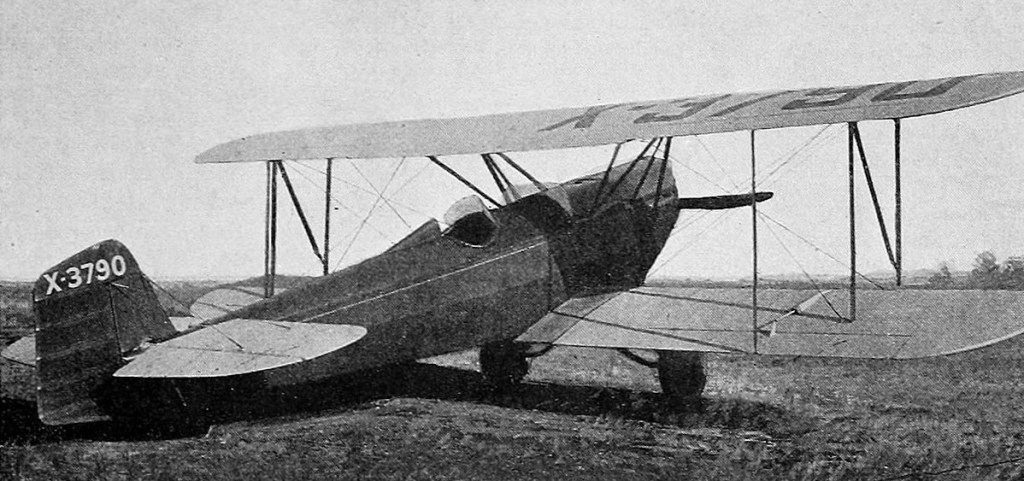
While normally a three-seat design, those aircraft with a T in the designation were built as two-seat trainers specifically for flight instruction, and a crop-dusting version was also sold, with the space in the front cockpit being filled with a large hopper, and the fuel tank relocated to the wing centre section. At least 17 of these were built, with others converted from other variants.
The 3C3 was one of the most pleasant and stable aircraft of the 1920’s. In the companies “hands off” flight demonstration, the fearless pilot would climb out of the cockpit and straddle the turtle deck like a horse while the aircraft cruised the skies, this proved a quite effective sales technique. He turned the aircraft by leaning in the desired direction.
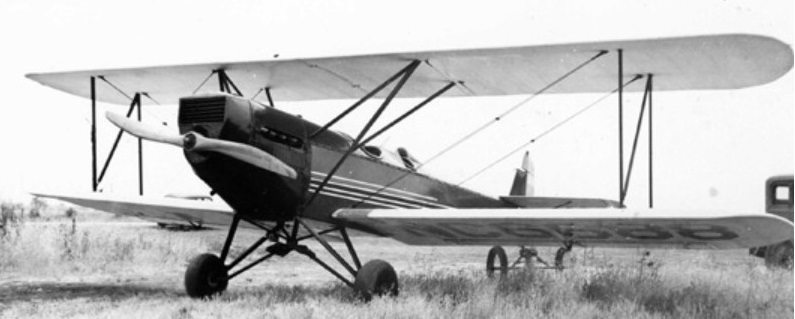
The 3C3 is similar in construction to most aircraft of the period and used a war surplus OX-5 engine. One of the notable features was the metal cowls, cockpit and turtle deck which made half the aircraft metal covered–not fabric covered. The aircraft was controlled by push-pull tubes and bell cranks, there were no wires, cables or pulleys.
In another publicity stunt, a flight of over 100 mi (160 km) from San Diego to Los Angeles was made without once using the control stick as all control inputs were through the rudder pedals.
In 1929, the government decided to allow aerobatics (known as stunting at the time), during the Annual Arkansas Air Tour being held in 1929 and so a team of three Warner-powered Command-Aire 3C3-As were formed as “The Blue Devils”, but painted incongruously in black and orange stripes.
The 3C3 sold for $5500 in 1929.
The BS-14 and BS-16 (BS standing for Biplane sport) were the final developments, and again featured extensive redesign work, but once again with few visible external alterations. The rudder was redesigned, and a new and promising engine was added to the lineup – the Lycoming R-680. On the BS-16, the undercarriage was changed to the outrigger type and a tailwheel was provided in lieu of the skid used previously, while the rear seat was raised to improve visibility.
A variety of engines were installed during the life of the design, with the area ahead of the firewall being redesigned to accommodate lighter engines, with longer noses to maintain the correct balance.
The problematic engine supply situation was well understood long before the last Curtiss OX-5 was installed in an airplane, and substantial efforts for alternatives were made. Simplicity and reliability were key, and the solutions invariably involved air-cooled radial engines, however the designs were not sufficiently developed, and there were many failures, and for various reasons. As a German, it was natural for Vollmecke to look to Germany, where some of the best designs were available, however two major problems surfaced. The first was that the supply of these engines was endangered by economic instability in Germany. The second was that the Command-Aire people were never able to get their engines to run right on the fuel available. Vollmecke suspected that the octane rating was too low, which caused knocking – potentially damaging the engine. Only 7 aircraft were built with the German radials. The Czechoslovakian Walter NZ-120 was even less successful, and only one was used. The most successful of the replacement engines with Command-Aire, was the Curtiss Challenger, despite its poor reputation elsewhere. Over 50 aircraft were fitted with this engine. Had the company continued in existence, then the Wright J6 and Lycoming R-680 that were only installed in a small number of airframes, would probably have eventually outsold the OX-5 as they did with other aircraft types.
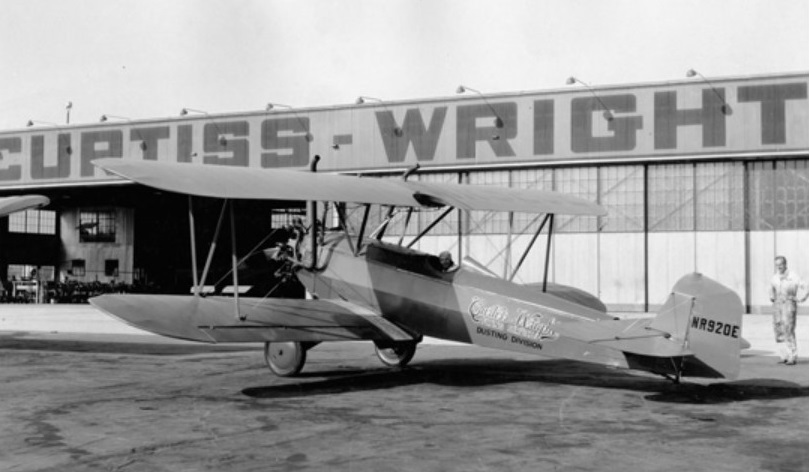
A Challenger powered-Command-Aire 5C3 was entered into the Guggenheim Safe Aircraft Competition in 1929. The 3C3 was the last aircraft not specially designed for the contest to be eliminated, and would actually enter revenue service. It later succeeded on a repeat of the test that it was eliminated on.
The Command-Aire 5C3 was featured in the Berryloid advertising series for aircraft dope, each featuring a different fabric covered aircraft, and each aircraft painted as a different bird. This advert was from the November 1929 Aerodigest
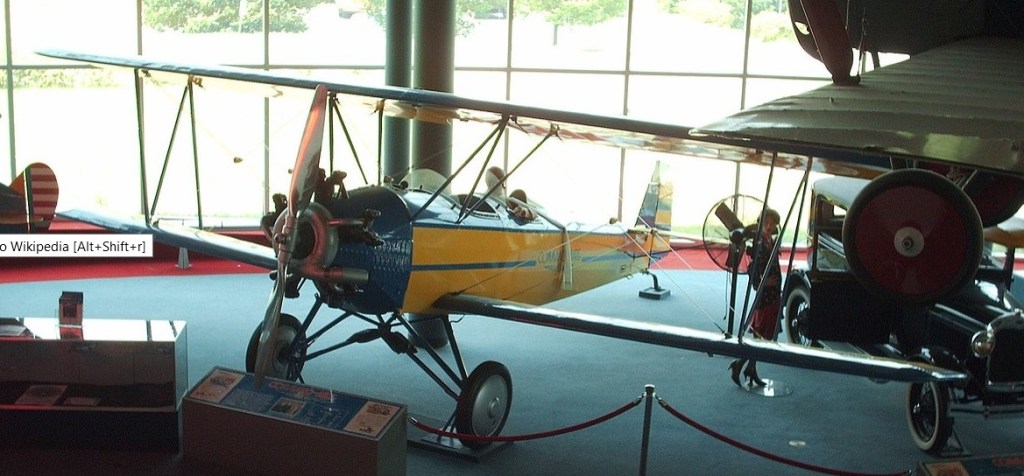
In 1929, Command-Aire contracted the Curtiss Flying Service to handle sales, through their large number of facilities, and Curtiss purchased a large number of aircraft for flight training for their own schools. Recognizing that the excessive number of aircraft companies in the aviation industry would force consolidation into a smaller number of larger companies, it had long been the intention to merge Command-Aire into a larger company even before the onset of the Great Depression forced matters. Negotiations had been underway for just such a merger – into Curtiss, at one time the largest aircraft manufacturer in the United States, however while negotiations were still underway, Curtiss’s financial problems forced it to merge with Wright Aeronautical. Unfortunately, Wright had themselves recently absorbed Travel Air, whose offerings included the Travel Air 2000 which was similar to the Command-Aire biplanes. Negotiations collapsed, and along with them, went the contracts for supplying the flying schools – and access to the sales network.
Command-Aire landed a by now much needed contract from the Chilean government to produce 36 3C3-BTs to be built at a specially-built facility in Chile, however no Command-Aires seem to have been either used in that country, either civil or military.
Only one example appears to have been exported, a 3C3 that went to Canada in 1931, where it went through a succession of private owners as CF-APQ, having previously been NC5590 in the US.
Produced 1928-1931a total of 184-254 (total for 3C3, 4C3, 5C3, BS-14 and BS-16) were built/
Known production:
3C3 N7885 msn 530
3C3 N136E msn 532
3C3 N476E msn 586
3C3-T N583E msn 607
3C3-B N610E msn W-69
3C3-AT N970E msn W-108
5C3 NC925E
5C3 N939E msn W-93
5C3 N946E msn W-95
5C3 N996E msn W-135
5C3 N997E msn W-136
Variants:
3C3
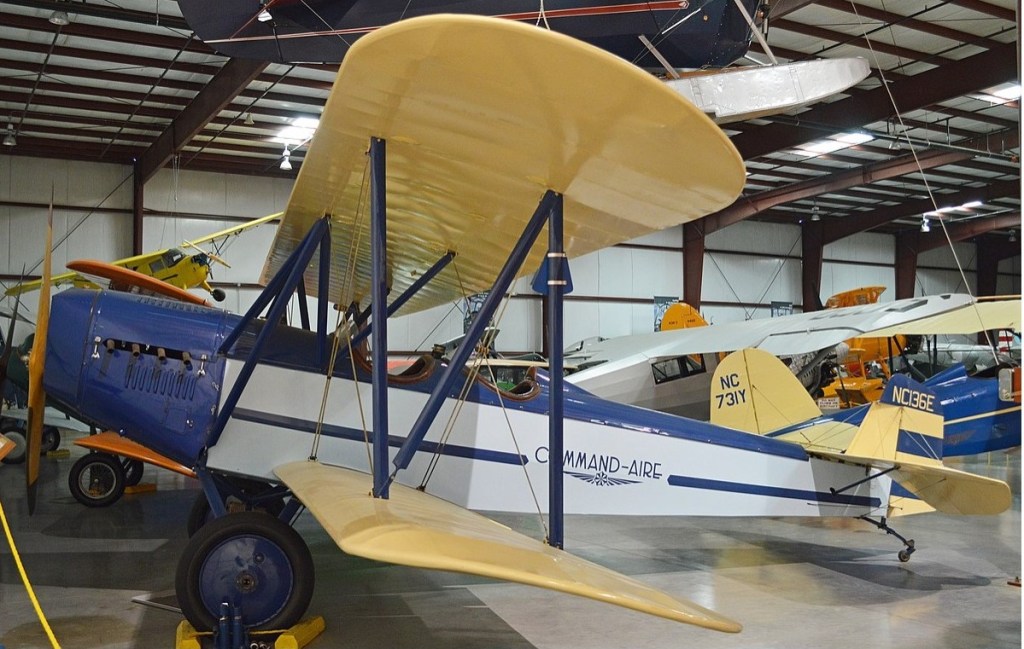
1928
ATC 53, 2-201
Engine: 90 hp (67 kW) Curtiss OX-5
Propeller: 2-bladed Wooden fixed pitch
Upper wingspan: 31 ft 6 in (9.60 m)
Upper chord: 60 in (1.5 m)
Wing sweep: 0°
Lower wingspan: 31 ft 6 in (9.60 m)
Lower chord: 60 in (1.5 m)
Wing area: 303 sq ft (28.1 m2)
Airfoil: Aeromarine 2A
Length: 24 ft 6 in (7.47 m)
Height: 8 ft 4 in (2.54 m)
Empty weight: 1,410 lb (640 kg)
Gross weight: 2,200 lb (998 kg)
Useful load: 790 lb (360 kg)
Fuel capacity: 40 US gal (150 l; 33 imp gal)
Oil capacity: 4 US gal (15 l; 3.3 imp gal)
Maximum speed: 100 mph (160 km/h, 87 kn)
Cruise speed: 85 mph (137 km/h, 74 kn)
Minimum control speed: 36 mph (58 km/h, 31 kn)
Range: 440 mi (710 km, 380 nmi)
116 built.
Crew: One
Capacity: Two
Undercarriage track: 87 in (2.2 m)
3C3-A
1929
ATC 118
Engine: 110 hp (82 kW) Warner Scarab
20 built.
1 fitted with Edo floats.
3C3-AT
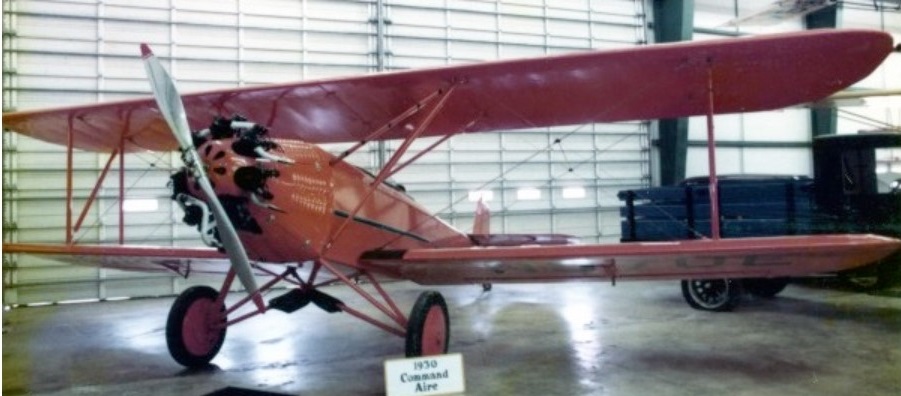
1929
ATC 151
2 seat trainer developed from 3C3-A
about 6 built.
3C3-B
1929
ATC 120, 2-440
Engine: 105 hp (78 kW) Siemens-Halske Sh 12
5 built
1st possibly modified from 3C3 with a new c/n.
3C3-BT
1929
ATC 209
Engine: 113 hp (84 kW) Siemens-Halske Sh 14
2 seat trainer developed from 3C3-B.
2 built plus 1 converted from 3C3-B.
3C3-T
1929
ATC 150
Engine: 90 hp (67 kW) Curtiss OX-5
30 built.
4C3
1929
Engine: 120 hp (89 kW) Walter NZ-120
1 built
5C3
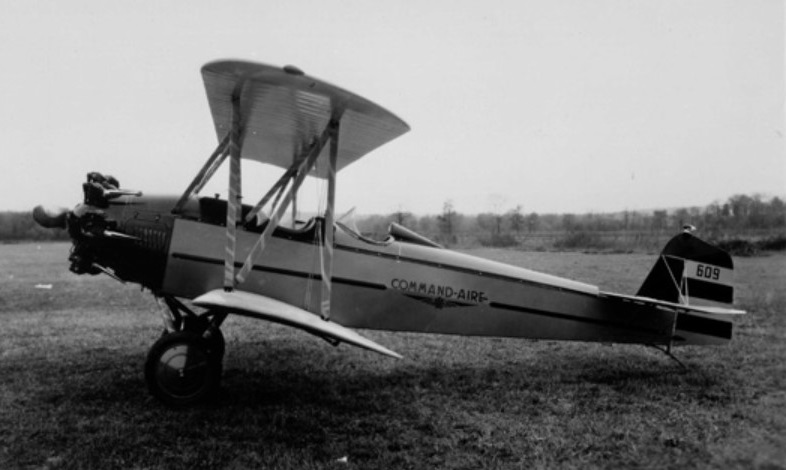
Curtiss Challenger-powered Command-Aire 5C3 N609
1929
ATC 184
Engine: 170 or 185 hp (127 or 138 kW) Curtiss Challenger
35 built.
5C3-A
1929
ATC 185
Engine: 180 hp (130 kW) Hisso-Wright E
3 built.
5C3-B
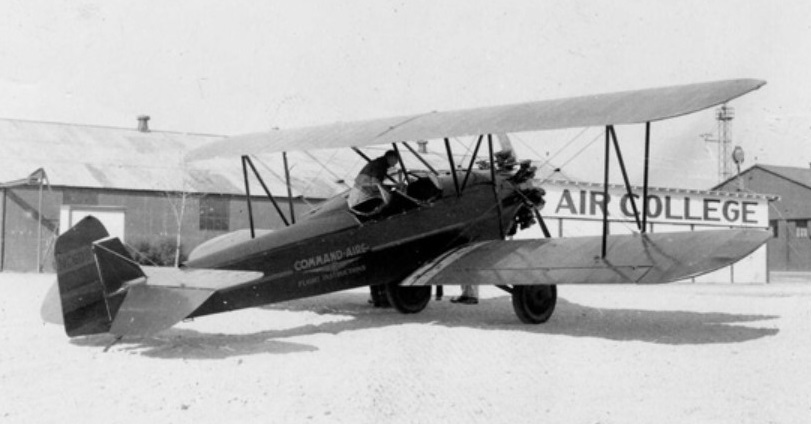
1929
ATC 214
Engine: 150 hp (110 kW) Axelson A
4 built, One might be conversion of 3C3-A.
5C3-C
1929
ATC 233
Engine: 165 hp (123 kW) Wright J-6
5 built
Some converted to cropdusters with front cockpit faired over
Cotton Duster
1930
Engine: 170 hp (130 kW) Curtiss Challenger-powered 5C3 cropduster
17 built.
BS-14
1930
ATC 2-204
Engine: 125 hp (93 kW) Warner Scarab
2 seat Biplane Sport aerobatic trainer
1 built.
BS-16
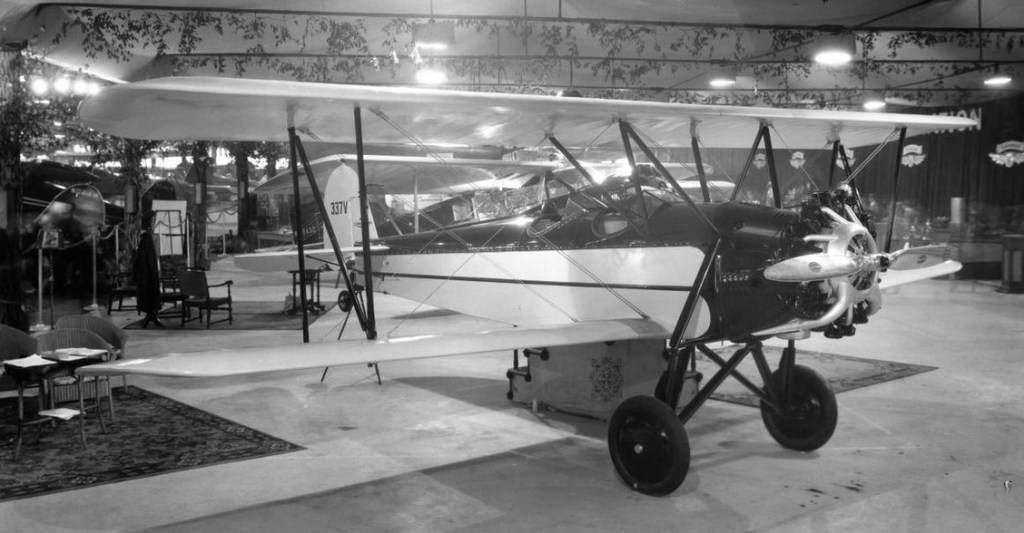
1930
Engine: 210 hp (160 kW) Lycoming R-680
2 seat aerobatic trainer
1 built.
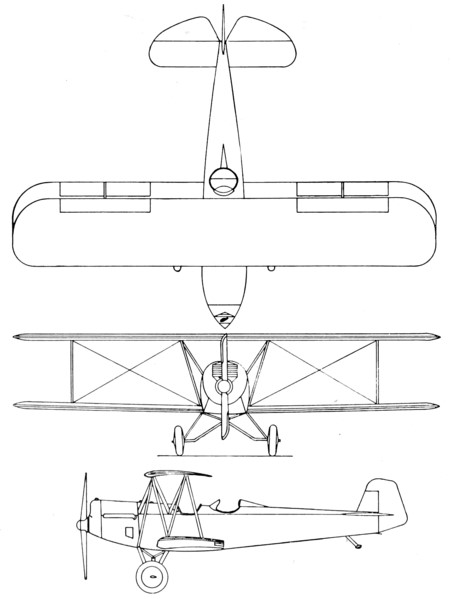
Command-Aire started in 1926 as the Arkansas Aircraft Co. Inc. of Little Rock, Arkansas.
In 1929 Command-Aire was one of the top manufacturers and was recognized for having one of only two designs to pass the Guggenheim Safety Trial, in which all existing aircraft designs were flown and judged for safety.
In 1930 the company entered their “Little Rocket,” in the All American Derby.
Command-Aire despite all of its successes was unable to survive the post-depression era and closed their doors forever in 1931.
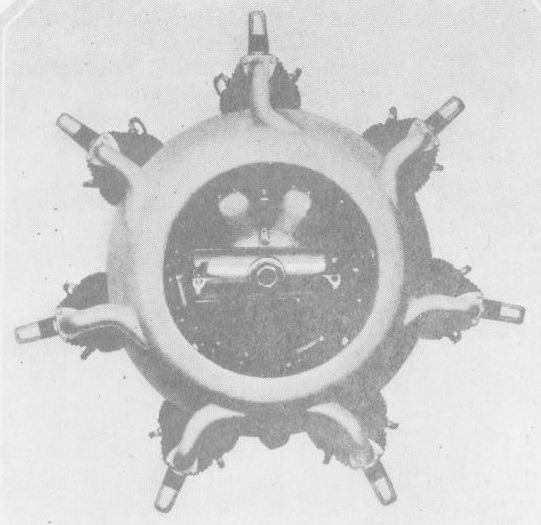
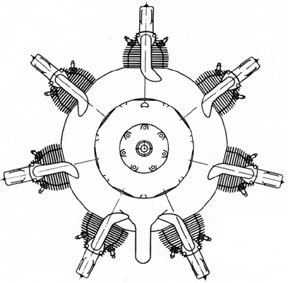
The Comet 7-D feature valves placed fore and aft, with exhaust valve forward for better cooling. Each cylinder has one rocker arm, ball bearing mounted, operating both valves on each cylinder. There is only one pushrod per cylinder. A single cam provides positive operation in both directions – push and pull – for all valve rods. The intake valves are operated by a downward pull on the valve rod. As a result, the tappet clearances on the intake valves decrease as the cylinders warm up, giving a longer intake opening at the higher speeds. The system reduces valve spring tension materially, giving a very light and evenly distributed load on the entire valve mechanism.
Spark plugs are placed on the sides of the cylinder heads for uniform spark plug temperatures. The cylinders are a steel barrel with integral mounting flange, over which a cast aluminium (Y-alloy) head is screwed and shrunk.
The crankshaft is carried in roller bearings, and is of two pieces for use of a solid master rod.
The crankcase is built of two sections united by seven through bolts, as well as by the cylinder flanges. The gear case cover carries the magneto and tachometer gears and oil pumps. The diffuser cover supports the magnetos and carburettor. A ball thrust bearing is carried in the front section. The cam is ball bearing mounted.
Equipment included an air cleaner and heater, complete exhaust manifold, nose cowling, tool kit, and instruction book. Available at extra cost was a Heywood starter.
7-D
Type: 7 cylinder, air cooled, fixed radial.
Approval type certificate No.9
Military Rating: 130 hp at 1825 rpm
Commercial Rating: 165 hp at 1900 rpm
Displacement: 611 cu.in
Compression ratio: 5-1
Bore: 4.5 in
Stroke: 5.5 in
Diameter: 46 7/8 in
Length: 35 5/8 in
Weight: 395 lb
Fuel consumption: not more than .55 lb/hp/hr
Oil consumption: not more than .015 lb/hp/hr
Lubrication: Force feed, scavengers and pressure pumps
Ignition: Dual Scintella magnetos
Carburation: Stromberg
Spark plugs: 2 per cylinder AC
Price: $2700
7-E
7 cylinder
Air-cooled
1929 (ATC 47)
165hp
612ci
7-RA
7 cylinder
Air-cooled
1928 (ATC 9)
130hp
Madison
Wisconson
USA
Engine builder circa 1929-30

