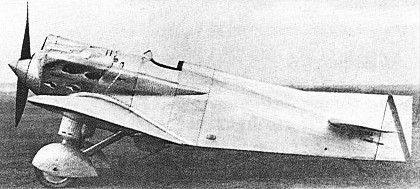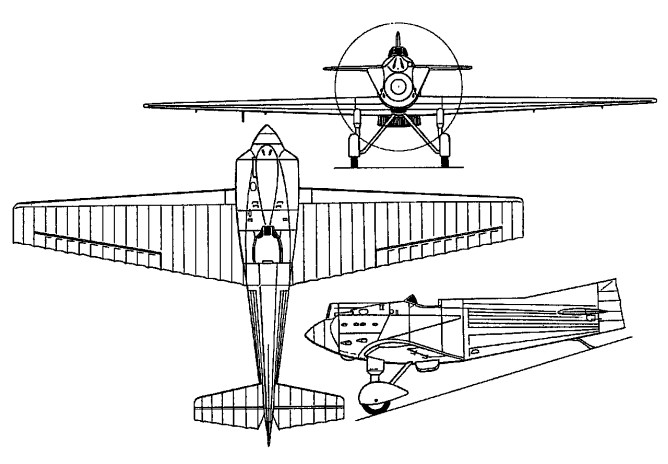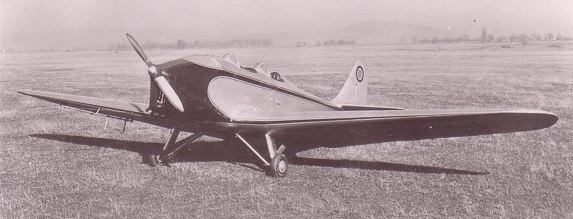
IAR IAR-22

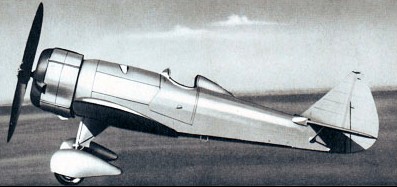
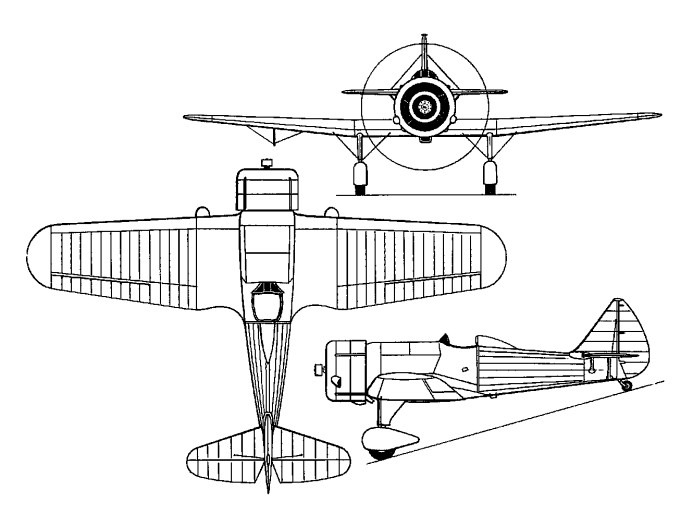
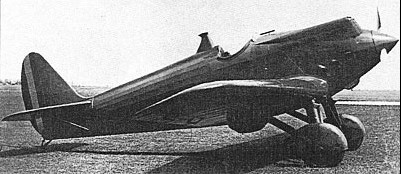
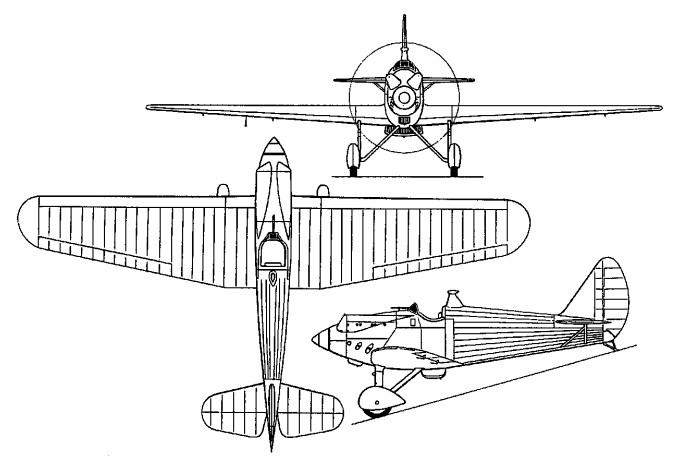
The 1934 CNIAR IAR-22 was a wooden construction, fabric-covered two-seat dual-control trainer/tourer. It has two seats in tandem and a fixed conventional undercarriage.

The wings were built around two spruce box spars, with plywood webs; plywood covered the whole wing except for the fabric trailing edges. In plan, the wings were straight-tapered, with most of the taper on the trailing edge, but with rounded tips. The wing trailing edge carried ailerons but no flaps. The tailplane was also straight-tapered, though with the taper more equally distributed between leading and trailing edges. The elevators were split, with a cut-out for rudder movement, and were horn balanced. The fin was also straight-edged but the broad rudder, also horn balanced, had a curved trailing edge.
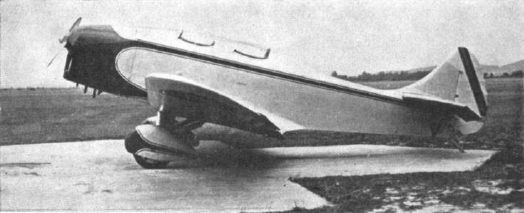
The fuselage of the IAR.22 was flat sided, tapering to the rear. It was a Warren truss structure with duralumin gussets; the forward fuselage was plywood covered, the remain fabric clad. Rounded decking, together with a head fairing behind the rear cockpit, gave the aircraft a slightly humped profile. The front cockpit was just behind the leading edge of the wing and the rear one at mid-chord. The nose line dropped slightly over the cowling of the 97 kW (130 hp) de Havilland Gipsy Major engine, an inverted air-cooled inline engine carried on a steel mounting and which drove a two-bladed propeller. The undercarriage had a wide track of over 2.5 m (100 in), with near perpendicular IAR-made shock absorber legs, split axles hinged at the fuselage centre line and trailing struts. The wheels had independent brakes but were not faired in.
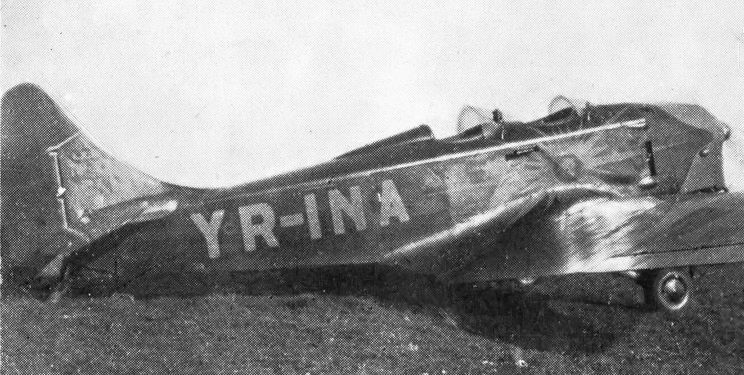
It was reported that the IAR.22 “gave very satisfactory results in tests” conducted by the Romanian Air Ministry’s Acceptance Commission but there is no record of its adoption by the Romanian Air Force. The design allowed for engines of up to 225 kW (300 hp) to be fitted: the intention was that it should be suitable for wireless, camera and gunnery training.
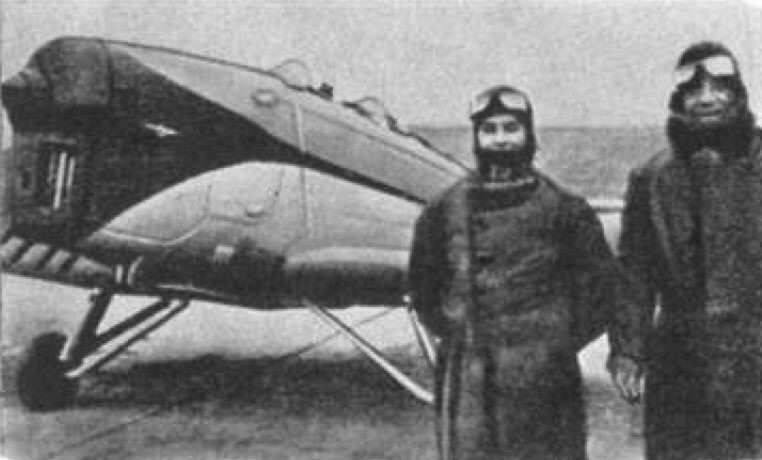
Irina Burnaia and Petre Ivanovici with an IAR-22 aircraft, 3 Jan 1935

Engine: 1 × de Havilland Gipsy Major, 97 kW (130 hp)
Propeller: 2-bladed fixed-pitch
Wingspan: 11.53 m (37 ft 10 in)
Wing area: 20.8 m2 (224 sq ft)
Length: 7.52 m (24 ft 8 in)
Height: 2.02 m (6 ft 8 in)
Empty weight: 647 kg (1,426 lb)
Gross weight: 880 kg (1,940 lb)
Maximum speed: 193 km/h (120 mph, 104 kn) at sea level
Stall speed: 73.73 km/h (45.81 mph, 39.81 kn)
Range: 550 km (340 mi, 300 nmi)
Service ceiling: 5,200 m (17,100 ft)
Absolute ceiling: 6,000 m (20,000 ft)
Rate of climb: 3.3 m/s (650 ft/min)
Time to 1,000 m (3,300 ft): 5 minutes 7 seconds
Time to 2,000 m (6,600 ft): 11 minutes 6 seconds
Time to 3,000 m (9,800 ft): 19 minutes 56 seconds
Wing loading: 42.3 kg/m2 (8.7 lb/sq ft)
Power/mass: 0.1103 kW/kg (0.0671 hp/lb)
Crew: 2
IAR IAR.16        

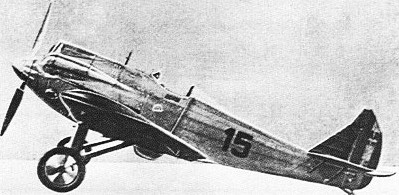
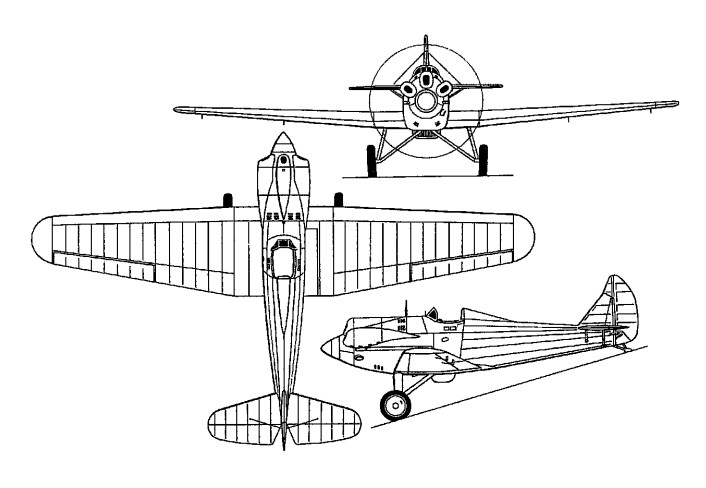
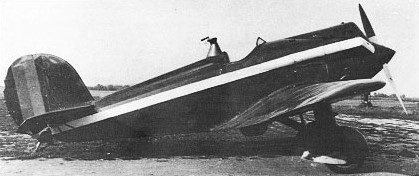
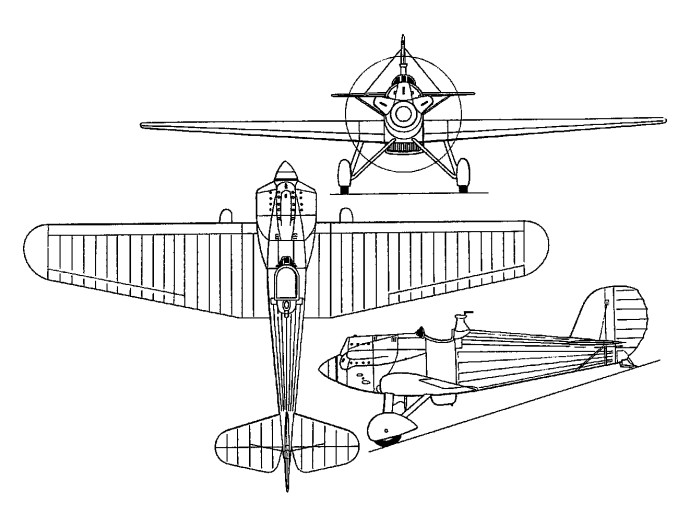
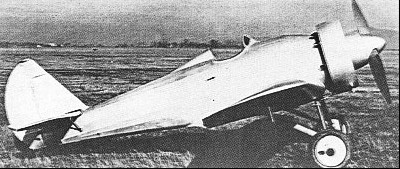
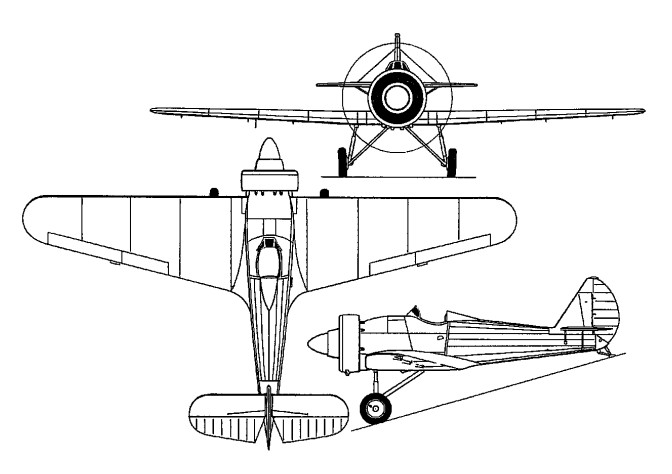
Although evolved in parallel with the I.A.R.15, the I.A.R.16, which flew for the first time in 1934, was the first of Carafoli’s fighters to feature an all-metal structure, this having plywood, fabric and duralumin skinning. It was powered by a 560hp Bristol Mercury IVS.2 nine-cylinder radial enclosed by a Townend ring and carried an armament of two 7.7mm Vickers guns. The I.A.R.16 was not developed further than a single prototype.

Engine: 560hp Bristol Mercury IVS.2 nine-cylinder radial
Take-off weight: 1650 kg
Empty weight: 1224 kg / 2698 lb
Wingspan: 11.70 m / 38 ft 5 in
Length: 7.37 m / 24 ft 2 in
Height: 2.80 m / 9 ft 2 in
Wing area: 20.30 sq.m / 218.51 sq ft
Max. speed: 342 km/h / 213 mph
Armament: two 7.7mm Vickers guns

IAR IAR.15

The I.A.R.15 flew for the first time late in 1933, powered by a 600hp Gnome-Rhone 9Krse nine cylinder radial and carring an armament of two 7.7mm Vickers machine guns. It had a welded steel-tube fuselage covered by duralumin sheet forward and fabric aft, this being mated with a three-piece wing with two duralumin spars, pine and plywood ribs and duralumin sheet skinning for the centre section with fabric covering for the outer panels. A series of five I.A.R.15s was ordered for the Aeronautica Militara, these differing from the prototype primarily in having three-bladed metal propellers in place of the two-bladed wooden unit. The I.A.R.15 established a national altitude record of 11631m in 1936. It was considered inferior to the P.Z.L. P.11 in manoeuvrability, and no further examples were ordered.

Engine: 600hp Gnome-Rhone 9Krse nine cylinder radial
Take-off weight: 1650 kg
Empty weight: 1215 kg / 2679 lb
Wingspan: 11.00 m / 36 ft 1 in
Length: 7.76 m / 25 ft 6 in
Height: 2.70 m / 8 ft 10 in
Wing area: 19.00 sq.m / 204.51 sq ft
Max. speed: 375 km/h / 233 mph
Range: 600 km / 373 miles
Armament: two 7.7mm Vickers machine guns

IAR IAR-14

The Aeronautica Militara selected the P.Z.L. P.11 for the re-equipment of its fighter element in 1934, and a small series of I.A.R.14s was also ordered that year for evaluation purposes. Flown in 1933, the I.A.R.14 was essentially similar to the I.A.R.13, but reverted to the Lorraine 12Eb engine, which had the advantage of being licence-built by I.A.R. The fuselage of the I.A.R.14 was redesigned, the turnover pylon was incorporated in a fairing aft of the cockpit, shorter-span, broad-chord ailerons were introduced, the vertical tail was redesigned and the span of the horizontal surfaces was increased, their inverted Vee type bracing struts giving place to parallel struts. Armament remained a pair of 7.7mm Vickers guns.
The last IAR 14 fighter, No 20, manufactured in series at IAR, made its first flight on September 2, 1939, five years after the order was placed by the Romanian government, and was still flown during the war years.
The twenty I.A.R.14s delivered to the Aeronautica Militara in 1934 were utilised, after service evaluation, in the fighter training role.

Engine: Lorraine 12Eb
Take-off weight: 1540 kg
Empty weight: 1150 kg / 2535 lb
Wingspan: 11.70 m / 38 ft 5 in
Length: 7.32 m / 24 ft 0 in
Height: 2.50 m / 8 ft 2 in
Wing area: 19.80 sq.m / 213.13 sq ft
Max. speed: 294 km/h / 183 mph

IAR IAR.13

Retaining the wings and horizontal tail surfaces of the I.A.R.12, the I.A.R.13, which made its debut in 1933, achieved an aerodynamically cleaner fuselage by replacing the W-configuration Lorraine engine of the earlier prototype with a Vee-twelve type Hispano-Suiza 12Mc of 500hp. The I.A.R.13 was of similar construction to preceding Carafoli-designed fighters, with a wooden fuselage and wing of mixed construction, and proved under test to have a very good performance. However, the Romanian Aeronautica Militara preferred the gulled shoulder-wing arrangement of the P.Z.L. P.11 fighter to the low-wing configuration of the I.A.R. fighters. In 1934, the Polish aircraft was selected for the re-equipment of its fighter element, with licence manufacture to be undertaken by I.A.R. Nevertheless, the Romanian company was to continue with its own fighter development.

Engine: Hispano-Suiza 12Mc, 500hp
Take-off weight: 1530 kg
Wingspan: 11.70 m / 38 ft 5 in
Length: 7.34 m / 24 ft 1 in
Height: 3.50 m / 11 ft 6 in
Wing area: 19.80 sq.m / 213.13 sq ft
Max. speed: 330 km/h / 205 mph

IAR IAR.12

Of similar configuration as the CV-11 and mixed construction, the I.A.R.12, designed by Elie Carafoli, was aerodynamically more advanced than its predecessor, even though heavier and with a lower-powered engine. Flown for the first time in 1932, the I.A.R.12 had a mixed structure of duralumin and Romanian pine. The fuselage was covered by light alloy panels forward and fabric aft of the cockpit, the wings being fabric skinned. The engine was a 450hp Lorraine 12Eb of W type, and armament consisted of two 7.7mm Vickers machine guns. Only one prototype of the I.A.R.12 was built, development continuing with an improved model, the I.A.R.13.

Take-off weight: 1540 kg / 3395 lb
Empty weight: 1150 kg / 2535 lb
Wingspan: 11.70 m / 38 ft 5 in
Length: 7.20 m / 23 ft 7 in
Height: 3.50 m / 11 ft 6 in
Wing area: 19.80 sq.m / 213.13 sq ft
Max. speed: 294 km/h / 183 mph

IAR CV.11

The first original aircraft design produced by the Industria Aeronautica Romana (I.A.R), established in 1925, was the CV-11 single-seat fighter completed and flown, in 1930. Designed by Elie Carafoli and a French engineer, M Virmoux, the CV-11 was of mixed construction and powered by a 600hp 12-cylinder W-type Lorraine 12Fa Courlis engine. Armament was two 7.7mm Vickers machine guns.
After completion of the initial flight test programme, the Lorraine engine was replaced by a 500hp Hispano-Suiza 12Mc 12-cylinder Vee-type and it was tested at Jstres during the first quarter of 1931. It then returned to Romania, where, on 9 December 1931, the CV-11 made an attempt on the 500km closed-circuit speed record. An engine failure necessitated a forced landing in which the pilot, Capt Romeo Popescu, was killed. Further development of the basic design by Carafoli led to the I.A.R.12.

Take-off weight: 1510 kg / 3329 lb
Empty weight: 1100 kg / 2425 lb
Wingspan: 11.50 m / 37 ft 9 in
Length: 6.98 m / 22 ft 11 in
Height: 2.46 m / 8 ft 1 in
Wing area: 18.20 sq.m / 195.90 sq ft
Max. speed: 329 km/h / 204 mph

CNIAR / IAR / Industria Aeronautica Romania / ICA Brasov / IAR-SA Brasov / Regia Autonoma Industria / Aeronautica Romana / Intreprinderea de Constructii Aeronautice / URMV-3 / Sovromtractor

In 1925 was established in Brason the first large Romanian aircraft named “Societate Anonima Industria Aeronautica Romana” (IAR) to build aircraft and aero engines. Between 1925 and 1945 this company built around 1000 aircraft of 25 different types of which eight were under foreign licence including the Potez 25, Morane-Saulnier 35, Fleet 10-G, PZL11 c and XXIV. Indigenous designs included the IAR.15 single-seat fighter monoplane.
The most known aircraft entirely conceived and built by this company was the IAR-80 combat plane, ranked the fourth in the world at the time of its appearance in 1939.
Renamed Regia Autonoma Industria Aeronautica Romana in 1940, but still using IAR for types.
Came under joint Soviet/Romanian control as Sovromtractor from 1946, with Brasov works known as URMV-3 between 1950 and 1959. Only a team of enthusiastic specialists led by Iosef Silimon continued to design, build, and repair light aircraft.
Aircraft development at Brasov by mid-1956 included IAR 811 piston trainer (first flown 1949), IAR 813 two-seat lightplane, IAR 814 twin-engined transport of 1953 and IAR 817 single-engined general-purpose light transport of 1955. Aircraft from LFIL factory at Reghin included RG-6 tandem two-seat sports and training monoplane.
The ICA-Brasov or Intreprinderea de Constructii Aeronautice Brasov (Aircraft Construction Factory Brasov) is responsible for all sailplane development and production in Romania, and their principal designer is Professor losif Silimon, who has created a long series of sailplanes that are widely used in the national clubs; these are prefixed by the letters ‘IS’ which form the Professor’s initials.

In 1968 it was decided to restore the the aircraft factory under the new name “ICA Brasov”. Undertook repair and overhaul of light aircraft; built aircraft of its own design, such as the IAR-824 six seat general-purpose light aircraft and IS-28/IS-29 sailplanes, manufactured Aerospatiale SA 316B Alouette III helicopters under license, participated in license-construction of the Britten-Norman BN-2A Islander and carried out series production of nationally designed aircraft.
In 1976 the IS28M2 motor glider began manufacture, and in 1977 the tandem two-seat IS28M1 motor glider prototype had been completed, from which the IAR-34 was derived.
Name changed to IAR-SA Brasov in 1991. Has built Aerospatiale Alouette helicopter as IAR 316B (280), Russian Ka-126 helicopter, and French Puma helicopter (as IAR 330L Puma) under license, with Puma 2000 upgraded IAR 330L model offered with more engine power, Hellfire antiarmor missiles and advanced avionics among changes. Has agreement with Eurocopter to construct up to 80 AS 350BA and AS 355N helicopters. Made agreement with Bell Helicopter Textron of U.S.A. to license build 96 AH-1W SuperCobra attack helicopters for the Romanian armed forces as AH-1RO Draculas, with Bell taking a majority shareholding in the privatizing company as part of the agreement. Kraiova works to license-manufacture Russian Beriev Be-32K. Own products include IAR 46 two-seat lightplane (first flown 1993), IAR-35 glider, and IS-28 series of gliders/motorgliders.
2008: IAR Brasov No. 1, Aeroportului Street P.O. Box 198 Brasov 2200 Romania

Compagnia Nazionale Aeronautica / CNA C-7

The CNA C-7 was a small nine-cylinder supercharged, geared, single row radial engine designed in Italy in the early 1930s. Three light aircraft class world altitude records were set by the CNA C-7 powered Fiat AS.1 and CNA Eta.

Applications:
CNA Beta
CNA Eta
Fiat AS.1

Specifications:
Bore: 80 mm (3.15 in)
Stroke: 85 mm (3.35 in)
Displacement: 3.85 L (235 cu in)
Dry weight: dry 125 kg (276 lb)
Construction: Aluminium cylinder heads and steel barrels. Cast “Elektron” metal crankcase.
Valvetrain: Two valves per cylinder. An overhead camshaft, driven by a bevel shaft running between each pair of cylinders operated the exhaust valve of one and the inlet valve of the next.
Supercharger: Centrifugal blower running at crankshaft speed.
Fuel system: 1× Memini carburetter
Cooling system: Air
Reduction gear: 3:1
Ignition: Dual ignition: 2× Marelli plugs per cylinder, driven by a different Marelli magneto
Power output: Normal 134 kW (180 hp) at 4,800 rpm
Compression ratio: 7:1

Compagnia Nazionale Aeronautica / CNA C.VI / IRC43

The CNA C.VI I.R.C.43 was a six cylinder, supercharged, inverted, inline engine designed and built in Italy in the 1930s. Following standard Italian practice, the designation IRC43 indicated that the engine was inverted, geared down and had a supercharger rated to 4,300 m (14,110 ft).

Applications:
CNA Eta
CNA 15
CNA 25

Specifications:
Bore: 90 mm (3.54 in)
Stroke: 110 mm (4.33 in)
Displacement: 4.2 L (256.2 cu in)
Dry weight: dry 185 kg (408 lb)
Valvetrain: Two underhead camshafts, one for inlet valves and one for exhaust
Supercharger: Roots type rated to 4,300 m (14,110 ft)
Cooling system: Air
Reduction gear: 2:1
Power output: rated 112 kW (150 hp) at 3,400 rpm at 4,300 m (14,110 ft)
Fuel consumption: 0.33 kg/kWh (0.54 lb/hp h)
Oil consumption: 24 g/kWh (0.053 lb/hp h)