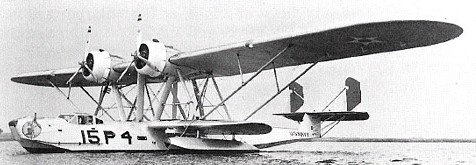
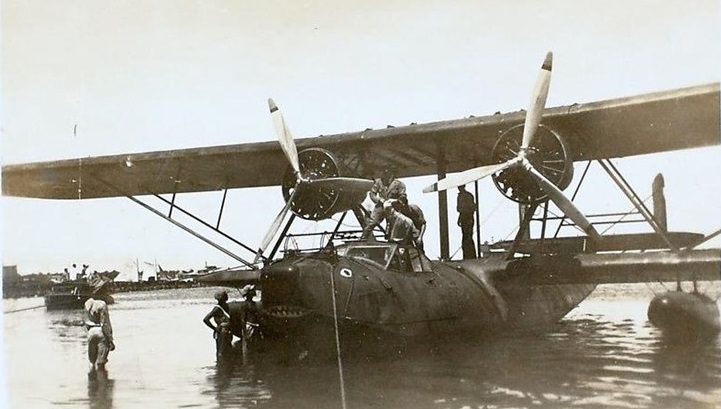
Foreign sales included a P2Y-1C for Colombia flown on December 23, 1932.
The sole P2Y-1C (ex NC2102) delivered to Cartagena, Colombia on Dec 31st 1932.
The Columbian P2Y remained in service until 1948.
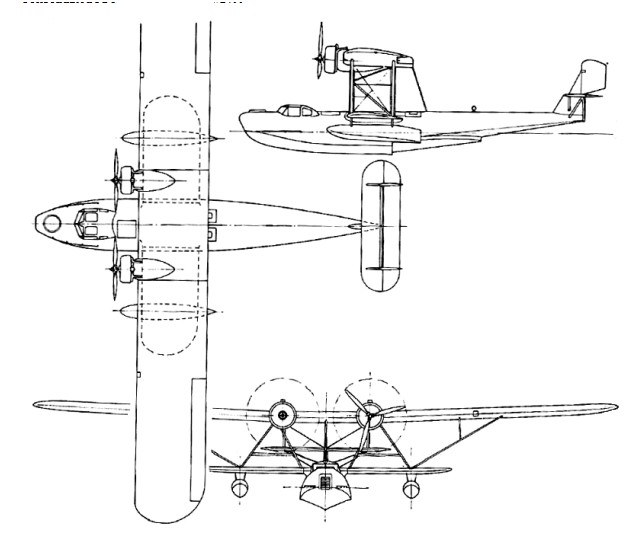
P2Y-3 Engine: 2 x 750hp Wright R-1820-90 Take-off weight: 11471 kg / 25289 lb Empty weight: 5797 kg / 12780 lb Wingspan: 30.48 m / 100 ft 0 in Length: 18.82 m / 61 ft 9 in Height: 5.82 m / 19 ft 1 in Wing area: 140.66 sq.m / 1514.05 sq ft Max. Speed: 224 km/h / 139 mph Cruise speed: 188 km/h / 117 mph Ceiling: 4907 m / 16100 ft Range: 1900 km / 1181 miles Armament: One flexible 7.62mm Browning in bows; two dorsal gun hatches in wings
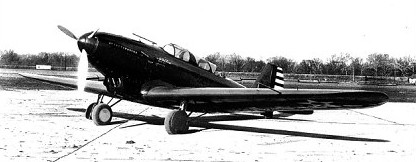
The P-25 was externally almost a replica of the Lockheed P-24 but slightly larger and heavier. One of Robert Wood’s design engineers moved from Lockheed to Consolidated and retained the goal of creating a fast, two-seat tandem fighter to replace the Berliner-Joyce P-16. The US Army Air Corps in 1932 was sufficiently interested to order two Consolidated Y1P-25 airframes, although the second was soon given the attack function and redesignated Y1A-11. A cantilever low-wing monoplane of all-metal construction (unlike its partly wood Lockheed forbear), the Y1P-25 had retractable landing gear, the familiar Curtiss Conqueror engine, and a rearward-facing machine-gunner. The engine was supercharged, making possible a top speed of 398km/h at 4500m. First flown in 1932, the Y1P-25 crashed on 13 January 1933 and was written off. The Y1A-11 was also lost that same month. But in its short test life the Y1P-25 had shown sufficient promise for the USAAC to seek further development. Indeed, by May 1932 the service had decided to explore the basic design further. The Y1P-27 and Y1P-28 variants, to be powered by Pratt & Whitney Wasp engines of different marks, were seriously contemplated but never built. Four Conqueror-powered service-test machines were completed as P-30s (see separate entry) and later machines were redesignated PB-2 (for pursuit, biplace) (see separate entry). The basic design, after being allocated several designations, became the principal USAAC two-seat fighter between world wars.
Take-off weight: 2318 kg / 5110 lb Empty weight: 1763 kg / 3887 lb Wingspan: 13.36 m / 43 ft 10 in Length: 8.94 m / 29 ft 4 in Height: 2.62 m / 8 ft 7 in Wing area: 27.87 sq.m / 299.99 sq ft Max. speed: 398 km/h / 247 mph Cruise speed: 290 km/h / 180 mph Ceiling: 8230 m / 27000 ft Range: 933 km / 580 miles Armament: 2 x 7.62mm fixed machine-guns + 1 x 7.62mm in the rear
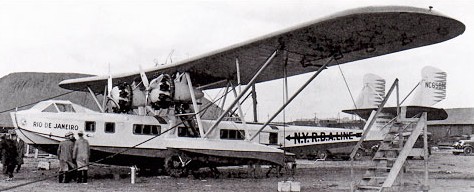
The Commodore twin-engined flying boat were ordered by a US-owned South American-based airline called NYRBA which challenged Pan American’s regional dominance and was later leveraged to sell its assets to Pan Am (circa 1930). Subsequently Pan Am went on to operate Commodores up to and through World War II, and some machines had short careers with successor operators. A total of 14 were ordered for commercial use. The Commodore failed to gain military orders in the form of XPY-1.
Model 16-1 Commodore Engine: 2 x 575hp Pratt & Whitney R-1860 Hornet radial Take-off weight: 7983 kg / 17600 lb Wingspan: 30.48 m / 100 ft 0 in Length: 18.80 m / 61 ft 8 in Height: 4.76 m / 15 ft 7 in Max. Speed: 206 km/h / 128 mph Ceiling: 3430 m / 11250 ft Range: 1609 km / 1000 miles Crew: 3 Passengers: 22
Developments of the PT-1 The O-17 was the PT-3 developed for National Guard as observation aircraft.
NY-2 Engine: 1 x 220 hp Wright R-790-8. Take-off weight: 1193 kg / 2630 lb Empty weight: 817 kg / 1801 lb Wingspan: 12.19 m / 39 ft 12 in Length: 8.51 m / 27 ft 11 in Height: 3.02 m / 9 ft 11 in Wing area: 34.37 sq.m / 369.96 sq ft Max. Speed: 158 km/h / 98 mph