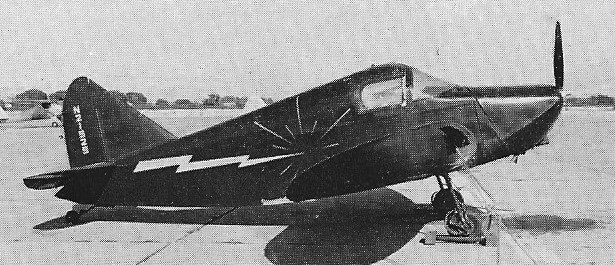
About fifty Dart Aircraft Co Darts were produced before the war, using one of three engines, the 90hp Lambert R 266 in the model G, the 90hp Ken¬Royce in the model GK and the 90hp Warner Scarab Junior in the model GW.
In 1939 the Dart Aircraft Co became the Culver Aircraft Co, and produced the new Culver Cadet. Rolled out at Port Columbus, Ohio, in February 1939, still called the Dart, the Culver L soon changed, its name to Cadet. The new model was announced in March 1940 and certificated under ATC 730 in September 1940. The first model was the LCA fitted with a 75hp Continental A 75 8 and later with the 80hp A 80 8. In 1941 it was offered with the 80hp Franklin 4AC 176 F3 as the model LFA. A further development was the LFA 90 with the 90hp Franklin 4AC 199 E3.
With a fuselage of semi monocoque wood construction the Cadet used stressed skin, plastic bonded plywood reinforced with longerons. The wings had an I beam main spar of laminated spruce and mahogany plywood. The leading edge was plywood covered back to the spar and the whole covered with fabric. Slots were built into the leading edge for improved control response at low speeds.
Undercarriage was retractable inwards into the wings, but the tailwheel was fixed. The fixed tail surfaces were of wood, covered in plywood, but the moving surfaces were of welded steel tube and fabric covered.
In general the Dart and the Culver were well liked. Both were short coupled and as a result were highly manoeuvrable. About 360 Cadets were built and probably about eighty were still around in 1987.
With Pearl Harbour the US economy was put on a war footing and the Cadet ceased production. Some were adapted as target drones, and the first PQ 8s were very similar to the LFA apart from the tricycle undercarriage necessary for radio controlled operation. The LAR 90 as Culver called it, was powered by a 90hp Franklin O 200 1 and 200 were built.
More powerful was the PQ 8A with a 125hp Lycoming 0 290 and a further 200 were built for the USAAF. Certificated in September 1941 under ATC 748, these were eligible for surplus sales post war, but only two were registered in 1948.
When Culver went out of business in 1946 Ray Applegate & Weyant, Tecumseh MI. acquired the rights to the Culver G Dart (ATC 674). About ten were built. powered by a 100hp Continental A-100 engine, before lack of sales halted production.

The rights were bought by Superior Aircraft Co and then sold to California Aero Co of Tracy. They revived the model in 1966 as the Helton Lark 95 with a 90hp Continental C 90 16. Dimensions were similar to the Cadet, though the overall height was 6ft 10in due to the tricycle gear.
LCA Cadet
Engine: Continental, 75 hp
Wingspan: 26 ft 11 in
Length: 17 ft 8 in
Height: 5 ft 6 in
Empty weight: 720 lb
Loaded weight: 1305 lb
Max speed: 140 mph
Cruise: 120 mph
ROC: 800 fpm
Service ceiling: 17,500 ft
Range: 600 mi
Seats: 2

