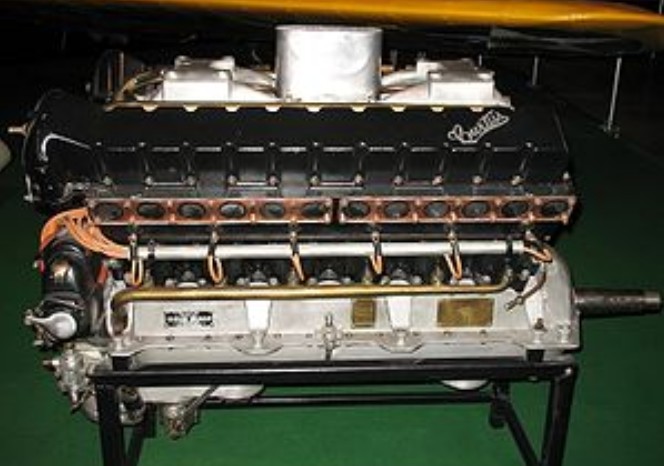
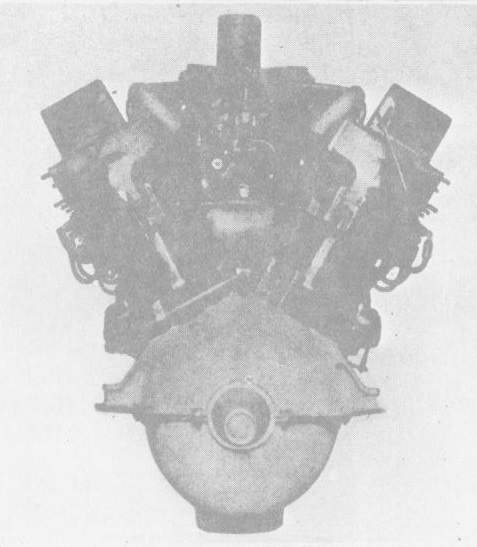
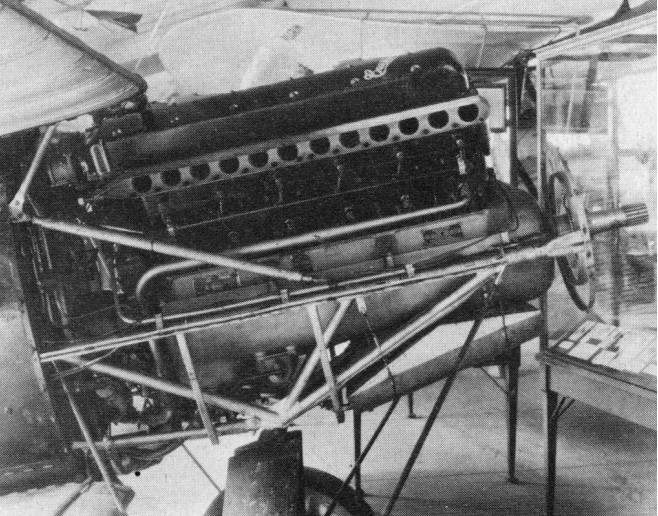
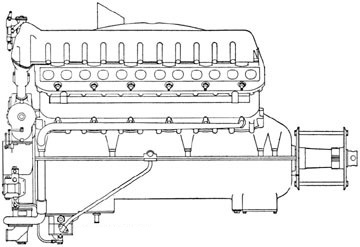
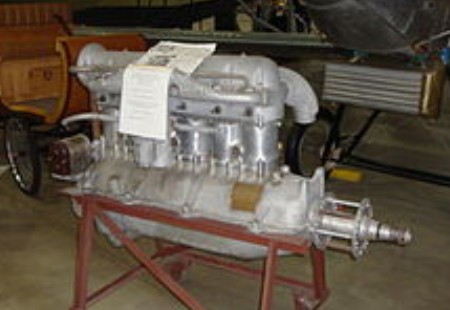
The 1922 Curtiss D-12 (ATC 10) was an aero engine of 18.8 litres capacity. A re-designed K-12 by Arthur Nutt. It was a water-cooled V12, producing 443 hp (330 kW) and weighing 693 lb (314 kg). It was designed by Arthur Nutt in 1921 with enbloc type jacket construction in two banks of six each. The cylinders were of heat treated hydraulically forged carbon steel with the head end closed.
Four interchangeable tulip valves seating directly in each cylinder head. The crankshaft was carried in eight bearings. The gear assembly is removable as a unit. The pistons are ribbed head type aluminium alloy. The connecting rods are master and articulating.
An accesssories costing extra was the Eclispe hand inertia starter.
Three Curtiss D-12 was used in the Curtiss CR-3 for the 1923 Schneider Trophy race. In racing trim the V-1400 D-12 gave 619 hp, against the normal 435 hp.
Fairey Aviation of England imported 50 Curtiss built examples in 1926, renaming them the Fairey Felix.
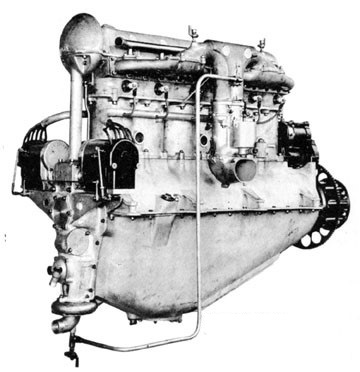
The 1922 Curtiss C-6 is a six-cylinder, water-cooled, inline aircraft engine and is a development of the Curtiss K-6 engine redesigned by Arthur Nutt. The C-6 features an overhead cam and aluminum cylinder jackets.
C-6 Type: 6-cylinder water-cooled inline Dry weight: 420 lb Valvetrain: Two intake and two exhaust valves per cylinder, pushrod-actuated Cooling system: Water-cooled Power output: 160 hp at 1,250 rpm 161 hp at 1,760 rpm Fuel consumption: .5 lbs per hp per hr Oil consumption: .016 lbs per hp per hr Power-to-weight ratio: 0.38 hp/lb
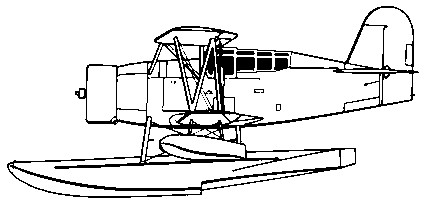
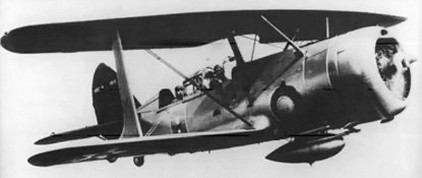
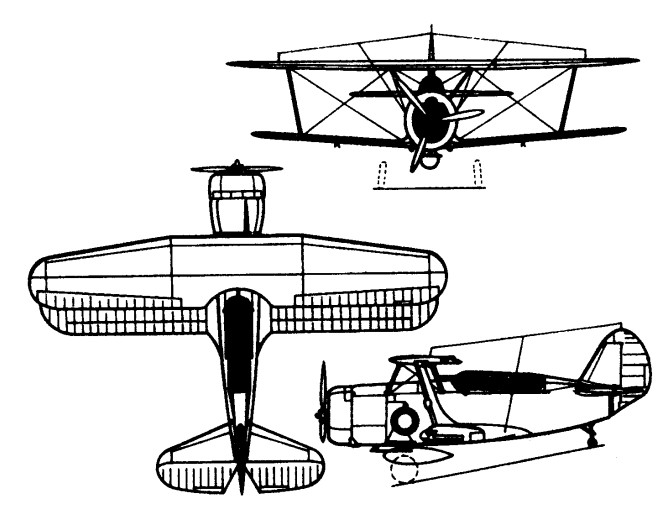
1937 saw the United States Navy looking for a replacement aircraft for its Curtiss SOC Seagull series of biplane floatplane aircraft. The requirement was circulated to US manufacturers in early 1933, resulting in proposals from Curtiss, Douglas and Vought, but it was the XO3C-1 prototype, company-designated Curtiss Model 71, ordered on 19 June 1933 and first flown in April 1934, which was ordered into production as the SOC-1 (Model 71A). This changed official designation reflected the combination of scout and observation roles. When first flown the prototype was equipped with amphibious landing gear, twin main wheels being incorporated in the central float. However, standard production aircraft were built as floatplanes, with non-retractable tailwheel landing gear optional; in any event they were easily convertible from one configuration to the other. Construction was mixed, with the foldable wings and tail unit of light alloy, a welded steel-tube fuselage structure, and a mixture of light alloy and fabric covering. The pilot and gunner/observer were accommodated in tandem cockpits, enclosed by a continuous transparent canopy with sliding sections for access. To provide a maximum field of fire for the flexibly-mounted gun in the rear cockpit, the turtleback could be retracted. Deliveries of the first SOC-1 production aircraft began on 12 November 1935. These were powered by Pratt & Whitney R-1340 Wasp engines, and the first squadrons to become fully equipped with the type comprised Scouting Squadrons VS-5B/ -6B/ -9S/ -10S/ -11S. Production of 135 SOC-1s was followed by 40 examples of the SOC-2 (Model 71B) with wheeled landing gear, detail improvements and R-1340-22 Wasp engines. A total of 83 examples of the SOC-3 (Model 71E) was built, these being generally similar to the SOC-1. SOC-2s and SOC-3s, after modification to install arrester gear during 1942, became redesignated SOC-2A and SOC-3A respectively. Curtiss also built three aircraft virtually the same as the SOC-3 for service with the US Coast Guard: these SOC-4 (Model 71F) aircraft were acquired by the US Navy in 1942 and equipped with arrester gear to bring them up to SOC-3A standard. In addition to the SOC Seagulls built by Curtiss, 44 were produced by the Naval Aircraft Factory at Philadelphia, Pennsylvania. Basically the same as the Curtiss-built SOC-3, these were designated SON-1 or, if fitted with arrester gear, SON-1A. Following termination of SOC production in early 1938, Curtiss became involved in the development and manufacture of a successor, designated SO3C Seamew. However, when the operational performance of the Seamew proved unsatisfactory it was withdrawn from first-line service; all available SOCs then reverted to operational status, continuing to fulfil their appointed role until the end of the war.
Curtiss SOC-1 Seagull Engine: 1 x Pratt & Whitney R-1340-18 Wasp, 447kW / 600 horsepower. Wingspan: 10.97 m / 35 ft 12 in Wing area: 31.77 sq.m / 341.97 sq ft Length: 8.08 m / 26 ft 6 in Height: 4.50 m / 14 ft 9 in Maximum Speed: 157mph (253kmh; 137kts) Cruise speed: 214 km/h / 133 mph Maximum Range: 954miles (1,535km) Rate-of-Climb: 1,000ft/min (305m/min) Service Ceiling: 14,895ft (4,540m) Armament: 1 x 0.30 cal (7.62mm) fixed, forward-firing machine gun. 1 x 0.30 cal (7.62mm) trainable machine gun in flexible mount in rear cockpit. 2 x 100lb bombs held underwing. Accommodation: 2 Hardpoints: 2 Empty Weight: 3,508lbs (1,591kg) Maximum Take-Off Weight: 5,437lbs (2,466kg)
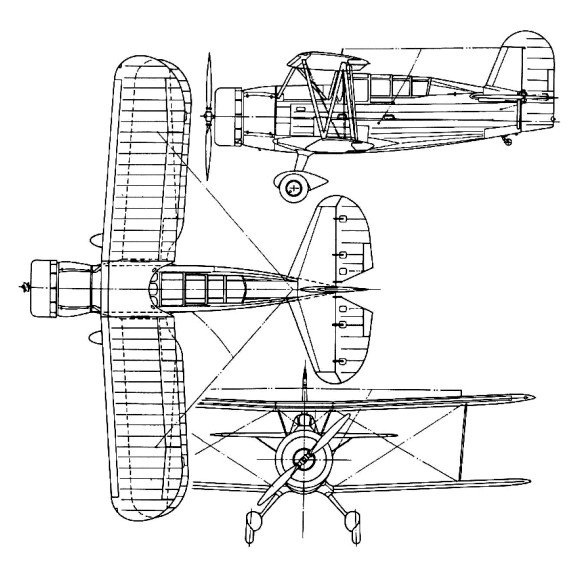
Among the evaluations of the Model 73 XF12C-1 was a dive bombing test in September of 1934 that resulted in a failure of the parasol monoplane wing assembly. Though the pilot and machine were wholly spared, the prototype was nonetheless heavily damaged. Testing had shown that the parasol wing assembly was generally unfit for the stresses of what the new aircraft would be called upon to achieve. As a result, the US Navy ordered a new prototype to fall in line with stricter requirements. Curtiss once again delivered an answer, this time the Model 77, to which the US Navy affixed the designation of XSBC-2. With a biplane wing, Wright R-1510-12 Whirlwind radial and three-bladed propeller, the first flight of the XSBC-2 was on December 9th, 1935. In March of 1936, a Pratt & Whitney R-1535-82 Twin Wasp Junior radial piston engine was fitted to the airframe, resulting in the revised company designation of “Model 77A” and the revised US Navy designation of “XSBC-3”.
The United States Navy contracted the company on August 29th, 1936, to deliver 83 SBC-3 “Helldiver” production aircraft. Initial deliveries occurred on July 17th, 1937 to Squadron VS-5 of the carrier USS Yorktown. By all reports, the SBC proved a rather pleasant airframe to control, however, the constantly changing world of technology in the late 1930s solidified the SBC as an out-of-date design, forcing the fighter to undertake second-line duties in the training of upcoming airmen out of Florida. The biplane dive-bomber soldiered on for a time longer with both US Navy and Marine Corps branches aboard such active carriers as the USS Hornet. The SBC Helldiver would lead a short active life with the US Navy and officially meet her end by October of 1944, being replaced by much-improved and modern types. The SBC Helldiver was the last biplane aircraft to be purchased by the United States Navy. The design was characterized by its staggered, uneven span biplane wing arrangement with outboard struts, cabling and skeletal inboard struts holding the wings in place. The fuselage was metal clad. The undercarriage, while retractable, still sported its visible wheels tucked in alongside each forward fuselage side. The crew of two sat in tandem under a glazed canopy. The cockpit was set at amidships, aft of the both wing assemblies.
Curtiss worked on improving the base SBC-3 series design and set one airframe aside for testing. The resulting tests yielded the new Model 77B, US Navy designation SBC-4. Fitted with a more powerful Wright R-1820-22 Cyclone 9 series radial piston engine of 850 horsepower, the US Navy signed a production contract on 5 January 1938 for 174 examples, 1938 with the first deliveries beginning in March of 1939.
France desperately attempted to counter the German advance by quickly improving their military inventory, even contracting American aircraft firms for whatever they could make available. In early 1940, the United States Navy rerouted some 50 of its actively serving SBC-4 Helldiver aircraft to the French Navy with a total of 90 on order for France. Aircraft were repainted via French standards and the 0.30 caliber armament was upgraded to a more potent pairing of 2 x 0.50 caliber. All American instruments were replaced by French-labeled ones and Curtiss employees would be involved in delivering the aircraft to the French carrier Bearn by way of Nova Scotia. The Bearn eventually accepted the aircraft and made her way across the Atlantic back to France. This delivery would arrive too late to be of much use in combat and the nation of France eventually capitulated. The Bearn moved south to the Caribbean island of Martinique where the remaining forty-nine SBC-4s fell victim to the corrosive effects of the tropical environment, destined never to fight. At least five SBC-4s were accepted into the inventory of the Royal Air Force under the designation of Curtiss “Cleveland” Mk.I and generally used to train ground personnel out of Little Rissington, UK.
The US Navy secured a revised SBC-4 model with the addition of self-sealing fuel tanks, and a total of 175 were built by April 1940, of which 117 were in service by December 1941. By the time the USA became involved in World War II, the SBC-3s had become obsolescent, but SBC-4s were then in service with US Navy Squadrons VB-8 and VS-8 on board the USS Hornet and with US Marine Squadron VMO-151. Overall production for the series was 308 aircraft.
XSBC 3 Engine: 825 hp Pratt & Whitney R¬-1535 82 Twin Wasp Junior Armament: 2 x 0.30 in (7.62 mm), 227 kg (500 lb) bomb
XSBC-4 Engine: Wright R 1820 22 Cyclone
Curtiss SBC-4 Helldiver Engine: 1 x Wright R-1820-34 Cyclone radial, 671kW / 950 horsepower. Wingspan: 10.36 m / 34 ft 0 in Length: 8.57 m / 28 ft 1 in Height: 3.17 m / 10 ft 5 in Wing area: 29.45 sq.m / 317.00 sq ft Take-off weight: 3211 kg / 7079 lb Empty weight: 2065 kg / 4553 lb Max. Speed: 377 km/h / 234 mph Cruise speed: 282 km/h / 175 mph Service Ceiling: 7315 m / 24000 ft Rate-of-Climb: 1,630ft/min (497m/min) Range w/max.payload: 652 km / 405 miles Maximum Range: 590miles (950km) Armament: 1 x 7.62mm forward-fixed M1919 Browning machine gun, 1 x 454 kg / 1,000lb bomb 1 x 7.62mm trainable machine gun in rear cockpit. Crew: 2 Hardpoints: 1
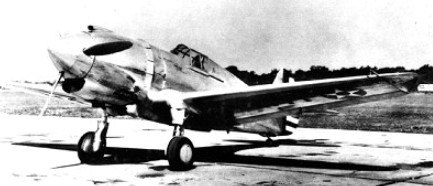
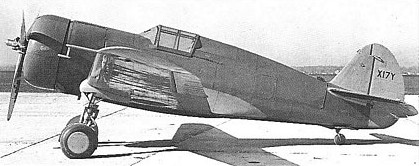
The Curtiss Aeroplane Company of Buffalo, New York, used the basic airframe of the Model 75 Hawk to create the re engined XP 37. The XP 37’s Allison V 1710 11, equipped with a General Electric turbo supercharger, was rated at 1,000 bhp. Engineers at Curtiss promised the US Army Air Corps that this in line powered offspring of the more familiar P 36 Mohawk (or Hawk 75) would be able to attain a level flight speed of no less than 340 mph. To attain increased speed, designers moved the cockpit of the XP 37 (known to the company as the Hawk 751) far back on the spine of the fuselage. At a normal angle of attack, the pilot could not see over the nose and wing in order to have a view of the runway.
After the first aircraft was tested in 1938, an effort was made to improve pilot visibility in 13 service test YP 37 airframes (serial numbers 38 472/484) by lengthening the fuselage 22 inches (to 32 ft 10 in). The YP 37s were powered by the slightly modified 992kW V 1710 21 engine. The YP 37s went through extensive testing at Wright Field in Dayton, Ohio, including gunnery trials. The US Army’s Pursuit Projects Office at Wright Field, under 1st Lieutenant Benjamin Kelsey, was sorely undermanned and starved of money so the YP 37 had to vie for attention with such promising types as the XP 38 Lightning and XP 39 Airacobra. Visibility remained a problem and the YP 37 was not as stable as Army pilots wanted. Both the XP 37 and YP 37 were a bit outlandish for their day, but Berlin, Kelsey and Air Corps procurement chief Colonel Oliver Echol lost interest when they saw flight results from the XP 40 Warhawk.
YP 37 Wing span: 11.38 m / 37 ft 4 in. Height: 2.90 m / 9 ft 6 in. Wing area: 21.92 sq.m / 236 sq ft. Length: 10 m / 32 ft 10 in Empty weight: 2596 kg / 5,723 lb. Maximum take off weight: 7,718 lb. Max speed: 331 mph at 20,000 ft. Cruise: 305 mph. Landing speed: 85 mph. Service ceiling: 10360 m / 34,000 ft. Range: 540 miles. Armament: 1 x 7.62mm + 1 x 12.7mm machine-guns
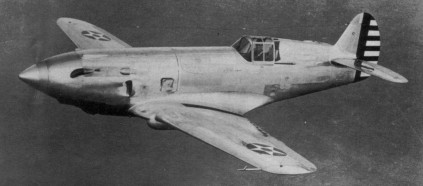
The Curtiss XP-42, a conversion of a P-36A Mohawk airframe and given the S/N of 38-004, was employed as a testbed at Wright Field, Ohio. Beginning in March 1939 test attempted to determine whether stream-lining could reduce drag in a radial-powered fighter and make it competitive with more advanced fighters employing inline engines. Delivered to the Army in March 1939, the XP-42 was powered by a 1,050 hp / 783kW Pratt & Whitney R-1830-31 Twin Wasp radial enclosed by a bullet-shaped, sheet-metal cowling extended forward to a large, pointed spinner and a three-blade propeller. A long shaft was developed to drive the propeller but gave serious vibration problems. An airscoop below the spinner provided cooling air, while smaller intakes above the engine provided air to the carburettor.
The aerodynamic nose shape provided almost no reduction in drag, and cooling problems proved almost insurmountable. While the XP-42 was marginally faster than the open-cowl P-36A, its performance did not compare favourably with the P-40 or with other, newer fighters of the immediate pre-war period. A variety of nose configurations was tried on the XP-42, altering its fuselage length with each change, but none vindicated the enclosed radial engine. When hostilities began, the XP-42 had been ruled out as a possible production aircraft but continued to aid in research. In 1942, the XP-42 tested an all-flying stabilizer, similar to the stabilator found on modern jets. The XP-42 had begun flying in natural metal finish and was camouflaged during one of its minor rebuilds. The airframe, which contributed knowledge to designers and engineers, was eventually taken out of service. The entire project was officially ended by 1947, at which the aircraft was scrapped for parts.
Curtiss XP-42 Engine: 1 x Pratt & Whitney R-1830-31 radial engine, 1,050hp. Length: 28.22ft (8.6m) Wingspan: 11.38 m / 37 ft 4 in Wing area: 21.83 sq.m / 234.98 sq ft Height: 8.20ft (2.50m) Empty Weight: 4,817lbs (2,185kg) Maximum Take-Off Weight: 5,648lbs (2,562kg) Maximum Speed: 250mph (402kmh; 217kts) Maximum Range: 830miles (1,336km) Service Ceiling: 37,198ft (11,338m) Crew: 1
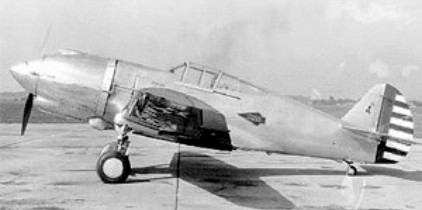
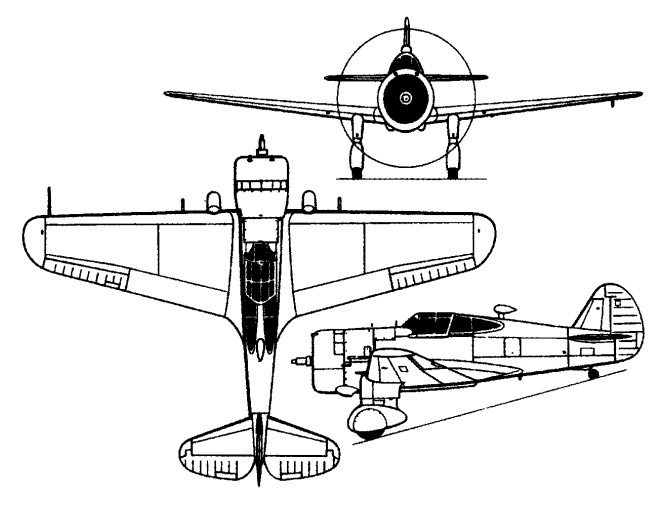
One of the first mono¬plane fighters to be put into full scale military service, designed by Donovan R Berlin, the Model 75 Hawk began as an entrant in a 1935 design competition. Work on the prototype began in October 1934, and it flew for the first time on 15 May 1935, powered by a 900 hp / 671kW Wright R 1670-5 two row radial engine. Featuring a monocoque fuselage and a multi-spar wing, proposed armament comprised one 12.7mm and one 7.62mm machine gun.
The competition was delayed by the other prospective entrants until August 1935, when the Curtiss entry was designated Model 75A during the trials. After this, all entrants were recommended to improve upon their designs. The unsatisfactory behaviour of the Wright engine resulted in its replacement by a 700hp Pratt & Whitney R-1535 Twin Wasp Junior.
This, too, proved troublesome and was succeeded by a 950hp Wright XR-1820-39 (G5) Cyclone nine-cylinder radial with which the prototype became the Model 75B.
In the rerun of the competition in April 1936 the modified Hawk, lost the main army contract to the Seversky SEV-1XP, but in July 1936 three examples were ordered for further trials.
Hawk 75B
Known as YIP 36s, they had retractable tailwheels, modified cockpit canopies, and were fitted with 1050 hp R-1830-13 Twin Wasps, first flying in January 1937. Two hundred and ten Model 75As were ordered in July 1937, of which 178 were completed as P 36As, with standard armament of two 0.30¬in (7.62 mm) machine guns above the engine, and 31 as P 36Cs with uprated engines (1200¬hp R 1830 17s) and an additional 0.30 in (7.62 mm) gun in each wing. The first production P-36A first flew in April 1938.
Deliveries began in April 1938 and ended early the next year, and on December 7, 1941, four P 36As of the 46th Pursuit Squadron shot down two Japan¬ese bombers in the second stream of the attack on Pearl Harbour. The US Army 18th and 20th Pursuit Groups operated the P-36A, the 20th employing three squadrons at Barksdale Field, Louisiana. As late as 1942, while war raged in the Aleutians, the 28th Composite Group operated P-36As in Alaska.
Only 177 P-36A were completed, the remaining machines being converted to P-36B with higher power engines.
The 1st Pursuit Group, Selfridge Field, Michigan, despatched a dozen P-36Cs to the National Air Races in Cleveland, Ohio, in September 1939, each machine painted in an elaborate, one-of-a-kind camouflage scheme. Amid the 7 December 1941 Japanese carrier strike on nearby Pearl Harbor, First Lieutenant Lewis M. Sanders, commander of the 46th Pursuit Squadron, got aloft from Wheeler Field with four P-36As and led his men in shooting down three attacking aircraft. Second Lieutenant Philip M. Rasmussen was credited with one of the kills, as was Second Lieutenant George H. Sterling, Jr, who was killed in the action, one of the first American fatalities of the conflict.
The XP-36D was tested with two cowl-mounted 12.7mm and four wing-mounted 7.62mm guns. The XP-36E was also a solitary armament test ship with one nose 12.7mm and eight wing 7.62mm guns. The XP-36F, also a one-off conversion, had two underwing 23mm Madsen cannon plus one 7.62mm and one 12.7mm nose guns. Production efforts shifted to 31 examples of the P-36C with engine improvements.
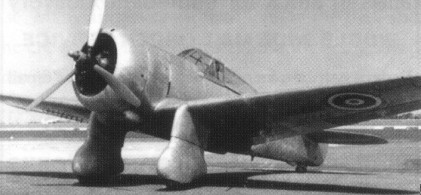
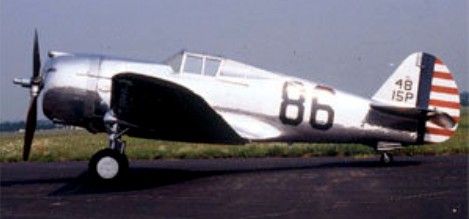
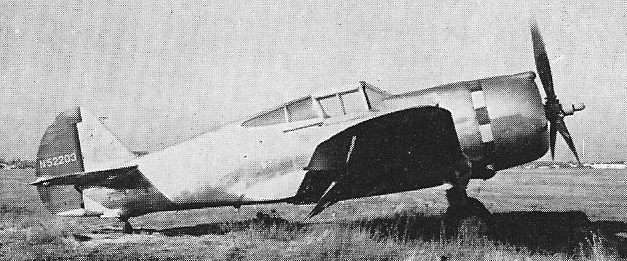
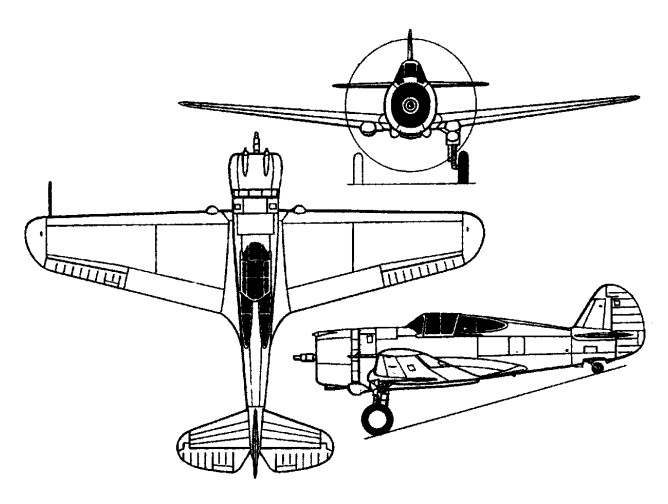
In 1937 Curtiss had built two Model 75H demonstrators for export in parallel with the three Y1P-36s ordered by the USAAC, these being of simplified design with a fixed cantilever undercarriage. Racks under each wing carried up to 136 kg (300 lb) of bombs, and powered by the 875hp Wright Cyclone GR-1820-G3 Cyclone nine-cylinder radial. One mounted an armament of one 12.7mm and one 7.62mm gun in the nose, and the other having this armament supplemented with a pair of wing-mounted 7.62mm weapons. These were sold singly to Argentina and China, both of whom became major customers for the fixed gear version. China was the first quantity purchaser of the fixed undercarriage Hawk 75, a total of 30 being delivered under the designation Hawk 75-M between May and August 1938. A further 82 were to have been assembled by CAMCO (Central Aircraft Manufacturing Company) at Loiwing, but these were cancelled in favour of assembly of the more advanced Hawk 75A-5. In 1938 112 examples of a less complex export version, the Hawk Model 75M, were purchased by the Chinese Nationalist air force powered by 875 hp Cyclones and armed with two 0.30 in (7.62 mm) machine guns The delivery followed from November 1938 of 29 aircraft to Argentina under the designation Hawk 75-O, these having an armament of four 7.62mm guns, and a further 20 examples were licence-built by the FMA.
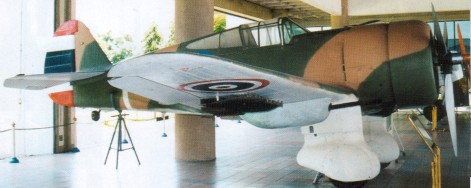
Delivered to Thailand in 1937 were 12 Hawk 75-Ns, these having two fuselage-mounted 7.62mm guns and two underwing 23mm Madsen cannon. The 75N is a ‘light-weight’ export version with a fixed spatted undercarriage and powered by a Pratt & Whitney R1830 radial. The type saw limited action, against France when Thailand invaded Indo-China in January 1941 and again in December against invading Japanese forces. Four were lost during opening battles and the remainder eventually falling into Japanese hands.
Two additional 0.30 in (7.62 mm) guns, wing mounted, were installed in the 25 Model 75Ns exported to Siam, while 30 Model 75Os ordered by Argentina had six 0.30 in (7.62 mm) guns, all mounted in the wings. A further 200 Model 75Os were licence built in Argentina, bringing overall Hawk 75 series production to 1443, including prototypes and those built outside the US.
Two export Hawk Model 75Qs went to China, one being presented to General Claire Chennault by Madame Chiang Kai-shek. In the USA, the relatively new P-36As were rapidly considered obsolescent as war clouds gathered.
Completed late in 1938 as a company-owned demonstrator, the Hawk 75-R was essentially similar to the USAAC’s P-36A. Its Pratt & Whitney R-1830-19 (SC2-G) Twin Wasp was, however, fitted with a turbo-supercharger mounted beneath the nose, just aft of the engine cowling, with a ventrally-mounted intercooler. Extensively tested by the USAAC, the Hawk 75-R was eventually returned to Curtiss as the turbo-supercharger proved unreliable and the manual monitoring of the unit was considered impracticable in combat. The turbo-supercharger was subsequently removed and the aircraft re-engined with a Cyclone.
Hawk 75A-1
No other P 36 model entered production for the US Army, but the designation P 36G was given to 30 H75A 8 export Hawks from an abortive Norwegian order, and there were numerous experimental models. The XP 36B, a P 36A fitted with an 1100 hp R 1830 25 Twin Wasp, was the fastest P 36 variant, but did not go into production. Another P 36A, converted in March 1939, became the XP 42 (Curtiss Model 75S) which, with an R 1830 31 engine and streamlining modifications, eventually reached 552 km/h (343 mph). The XP 36D, XP 36E and XP 36F were one off armament testbeds. One XP 37 (Curtiss Model 75I), based on the P 36 design, had a longer fuselage, the cockpit further aft, and an 1150 hp Allison V¬1710 11 engine. It was the first US fighter to exceed 483 km/h (300 mph), and 13 were ordered for service trials as YP 37s; but further development was abandoned, as the XP 40 (Curtiss Model 75P) Warhawk prototype was clearly the better proposition for series production.
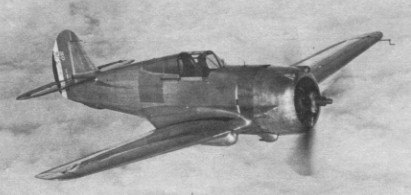
Against the 228 P 36 type Hawks built to USAAC/USAAF contract, more than 1200, in numerous versions, were built for export, serving in many theatres of the Second World War and with both sides involved in the conflict. First export model was the H75A-1, of which 100 were ordered by France in May 1938, deliveries beginning in February 1939. They were similar to the P 36A, with a 1050hp R 1830 SC3G Twin Wasp engine, two 73mm (0.295 in) FN Browning machine guns above it, and one in each wing. Designated H75 C1 by the French, indicating Chasse or fighter, one seat, when that country fell in 1940 some were captured by the Luftwaffe, others escaped to unoccupied France, North Africa or the UK, and some were resold to Finland. Those absorbed by the RAF were named Mohawk I; similarly, Mohawk IIs were escaped H75A 2s from the second batch of 100 ordered by France in 1938, which had 1050 hp R 1830 S1C3G Twin Wasps and two extra 7.5 mm (0.295 in) guns. Delivery of the penultimate French order, for 135 H75A 3s, was completely disrupted by the country’s collapse. Identical to the H75A-2s but for their uprated (1200 hp) Twin Wasp engines, some A 3s went to the West Indies as trainers while others rusted away at their delivery depots. Those still under construction in May 1940 eventually reached the RAF as Mohawk IIs, their six guns being exchanged after arrival for 0.303 in (7.7 mm) Brownings. Their first combat duties were in India in late 1941, although some had served earlier with the South African and Portuguese air forces. The last order from France was for 395 H75A-4s. They were similar to the 2 and 3 except for their 1200hp Wright Cyclone radial engines, and suffered a fate similar to their predecessors while undergoing delivery. Those arriving in the UK were named Mohawk IV, and rearmed to the same standard as before. RAF Mohawks continued to serve in the Burma theatre until 1944.
On Sunday 8 October 1939 at around 3.00pm two French fliers named Villey and Casenobe shot down one Messerschmitt 109 each near Landau, during an aerial combat between 5 Curtiss Hawks of the French ‘Red Devil’ Squadron (4 Sqn 2nd Fighter Group), and for Me 109s. These were the first French kills of the war.
P-36
Five of an intended 48 ‘Cyclone Hawks’, or similar to the H75A-4, were licence built by the Hindustan Aircraft Company in India. Curtiss built one similar H75A 5 which, with components to assemble others, was sent to China; but further details are unknown. Some went to the Luftwaffe, eight were sold to Finland, and those undelivered were sup¬plied subsequently as trainers to the free Norwegian forces in Canada. Holland ordered 35 Cyclone engined H75A 7s, of which 24 were sent to the Dutch East Indies air force for use against the Japanese. Thirty-¬six F175A 8s (Cyclone engines, nose guns of 12.7 mm (0.5 in) calibre) were ordered by Norway. A total of 24 Hawks reached Norway before a 1940 embargo by President Roosevelt on US fighter deliveries to Scandinavia. Six went to the free Norwegians in Canada; the rest became USAAF P 36Gs, 28 of them later going to Peru under Lend Lease. Ten Cyclone-engined H75A 9s (similar to the 4) were ordered by Iran, but never got there: they were captured by the British, shipped to India, and reassembled as Mohawks.
It was also built under licence in India and, with a fixed undercarriage, as the Hawk 75A-0 in Argentina.
Hawk 75N
Curtiss used this basic airframe to create the re engined XP 37. In July 1937 Curtiss installed an 1160 hp supercharged Allison V 1710 19 V type engine in the 10th production P 36A, and the XP 40 (Model 75P) was born: the first of a new series of fighter monoplanes that was to reach an eventual production total of 13738 and to serve with ten Allied nations during the Second World War. The XP 40, flown for the first time on October 14, 1938, and evaluated by the USAAC in the spring of 1939, brought Curtiss a $13 million contract for 524 production aircraft, fitted with 1040 hp Allison V¬1710 33 engines, in April of that year. The first three of these were used as prototypes, the first flight by a production P 40 (Curtiss Model 81 A) being made on April 4, 1940.
P 36A Engine: Pratt & Whitney R-1830-13 Twin Wasp, 1050 hp Wingspan: 37 ft 3.5 in / 11.36 m Length: 28 ft 7 in / 8.7 m Height: 9 ft 6 in / 2.89 m Wing area: 236 sq.ft Empty weight: 4541 lb / 2060 kg Loaded weight: 6662 lb / 3020 kg Max speed: 303 mph / 488 kph at 19,00 ft Cruise: 259 mph ROC: 2500 fpm / 762 m/min Service ceiling: 32,800 ft Range int.fuel: 680 mi / 1100 km Armament: 1 x 0.50in Browning, 1 x 0.30in Browning Bombload: 400 lb / 181 kg Seats: 1
P-36 C Hawk Engine: Pratt & Whitney R 1830-17 Twin Wasp, 1184 hp Length: 28.51 ft / 8.69 m Height: 9.514 ft / 2.9 m Wing span: 37.336 ft / 11.38 m Wing area: 235.947 sq.ft / 21.92 sq.m Max take off weight: 6010.8 lb / 2726.0 kg Weight empty: 4621.7 lb / 2096.0 kg Max. speed: 271 kts / 501 kph Cruising speed: 235 kts / 435 kph Service ceiling: 33694 ft / 10270 m Wing load: 25.42 lb/sq.ft / 124.0 kg/sq.m Range: 713 nm / 1320 km Crew: 1 Armament: 1x cal.50 MG (12,7mm), 3x cal.30 MG (7,62mm)
Hawk 75A Engine: Wright GR-1820-G205A Cyclone, 1200 hp Wingspan: 37 ft 3.5 in / 11.36 m Length: 28 ft 7 in / 8.7 m Height: 9 ft 6 in / 2.89 m Empty weight: 4541 lb / 2060 kg Loaded weight: 6662 lb / 3020 kg Max speed: 303 mph / 488 kph ROC: 2500 fpm / 762 m/min Service ceiling: 30,000 ft Range int.fuel: 680 mi / 1100 km Armament: 6 x 0.303in Bombload: 400 lb / 181 kg Seats: 1
Model 75B Wingspan: 11.37 m / 37 ft 4 in Length: 8.56 m / 28 ft 1 in Height: 2.74 m / 8 ft 12 in Wing area: 21.55 sq.m / 231.96 sq ft Take-off weight: 2302 kg Empty weight: 1837 kg / 4050 lb Max. speed: 459 km/h / 285 mph Range: 1175 km / 730 miles
Curtiss P-36G Hawk / Mohawk Engine: 1 x Wright R-1820-G205A Cyclone piston radial, 1,200hp. Wingspan: 11.28 m / 37 ft 0 in Wing area: 21.92 sq.m / 235.94 sq ft Length: 8.69 m / 28 ft 6 in Height: 2.82 m / 9 ft 3 in Empty Weight: 4,676lbs (2,121kg) Maximum Take-Off Weight: 5,880lbs (2,667kg) Maximum Speed: 322mph (518kmh; 280kts) Maximum Range: 650miles (1,046km) Cruise speed: 420 km/h / 261 mph Rate-of-Climb: 2,500ft/min (762m/min) Service Ceiling: 32,349ft (9,860m) Armament: 4 x 7.62mm machine guns 2 x 12.7mm machine guns Accommodation: 1 Hardpoints: 1
Hawk 75M Span: 11.38 m (37 ft 4 in) Length: 8.71 m (28 ft 7 in) Gross weight: 2406 kg (5304 lb) Maximum speed: 451 km/h (280 mph).
Hawk 75R Take-off weight: 2795 kg Empty weight: 2302 kg Wingspan: 11.37 m / 37 ft 4 in Length: 8.69 m / 28 ft 6 in Height: 3.71 m / 12 ft 2 in Wing area: 21.92 sq.m / 235.94 sq ft Max. speed: 531 km/h / 330 mph Range: 966 km / 600 miles
Hawk 75-0 Take-off weight: 2346 kg Empty weight: 1803 kg / 3975 lb Wingspan: 11.38 m / 37 ft 4 in Length: 8.71 m / 28 ft 7 in Height: 2.84 m / 9 ft 4 in Wing area: 21.92 sq.m / 235.94 sq ft Max. speed: 451 km/h / 280 mph Range: 880 km / 547 miles
H75A-1 Span: 11.38 m (37 ft4 in) Length: 13.711 m (28 ft 7 in) Gross weight: 2582 kg (5692 lb) Maximum speed: 488 km/h (303 mph)
H75A-4 Span: 11.38 m (37 ft.4 in) Length: 8.79 m (28 ft 10 in) Gross weight.’ 2608 kg (5750 lb) Maximum speed: 520 km/h (323 mph)
Mohawk IV Engine: Wright GR-1820-G205A Cyclone, 1200 hp Wingspan: 37 ft 3.5 in / 11.36 m Length: 28 ft 7 in / 8.7 m Height: 9 ft 6 in / 2.89 m Empty weight: 4541 lb / 2060 kg Loaded weight: 6662 lb / 3020 kg Max speed: 303 mph / 488 kph ROC: 2500 fpm / 762 m/min Service ceiling: 30,000 ft Range int.fuel: 680 mi / 1100 km Armament: 6 x 0.303in Bombload: 400 lb / 181 kg Seats: 1
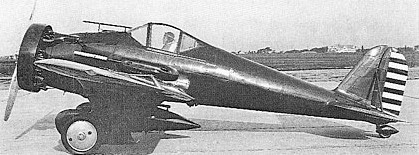
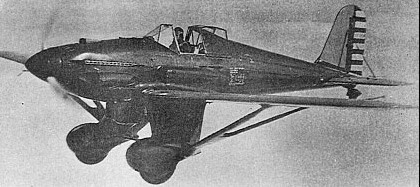
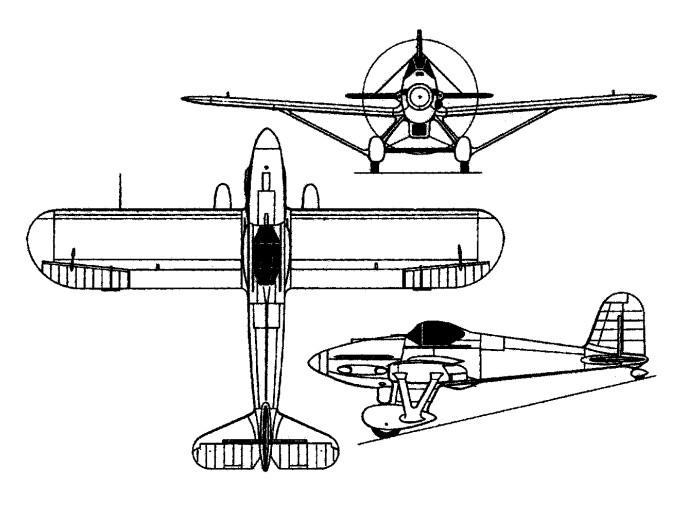
The XP-31 or Curtiss Shrike of 1932-3 was an all-metal, low wing, strut-braced fighter design which drew heavily upon the characteristics of the manufacturer’s A-8 Shrike (enclosed cockpit, trailing edge flaps and leading-edge slots), but failed to attain the A-8’s production status. The sole prototype XP-31, at first designated XP-934, arrived on the scene just when the comparable Boeing P-26 ‘Peashooter’ had already proven itself superior in most aspects of performance.
First flown in July 1932 with a 522kW Wright R-1820-4 Cyclone engine, the XP-31 was immediately found to be underpowered. Though the purpose seems unclear, the sole airframe was re-engined with a 447kW Curtiss V-1570 Conqueror powerplant which, in 1933 flight tests, offered no improvement of any kind. Slower than the P-26, and with a 595km range, the XP-31 helped Curtiss to upgrade its design and structural thinking at a time when the monoplane was clearly the aircraft of the future. Its non-retractable landing gear and drag-inducing wing struts were the last to appear on a USAAC fighter, but the XP-31, although very small by comparison with other pursuit ships of its day, was unduly heavy. The XP-31 was rigorously tested and underwent various minor modifications in the early 1930s, but it was not chosen for production and did not, directly, lead to any later designs. The existing XP-31 is understood to have been scrapped in 1935.
Engine: 522kW Wright R-1820-4 Cyclone Take-off weight: 1879 kg / 4143 lb Empty weight: 1512 kg / 3333 lb Wingspan: 10.97 m / 35 ft 12 in Length: 8.00 m / 26 ft 3 in Height: 2.36 m / 7 ft 9 in Wing area: 18.86 sq.m / 203.01 sq ft Max. speed: 334 km/h / 208 mph Ceiling: 7430 m / 24400 ft Range: 595 km / 370 miles Armament: 4 x 7.62mm machine-guns
Ordered in July 1931, the Curtiss XP-23 was the last biplane in the pursuit series, altered on the production line from the final airframe of the 45 ordered as Y1P-22 but redesignated P-6E. With fabric-covered metal wings of standard P-6 planform and a new metal skinned fuselage and initially powered by a 447kW Curtiss GIV-1570C Conqueror with a turbo-charger and three-blade propeller, the YP-23 was delivered 16 April 1932. Evaluated by operational fighter pilots at Wright Field with turbo-charger removed, two-blade propeller retrofitted, and its designation changed to YP-23, the YP-23 seems to have performed very well, subject only to the limitations of the biplane configuration. Some reports that the XP-23 was excessively heavy, with maximum take-off weight as high as 1950kg appear to be based on an erroneous interpretation of Curtiss documents from the period. The XP-23 was denied a production contract, competing not with other biplanes but with the monoplane Boeing P-26 ‘Peashooter’. Ultimately, the YP-23 was deleted from Army inventory and turned back to Curtiss, where its wings were retained for use on the prototype US Navy XF11C-1 shipboard fighter.
XP 23 Engine: Curtiss V 1570 23 Conqueror, 447kW Wingspan: 9.60 m / 31 ft 6 in Length: 7.26 m / 23 ft 10 in Height: 2.90 m / 9 ft 6 in Wing area: 23.23 sq.m / 250.05 sq ft Take-off weight: 1542 kg / 3400 lb Empty weight: 1315 kg / 2899 lb Top speed: 354 km/h / 220 mph at 4570 m / 15 000 ft Initial climb, 1,370 ft/min (6,96 m/sec) Ceiling: 7925 m / 26000 ft Range: 700 km / 435 miles Armament: 1 x 12.7mm + 1 x 7.62mm fixed machine-guns, 227kg of bombs
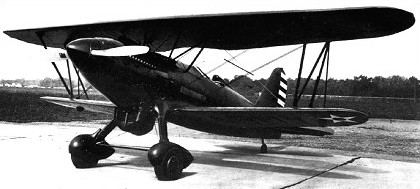
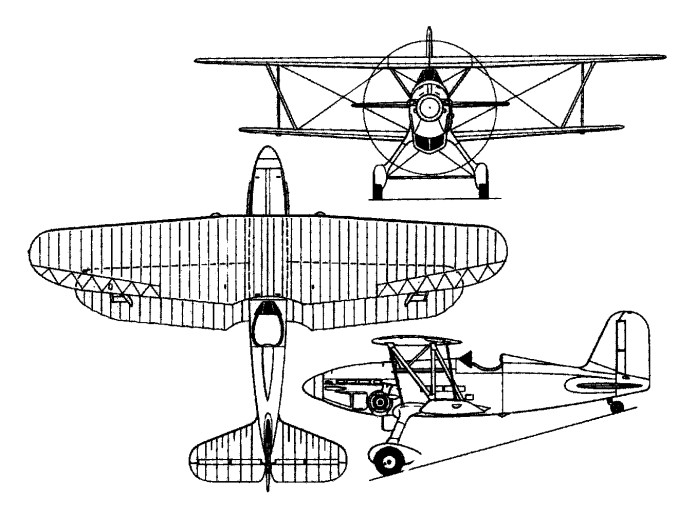
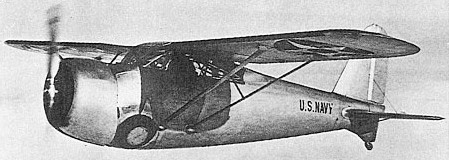
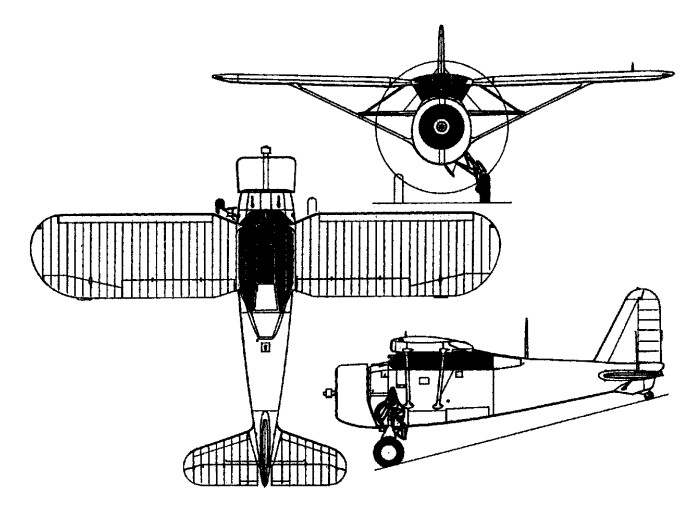
Perhaps the most unusual single-seat fighter developed by Curtiss was the Model 70, which was designed from the outset to be flown either as a monoplane or as a biplane with the minimum of structural change. A metal semi-monocoque aircraft with fabric-covered wings, it was ordered on 23 November 1932 as the XF13C powered by a Wright SGR-1510-2 two-row radial rated at 600hp at 3050m. The designation XF13C-1 was assigned to it for test in monoplane form and XF13C-2 in biplane (or more strictly, sesquiplane) form. It was initially flown in December 1933 as a biplane, flying in monoplane form on 7 January 1934, and being delivered to the US Navy as the XF13C-1 on the following 10 February. Featuring a manually-operated retractable undercarriage, an enclosed cockpit, retractable upper wing leading-edge slats and trailingedge flaps, the XF13C-1 did not revert to biplane standard, but, in February 1935, was returned to Curtiss for various modifications, including installation of an XR-1510-12 engine affording 700hp at 2135m. With these changes it was redesignated XF13C-3. In biplane configuration, the XF13C was 30km/h slower than as a monoplane, but possessed a shorter take-off run and better low-speed characteristics. Trials were terminated in October 1935, primarily owing to lack of engine spares.
XF13C-3 Engine: Wright SGR-1510-2 two-row radial, 600hp at 3050m Take-off weight: 2142 kg / 4722 lb Wingspan: 10.67 m / 35 ft 0 in Length: 7.86 m / 25 ft 9 in Height: 3.88 m / 12 ft 9 in Wing area: 19.04 sq.m / 204.94 sq ft Max. speed: 373 km/h / 232 mph