Czerwiński CW II / CW.III              

CW.II

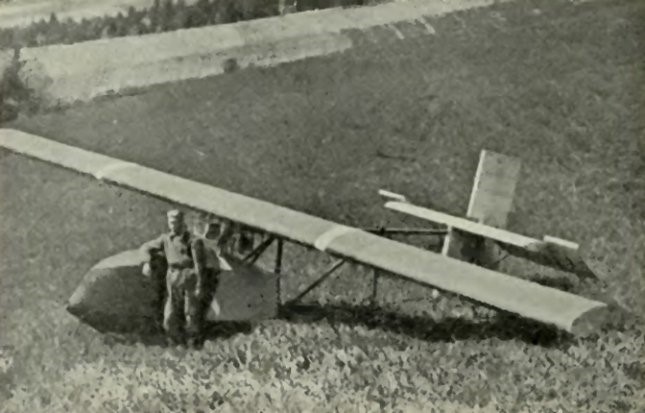
ZASPL, the Aviation Association of students of the Lwów Technical University, was the oldest aviation organization in Poland. Revived after World War I, by 1926 it had workshops in Lwów which began building the glider designs of ZASPL member Wacław Czerwiński. The second and third of these, the CW II and CW III, were both built there during 1929. Both were high wing, wooden, open frame gliders, though only the CW II had a nacelle enclosing the pilot’s cockpit.

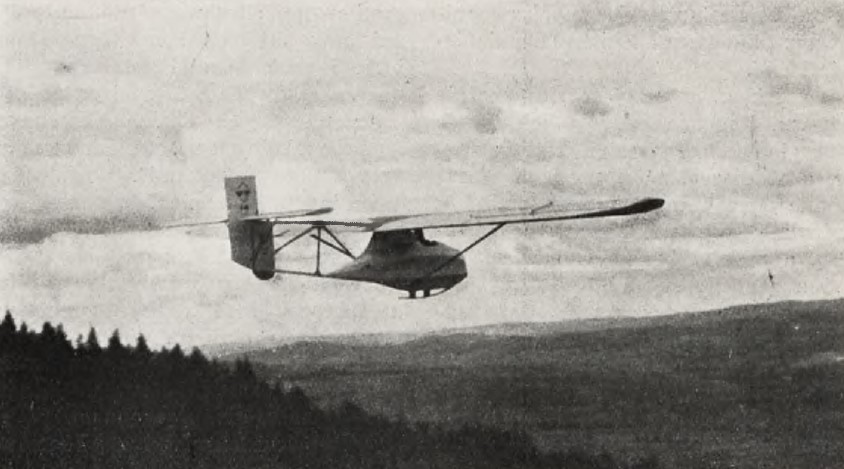
The CW II (also known as CW-02) had a rectangular plan, single spar wing, with plywood covering forward of the spar and aircraft fabric covering elsewhere, which was built in three parts, a half-span wide centre-section and two outer panels with trailing edges filled with ailerons. The centre-section was mounted just above the upper longeron, or chord, of the flat girder fuselage on four outward leaning inverted-V struts. Wire bracing from the lower longerons to the outer ends of the centre-section carried lift loads. The longerons were straight, parallel and cross-braced with alternate vertical and diagonal cross-members. The lower longeron extended forward of the wing and carried a plywood nacelle with an open cockpit; the nacelle extended rearwards under the wing. Under it, a wooden landing skid was mounted on rubber shock absorbers. The empennage was conventional, with fabric-covered rectangular surfaces. Its fin extended upwards from the lower longeron to just beyond the upper one, carrying the tailplane close above; a tall, balanced rudder operated in a cut-out between balanced elevators.
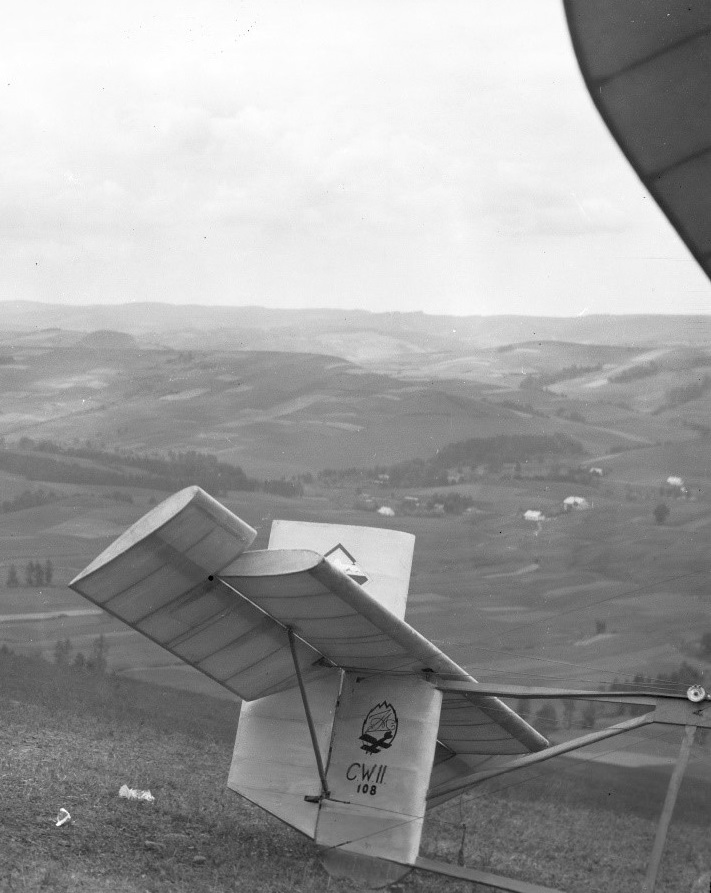
CW.II

In 1929 Greszczyk made the first, brief flights of both the CW II and CW III, towed behind a car. In the autumn of 1929 they were taken to Bezmiechowa Górna for pilot training. Over fifty flights were made, chiefly on the better-handling CW III, but on 2 November Greszczyk set a new national gliding duration record of 2:11:4.5 hours in the CW II. In the following spring they returned to Bezmiechowa with some thirteen novices, including the first two female Polish glider pilots, Danuta Sikorzaanka and Wanda Olszewskz. The CW III was used as a basic trainer, with the CW II reserved for the more experienced.
CW.II

In 1930 ZASPL began a short production run of the CW III (also known as CW-03), an improved version of the CW II also first flown in 1929, making it the first Polish glider to go into production. A few more were amateur built and overall as many as twenty were completed. The chief difference between it and the CW II was a new, two-part, rectangular plan wing with Gôttingen Gô 365 section. This had a lower aspect ratio of 5.9, with a reduced span but increased area. There was no nacelle, with the pilot exposed on a lowered seat. It proved easier to fly than the higher-performing CW II and well suited for its intended basic training role.

After successful operation between 1929 and 1931, the sole CW-II was considerably modified during the winter of 1931-2. It received a new, two part centre-section which was attached directly to the upper longeron and braced with a single strut on each side to the lower longeron. The wingtips were altered in plan from rectangular to curved, reducing the wing area by 3%, and the nacelle was better streamlined. These changes significantly improved the best glide ratio, though values given by various references differ.

From 1930 many Polish pilots learned to fly on the production CW IIIs, though these were soon joined and then supplanted by a 1931 CW II development, the simpler and cheaper CWJ. The last CW IIIs were withdrawn from service in 1938.

Variants:

CW II
Built in parallel with CW III, completed 1929. Open frame glider with pilot’s nacelle.

CW IIbis
CW II revised in 1931-2 with a reduced area wing which had a new, strut braced, two part centre-section and rounded tips. Better aerodynamics and performance.
Wingspan: 11 m (36 ft 1 in)
Wing area: 18.1 sq.m (195 sq ft)
Aspect ratio: 6.7
Airfoil: Gôttingen Gô 535
Length: 6.25 m (20 ft 6 in)
Height: 1.75 m (5 ft 9 in)
Empty weight: 120 kg (265 lb)
Gross weight: 195 kg (430 lb)
Stall speed: 38 km/h (24 mph, 21 kn) minimum speed
Maximum glide ratio: 13 at 47 km/h (29 mph; 25 kn)
Rate of sink: 0.95 m/s (187 ft/min) at 44 km/h (27 mph; 24 kn)
Crew: One

CW III
Built in parallel with CW II, completed 1929, it was similar to the Cw II but lighter, with no pilot’s nacelle, a different wing of lower aspect ratio and a different airfoil. It had lower performance than the CW II but was easier for novices to fly. Limited production from ZAPL and some amateur builds together provided about twenty airframes; it was the first Polish glider to reach production.
C.W. Aircraft

UK
Established 1936 by C R. Chronander and J. I. Waddington to design and develop Cygnet two-seat all-metal cabin monoplane, which first flew in 1937. Rights in Cygnet acquired by General Aircraft Ltd. in 1938. C W. was then re-formed as Chronander Waddington Aircraft Ltd., a company not concerned with the building of aircraft.

Curtiss-Wright 62 / O-40 Raven

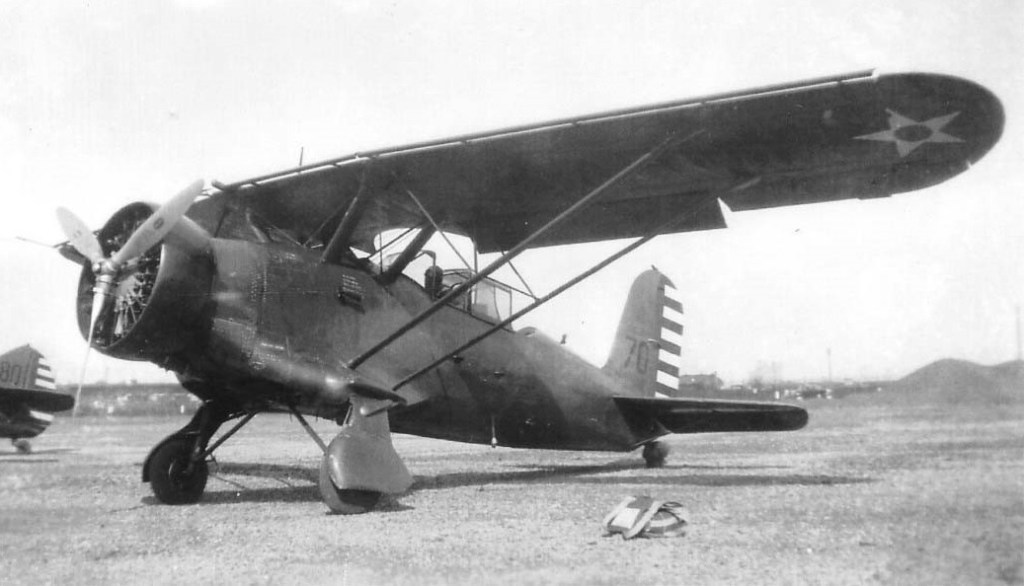
The original prototype YO-40

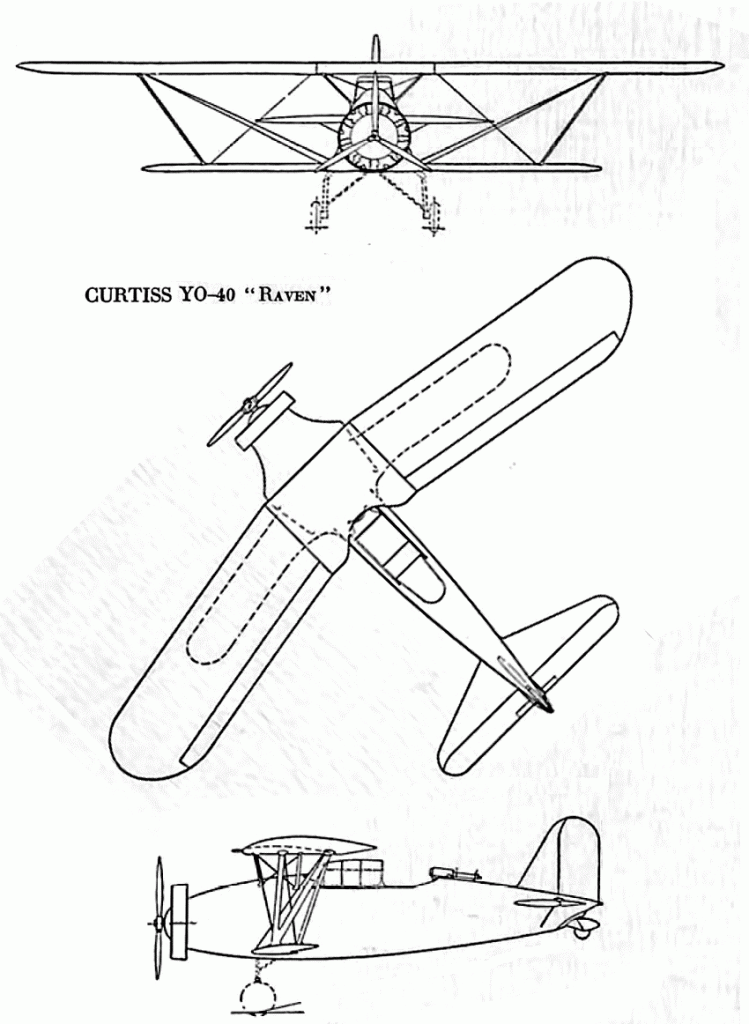
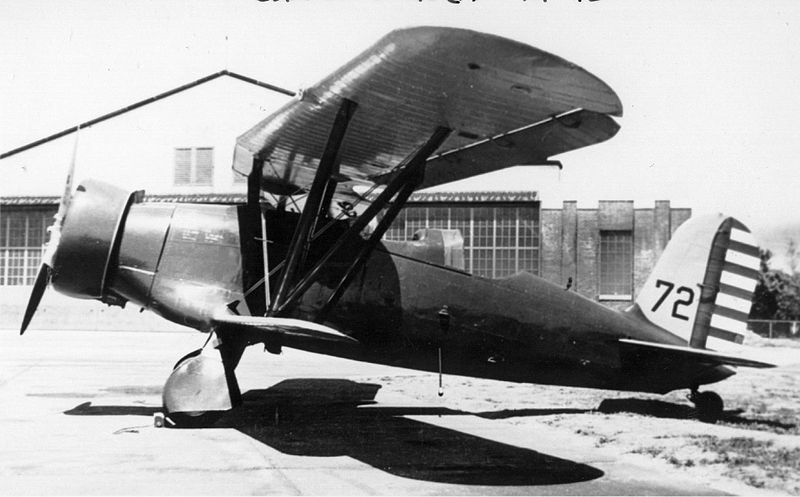
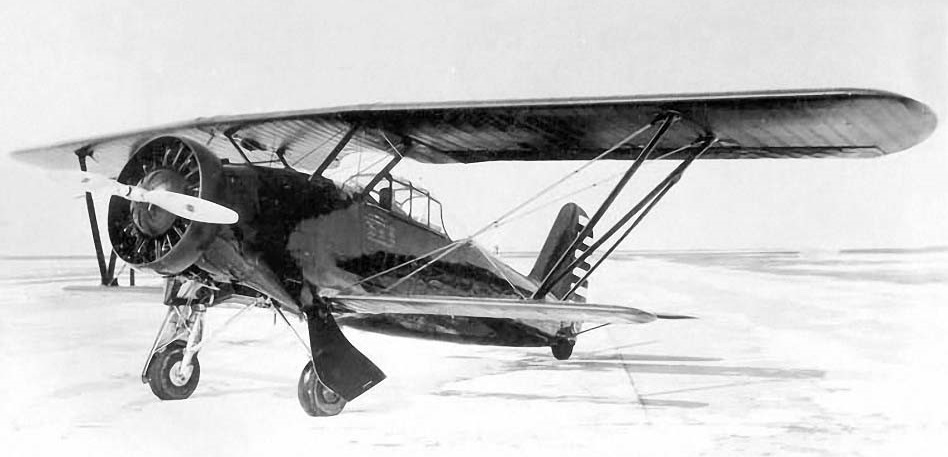
In 1931, in response to a United States Army Air Corps requirement for a new observation aircraft, Curtiss designed the Model 62, a single-engined biplane with the lower wing much smaller than the upper, known as a sesquiplane (i.e. “one-and-a-half wings”), while the outer panels of the upper wings were swept back to avoid centre-of-gravity problems. The lower wing was connected to the upper wing by one set of struts. It was of all-metal construction, with a monocoque fuselage and had a retractable tailwheel undercarriage with inwards retracting mainwheels, and was powered by a Wright Cyclone radial engine. The crew of two sat in tandem in open cockpits. It was armed with one fixed forward firing .30in machine gun in the right upper wing and one flexibly mounted .30in gun in the rear cockpit.

A prototype (sn 32-343), designated YO-40, flew in February 1932. It crashed on 20 May that year, and had to be returned to Curtiss where it was rebuilt with stronger wings and an enclosed cockpit as the YO-40A. The YO-40A was scrapped in 1938.

YO-40A

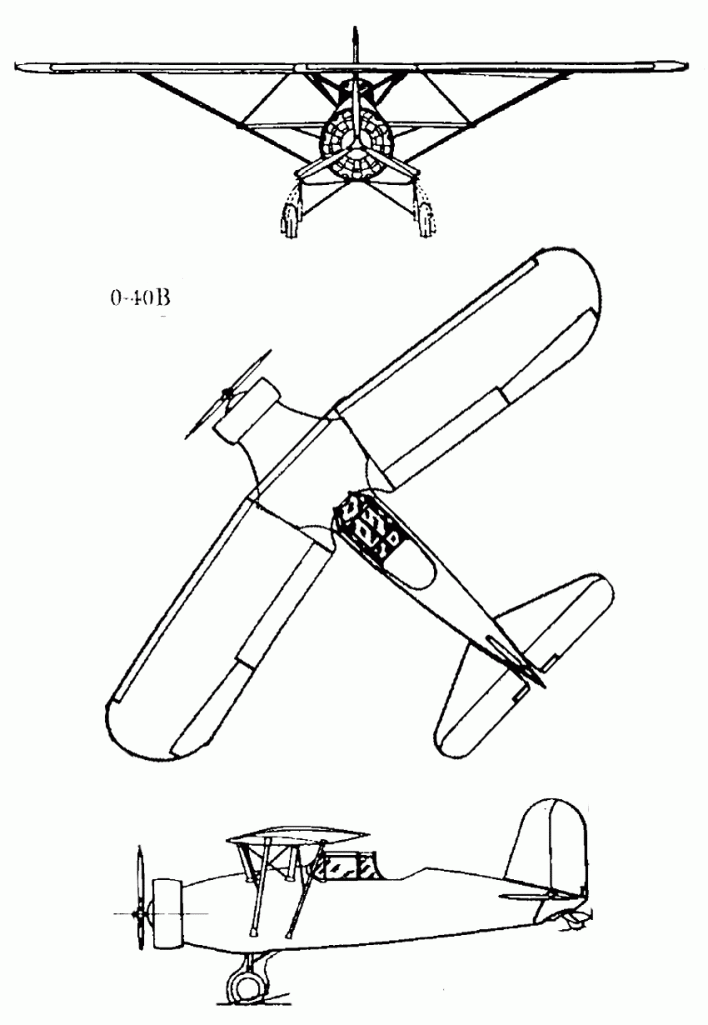
A further four YO-40As were ordered, but they were redesigned as monoplanes by removing the lower wing, the resultant aircraft being designated Y1O-40B. A stub of the lower wing had to be retained as it contained the retractable landing gear. The engine was upgraded to a more powerful R-1820-27 and the wingspan reduced by 2ft 4in. The new aircraft were heavier than the original prototype, and their performance was generally worse.

O-40B

The four Y1O-40Bs (sn from 32-415 to 32-418) were delivered in June 1933, and after service tests, were re-designated O-40B Raven, being operated by the 1st Observation Squadron of the USAAC. While the aircraft’s performance and manoeuvrability were good, the Air Corps was disappointed with the cockpit arrangements and the low fuel capacity, and no more orders followed. The last O-40B was withdrawn from use in 1939.

Gallery

YO-40
Engine: Wright R-1820E Cyclone, 653 hp / 487 kW

YO-40A

Y1O-40B / O-40B
Engine: Wright R-1820-27 Cyclone, 670 hp / 500 kW
Wingspan: 41 ft 8 in (12.70 m)
Wing area: 266 sq.ft (24.7 sq.m)
Length: 28 ft 10 in (8.79 m)
Height: 10 ft 8 in (3.25 m)
Empty weight: 3,754 lb (1,703 kg)
Gross weight: 5,180 lb (2,350 kg)
Maximum speed: 187.7 mph (302 km/h; 163 kn)
Cruise speed: 160.5 mph (258 km/h; 139 kn)
Stall speed: 62 mph (100 km/h; 54 kn)
Range: 324 mi (282 nmi; 521 km)
Service ceiling: 23,100 ft (7,000 m)
Rate of climb: 1,660 ft/min (8.4 m/s)
Armament: 1× fixed forward firing .30 in Browning machine gun and 1× .30 in Browning machine gun in observers cockpit
Crew: two

Curtiss-Wright CW-23

In April 1939, Curtiss-Wright’s St Louis Airplane Division flew the prototype of the CW-23 basic combat trainer which was essentially a tandem two-seat, lower-powered derivative of the CW-21 single-seat fighter. It introduced inward-retracting, fully-enclosed main undercarriage members and hydraulically-actuated rather than manually-operated flaps, and these features were adopted for a new version of the single-seat fighter, the CW-21B.
It had a 447kW Pratt & Whitney R-1340 Wasp engine and was intended as a basic combat trainer for the US Army. Flown in 1939, official testing led to its rejection for production.

Curtiss-Wright CW-19

CW-19R

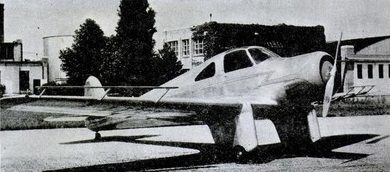
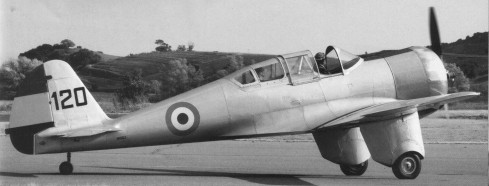
In 1935, the Curtiss-Wright Corp, in response to an order from the US Bureau of air Commerce, and George Page designed and produced a single prototype of the CW-19L Coupe at its St. Louis, Missouri plant. A development of the CR-2 Coupe design, the model 19L was a two seat, fixed undercarriage low-wing monoplane, powered by a 90 hp 5 cylinder Lambert R-266 radial engine. Of all metal monocoque construction with an enclosed cabin, the CW-19 was envisioned to be sold to private owners.
The two occupants were side-by-side, with a car type door on each side. The fixed undercarriage was enclosed in streamlined spats. Registered as NS69, it was granted an Approval Type Certificate (ATC number 589) on 3 December 1935.
Later repowered with a 145 hp Warner Scarab engine, the sole prototype became the 19W, with a 154 mph maximum and 132 mph cruise speeds.
The performance and cost were too great for private pilots. No production was under taken and the original prototype was the only example built.
Curtiss decided to develop the design as a military trainer. As the model 19R, re-configured into a tandem layout, with the two seats under sliding clear canopies. Still with fixed undercarriage, power was increased, initially to a 350 hp Wright R-760 Whirlwind, and later a 420 hp Wright R-975.
A single, fixed synchronised 0.30 calibre machine gun was mounted in the nose and provision was made for an additional flexible mount machine gun in the rear cockpit (for use as a gunnery trainer). Bomb racks could also be fitted. Two 35 USG were fitted.
A photo-recon variant, with two belly-mounted cameras was also developed and at least one of the Bolivian examples appears to have been delivered in this configuration.
When the flaps were extended a latch was released, allowing the undercarriage struts to fully extend, the wheels dropping an additional 6 inches from the spats. When the aircraft had landed the struts were compressed again, retracting the flaps re-engaging the latch so the wheels were held in their ground position until the flaps were lowered for landing again.
The prototype, c/n 19R-1 was registered NR11781 and was first flown in early 1936. Approved Type Certificate 629 was issued on 19 February 1937. Performance was increased from the model 19L, with maximum 185 mph and cruise 164 mph speeds.
The prototype was written off in Brasil during a sales tour of South America. Orders were received for 23 from several Latin American governments.
Two more company demonstrators were built, c/n 19R-10 (N16417) in January 1937 and A19R-14 (NC16421) also in 1937. N16417 was later converted to CW-22 specifications and sold in May 1940, and NC16421 crashed in Miami in April 1938.
A total of 26 CR-19Rs were built between 1936 and 1938. 23 for export plus 3 company demonstrators.
An unarmed basic trainer version of the CW-19R was built as the CW-A19R. Flown in February 1937 it was tested by the US Army but no production orders followed.
The type is known to have been evaluated by the USAAC at Wright Field in Ohio, and also by USAAC pilots at Bolling Field and US Naval pilots at Anacostia NAS, both in Washington DC.
Ecuador ordered six aircraft in June 1936 and all were delivered in the following September. They were c/ns 19R-2 to 19R-7, and were given the Ecuadorian AF serial numbers 51 to 56. Two were lost in service and the remained served until at least early 1946.
Dominican Republic ordered two (c/ns 19R-11 and –12) in early 1937. One was not repaired after a landing accident in February 1942, and the other was retired in 1946, to be preserved in a museum near Santo Domingo.
Cuba ordered 5 in 1937, all delivered by January 1938. C/ns 19R-8, -9, -13, -15 and –16, they carried serial numbers 50-54 in Cuba. Three survivors were later re-serialed 100-102, all but 102 lost in accidents by 1949, when 102 was retired.
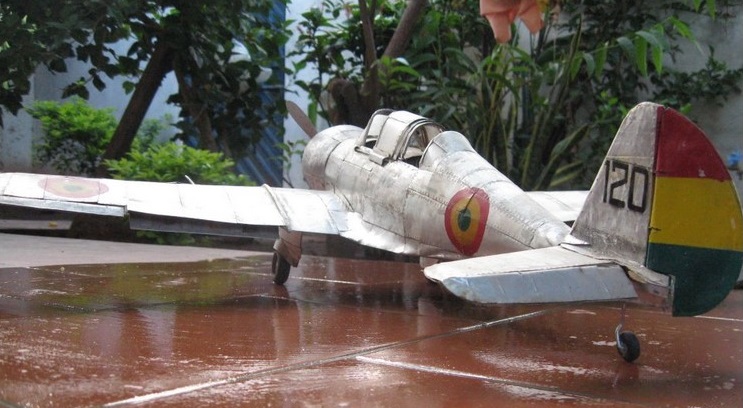
Bolivia bought the last ten produced (c/ns 19R-17 to 19R-26, Bolivian AF 118-127). They were delivered crated in late 1938 to El Alto aerodrome near La Paz and re-assembled under the supervision of Harry Berguer.

Courtesy Yerko Jaldin

CW-19L
Engine: 90 hp / 67 kW Lambert R-266 5 cylinder radial
Max speed: 130 mph
Cruise speed: 115 mph

CW-19W
Engine: 145 hp / 108 kW Warner Scarab
Max speed: 154 mph
Cruise speed: 132 mph

CW-19R
Engine: Wright R-760E2 (J-6-7) Whirlwind, 350 hp / 261kW
Wingspan: 10.67 m / 35 ft 0 in
Length: 8.03 m / 26 ft 4 in
Height: 2.49 m / 8 ft 2 in
Wing area: 16.16 sq.m / 173.94 sq ft
Max take-off weight: 1588 kg / 3501 lb
Empty weight: 904 kg / 1993 lb
Max speed: 298 km/h / 185 mph
Cruise speed: 164 mph
Rate of Climb: 2000 fpm
Armament: 2 x 7.7mm machine-guns, light bombs on underwing racks

CW-19R
Engine: Wright R-975E3 (J-6-9), 336kW

Curtiss-Wright CW-15 Sedan

CW-15С

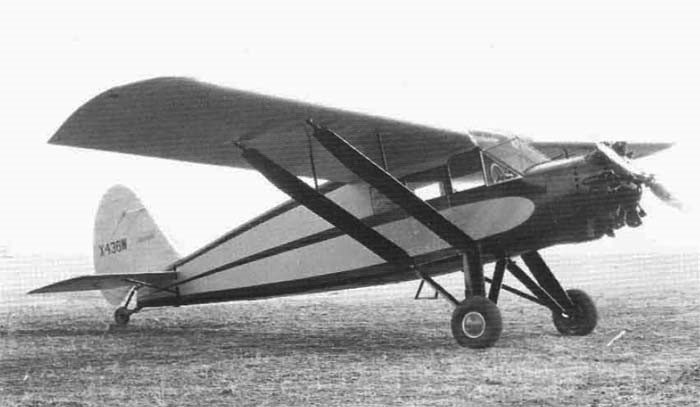
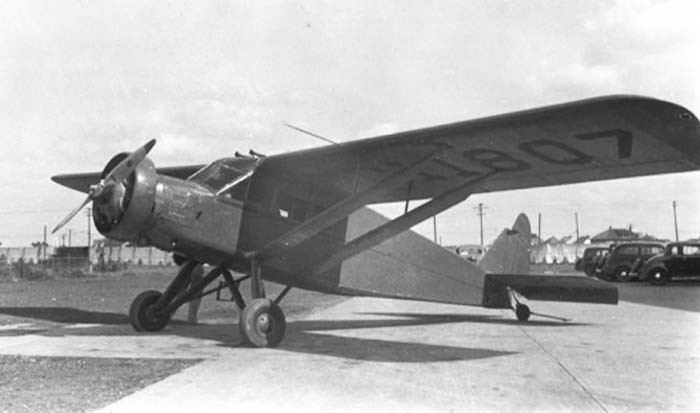
The Curtiss-Wright CW-15 Sedan was a four-seat utility aircraft produced in small numbers in the United States in the early 1930s. It was a braced high-wing monoplane with conventional tailwheel landing gear with a fully enclosed cabin, superficially resembling the Travel Air 10. At the time of the CW-15’s design, Travel Air had recently been acquired by Curtiss-Wright.

CW-15N

Designed by Walter Burnham, the CW-15 Sedan first flew in 1931 and 15 were built.

The -15 Sedan was initially produced with the 180 hp Curtiss Challenger and 210 hp Kinner C-5 engines, but the remaining examples were powered by 300 hp Wright Whirlwind (Sedan 15-D) and 245 hp Jacobs (Sedan 15-N).

Sedan 15-D

Gallery

CW-15C
Engine: Curtiss R-600 Challenger, 185 hp (138 kW)
Propeller: 2-bladed fixed-pitch metal
Wingspan: 46 ft 5 in (14.15 m)
Wing area: 240 sq ft (22 m2)
Airfoil: Göttingen 593
Length: 30 ft 5 in (9.27 m)
Height: 8 ft 10 in (2.69 m)
Empty weight: 2,083 lb (945 kg)
Gross weight: 3,281 lb (1,488 kg)
Maximum speed: 115 mph (185 km/h; 100 kn)
Cruise speed: 97 mph (156 km/h; 84 kn)
Range: 525 mi (456 nmi; 845 km)
Service ceiling: 12,000 ft (3,700 m)
Rate of climb: 600 ft/min (3.0 m/s)
Crew: 1
Capacity: 3 pax
nine built

Sedan 15-D
Engine: 300 hp Wright Whirlwind
Wing span: 43 ft 5 in
Wing area: 215.06 sq.ft
Length: 30 ft 5 in
Height: 9 ft 7 in
Empty weight: 2121 lb
Loaded weight: 3319 lb
Max speed: 135 mph
ROV: 750 fpm
Service ceiling: 14,000 ft
Range: 500 mi
Three built

CW-15N
Engine: Kinner C-5
three built

Curtiss-Wright CW-3 Duckling / Teal

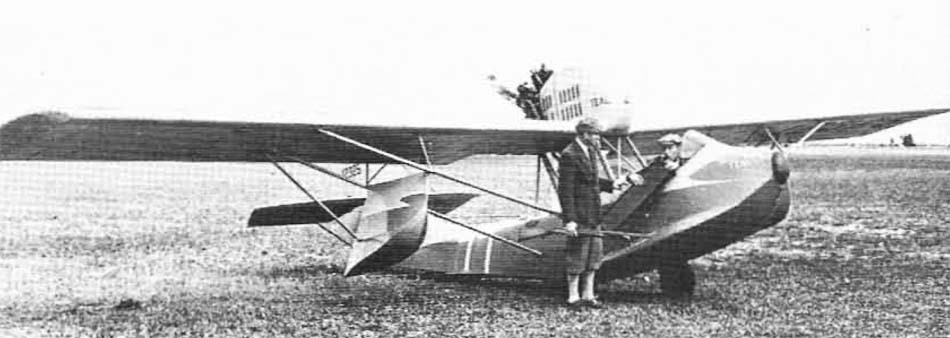
The first prototype CW- 3

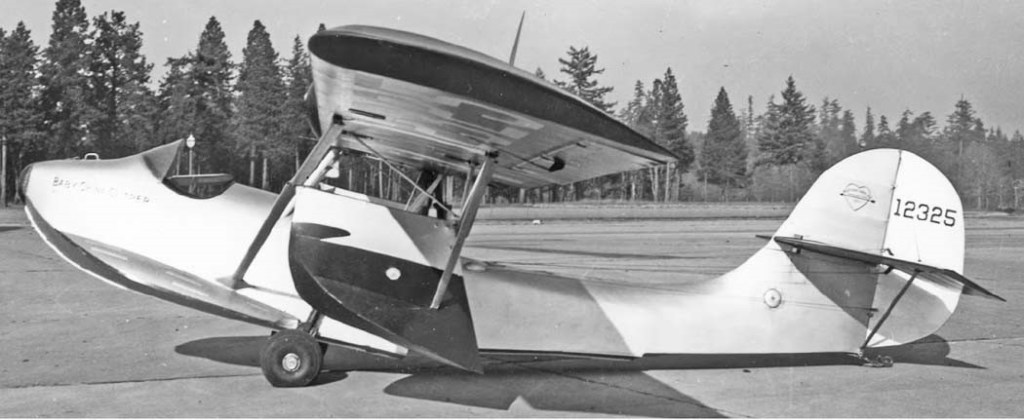
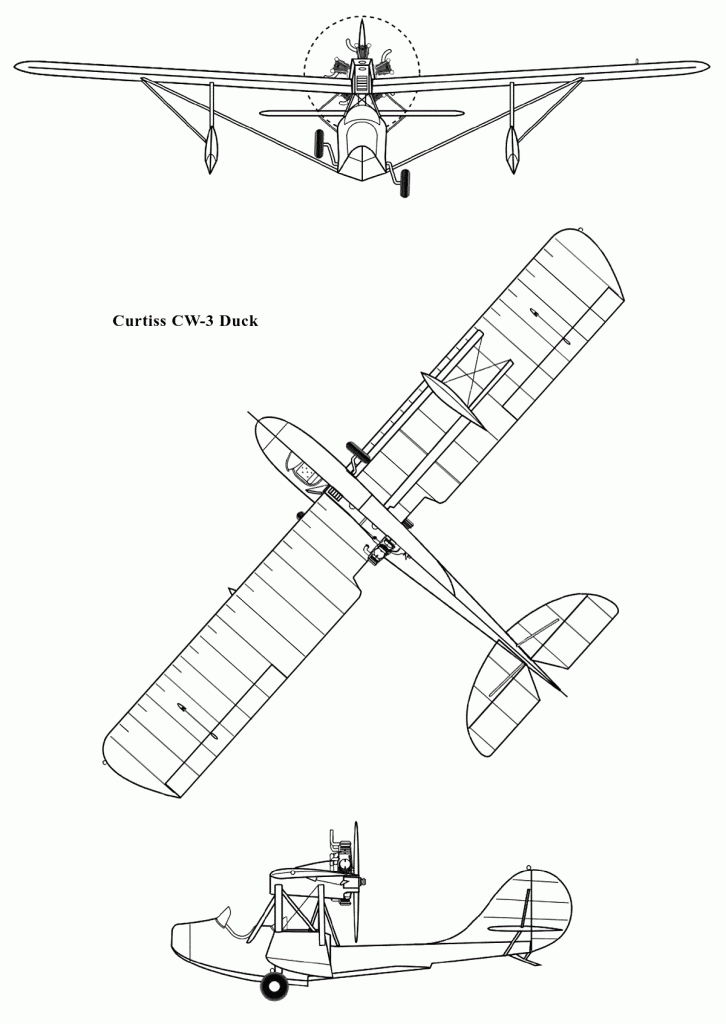
The Curtiss-Wright CW-3 Duckling (sometimes called the Teal) was an American two-seat amphibian flying-boat developed by Curtiss-Wright as a modification of the CW-1 Junior. The new aircraft was distinguished by a double cabin, where the pilot and passenger sat side by side, and the new fuselage. The fuselage had a plywood V-shaped underside added and the addition of strut-mounted pontoons. The engine was mounted above the wing driving a pusher propeller. The wing and engine installation remained unchanged, although floats were added under the wing for stability on the water surface.

First flying in 1931 only three aircraft were built, all powered by different engines, but the power was the same – 90 hp (67 kW).

The first prototype was equipped with a Velie M-5 radial engine, the second CW-3L for $1,250 with a Lambert engine, the third CW-3W with a Warner Scarab engine.

CW-3L

The release of CW-3 ended there, since the financial crisis began in the USA and there were no amphibious customers.

Gallery

CW-3L
Engine: Lambert, 90 hp
MTOW: 544 kg
Wingspan: 12.04 m
Length: 6.48 m
Wing area: 16.38 sq.m
Maximum speed: 129 km / h
Cruising speed: 105 km / h
Crew: 2

CL-3W
Engine: 1 × Warner Scarab, 90 hp (67 kW)
Wingspan: 39 ft 6 in (12.04 m)
Length: 21 ft 3 in (6.48 m)
Crew: two